
If you’re looking for a stable career with good pay and strong job security, becoming a licensed HVAC technician is a smart move. The heating, ventilation, air conditioning, and refrigeration industry continues to grow year after year. I’ve been in the trades for over 15 years, and I’ve seen firsthand how getting properly licensed can transform your earning potential and career options. This guide on how to get HVAC license will walk you through everything you need to know, from education requirements to state licensing exams.
The path to becoming licensed varies by state, but the core requirements are similar across most of the country. You’ll need a combination of education, hands-on experience, and certifications. The process typically takes 3-5 years from start to finish, but there are ways to accelerate your journey. Let me break down exactly what you need to do to get your HVAC license and start working in this rewarding field.
What’s the Difference Between HVAC License and Certification?
Before diving into the licensing process, it’s important to understand the distinction between a license and a certification. Many people use these terms interchangeably, but they serve different purposes in the HVAC industry.
An HVAC license is a state-issued credential that legally authorizes you to work as an HVAC contractor or technician. Each state sets its own licensing requirements, which typically include a combination of education, work experience, and passing a state exam. Without a license, you cannot legally operate as an independent HVAC contractor or start your own HVAC business in most states.
Certifications, on the other hand, are voluntary credentials that demonstrate your expertise in specific areas of HVAC work. The most well-known is the EPA Section 608 certification, which is actually mandatory for anyone working with refrigerants. Other certifications like NATE and HVAC Excellence are optional but can help you stand out to employers and clients. Think of it this way: your license gives you legal permission to work, while certifications prove your competence.
How to Get HVAC License: Step-by-Step Process
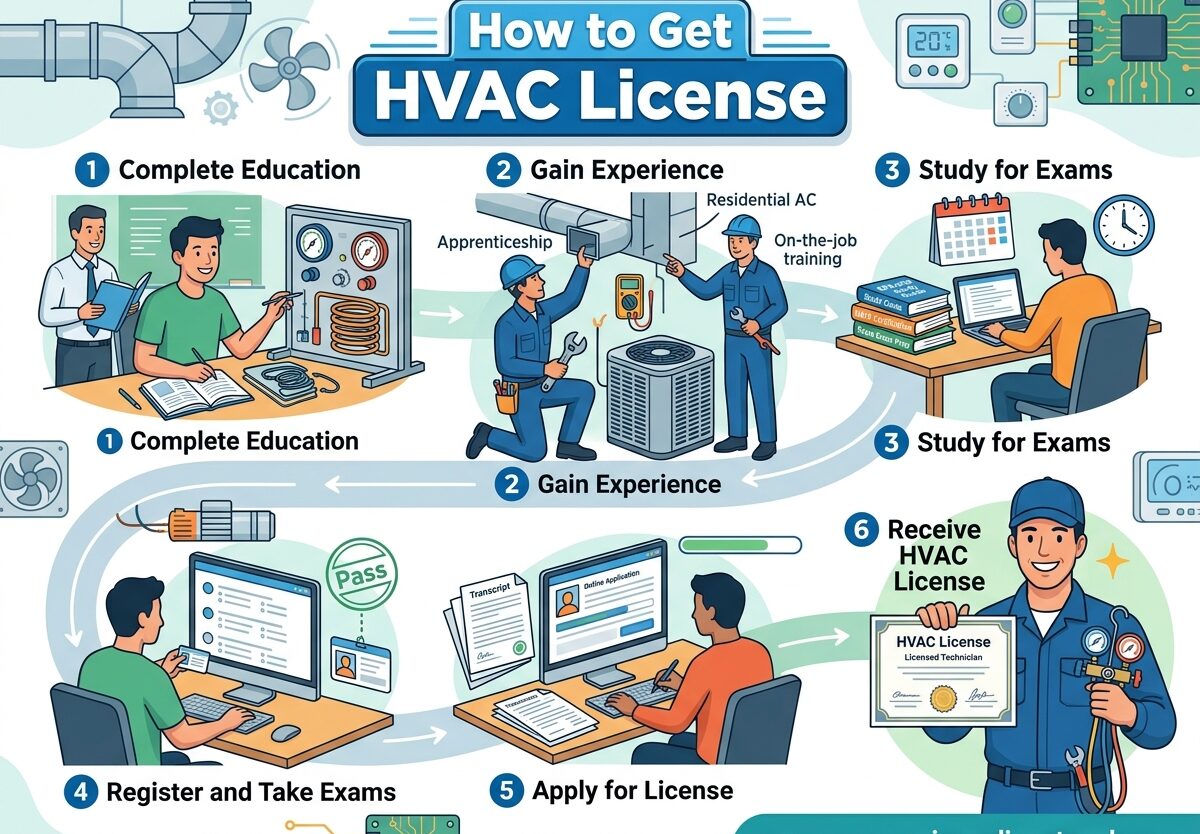
Getting your HVAC license follows a relatively consistent path across most states. Here’s the step-by-step process I recommend based on my experience helping dozens of technicians get started:
Step 1: Get your EPA Section 608 certification. This is required nationwide for anyone handling refrigerants. You can study online and take the exam at an approved testing center. Start with the Universal certification if you want maximum flexibility.
Step 2: Complete your HVAC education. Options include trade school programs (6-24 months), community college courses, or entering an apprenticeship program. Trade school gives you comprehensive classroom knowledge, while apprenticeships provide paid on-the-job training.
Step 3: Gain supervised work experience. Most states require 2-5 years of experience working under a licensed contractor. This is where you learn the real-world skills that classroom education can’t teach you. Document your hours carefully—you’ll need proof when applying for your license.
Step 4: Apply for your state HVAC license. Submit your application, work history, and education documentation to your state’s licensing board. Some states require you to pass a trade exam and a business law exam.
Step 5: Pass your state licensing exam. Study using prep courses and practice tests specific to your state. The exam typically covers electrical systems, refrigeration, heating and cooling systems, and state regulations.
Step 6: Start working as a licensed technician. Once you pass the exam and receive your license, you can work independently, start your own business, or specialize in areas like commercial refrigeration or solar HVAC systems.
HVAC Education Paths: Trade School vs Apprenticeship
One of the biggest decisions you’ll face is choosing between trade school and an apprenticeship. Both paths can lead to a successful HVAC career, but they have different advantages and trade-offs.
Trade school programs provide comprehensive classroom education combined with hands-on training. Programs typically last 6-24 months and cost $15,000-$20,000. You’ll learn electrical theory, refrigeration principles, system design, and troubleshooting techniques. The advantage is that you get a complete education before entering the workforce. Many employers prefer trade school graduates because they require less on-the-job training. However, the cost can be significant, and you won’t earn income while attending school.
Apprenticeships combine paid on-the-job training with classroom instruction. You work alongside experienced technicians during the day and take classes in the evenings or on weekends. Apprenticeships typically last 3-5 years, and you earn a wage throughout the program. The big advantage is that you gain real-world experience immediately and avoid taking on student debt. However, the training can be less structured than trade school, and you’ll start with lower wages until your skills improve.
Based on my experience observing both paths, I recommend starting with a helper position or apprenticeship while taking evening classes at a community college. This hybrid approach gives you the best of both worlds—you start earning income right away while building your knowledge base. Many community colleges offer HVAC certificate programs that cost significantly less than private trade schools while providing solid foundational knowledge.
EPA 608 Certification: What You Need to Know
EPA Section 608 certification is non-negotiable for anyone working with refrigerants. The Clean Air Act requires technicians to be certified when handling air conditioning and refrigeration equipment. This certification is administered by the EPA and is recognized nationwide.
The EPA 608 exam covers four types of certifications: Type I for small appliances, Type II for high-pressure appliances, Type III for low-pressure appliances, and Universal which covers all three types. Most technicians pursue the Universal certification since it provides the broadest work opportunities. The exam consists of a core section covering regulations and safety, plus type-specific sections depending on which certifications you’re pursuing.
You can study for the exam using online resources, practice tests, and study guides. Many HVAC programs include EPA 608 preparation as part of their curriculum. The exam itself is multiple-choice and typically takes 2-3 hours to complete. Testing centers are located throughout the country, and you usually receive your results immediately upon completion. The certification doesn’t expire, though you may want to stay updated on regulation changes.
The cost for EPA 608 certification typically ranges from $50-$150, including study materials and exam fees. This is one of the most affordable certifications in the HVAC field, and it’s absolutely essential for your career. Don’t attempt any refrigerant work without it—fines for violations can reach $44,000 per day.
Other Valuable HVAC Certifications
While EPA 608 certification is mandatory, several other certifications can help you advance your career and increase your earning potential. These optional credentials demonstrate specialized knowledge and can make you more attractive to employers and clients.
NATE (North American Technician Excellence) certification is widely recognized in the industry. NATE offers certifications in installation, service, and senior-level proficiency across various specialties including air conditioning, heat pumps, gas furnaces, and commercial refrigeration. To earn NATE certification, you must pass both a core exam and a specialty exam. NATE certifications are valid for two years and require recertification or continuing education to maintain.
HVAC Excellence offers certifications ranging from employment-ready credentials to master specialist designations. Their employment-ready certification is designed for technicians completing training programs and demonstrates core competency. The master specialist certification requires years of experience and demonstrates advanced knowledge in specific areas like commercial refrigeration or residential air conditioning.
RETA (Refrigerating Engineers and Technicians Association) certifications focus specifically on industrial refrigeration. These credentials are valuable if you plan to work in large-scale facilities like food processing plants, cold storage warehouses, or ice rinks. RETA offers four certification levels: Industrial Refrigeration Operator, Industrial Refrigeration Service, Industrial Refrigeration Technician, and Certified Assistant Refrigeration Operator.
State HVAC Licensing Requirements
HVAC licensing requirements vary significantly from state to state. Some states have strict licensing requirements with multiple levels, while others have minimal or no state-level licensing. Understanding your state’s specific requirements is crucial for planning your career path.
States like California, Texas, Florida, and New York have comprehensive licensing programs. California offers multiple license classifications including C-20 for warm-air heating, ventilation, and air conditioning, and C-38 for refrigeration. Texas requires contractors to pass both a trade exam and a law exam. Florida licenses contractors at the state level but has local licensing requirements in some counties. New York doesn’t have statewide licensing but requires local licenses in most jurisdictions.
Many states require 2-5 years of documented work experience under a licensed contractor. This experience must be verified and typically includes specific requirements about the types of systems you’ve worked on. Some states accept trade school education to substitute for a portion of the experience requirement, while others require the full experience period regardless of your education.
State licensing exams typically cover both technical knowledge and business practices. Technical sections test your understanding of electrical systems, refrigeration cycles, heating and cooling equipment, and system design. Business sections cover relevant laws, regulations, contracts, insurance requirements, and tax obligations. Some states require separate exams for journeyman and master level licenses.
Licensing fees range from $100-$500 depending on the state and license type. Most states require licenses to be renewed every 1-3 years, with renewal fees and continuing education requirements. Make sure to budget for these ongoing costs when planning your career.
HVAC Licensing Costs and Timeline
The total cost of getting your HVAC license varies depending on your education path and state requirements. Understanding these costs upfront helps you plan your finances and choose the most affordable path to licensure.
Trade school programs typically cost $15,000-$20,000 for a 6-24 month program. Community college programs are more affordable, ranging from $5,000-$10,000. Apprenticeships cost little to nothing upfront, but you’ll earn lower wages during your training period. EPA 608 certification costs approximately $50-$150 including study materials and exam fees. State licensing fees range from $100-$500 depending on your location.
The timeline to becoming a licensed HVAC technician typically ranges from 3-5 years. Trade school graduates can complete their education in 6-24 months but still need to accumulate the required work experience before becoming licensed. Apprenticeships last 3-5 years but provide paid experience throughout the process. Some states allow you to work under a limited license while completing your experience requirements.
Based on forum discussions from experienced technicians, the fastest path to licensure typically involves starting as a helper or apprentice while pursuing evening classes at a community college. This approach allows you to start accumulating experience immediately while building your knowledge base. Most technicians report taking 4-5 years from starting their education to receiving their full license.
Don’t forget to factor in the cost of tools, which can add $2,000-$5,000 to your initial investment. Quality tools are essential for your work and will last for years if properly maintained. Many employers provide tools for apprentices, but you’ll eventually need to build your own collection as you advance in your career.
HVAC Career Paths and Salary Expectations
Once you’re licensed, numerous career paths open up to you. The HVAC industry offers diverse opportunities beyond residential service work, and understanding your options helps you plan your long-term career.
Residential HVAC technicians typically work for service companies or as independent contractors. This path involves installing and maintaining heating and cooling systems in homes. The work is varied and often requires customer service skills as you interact directly with homeowners. Entry-level residential technicians typically earn $40,000-$50,000 annually, with experienced technicians earning $60,000-$80,000 or more depending on location and specialization.
Commercial HVAC work involves larger systems for office buildings, retail spaces, and industrial facilities. These positions often pay more than residential work due to the complexity of the systems and the specialized knowledge required. Commercial HVAC technicians can earn $60,000-$90,000, with project managers and supervisors earning $100,000 or more.
Refrigeration specialists work with commercial refrigeration systems used in restaurants, grocery stores, and cold storage facilities. This specialty requires additional knowledge but offers higher pay due to the specialized nature of the work. Refrigeration technicians typically earn $55,000-$75,000, with experienced specialists earning significantly more.
For those with entrepreneurial ambitions, starting your own HVAC business offers unlimited earning potential. Successful HVAC business owners can earn well over $100,000 annually, though this path requires business skills beyond technical expertise. The $5,000 rule often discussed in HVAC forums suggests that you need approximately $5,000 in monthly revenue per employee to maintain a profitable business—though this varies widely based on your location and business model.
Your HVAC Licensing Checklist
To help you stay organized throughout the licensing process, here’s a practical checklist of everything you need to accomplish on your path to becoming a licensed HVAC technician:
- Research your state’s specific licensing requirements
- Choose your education path (trade school, apprenticeship, or hybrid)
- Complete your HVAC education program
- Earn EPA Section 608 Universal certification
- Secure a position working under a licensed contractor
- Document all work hours for your state requirements
- Complete required years of supervised experience
- Prepare for and pass your state licensing exam
- Submit your license application with all required documentation
- Pay licensing fees and receive your license
- Consider additional certifications (NATE, HVAC Excellence)
- Plan for ongoing license renewal and continuing education
FAQs
What is the fastest way to get an HVAC license?
The fastest path combines starting as a helper or apprentice while taking evening classes at a community college. This allows you to accumulate work experience immediately while building your knowledge base. Most technicians complete this path in 3-4 years, compared to 4-5 years for traditional apprenticeships or trade school plus experience requirements.
What is the $5000 rule for HVAC?
The $5000 rule is a general guideline suggesting that HVAC businesses need approximately $5000 in monthly revenue per employee to maintain profitability. This varies based on your location, business model, and overhead costs. Some businesses need more, others less, but it’s a useful benchmark for financial planning when starting an HVAC company.
Does Georgia require an HVAC license?
Yes, Georgia requires HVAC contractors to be licensed at the state level. The Georgia State Board of Conditioned Air Contractors issues licenses for Class I (unrestricted systems) and Class II (restricted systems) contractors. Requirements include passing an exam, providing proof of experience, and maintaining liability insurance.
Can you make $200k in HVAC sales?
Yes, it’s possible to earn $200k or more in HVAC sales, but it typically requires working in a high-volume market and building a strong client base over several years. Sales positions often pay commission-based compensation, so your income depends on your sales volume. Top performers in large markets can exceed $200k, but most HVAC sales representatives earn between $80k-$150k annually.
Conclusion
Learning how to get HVAC license is the first step toward a rewarding career in a growing industry. The path requires dedication, hands-on experience, and passing both certification exams and state licensing tests, but the investment pays off in job security, earning potential, and career flexibility.
Whether you choose trade school, an apprenticeship, or a hybrid approach, the key is to get started. Begin by researching your state’s specific requirements and securing a position where you can learn from experienced technicians. Get your EPA 608 certification early, document all your work experience, and steadily progress toward your license.
The HVAC industry will always need qualified technicians, and getting licensed opens doors to numerous career paths from residential service to commercial contracting to business ownership. Start today, and in a few years you’ll have the skills and credentials to build a successful HVAC career that can last a lifetime.






Leave a Comment