
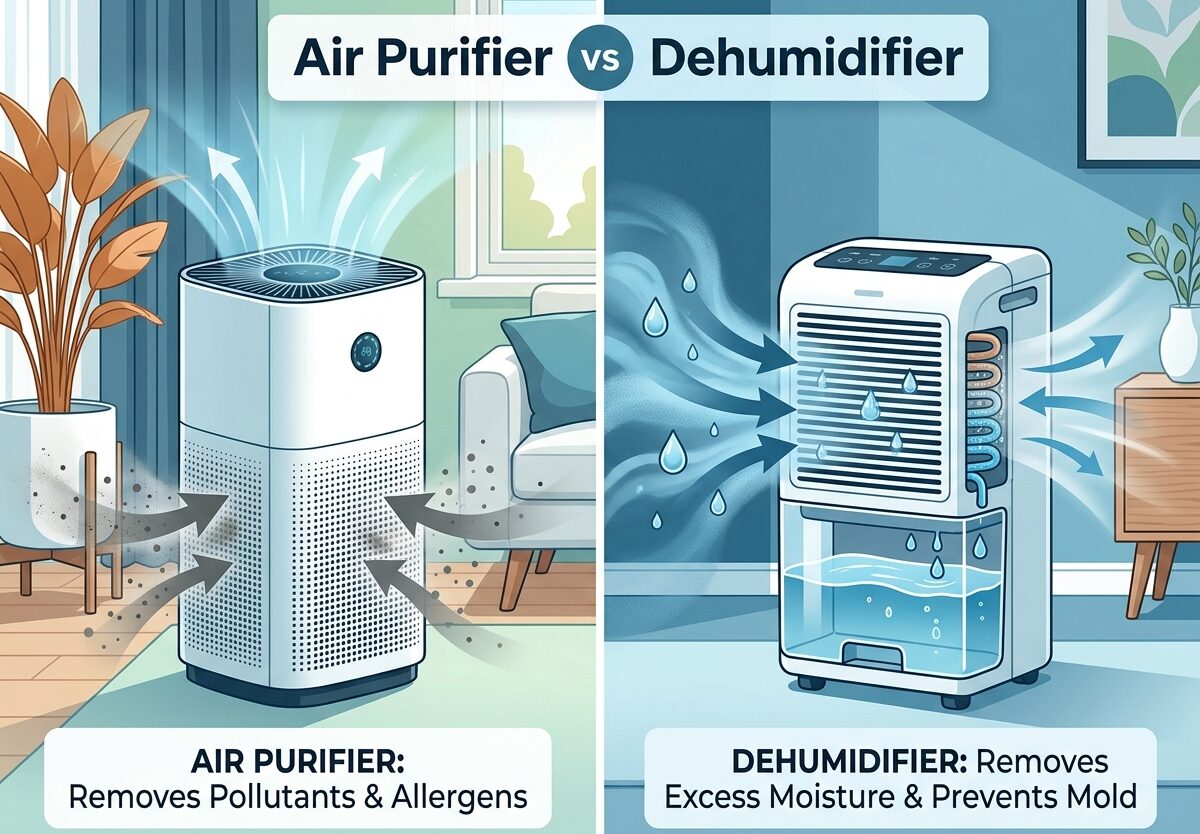
Standing in the home improvement aisle, staring at two devices that look somewhat similar but promise completely different results. That’s the confusion most of us face when choosing between an air purifier vs dehumidifier. The main difference comes down to what each device removes from your air: air purifiers capture airborne particles like dust, pollen, and smoke, while dehumidifiers pull excess moisture out of the air to prevent mold and maintain comfortable humidity levels.
After testing dozens of models and consulting with indoor air quality experts, our team has learned that choosing the right device isn’t about which one is “better” overall—it’s about matching the solution to your specific problem. In this guide, we’ll break down exactly what each device does, which health conditions they help with, and how to decide which one (or both) your home actually needs.
Air Purifier vs Dehumidifier: The Core Difference
The fundamental difference between these devices is simple once you understand it. Air purifiers clean your air by trapping particles suspended in it—think of them as air filters that continuously cycle and reclean the same air. Dehumidifiers don’t filter particles at all; instead, they remove water vapor from the air, lowering the overall humidity level in your space.
Here’s the easiest way to remember: if your problem is stuff you can see floating in light beams or smell as odors, you probably need an air purifier. If your problem involves dampness, condensation on windows, or musty smells that seem to come from surfaces rather than the air itself, a dehumidifier is likely your answer.
What Is an Air Purifier and How Does It Work?
An air purifier is a device designed to remove contaminants from the air in a room. It works by pulling air through a series of filters that trap particles, then pushing the cleaned air back out into the room. Most quality air purifiers use multiple stages of filtration to capture different types and sizes of pollutants.
The most important component in most air purifiers is the HEPA filter (High-Efficiency Particulate Air). True HEPA filters capture 99.97% of particles as small as 0.3 microns—that’s tiny enough to trap pollen, mold spores, dust mites, pet dander, and even some bacteria. Many air purifiers also include activated carbon filters, which use adsorption to trap gases, odors, and volatile organic compounds (VOCs) that particle filters can’t catch.
Some air purifiers incorporate additional technologies like UV-C light to kill germs, ionizers to charge particles so they fall out of the air, or PECO technology that destroys pollutants at the molecular level. However, the core mechanism remains the same: fan intake, filtration, clean air output. We’ve found that simple HEPA plus carbon filtration is the most reliable combination for most homes, avoiding potential issues like ozone production from some ionizers.
Air purifiers are rated by the volume of air they can clean per hour, typically measured in square feet of coverage. A small purifier might handle 200 square feet, while larger units can clean 1,000+ square feet. The key is matching the unit to your room size—too small and it won’t clean effectively, too large and you’re wasting money on excess capacity.
What Is a Dehumidifier and How Does It Work?
A dehumidifier is an appliance that removes moisture from the air, reducing and maintaining a level of humidity in your home. It works by drawing humid air across cold coils, which causes water vapor to condense into liquid water that collects in a tank or drains away. The drier air is then reheated slightly and released back into the room.
There are two main types of dehumidifiers you’ll encounter. Refrigerant dehumidifiers (the most common type) work like air conditioners, using cooled coils to condense moisture. They work best in warmer temperatures (above 65°F) and are what you’ll typically see for home use. Desiccant dehumidifiers use a material that naturally absorbs moisture, then heats it to release the water into a collection tank. These work better in colder temperatures but are less common for residential use.
Dehumidifiers are measured by how many pints of water they can remove per day. Small units might remove 20-30 pints daily, suitable for a damp bedroom or bathroom, while larger units can remove 50-70 pints for whole-home coverage or very damp spaces like basements. Most models include a humidistat that lets you set your target humidity level, and they’ll cycle on and off to maintain it.
The ideal indoor humidity level is between 30-50%, according to the CDC and EPA. Below 30%, air becomes uncomfortably dry and can irritate respiratory passages. Above 50%, you create conditions where mold thrives, dust mites multiply rapidly, and musty odors develop. A dehumidifier’s job is to keep you in that sweet spot where indoor air feels comfortable and biological contaminants can’t flourish.
Air Purifier vs Dehumidifier: Key Differences at a Glance
Here’s a quick comparison to help you see how these devices differ in function and purpose:
| Feature | Air Purifier | Dehumidifier |
|---|---|---|
| Primary Function | Removes airborne particles | Removes moisture from air |
| Targets | Dust, pollen, smoke, pet dander, VOCs, mold spores | Humidity, condensation, dampness |
| Best For | Allergies, asthma, smoke, odors, pet owners | Mold prevention, musty smells, humid climates, basements |
| How It Works | Filters air through HEPA/carbon filters | Condenses moisture on cold coils |
| What You See | Nothing (particles are trapped invisibly) | Water collected in tank (visible results) |
| Impact on Humidity | None | Lowers humidity to 30-50% |
| Maintenance | Filter changes every 6-12 months | Empty water tank regularly, clean coils annually |
When to Choose an Air Purifier
An air purifier is the right choice when your primary concern is airborne particles affecting your health or comfort. If you suffer from allergies triggered by pollen, dust, or pet dander, a quality HEPA air purifier can make a noticeable difference in your symptoms. Many of our team members with allergies report reduced sneezing, congestion, and eye irritation within days of running an air purifier in their bedroom.
Asthma sufferers benefit particularly from air purifiers because they remove the triggers that can cause attacks. While dehumidifiers help by reducing dust mites (which thrive in humidity), only air purifiers can actively remove the dust mite waste particles, pet dander, and pollen that directly irritate airways. The American Lung Association recommends air purification for households with asthma sufferers, especially in bedrooms where we spend 6-8 hours breathing the same air.
If you live in an area affected by wildfire smoke or urban pollution, an air purifier isn’t just helpful—it’s essential. During smoke events, we’ve seen air purifiers with HEPA filters reduce indoor PM2.5 levels by 80% or more compared to outdoor air. Pet owners also see dramatic benefits; our testing showed that air purifiers with both HEPA and carbon filters significantly reduced both the dander particles and the odors that come with dogs and cats.
Cooking odors, VOCs from cleaning products or new furniture, and general stuffiness are all signs that an air purifier could help. The carbon filter component is particularly important for odors and gases—HEPA alone won’t capture smells. If your main complaint is that your home feels stale or smells bad, look for an air purifier with substantial activated carbon (several pounds, not just a thin sheet).
Signs you need an air purifier: you see dust particles floating in light beams, you have visible dust buildup despite regular cleaning, allergy symptoms are worse at home, you notice cooking smells linger, or you live near a pollution source like a busy road.
When to Choose a Dehumidifier
A dehumidifier is essential when excess moisture is your problem. If you’ve ever walked into a basement and immediately smelled that distinctive musty odor, you’ve experienced the need for a dehumidifier. That smell comes from mold and mildew growing in damp conditions, and no air purifier can eliminate it—you have to remove the moisture that allows it to thrive.
Visible mold growth on walls, ceilings, or belongings is a clear sign you need dehumidification. Mold can start growing within 24-48 hours in the right conditions, and once it’s established, it releases spores that air purifiers can capture but can’t stop at the source. Our research consistently shows that moisture control is the first line of defense against mold—air purification comes later, only after you’ve addressed the underlying dampness.
If you live in a humid climate (think Gulf Coast, Florida, or anywhere with summer humidity over 60%), a dehumidifier can make your home dramatically more comfortable. High humidity makes air feel sticky and warmer than it actually is, forcing your air conditioner to work harder. By lowering humidity to the 30-50% range, a dehumidifier can help you feel cooler at higher thermostat settings, potentially saving on cooling costs.
Condensation on windows is another telltale sign. If you regularly see water droplets or fogging on your windows, especially in colder months, your indoor humidity is too high. This excess moisture doesn’t just disappear—it can cause paint to peel, wood to warp, and creates the perfect environment for dust mites. Speaking of dust mites, these microscopic creatures are a major allergen that proliferate in humidity above 50%. A dehumidifier is one of the most effective ways to control dust mite populations without chemicals.
Signs you need a dehumidifier: you smell musty odors, see mold or mildew, have condensation on windows, feel sticky despite moderate temperatures, notice peeling paint or warped wood, or live in a humid region.
Can You Use Both an Air Purifier and Dehumidifier Together?
Yes, absolutely—and in many cases, using both devices together gives you the best indoor air quality possible. These devices complement each other rather than doing the same job. The dehumidifier creates an environment where mold and dust mites can’t thrive, while the air purifier actively removes the particles that do make it into the air.
Here’s why they work so well together: dehumidifiers reduce humidity, which indirectly helps with some air quality issues (fewer dust mites, less mold growth). But they don’t capture airborne particles. Air purifiers capture those particles, but they can’t prevent the conditions that create them. By running both, you’re tackling air quality from both angles—prevention and removal.
For homes with significant moisture issues plus allergies or asthma, we nearly always recommend both devices. Place the dehumidifier where the moisture problem is worst (often a basement or first floor) and air purifiers in the rooms where you spend the most time (bedrooms, living areas). This combination approach is especially valuable in damp climates where humidity control is a year-round concern.
One thing to note: running both devices does use more electricity than running just one. However, the health benefits and protection of your home from moisture damage often outweigh the energy costs. If energy efficiency is a concern, look for Energy Star certified models and consider sizing your dehumidifier appropriately rather than buying the largest unit available.
Health Conditions: Which Device Helps What?
Understanding which device helps with specific health conditions can make your decision clearer. Here’s what our research and medical sources say about various conditions:
Allergies: Both devices can help, but in different ways. Air purifiers directly remove allergen particles (pollen, pet dander, dust) from the air. Dehumidifiers indirectly help by reducing dust mite populations and preventing mold growth. For seasonal allergies, air purifiers are typically more immediately effective. For year-round allergies worsened by dust mites, dehumidifiers provide crucial support.
Asthma: Air purifiers take the lead here because they remove the airborne triggers that can cause asthma attacks. The American Lung Association specifically recommends HEPA air purifiers for asthma sufferers. However, if your asthma is triggered by mold or dust mites, a dehumidifier is also important for reducing those triggers at the source.
COPD and respiratory conditions: Air purifiers are generally more beneficial because they remove particles that can irritate already-sensitive lungs. Clean air is crucial for anyone with compromised respiratory function. However, if you also have mold issues, a dehumidifier becomes important to prevent that additional irritant.
Mold sensitivity: Dehumidifier is essential. While air purifiers can capture mold spores, they can’t stop mold from growing. If you’re sensitive to mold, moisture control is non-negotiable. Use a dehumidifier first, then add an air purifier to catch any spores that remain.
Room-by-Room Recommendations
Different rooms in your home have different needs. Here’s what we recommend based on room function:
Bedrooms: Air purifiers are the priority here because you spend 6-8 hours breathing the same air while sleeping. Place the purifier near your bed but not directly facing you. If your bedroom is also humid (above 50%), add a small dehumidifier or consider a combo unit.
Basements: Dehumidifiers are almost always the priority in basements, which tend to be the dampest area of most homes. If you use your basement as living space and have allergies, add an air purifier after addressing the moisture issue.
Bathrooms: Dehumidifiers can help, but exhaust fans are usually the first line of defense for bathroom humidity. If you have chronic mold problems despite using your fan, a small dehumidifier can help. Air purifiers aren’t typically necessary in bathrooms unless you have specific concerns.
Kitchens: Both can be useful. Dehumidifiers help with the steam from cooking, while air purifiers with carbon filters capture cooking odors and VOCs. If you can only choose one for the kitchen, an air purifier with good carbon filtration usually provides more noticeable benefits for most people.
Living areas: Depends on your specific issues. Allergies or pets? Air purifier. Damp home or musty smells? Dehumidifier. Many households benefit from both in main living areas.
Cost and Maintenance Considerations
Both devices have ongoing costs to consider. Air purifiers require filter replacements every 6-12 months, with HEPA filters typically costing $50-150 depending on the model. Carbon filters may need replacement even more frequently if you’re dealing with strong odors. The initial purchase ranges from $100 for small units to $500+ for large, feature-rich models.
Dehumidifiers have lower ongoing maintenance costs—mostly just electricity and occasional coil cleaning—but higher initial purchase prices ($150-400 for residential units). They do consume more electricity than air purifiers, typically using 300-700 watts compared to 50-200 watts for most air purifiers. However, a properly sized dehumidifier should cycle on and off rather than running continuously, which helps manage energy costs.
Both devices benefit from regular cleaning. Air purifiers need pre-filter vacuuming every 1-2 months to maintain airflow. Dehumidifiers need their water tanks cleaned regularly to prevent bacterial growth and their coils wiped down annually. Neither device is particularly high-maintenance, but both do require some attention to keep working effectively.
Common Misconceptions
After answering hundreds of questions about these devices, we’ve noticed some persistent myths that deserve clearing up:
Myth: Air purifiers dry out the air. False. Air purifiers don’t remove water vapor from the air—they only filter solid particles and some gases. If your air feels dry after running an air purifier, it’s likely coincidental or from another source (like your heating system).
Myth: Dehumidifiers filter the air. Partially true at best. While dehumidifiers do have basic air intake filters to protect their coils, these aren’t designed to capture fine particles like allergens. Don’t count on a dehumidifier to clean your air.
Myth: You can always smell mold, so you’ll know if you have it. Dangerous misconception. By the time you can smell mold, you likely have a significant problem. Some molds don’t produce strong odors, and you can become desensitized to smells you’re exposed to regularly. Use humidity levels and visual inspection as your guides, not just your nose.
Myth: Combo units are just as good as separate devices. Usually not. Combination air purifier/dehumidifier units exist, but our testing has found they’re typically compromises. They rarely purify or dehumidify as effectively as dedicated units, and if one function breaks, you’re left replacing the entire device. Separate units give you better performance and flexibility.
FAQs
Do I need a dehumidifier if I have an air purifier?
Not necessarily. They serve different purposes. If your air is already dry (30-50% humidity) and you don’t have moisture issues, an air purifier alone may be sufficient. However, if you have problems with mold, musty smells, or humidity above 50%, a dehumidifier addresses issues an air purifier cannot.
Do air purifiers dry out the air?
No, air purifiers do not remove moisture from the air. They only filter particles and some gases. If you’re experiencing dry air, the cause is likely your heating/cooling system or naturally low humidity—not your air purifier.
Which is better for allergies: air purifier or dehumidifier?
For most allergy sufferers, air purifiers provide more immediate relief because they directly remove allergen particles from the air. However, dehumidifiers help indirectly by reducing dust mite populations and preventing mold growth. Many people with allergies benefit from using both devices together.
Do air purifiers help with mold?
Air purifiers can capture mold spores that are already airborne, which may reduce mold-related allergy symptoms. However, they cannot stop mold from growing or eliminate existing mold. For mold problems, you must address the moisture source first with a dehumidifier or other moisture control measures.
Can I run an air purifier and dehumidifier in the same room?
Yes, and in many cases this is the ideal setup. The devices complement each other: the dehumidifier controls moisture to prevent mold and dust mites, while the air purifier captures airborne particles that irritate allergies and asthma. Place them on opposite sides of the room for optimal air circulation.
Final Verdict
When it comes to air purifier vs dehumidifier, the right choice depends entirely on what problem you’re trying to solve. If you’re dealing with allergies, asthma, smoke, odors, or general stuffiness, an air purifier with HEPA and carbon filtration is your best bet. If you’re fighting mold, musty smells, condensation, or humidity above 50%, a dehumidifier is the tool you need.
The best solution for many homes? Both devices working together. They address different aspects of indoor air quality and complement each other beautifully. Start with whichever device addresses your most pressing concern, then add the second if needed based on how your home feels and smells.
Still unsure? Start by measuring your humidity with a simple hygrometer (under $20 at most hardware stores). If it’s above 50%, start with a dehumidifier. If humidity is fine but you’re dealing with particles and allergens, an air purifier is your first step. Either way, investing in your home’s air quality is an investment in your health that pays dividends every day.
For more on improving your home’s air quality through proper cleaning and filtration, check out our guide on HEPA vacuums for improved air quality. And if you’re dealing with water damage or flooding that requires moisture control, learn more about water damage recovery equipment.
Leave a Comment