
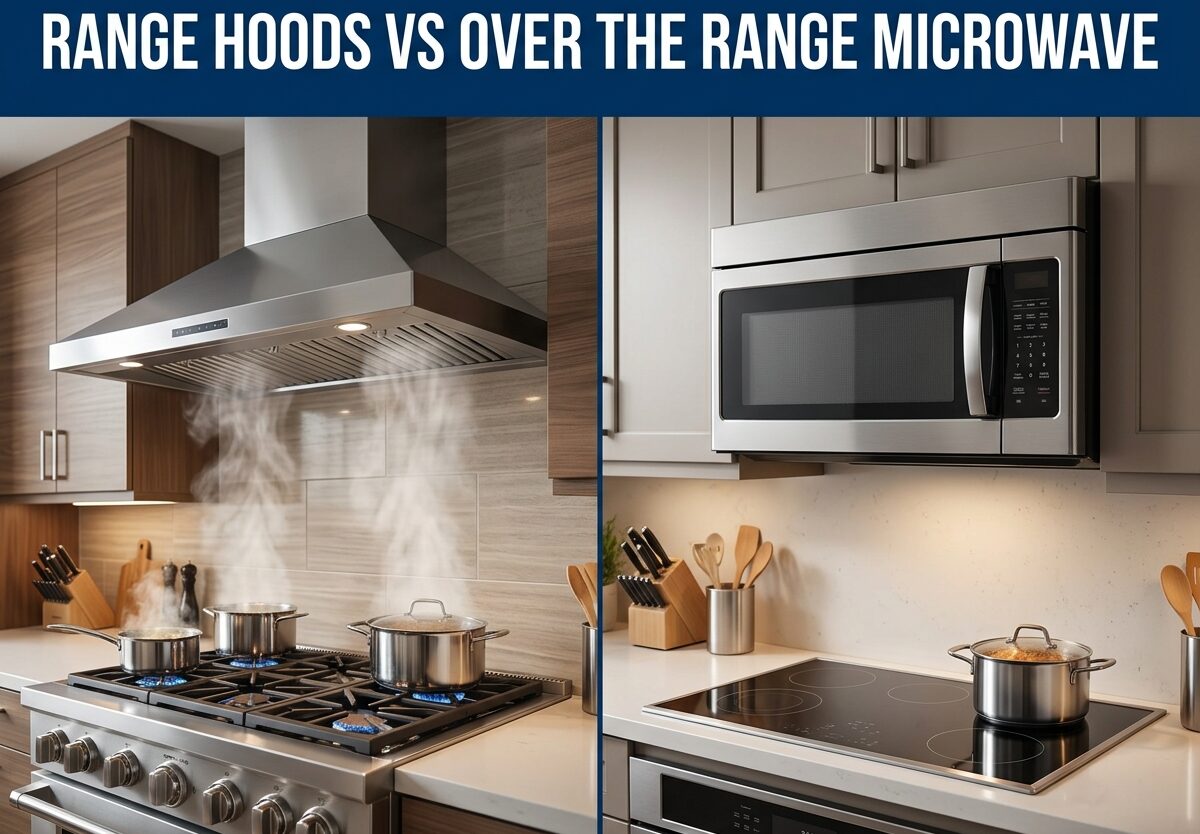
When designing or remodeling a kitchen, one of the most important decisions you’ll face is how to handle ventilation above your cooktop. Range hoods vs over the range microwave is a debate that has divided homeowners for decades, and for good reason – both options offer distinct advantages depending on your cooking style, kitchen layout, and priorities. This comparison will help you make an informed decision based on real-world performance data, not just manufacturer claims.
The core difference between these two options comes down to specialization versus convenience. A range hood is designed specifically for ventilation – removing smoke, grease, odors, and heat from your kitchen. An over-the-range (OTR) microwave combines microwave functionality with ventilation capabilities, attempting to serve two purposes in one appliance. Understanding this fundamental difference is key to choosing the right option for your home.
Quick Comparison: Range Hood vs Over-The-Range Microwave
Before diving into the details, here’s a straightforward comparison of the key differences:
| Feature | Range Hood | Over-The-Range Microwave |
|---|---|---|
| Ventilation Power | 300-1200+ CFM (superior) | 200-400 CFM (adequate for light cooking) |
| Capture Area | Deep canopy, optimal height | Shallow, often installed too low |
| Space Efficiency | Frees counter space for microwave | Saves counter space by combining functions |
| Installation Cost | $400-$1500+ (often professional required) | $200-$600 (often DIY-friendly) |
| Best For | Serious cooks, gas ranges, heavy frying | Casual cooks, electric ranges, space-constrained kitchens |
| Heat Tolerance | High – handles all BTU outputs | Limited – may struggle with high-BTU gas ranges |
| Noise Level | Varies – can be quieter at same CFM | Often louder due to compact design |
| Maintenance | Filter cleaning every 1-3 months | Filter cleaning every 1-2 months (greasier) |
Range Hoods: The Ventilation Specialists
Range hoods are purpose-built appliances designed solely for kitchen ventilation. This specialization allows them to outperform OTR microwaves in virtually every ventilation metric. When you prioritize air quality and cooking performance, a range hood is the clear winner.
Ventilation Power and CFM Performance
The most important metric for any ventilation system is CFM (cubic feet per minute) – the measure of how much air the fan can move. Range hoods typically offer 300-1200+ CFM, compared to just 200-400 CFM for most OTR microwaves. This difference isn’t just about numbers – it’s about real-world performance.
When you’re searing a steak, frying fish, or stir-frying at high heat, you need powerful airflow to capture smoke and grease before it spreads throughout your kitchen and home. Range hoods deliver this power consistently. Many Reddit users who switched from OTR microwaves to proper range hoods report dramatic improvements in air quality, with one user noting they “finally stopped setting off smoke alarms every time they cooked bacon.”
Design Flexibility and Style Options
Range hoods come in a variety of styles to match any kitchen aesthetic. Under-cabinet hoods mount beneath cabinets, wall-mount hoods make a statement as focal points, island hoods ventilate cooktops in kitchen islands, and downdraft hoods rise from behind the cooktop when needed. This variety allows you to choose ventilation that complements your kitchen design rather than compromising it.
OTR microwaves, by contrast, offer limited style options. You’re essentially choosing between black, white, or stainless steel in a standard boxy shape. For homeowners who view appliances as design elements, this limitation is significant.
Better Capture Area and Height
The depth and height of a range hood create a larger capture area – the space where smoke, grease, and steam are effectively contained and removed. OTR microwaves are shallow by design, and they’re often installed too low due to cabinet height constraints, reducing their effectiveness even further.
This shallow design causes practical problems. Multiple Reddit users mention difficulty accessing rear burners and stirring tall pots under OTR microwaves. One user commented, “I always end up visualizing hot liquid splashing on me from an over the range microwave” – highlighting a real safety concern that doesn’t exist with properly installed range hoods.
Heat Tolerance for High-BTU Cooking
If you cook with gas, especially with high-BTU burners common on pro-style ranges, a range hood is essentially mandatory. The intense heat output from these burners requires ventilation that can handle sustained high temperatures without overheating. Range hoods are designed for this exact scenario.
OTR microwaves, containing sensitive electronics, simply aren’t built to handle the heat output from powerful gas burners. Using them with high-BTU ranges can lead to premature failure and potential safety concerns. For serious home cooks who value performance above all else, this is often the deciding factor.
Long-term Value and Durability
While range hoods cost more upfront, they offer better long-term value. A quality range hood can last 15-20 years with proper maintenance, while OTR microwaves typically need replacement after 8-12 years. When you factor in that you’ll likely need a separate microwave anyway, the total cost of ownership often favors the range hood approach.
Over-The-Range Microwaves: The Space-Saving Solution
Despite their ventilation limitations, OTR microwaves remain popular for good reason. They solve a fundamental problem in small kitchens – how to fit essential appliances into limited space. For many homeowners, space efficiency outweighs ventilation performance.
Space-Saving Dual Functionality
The primary advantage of OTR microwaves is consolidation. By combining two appliances into one, they free up valuable counter or cabinet space that would otherwise be occupied by a standalone microwave. In small kitchens, apartments, and condos, this space savings can be the difference between a functional kitchen and one that feels cramped and impractical.
This dual functionality also means one less appliance to purchase initially. For budget-conscious homeowners or those furnishing a first kitchen, this consolidation can make OTR microwaves an attractive option.
Counter Space Recovery
Kitchen counters are prime real estate. By moving the microwave above the range, you recover 2-4 square feet of workspace that can be used for food preparation, small appliances, or simply keeping your kitchen organized. This benefit shouldn’t be underestimated – anyone who’s cooked in a kitchen with limited counter space understands how valuable every inch becomes during meal preparation.
Cost-Effective Consolidation
Purchasing an OTR microwave typically costs $300-$800, compared to $600-$2000+ for a quality range hood plus the cost of a separate countertop microwave. For homeowners working with tight budgets, this significant cost difference makes OTR microwaves an appealing option. The installation is also often simpler and more DIY-friendly, reducing labor costs.
Easier Installation Process
Many OTR microwaves are designed for relatively straightforward installation, especially when replacing an existing unit. They often plug into standard outlets and can be installed by competent DIYers. Range hoods, particularly ducted models, frequently require professional installation involving electrical work, ductwork modifications, and carpentry – all of which add significantly to the total cost.
Convenience Features
Modern OTR microwaves offer features that add convenience beyond basic reheating. Sensor cooking automatically adjusts cooking time, convection microwave models can bake and brown, and multi-stage cooking lets you program complex heating sequences. While these features don’t compensate for weak ventilation, they do add functionality that dedicated range hoods can’t match.
Range Hoods vs Over The Range Microwave: Key Differences
CFM Performance: The Critical Difference
CFM rating isn’t just a specification – it determines whether your ventilation actually works. For electric cooktops, you generally need at least 200-300 CFM. For gas ranges, the recommendation is 10 CFM per 100 BTU – meaning a 15,000 BTU burner needs 150 CFM just for that single burner, and a 60,000 BTU total output range needs 600 CFM minimum.
Range hoods routinely meet or exceed these requirements. OTR microwaves often fall short, especially for gas cooking. This is why homeowners who do heavy frying, searing, or spicy cooking consistently report better results with range hoods. The airflow difference is something you can feel – smoke is captured before it spreads, grease doesn’t coat your cabinets, and your kitchen doesn’t smell like dinner three hours later.
Installation Requirements and Costs
Installation complexity varies dramatically between the two options. OTR microwaves typically mount to the cabinet above with a simple bracket, plug into a standard outlet, and can vent either to the outside or recirculate through a charcoal filter. Many homeowners can handle this installation themselves in 2-4 hours.
Range hoods, especially ducted models, are more involved. Ducted installation requires cutting holes in exterior walls or roofs, running ductwork, and ensuring proper slope for condensation drainage. This work typically costs $400-$1500+ in professional installation fees. However, ducted venting is far more effective than recirculating – it actually removes air from your kitchen rather than filtering it and returning it.
Space Efficiency vs Ventilation Power
This is the fundamental tradeoff. OTR microwaves prioritize space efficiency at the expense of ventilation power. Range hoods prioritize ventilation performance at the expense of additional space requirements. There’s no way around this tradeoff – you can’t have maximum ventilation performance in the shallow form factor of an OTR microwave.
The question becomes: what matters more for your lifestyle? If you rarely cook anything that produces significant smoke or grease, the OTR microwave’s space savings may be worth the ventilation compromise. If you cook frequently, especially with high-heat methods, the ventilation power of a range hood will dramatically improve your cooking experience and home air quality.
Cooking Performance Impact
Better ventilation enables better cooking. When you can sear at high heat without setting off smoke alarms, when you can stir-fry without greasing your entire kitchen, when you can fry fish without the smell lingering for days – you cook differently. You attempt recipes you’d otherwise avoid. you use techniques that require high heat.
Multiple Reddit users who switched from OTR microwaves to range hoods report cooking more adventurously after the switch. The ventilation wasn’t just removing smoke – it was enabling better cooking. This is an intangible benefit that doesn’t show up in specification comparisons but dramatically affects your cooking experience.
Noise Levels Comparison
While neither option is particularly quiet, range hoods often have an advantage at equivalent CFM ratings. Larger fan blades and more spacious housings allow range hoods to move more air with less turbulence, reducing noise. OTR microwaves, with their compact designs and smaller fans, often produce higher-pitched whining that’s more noticeable in open-concept homes.
For homes where the kitchen connects to living areas, this noise difference matters. Being able to maintain a conversation while the ventilation runs – or watch TV without blasting the volume – is a quality of life factor worth considering.
Maintenance and Cleaning
Both options require regular filter cleaning, but OTR microwaves often need more frequent attention. Their shallower capture area means more grease escapes and coats the filter and surrounding surfaces. Range hoods with deeper canopies capture more grease before it spreads, potentially reducing cleaning frequency elsewhere in your kitchen.
Charcoal filters in recirculating units (more common with OTR microwaves) typically need replacement every 6-12 months and cost $30-$60 each. Metal mesh filters in ducted systems can be washed and reused indefinitely, reducing long-term maintenance costs.
Which Should You Choose: Range Hood or OTR Microwave?
Choose a Range Hood If:
- You cook frequently with high-heat methods – searing, frying, stir-frying, grilling indoors
- You have a gas range – especially one with high-BTU burners
- You cook strong-smelling foods – fish, spices, curries, fermented ingredients
- You have an open floor plan – where kitchen odors spread throughout the home
- You value air quality – and want to remove pollutants, not just filter them
- You have space for a separate microwave – in a pantry, appliance garage, or on a counter
- You’re planning to stay in your home long-term – and want the best performing solution
Choose an OTR Microwave If:
- You have a small kitchen – where counter space is at a premium
- You cook mostly simple meals – that don’t produce heavy smoke or grease
- You have an electric cooktop – especially a smoothtop model
- You’re on a tight budget – and need to minimize upfront costs
- You’re a renter – who can’t modify the kitchen extensively
- You rarely use high-heat cooking methods – and mostly reheat or light-cook
- You’re furnishing a vacation home – where space is more important than power
Frequently Asked Questions
Which is better over the range, microwave or range hood?
Range hoods are better for ventilation performance, offering 2-3x the CFM of OTR microwaves. They capture smoke and grease more effectively and handle high-BTU cooking better. OTR microwaves are better for space efficiency, combining two appliances in one and freeing up counter space. Choose based on whether ventilation power or space savings is your priority.
What are the disadvantages of over the range microwaves?
Weak ventilation power (typically 200-400 CFM), shallow capture area that allows smoke to escape, often installed too low making rear burner access difficult, electronics can overheat with high-BTU gas ranges, shorter lifespan than dedicated range hoods, filters require more frequent cleaning due to grease buildup, and limited style options compared to range hoods.
Do I need a range hood if I have a microwave above the range?
Building codes typically require some form of ventilation above cooktops, which OTR microwaves can satisfy. However, for optimal ventilation performance – especially with gas cooking or high-heat methods – a dedicated range hood is recommended. Many homeowners eventually add a range hood when they upgrade their cooking equipment or find the OTR microwave’s ventilation inadequate.
Do over the range microwaves have exhaust fans?
Yes, OTR microwaves include built-in exhaust fans that vent either to the outside through ductwork or recirculate air through charcoal filters. However, these fans are typically less powerful than dedicated range hood fans, maxing out around 300-400 CFM compared to 600-1200+ CFM for quality range hoods.
Can an over the range microwave be vented outside?
Yes, many OTR microwaves can be vented outside through ductwork, and this is strongly recommended for better performance. Ducted venting removes air from the kitchen entirely, while recirculating modes only filter and return it. However, even when vented outside, OTR microwaves still have lower CFM ratings than dedicated range hoods.
Are over the range microwaves out of style?
OTR microwaves remain popular for their space-saving benefits, especially in smaller homes and apartments. However, design trends are shifting toward dedicated range hoods with separate microwaves in pantry spaces or appliance garages. This trend prioritizes ventilation performance and cleaner aesthetics over space consolidation, particularly in higher-end kitchen renovations.
Why do Americans put the microwave above the stove?
OTR microwaves became popular in American kitchens during the 1980s and 1990s as kitchens shrank and counter space became more valuable. They offered a way to consolidate two essential appliances into one footprint. This trend was particularly strong in new construction where builders could save on both cabinet costs and appliance packages by specifying OTR microwaves instead of separate units.
Conclusion: Making Your Decision
The range hoods vs over the range microwave debate ultimately comes down to your priorities. If you’re a serious cook who values ventilation performance, owns a gas range, or frequently uses high-heat cooking methods, a dedicated range hood is the superior choice. The difference in air quality and cooking capability is substantial, and most homeowners who make the switch never look back.
However, if you’re working with limited space, have an electric cooktop, cook mostly simple meals, or are on a tight budget, an OTR microwave offers a practical compromise that serves dual purposes adequately. Many homeowners are perfectly satisfied with this solution, especially in smaller kitchens where every inch counts.
The key is understanding what you’re getting – and what you’re giving up – with each option. Both range hoods and over-the-range microwaves have their place in modern kitchens. By considering your cooking habits, kitchen layout, and priorities, you can choose the solution that will serve you best for years to come.




Leave a Comment