
If you’ve ever wondered what makes your air conditioner actually cool your home, the answer is refrigerant. This chemical compound is the lifeblood of your HVAC system, quietly working behind the scenes to transfer heat and keep you comfortable. But not all refrigerants are created equal, and understanding the differences could save you thousands of dollars when it’s time for repairs or replacement.
I’ve spent years researching HVAC systems, and I’ve seen countless homeowners confused by refrigerant terminology like Freon, Puron, and the alphabet soup of R-22, R-410A, R-454B, and R-32. The truth is, refrigerant technology has undergone a massive transformation over the past decade due to environmental regulations, and knowing which type your system uses is more important than ever.
In this guide, I’ll break down everything you need to know about air conditioner refrigerants in plain English. You’ll learn how they work, the differences between major types, what phase-outs mean for your wallet, and how to future-proof your next HVAC purchase.
What is Air Conditioner Refrigerant?
Air conditioner refrigerant is a chemical fluid that circulates through your HVAC system to absorb heat from inside your home and release it outside. It’s the working medium that makes the entire cooling process possible. Without refrigerant, your air conditioner is just an expensive fan.
Think of refrigerant as a heat shuttle. Inside your home, it absorbs thermal energy from the air, turning from a liquid into a gas. Outside, it releases that heat and condenses back into a liquid, ready to repeat the cycle. This phase change from liquid to gas and back again is what allows air conditioners to move heat so efficiently.
The most important thing to understand about refrigerant is that it doesn’t get “used up” like fuel. In a properly functioning system, the same refrigerant circulates indefinitely. If your system is low on refrigerant, it means you have a leak that needs to be fixed.
You’ll often hear refrigerant referred to by brand names like Freon or Puron, but these are just proprietary names for specific chemical formulations. The industry identifies refrigerants by their R-number (like R-22 or R-410A), which tells you exactly what chemical compound you’re dealing with.
How Air Conditioner Refrigerants Work
Understanding the refrigeration cycle will help you appreciate why choosing the right refrigerant matters. Here’s what happens inside your AC system every time it runs:
Step 1: Compression. The refrigerant enters the compressor as a low-pressure gas. The compressor squeezes it, raising both pressure and temperature dramatically.
Step 2: Heat Rejection. Now a hot, high-pressure gas, the refrigerant flows through the condenser coils in your outdoor unit. A fan blows air across these coils, and the refrigerant releases its heat to the outside air. As it cools, it condenses into a liquid.
Step 3: Expansion. The liquid refrigerant passes through an expansion valve, which rapidly drops its pressure. This sudden pressure drop causes the refrigerant to become very cold.
Step 4: Heat Absorption. The cold refrigerant flows through the evaporator coils in your indoor unit. Warm air from your home blows across these coils, and the refrigerant absorbs the heat, cooling the air. The refrigerant evaporates back into a gas, and the cycle begins again.
This continuous loop is why your refrigerant choice matters. Different refrigerants have different thermodynamic properties that affect efficiency, operating pressures, and how well your system transfers heat. Modern refrigerants are designed to make this cycle more efficient while reducing environmental impact.
Types of Air Conditioner Refrigerants
The HVAC industry has transitioned through several generations of refrigerants, each replacing the previous one due to environmental concerns. Let’s examine the four main types you’ll encounter today.
R-22 (Freon) – The Legacy Refrigerant
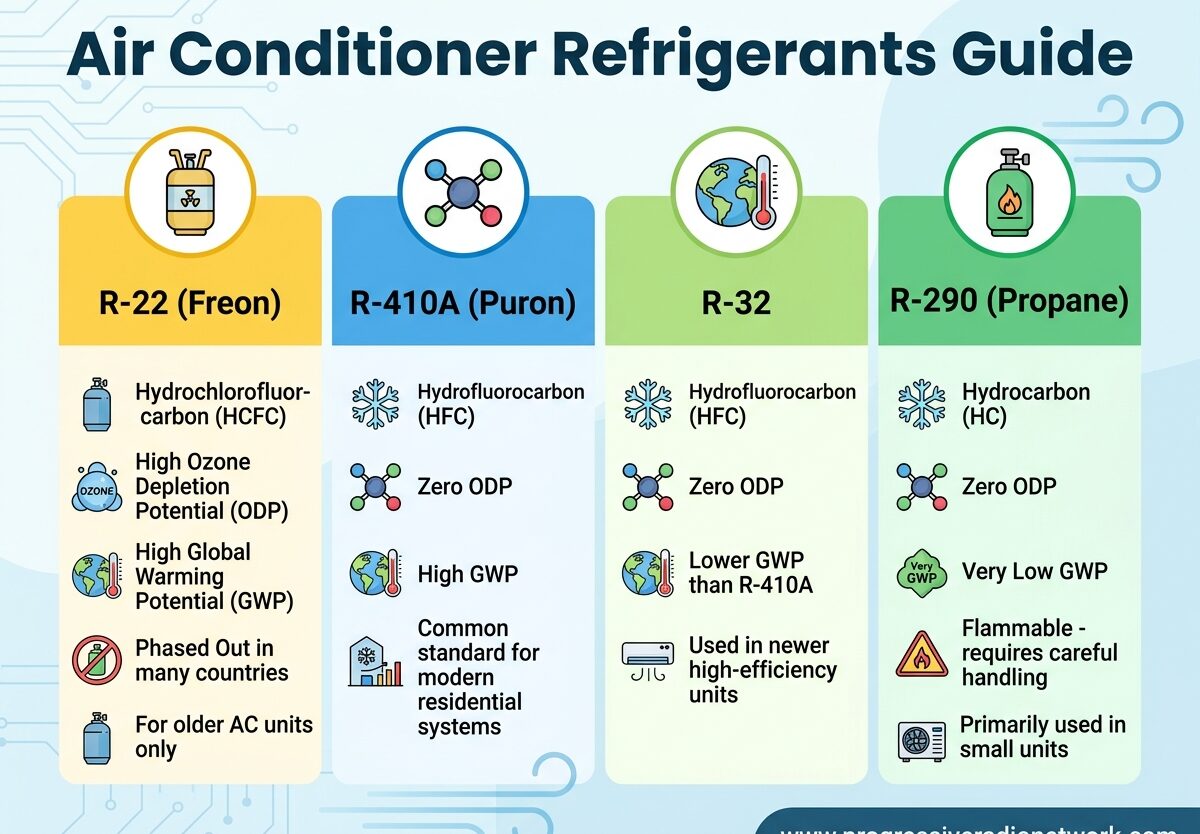
R-22, commonly known by the brand name Freon, was the standard residential refrigerant for decades. Installed in millions of systems built before 2010, R-22 is a hydrochlorofluorocarbon (HCFC) that efficiently cools homes but comes with serious environmental drawbacks.
The problem with R-22 is its ozone depletion potential. When released into the atmosphere, it damages the ozone layer that protects Earth from harmful UV radiation. Because of this, R-22 production was banned in the United States in 2020 under the Clean Air Act.
Today, if you have an R-22 system that needs refrigerant, you’re in a difficult position. New R-22 is no longer manufactured, so you can only buy reclaimed or recycled refrigerant at premium prices. A single pound of R-22 can cost over $100, compared to $10-20 for newer alternatives.
Many homeowners with R-22 systems face a tough choice: pay exorbitant prices for refrigerant to keep an aging system running, or invest in a new system designed for modern refrigerants. This decision point is why knowing your refrigerant type is so important.
R-410A (Puron) – Current Standard
R-410A, sold under the brand name Puron by Carrier and other names by different manufacturers, has been the standard refrigerant for residential air conditioners since 2010. It’s a hydrofluorocarbon (HFC) that doesn’t harm the ozone layer, making it a significant environmental improvement over R-22.
R-410A operates at significantly higher pressures than R-22, which required manufacturers to redesign AC components to handle the stress. This is why you can’t simply put R-410A in an R-22 system, or vice versa, the equipment isn’t compatible.
The advantages of R-410A include better energy efficiency and more reliable cooling performance. Systems designed for R-410A typically achieve higher SEER ratings, translating to lower electric bills. It also absorbs and releases heat more effectively than R-22, making it better suited for the extreme temperatures we experience in many parts of the country.
However, R-410A isn’t perfect. It has a very high global warming potential (GWP) of 2088, meaning it traps heat in the atmosphere if released. This environmental impact has led to its own scheduled phase-out, which we’ll cover shortly.
R-454B – The Next Generation
R-454B is one of the refrigerants positioned to replace R-410A in residential applications. It’s a blend of R-32 and R-1234yf designed to offer similar performance to R-410A with dramatically lower environmental impact.
The standout feature of R-454B is its GWP of 466, less than one-quarter that of R-410A. This reduction is significant enough to meet current EPA regulations and future requirements under the AIM Act, which phases down high-GWP refrigerants.
From a performance standpoint, R-454B maintains cooling capacity very close to R-410A while offering slightly improved efficiency. Equipment manufacturers like Carrier have already begun transitioning to R-454B, with systems using this refrigerant becoming available in 2026.
The trade-off with R-454B is mild flammability. It’s classified as an A2L refrigerant, meaning it has low flammability characteristics similar to many household products. This classification requires updated safety protocols for technicians but doesn’t pose unusual risks for homeowners when handled properly.
R-32 – The Efficient Alternative
R-32 has emerged as another leading replacement for R-410A, particularly in ductless mini-split systems. It’s a single-component refrigerant (not a blend) with excellent thermodynamic properties and a GWP of 675, about one-third that of R-410A.
The efficiency advantage of R-32 is significant. Systems using R-32 can achieve up to 12% better efficiency than comparable R-410A equipment, directly impacting your energy costs. R-32 also has better heat transfer characteristics, allowing for smaller heat exchangers and potentially more compact equipment designs.
Like R-454B, R-32 is classified as A2L for mild flammability. This characteristic has been extensively studied, and when proper installation procedures are followed, R-32 systems are just as safe as traditional options. The refrigerant is widely used in Europe and Asia, giving it a track record of reliability.
From an availability standpoint, R-32 has an advantage. As a single-component refrigerant, it’s easier to manufacture and supply than blended alternatives. Reddit HVAC professionals frequently note that R-32 is becoming more available worldwide, which could translate to more stable pricing as the market transitions.
Environmental Impact and GWP Comparison
Global Warming Potential (GWP) is a measure of how much heat a greenhouse gas traps in the atmosphere compared to carbon dioxide. CO2 has a GWP of 1 by definition. When you hear about refrigerants with GWPs in the hundreds or thousands, it means they’re hundreds or thousands of times more potent than CO2 at trapping heat.
This matters because refrigerants can escape during installation, maintenance, or equipment disposal. Even small leaks from millions of AC units add up to significant environmental impact. The EPA’s AIM Act phases down high-GWP refrigerants to reduce HVAC’s contribution to climate change.
Here’s how the main refrigerants compare:
- R-22: GWP 1810 (plus ozone depletion)
- R-410A: GWP 2088
- R-32: GWP 675
- R-454B: GWP 466
The trend is clear: each new refrigerant generation dramatically reduces GWP. R-454B and R-32 represent a 75-80% reduction compared to R-410A. This improvement is why regulatory agencies are mandating the transition.
It’s worth noting that GWP isn’t the only environmental consideration. Older refrigerants like R-22 also deplete the ozone layer, a separate environmental issue that modern refrigerants have addressed. Today’s options are ozone-friendly with much lower climate impact.
Refrigerant Phase-Out Timeline and Regulations
The phase-out of high-GWP refrigerants is happening on a defined schedule set by the EPA’s AIM Act. Here’s what you need to know about the timeline and how it affects your HVAC decisions.
2020: Production and import of R-22 ended completely. Only recycled or reclaimed R-22 remains available, driving up prices as supply dwindles. Systems using R-22 became increasingly expensive to maintain.
2023-2024: The EPA established baseline production levels for HFC refrigerants, including R-410A. This set the stage for the phased reduction that follows.
2025-2028: Production allowances for high-GWP HFCs decrease incrementally. By 2028, production will be reduced to 30% of baseline levels. This reduction gradually increases prices and encourages transition to lower-GWP alternatives.
2029 and beyond: Further reductions continue, with the goal of an 85% reduction by 2036. New installations will predominantly use low-GWP refrigerants like R-454B and R-32.
What does this mean for you? If you’re buying a new system in 2026, you’ll likely get equipment designed for R-454B or R-32. These systems aren’t becoming obsolete; they’re the new standard. If you have an R-410A system, don’t worry, it will remain serviceable throughout its expected lifespan of 15-20 years. The phase-out affects new equipment production, not existing systems.
The Montreal Protocol, the international environmental agreement that originally addressed ozone-depleting substances, has been amended to address HFC phase-down as well. This global coordination means refrigerant availability and pricing should remain relatively stable during the transition.
Which Refrigerant Does My AC Use?
Identifying your refrigerant type is straightforward once you know where to look. This information is essential for maintenance planning and understanding your options if repairs are needed.
Check the outdoor unit label. Every air conditioner has a data plate on the outdoor condenser unit that lists the refrigerant type. Look for “Refrigerant:” or “Ref. Type:” followed by the designation. This is the most reliable method.
Check your owner’s manual. The manual should specify the refrigerant type, often on the specifications page. If you’ve misplaced the manual, most manufacturers have digital copies available online.
Look at the compressor label. Sometimes the refrigerant type is printed directly on the compressor inside the outdoor unit. This requires removing the access panel, so only do this if you’re comfortable working safely around electrical components.
Consider your system’s age. As a general rule, systems installed before 2010 likely use R-22. Systems from 2010-2024 typically use R-410A. Systems installed in 2026 or later may use R-454B or R-32. Age alone isn’t definitive, but it’s a helpful clue.
If you’re still unsure, an HVAC technician can identify your refrigerant type during a service call. They have the tools and expertise to determine exactly what your system requires. This information should be recorded on your service paperwork for future reference.
Signs of Refrigerant Leaks
Refrigerant leaks are a common AC problem, and recognizing the signs early can prevent more extensive damage. Remember, your system doesn’t consume refrigerant, so low levels always indicate a leak that needs professional attention.
Reduced cooling performance. If your AC isn’t keeping up with heat like it used to, low refrigerant could be the cause. The system will run longer without reaching the set temperature, increasing energy bills.
Ice buildup on refrigerant lines. When refrigerant levels drop, pressure in the system falls, causing temperature drops that can freeze the evaporator coil. If you see ice on the copper lines connecting your indoor and outdoor units, you likely have a leak.
Hissing or bubbling sounds. Refrigerant escaping through a small leak can produce hissing noises. Larger leaks might cause bubbling sounds at the leak point. These sounds indicate active refrigerant loss.
Higher than normal energy bills. Low refrigerant forces your system to work harder and run longer to maintain comfort. If your electric bills have spiked without a change in usage patterns, have your refrigerant levels checked.
Forum discussions from HVAC professionals reveal that leak detection is one of the most challenging aspects of refrigerant service. Some leaks are so small they’re nearly invisible to standard detection methods, requiring electronic leak detectors or ultraviolet dye testing. This is why professional diagnosis is essential.
Safety and Handling Guidelines
I need to be very clear about this: refrigerant handling is not a DIY project. Federal law under Section 608 of the Clean Air Act prohibits intentionally venting refrigerants into the atmosphere, and only certified technicians can purchase and handle many refrigerants.
Refrigerants are chemicals under pressure, often in liquid form that can cause freeze burns if they contact skin. Modern refrigerants like R-32 and R-454B have mild flammability characteristics that require specific safety protocols during installation and service.
Professional HVAC technicians undergo extensive training and certification to handle refrigerants safely. They have the specialized equipment to recover, recycle, and recharge refrigerant without releasing it into the environment. When your AC needs refrigerant service, this is absolutely a job for a qualified professional.
Beyond regulatory requirements, proper handling ensures your system operates efficiently and safely. Incorrect refrigerant charge can damage your compressor, the most expensive component in your system. Technicians use precise charging methods to ensure optimal performance.
Future of HVAC Refrigerants
The refrigerant transition continues as environmental regulations tighten and technology advances. While R-454B and R-32 are the current solutions for residential cooling, research is already underway on next-generation options with even lower environmental impact.
Manufacturers are exploring ultra-low GWP refrigerants that could reduce climate impact further. Some European markets are already testing refrigerants with GWPs below 150, though these options face challenges for widespread adoption in the United States due to different climate conditions and equipment requirements.
For homeowners, the key takeaway is that newer refrigerants are environmentally superior without sacrificing performance. Today’s R-454B systems cool just as effectively as yesterday’s R-410A units while reducing environmental impact by 75% or more.
The industry is moving toward refrigerants that are sustainable in the long term. When you purchase a new system today, you’re buying technology that will remain supported and serviceable for its full lifespan. The days of rapid refrigerant obsolescence like R-22 experienced are largely over.
For those concerned about future-proofing, systems designed for R-454B or R-32 represent the current state of the art. These refrigerants meet current regulations and have the industry backing to remain viable options for the foreseeable future.
FAQs
Is R410 going to be phased out?
Yes, R-410A is being phased out under the EPA’s AIM Act. Production of high-GWP HFCs like R-410A will be reduced by 70% by 2028 and 85% by 2036. However, existing R-410A systems will remain serviceable throughout their expected lifespan. New equipment will transition to lower-GWP alternatives like R-454B and R-32.
How do I know if my AC is 410A or R-22?
Check the data plate on your outdoor condenser unit for the refrigerant type listed under Ref. Type or Refrigerant. Systems installed before 2010 likely use R-22, while systems from 2010-2024 typically use R-410A. You can also check your owner’s manual or have an HVAC technician identify the type during service.
Which refrigerant is better, R-32 or R410?
R-32 offers several advantages over R-410A: it has a GWP of 675 compared to 2088 for R-410A, provides up to 12% better efficiency, and has better heat transfer properties. However, R-32 is mildly flammable (A2L classification) while R-410A is not. R-32 is particularly common in ductless mini-split systems, while R-410A remains standard in traditional split systems through the mid-2020s.
What happens if I use the wrong refrigerant?
Using the wrong refrigerant can cause severe damage to your AC system. Different refrigerants operate at different pressures and require specific oil types. Running a system with incorrect refrigerant can cause compressor failure, heat exchanger damage, and complete system breakdown. The repair cost typically exceeds $3000, which is why professional identification of the correct refrigerant is absolutely essential.
Can I add refrigerant to my AC myself?
No. Federal law under Section 608 of the Clean Air Act prohibits intentional venting of refrigerants, and only EPA-certified technicians can purchase and handle many refrigerants. DIY refrigerant charging risks personal injury from pressurized chemicals, system damage from improper charging, and environmental harm from refrigerant release. Always use a certified HVAC professional for refrigerant service.
How much does refrigerant replacement cost?
Refrigerant costs vary dramatically by type. R-22 costs $80-150 per pound for reclaimed material due to the production ban. R-410A costs $10-20 per pound. Newer refrigerants like R-454B and R-32 typically cost $15-30 per pound. Most residential systems need 4-10 pounds depending on size. Labor for leak detection and repair adds $200-800. Total service costs typically range from $300 for minor R-410A top-offs to over $1500 for comprehensive R-22 system repairs.
What is the difference between Freon and Puron?
Freon is a brand name for R-22 refrigerant, while Puron is Carrier’s brand name for R-410A. Freon (R-22) is an older HCFC refrigerant that depletes ozone and was phased out of production in 2020. Puron (R-410A) is an HFC refrigerant that doesn’t harm ozone but has high GWP. Today’s systems are moving toward R-454B and R-32, which have significantly lower environmental impact than both Freon and Puron.
Will my AC become obsolete when R-410A is phased out?
No. The R-410A phase-out affects new equipment production, not existing systems. Your R-410A air conditioner will remain fully serviceable throughout its 15-20 year expected lifespan. Refrigerant will continue to be available for service needs, though prices may gradually increase. You won’t be forced to replace a functioning system. When your AC eventually needs replacement, you’ll simply choose a model designed for the newer refrigerants available at that time.
Conclusion: Making Informed Decisions About Air Conditioner Refrigerants
Understanding air conditioner refrigerants empowers you to make smarter decisions about your HVAC system. Whether you’re maintaining an existing unit or shopping for a new one, knowing your refrigerant type helps you plan for the future and avoid costly mistakes.
If you have an R-22 system, you’re facing difficult economics. High refrigerant costs make major repairs questionable, and replacement with a modern system often makes financial sense. The good news is today’s equipment is significantly more efficient, so you’ll recoup some of that investment through lower energy bills.
For those with R-410A systems, breathe easy. Your equipment will remain fully supported for years to come. The phase-out of new R-410A production doesn’t affect your ability to service existing systems. When your AC eventually reaches end-of-life, you’ll transition to R-454B or R-32 naturally.
If you’re shopping for a new air conditioner in 2026, focus on efficiency ratings and equipment quality rather than refrigerant type. R-454B and R-32 both represent the future of residential cooling, and manufacturers are selecting the option that works best for their equipment designs. You’re buying technology that will remain current for its full lifespan.
The refrigerant landscape has changed dramatically over the past decade, and more changes are coming. But these transitions reflect real progress in reducing environmental impact while maintaining and improving cooling performance. By understanding air conditioner refrigerants, you’re better equipped to navigate these changes and make decisions that serve both your comfort and your budget.


Leave a Comment