
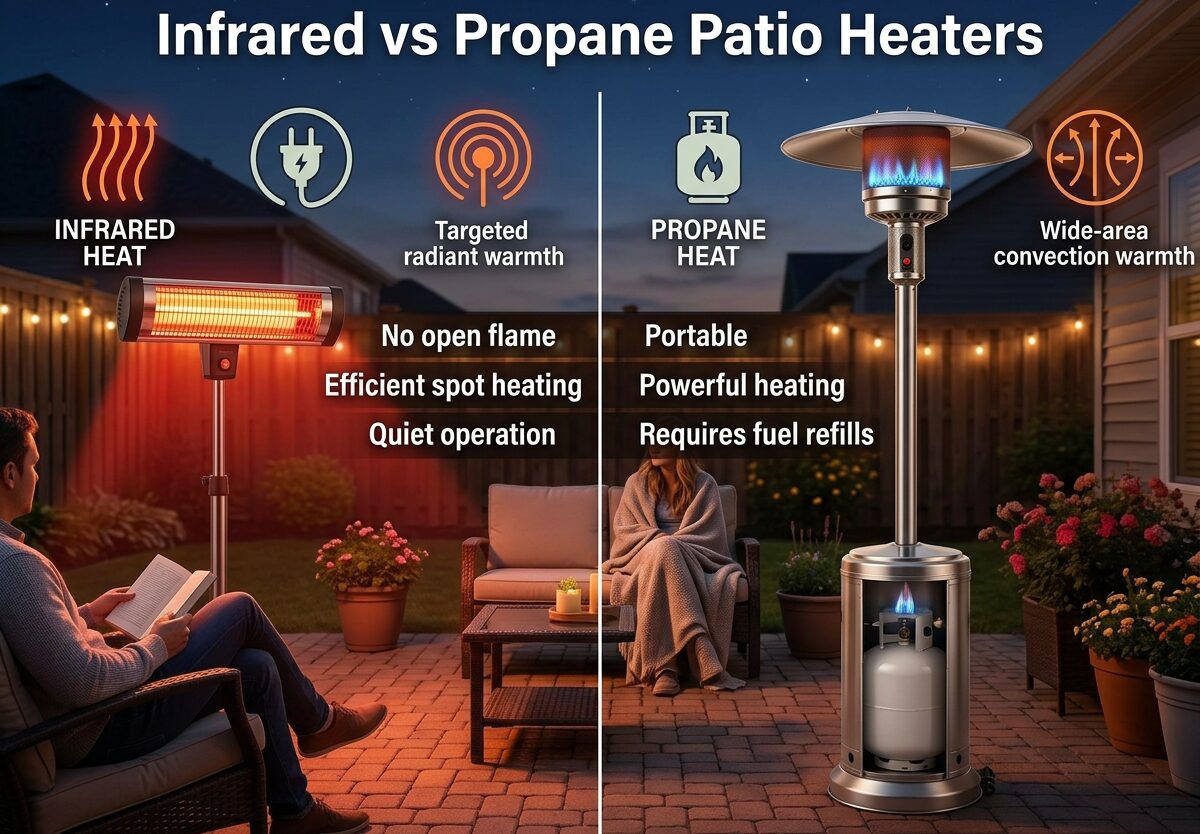
There’s nothing quite like gathering on your patio for a crisp evening dinner, only to have everyone shivering through dessert before retreating indoors. If you’re looking to extend your outdoor living season, choosing between infrared vs propane patio heaters is one of the most important decisions you’ll make.
The right outdoor heater can add 2-3 months of usable patio time each year. But these two heater types work completely differently, have dramatically different operating costs, and shine in different situations.
In this infrared vs propane patio heaters comparison, I’ll break down exactly how each type works, what they cost to run, safety considerations you need to know, and which one performs best for your specific setup. I’ve also gathered real insights from patio owners who’ve lived with both options.
Quick Comparison: Infrared vs Propane Patio Heaters at a Glance
| Factor | Infrared Patio Heaters | Propane Patio Heaters |
|---|---|---|
| Heat Type | Radiant heat (warms objects directly) | Convection heat (warms surrounding air) |
| Cost per Hour | $0.20-$0.40 (electricity rates dependent) | $1.50-$3.00 (propane tank dependent) |
| Initial Cost Range | $150-$800+ | $100-$500 |
| Portability | Limited (requires power source) | Excellent (self-contained tank) |
| Wind Performance | Excellent (heat not affected by wind) | Poor (heat blown away by wind) |
| Maintenance | Minimal (dust element occasionally) | Moderate (tank refills, connection checks) |
| Environmental Impact | Zero emissions at point of use | Carbon emissions from burning propane |
| Ideal For | Covered patios, windy areas, frequent use | Large open spaces, occasional use, portability needs |
How Infrared vs Propane Patio Heaters Work
The fundamental difference between these two heater types comes down to physics. Understanding this difference explains almost everything about how they perform differently in real-world conditions.
Infrared Heaters Use Radiant Heat Like the Sun
Infrared patio heaters work exactly like the sun on a cold winter day. The air temperature might be freezing, but when you step into direct sunlight, you feel warm immediately. That’s because infrared electromagnetic waves travel through the air and warm whatever objects (and people) they encounter directly.
The heater doesn’t waste energy trying to warm the air. Instead, it sends focused infrared radiation that heats you, your furniture, and the surrounding surfaces. Those objects then radiate warmth back into the immediate area. This is why infrared heat feels instant and focused.
Most electric patio heaters use quartz or halogen elements that glow red-hot when electricity passes through them, emitting infrared radiation in the process. The heat travels in straight lines from the element, making infrared heaters highly directional.
Propane Heaters Warm the Air Through Convection
Propane patio heaters work on a completely different principle. They burn propane gas to create an open flame, which heats a metal element or burner assembly. The heat from this burner then warms the surrounding air through convection.
As the air near the burner gets hot, it rises and cooler air moves in to replace it, creating a continuous cycle of warm air circulating around the heater. The typical mushroom-style propane patio heater is designed specifically to facilitate this convection pattern, with the burner at the top and a reflector dome pushing the heat downward.
This convection heating approach means propane heaters warm everything in their vicinity, including the air itself. That’s why they can feel comfortable in still conditions but struggle significantly when wind disrupts the warm air pocket they’ve created.
Infrared vs Propane Patio Heaters Cost Comparison
When comparing infrared vs propane patio heaters, cost is usually the biggest factor people consider. But you need to look at both initial costs and ongoing operating costs to get the true picture.
Initial Purchase and Installation Costs
Propane patio heaters generally have a lower upfront cost, with basic freestanding models starting around $100 and quality units running $200-400. The simplicity of the design (burner, tank, reflector) keeps manufacturing costs down, and most propane heaters are essentially plug-and-play with minimal setup required.
Infrared electric heaters typically cost more upfront, starting around $150 for basic wall-mounted units and ranging up to $800+ for premium commercial-grade models with multiple heating elements and sophisticated controls. However, installation costs vary dramatically based on whether you choose a plug-in unit or a hardwired model.
Hardwired infrared heaters require an electrician and professional mounting, adding $200-500 to your total investment. However, once installed, they’re permanent fixtures that blend seamlessly into your patio design and don’t need to be set up or stored each season.
Operational Costs: The Hourly Breakdown
This is where infrared heaters really shine over the long term. To calculate operating costs, you need to understand that most residential infrared patio heaters draw 1500-4000 watts, while propane heaters typically consume 40,000-50,000 BTU per hour.
A standard 1500-watt infrared heater costs approximately $0.20-$0.40 per hour to run, depending on your local electricity rates. At the national average of roughly $0.15 per kilowatt-hour, you’re looking at about $0.23 per hour of operation.
Propane heaters cost significantly more to run. A typical 20-pound propane tank contains approximately 4.7 gallons of propane, and most patio heaters consume 1-2 pounds of propane per hour. At current propane prices averaging $3-4 per gallon, you’re spending $1.50-$3.00 per hour on fuel.
Over the course of a typical patio season, these differences really add up. If you use your heater for 5 hours each weekend over a 20-week season, that’s 100 hours of operation. The infrared heater costs $23-40 for the entire season, while the propane heater costs $150-300 for the same usage.
Long-Term Cost Projections
Looking at a 5-year ownership period, the cost advantage of infrared becomes even more clear. Even with a higher upfront price, an infrared heater typically costs less overall after just 1-2 seasons of regular use. By year 5, you could save $500-1000 or more in operating costs compared to propane, depending on usage patterns and local energy prices.
However, if you only use your patio heater occasionally for special events, the propane heater’s lower upfront cost might make more financial sense despite higher per-hour operating costs.
Heat Efficiency and Coverage Area
When people ask about infrared vs propane patio heaters, they really want to know which one will actually keep them warm. The answer depends heavily on your specific space and conditions.
Understanding BTU vs Wattage
One source of confusion is that propane heaters are rated in BTU (British Thermal Units) while infrared heaters are rated in watts. Here’s the conversion: 1 watt equals approximately 3.41 BTU. So a 1500-watt infrared heater produces about 5,115 BTU of heat, while a standard 40,000 BTU propane heater produces nearly 8 times more raw heat energy.
However, raw BTU numbers don’t tell the whole story because the two heating types work differently. Infrared heat is directional and focused, meaning more of that heat energy actually reaches you rather than dissipating into the surrounding environment.
Coverage Area Differences
Propane heaters generally provide wider coverage areas due to their higher BTU output and convection heating approach. A standard 40,000 BTU mushroom heater can effectively warm a circular area 10-15 feet in diameter in ideal conditions. This makes propane excellent for large open patios, decks, or commercial settings with multiple seating areas.
Infrared heaters provide more focused heat in a specific direction. Wall-mounted units typically cover a 6-10 foot radius directly in front of the heating element. However, you can strategically position multiple infrared units to create overlapping heat zones for larger spaces. This directional heating can actually be more efficient because you’re only heating the areas where people actually sit, rather than wasting energy on empty space.
Wind Resistance Performance
This is one of the most dramatic differences between infrared vs propane patio heaters. Because infrared heat travels as electromagnetic waves, wind has almost no effect on its performance. The infrared rays pass through air unaffected, so you’ll feel just as warm on a windy day as you would in still conditions.
Propane heaters struggle significantly in wind. Since they work by creating a pocket of warm air around the heater, any breeze disrupts this pattern and blows the heat away. On windy days, a propane heater’s effective coverage area can shrink by 50% or more. I’ve heard from many patio owners who love their propane heaters on calm nights but find them practically useless when the wind picks up.
If your patio is exposed to consistent wind, infrared is almost certainly the better choice. Some propane heaters include wind shields, but these provide only marginal improvement compared to infrared’s inherent wind resistance.
Instant Heat vs Warm-Up Time
Infrared heaters provide instant heat the moment you turn them on. Within seconds of activating an infrared heater, you’ll feel warmth radiating toward you. This on-demand heating makes infrared perfect for impromptu patio sessions and means you only run the heater when you actually need it.
Propane heaters take 5-15 minutes to reach full heating effectiveness. The burner needs to warm the metal components, which then gradually warm the surrounding air. This warm-up period means you often need to turn on your propane heater before your guests arrive, potentially wasting fuel warming an empty patio.
Safety Considerations for Both Heater Types
Safety should always be a priority with any heating appliance. Both infrared and propane patio heaters have specific safety considerations you need to understand.
Propane Heater Safety Concerns
Propane heaters involve combustion, which introduces several safety considerations. The open flame creates a fire hazard if flammable materials are placed too close. Most manufacturers recommend maintaining at least 3 feet of clearance around the heater in all directions.
Carbon monoxide is another concern with propane heaters. While they produce less CO than other fossil fuels, any combustion appliance can generate dangerous carbon monoxide if not properly maintained. Never use a propane heater in an enclosed space without adequate ventilation.
Modern propane heaters include important safety features like tip-over protection that automatically shuts off the heater if it’s knocked over, and automatic shutoff valves that stop propane flow if the flame goes out. These features have dramatically improved propane heater safety, but the basic risks of combustion still exist.
The propane tanks themselves also require attention. Tanks should be stored upright and away from direct sunlight or extreme heat. Connections should be checked regularly for leaks using soapy water (bubbles indicate a leak). Many users find the tank refilling process inconvenient, requiring trips to hardware stores or gas stations.
Infrared Heater Safety Features
Electric infrared heaters eliminate combustion-related risks entirely. There’s no open flame, no carbon monoxide production, and no fuel storage concerns. This makes them inherently safer for covered patios, screened porches, and other semi-enclosed spaces where propane heaters shouldn’t be used.
However, infrared heaters still generate significant heat, and the heating element can reach very high temperatures. Quality infrared units include protective cages or screens to prevent direct contact with the heating element, and most models feature automatic shutoff if the unit tips over or overheats.
One safety advantage of infrared is that many models mount high on walls or ceilings, placing the heat source well out of reach of children and pets. This elevated positioning also reduces tripping hazards and keeps the patio floor clear.
For covered patios, infrared is generally considered the safer choice since there’s no combustion byproduct buildup concern and no open flame near combustible patio cover materials.
Covered vs Uncovered Patio Considerations
Most manufacturers explicitly recommend against using propane heaters under covered patios or awnings. The combustion byproducts can accumulate in the covered space, and the open flame proximity to fabric or wood cover materials creates a fire hazard.
Infrared heaters are much better suited for covered patios. Without combustion byproducts to worry about and without an open flame, they can be safely mounted under patio covers. In fact, mounting an infrared heater under a cover actually improves its effectiveness by keeping the heat focused within the covered space.
Maintenance Requirements: Infrared vs Propane
Ongoing maintenance needs differ significantly between these two heater types, affecting both convenience and long-term ownership costs.
Infrared Heater Maintenance
Electric infrared heaters require minimal maintenance. The primary task is keeping the heating element clean and free of dust and debris. A dirty or dusty heating element can reduce heating efficiency and potentially create a burning smell when first turned on.
Most manufacturers recommend periodically vacuuming dust from the heating element using a soft brush attachment and wiping down the reflector surfaces with a damp cloth. That’s essentially it for routine maintenance.
Occasionally, the heating element may need replacement after years of use. However, quality infrared heaters typically have elements rated for 5,000-10,000 hours of operation, which translates to many years of normal residential use before replacement is needed.
There are no fuel filters to change, no ignition systems to troubleshoot, and no connections to check. This simplicity is a major advantage for people who want a “set it and forget it” heating solution.
Propane Heater Maintenance
Propane heaters require more ongoing attention. The propane tank needs regular refilling, with a standard 20-pound tank lasting approximately 8-10 hours at full output. For frequent patio users, this means keeping spare tanks on hand and planning trips to refill stations.
The burner and ignition system require periodic maintenance to ensure reliable operation. Spider webs and debris can clog the burner ports, causing uneven flames or ignition failures. The pilot light assembly may need cleaning if the heater becomes difficult to start.
Gas connections should be checked regularly for leaks using a simple soapy water test. The regulator and hose assemblies should be inspected for cracks or deterioration and replaced every few years as a precaution.
Moving parts like wheels and base components may need lubrication and tightening over time. While not difficult, these maintenance tasks add to the ongoing effort of propane heater ownership compared to the minimal needs of electric infrared units.
Environmental Impact Comparison
If environmental considerations factor into your purchasing decision, there’s a clear winner between infrared vs propane patio heaters.
Infrared: Zero Emissions at Point of Use
Electric infrared heaters produce zero emissions at the point of use. There’s no combustion, no carbon dioxide output, no carbon monoxide, and no other combustion byproducts. While the electricity generation source does have environmental impact depending on your local power grid, the heater itself operates cleanly.
As electricity grids increasingly incorporate renewable energy sources, the environmental footprint of electric heating continues to improve. In areas with significant wind, solar, or hydroelectric generation, electric infrared heaters can be an impressively sustainable heating choice.
The precision of infrared heating also contributes to its efficiency. By directing heat specifically to where people are located rather than wastefully heating empty space, infrared systems reduce overall energy consumption compared to less targeted heating approaches.
Propane: Carbon Emissions from Fossil Fuel
Propane is a fossil fuel product, and burning it produces carbon dioxide as a byproduct of combustion. A typical patio heater burning propane produces approximately 4-5 pounds of carbon dioxide per hour of operation. Over a typical patio season, that adds up to hundreds of pounds of CO2 emissions.
Beyond carbon dioxide, propane combustion produces small amounts of other combustion byproducts including nitrogen oxides and particulate matter. While modern propane heaters burn relatively cleanly compared to older designs, they still contribute to air pollution and greenhouse gas emissions.
The environmental impact extends beyond just combustion. Propane production, refining, transportation, and distribution all have environmental costs. The steel propane tanks themselves require regular testing and replacement when they reach their expiration dates, creating additional manufacturing and recycling impacts.
For environmentally conscious consumers, infrared electric heaters paired with renewable electricity sources represent a significantly more sustainable patio heating solution.
Which Heater to Choose Based on Your Situation
After comparing infrared vs propane patio heaters across all these dimensions, the choice becomes clearer when matched to specific situations. Here’s my guidance based on different scenarios.
Choose Infrared If:
You have a covered patio or screened porch: Infrared heaters work safely under covers and are actually more effective in semi-enclosed spaces where the heat is contained. Propane heaters generally shouldn’t be used under covered areas due to combustion byproduct concerns.
You live in a windy area: If your patio is exposed to consistent breezes or wind, infrared’s wind resistance performance is a game-changer. You’ll stay warm regardless of wind conditions, whereas propane heaters lose effectiveness rapidly in wind.
You want the lowest operating costs:
You plan to use your heater frequently: For regular patio use throughout the season, infrared’s dramatically lower operating costs will save you hundreds of dollars per year compared to propane. The higher upfront cost pays for itself within 1-2 seasons of regular use.
You have easy access to electrical outlets: If you have exterior outlets or can have an electrician install a dedicated circuit, infrared heaters provide hassle-free operation without tank refills or fuel storage.
You value instant heat: If you want heat immediately without waiting 10+ minutes for the patio to warm up, infrared provides instant warmth the moment you turn it on. This is perfect for impromptu patio sessions.
Choose Propane If:
You need maximum portability: If you want to move heat between different locations or store the heater when not in use, propane’s self-contained design makes it easy to relocate. No cords to manage and no mounting hardware required.
You have a large open deck or patio: For expansive outdoor spaces without covers, propane’s high BTU output and wide coverage area make it effective for warming large areas that would require multiple infrared units.
You lack electrical access: If your patio doesn’t have convenient electrical outlets and you don’t want to pay for electrical work, propane provides heat anywhere without requiring any infrastructure.
You only use your heater occasionally: For special events or occasional patio use, the lower upfront cost of propane might make more financial sense even though operating costs are higher per hour.
You want higher heat output: If you need maximum raw heating power for particularly cold climates or large gatherings, propane’s 40,000+ BTU output provides more raw heat than most residential infrared units.
Climate-Specific Recommendations
Mild climates (rarely below 50°F): Infrared heaters are usually sufficient and more economical for these conditions. The instant heat is perfect for taking the chill off mild evenings.
Cold climates (frequently below 40°F): Propane’s higher BTU output provides more raw heating power for genuinely cold conditions. However, if wind is also a factor, infrared may still perform better overall.
Windy locations: Infrared is the clear winner regardless of temperature. Wind dramatically reduces propane heater effectiveness while having minimal impact on infrared performance.
Urban settings with covered patios: Infrared electric heaters are perfect for urban balcony and covered patio applications where propane tanks would be impractical and combustion byproducts could bother neighbors.
Real User Experiences from the Community
I’ve gathered insights from real patio owners who’ve lived with both heater types, and their experiences highlight important practical considerations that don’t always show up in product specifications.
Many propane owners report loving the portability but finding the tank refills inconvenient over time. One user mentioned that after initially choosing propane for the lower upfront cost, they now regret it because they feel like they’re “always running to get propane refills” before guests arrive.
Infrared owners consistently praise the instant-on convenience and quiet operation. Unlike propane heaters with their burner sounds and occasional ignition clicks, infrared heaters operate silently, which many users appreciate for conversation-friendly patio environments.
Several users who switched from propane to infrared mentioned being surprised by the wind resistance difference. One owner in a coastal area said their propane heater was “useless on breezy days” but their new infrared heater “works perfectly regardless of wind.”
However, some propane users in very cold climates note that electric infrared heaters sometimes struggle to provide enough warmth on particularly cold nights (below 35°F), while their high-BTU propane units can still create comfortable conditions even in frigid weather.
Business owners with commercial patios often prefer propane for the flexibility of reconfiguring seating layouts without being tied to fixed mounting locations. However, restaurants with fixed seating and covered areas increasingly choose infrared for the lower operating costs and suitability for covered spaces.
FAQ: Infrared vs Propane Patio Heaters
Are infrared heaters better than propane?
Infrared heaters are better for covered patios, windy areas, and frequent use due to lower operating costs and instant heat. Propane heaters are better for large open spaces, occasional use, and situations requiring portability. The right choice depends on your specific space and usage patterns.
How much does it cost to run a 1500 watt infrared heater for 24 hours?
At the national average electricity rate of $0.15 per kilowatt-hour, a 1500 watt infrared heater costs approximately $5.40 to run for 24 hours (1.5 kW x $0.15 x 24 hours = $5.40). Costs vary by region with electricity rates ranging from $0.10-$0.30 per kWh in most areas.
What are the disadvantages of infrared heaters?
Infrared heaters typically cost more upfront than propane models. They require access to electrical outlets or professional hardwiring installation. Their heat is directional and focused rather than dispersed, which may require multiple units for larger spaces. They may also struggle in extremely cold temperatures below 35°F compared to high-BTU propane units.
Are infrared patio heaters worth it?
Yes, infrared patio heaters are worth it for most residential users. Despite higher upfront costs, they save $200-500+ per year in operating costs compared to propane. They work safely under covered patios, perform well in wind, provide instant heat, and require minimal maintenance. For anyone using their patio regularly throughout the season, infrared offers the best long-term value.
Do infrared patio heaters work well in wind?
Yes, infrared patio heaters work exceptionally well in wind. Because infrared heat travels as electromagnetic waves rather than heated air, wind has almost no effect on performance. This makes infrared dramatically more effective than propane in breezy or windy locations, where propane heaters lose up to 50% or more of their effectiveness.
Are propane infrared heaters safe?
Propane infrared heaters are safe when used properly with adequate ventilation and clearance from combustible materials. However, they should never be used indoors or in fully enclosed spaces due to carbon monoxide concerns. All combustion heaters require tip-over protection, proper clearance distances (typically 3 feet), and regular maintenance of gas connections.
How long does a 20 lb propane tank last in a patio heater?
A standard 20-pound propane tank lasts approximately 8-10 hours when used with a typical 40,000 BTU patio heater running at full output. Actual burn time varies based on the heater’s BTU rating, whether you run it continuously or intermittently, and outdoor temperature. Most patio heater owners keep 1-2 spare tanks to avoid running out during gatherings.
Can I use an infrared heater under a covered patio?
Yes, infrared electric heaters are specifically recommended for covered patios and screened porches. Because they don’t produce combustion byproducts and have no open flame, they’re safe for semi-enclosed spaces. In fact, mounting an infrared heater under a cover improves its effectiveness by containing the heat within the covered area. Propane heaters should never be used under covered areas.
Conclusion: Making Your Final Decision on Infrared vs Propane Patio Heaters
When comparing infrared vs propane patio heaters, there’s no single winner that’s best for everyone. The right choice depends on your specific space, climate, usage patterns, and priorities.
Choose infrared if: You have a covered patio, live in a windy area, plan to use your heater frequently, want the lowest operating costs, have electrical access available, and value instant-on convenience. Most residential patio owners fall into this category and find infrared offers the best long-term value despite higher upfront costs.
Choose propane if: You need maximum portability, have a large open patio without electrical access, only use your heater occasionally, want the highest possible heat output for cold climates, or prioritize lower upfront purchase price over long-term operating costs.
For most homeowners, infrared patio heaters offer the best combination of safety, convenience, efficiency, and long-term value. While the initial investment is higher, the dramatically lower operating costs, wind resistance performance, and suitability for covered patios make infrared the superior choice for regular patio use.
Whichever type you choose, both infrared vs propane patio heaters can effectively extend your outdoor living season and help you enjoy your patio for months longer each year. Consider your specific situation carefully, and you’ll make the choice that keeps you comfortable and satisfied for seasons to come.

Leave a Comment