
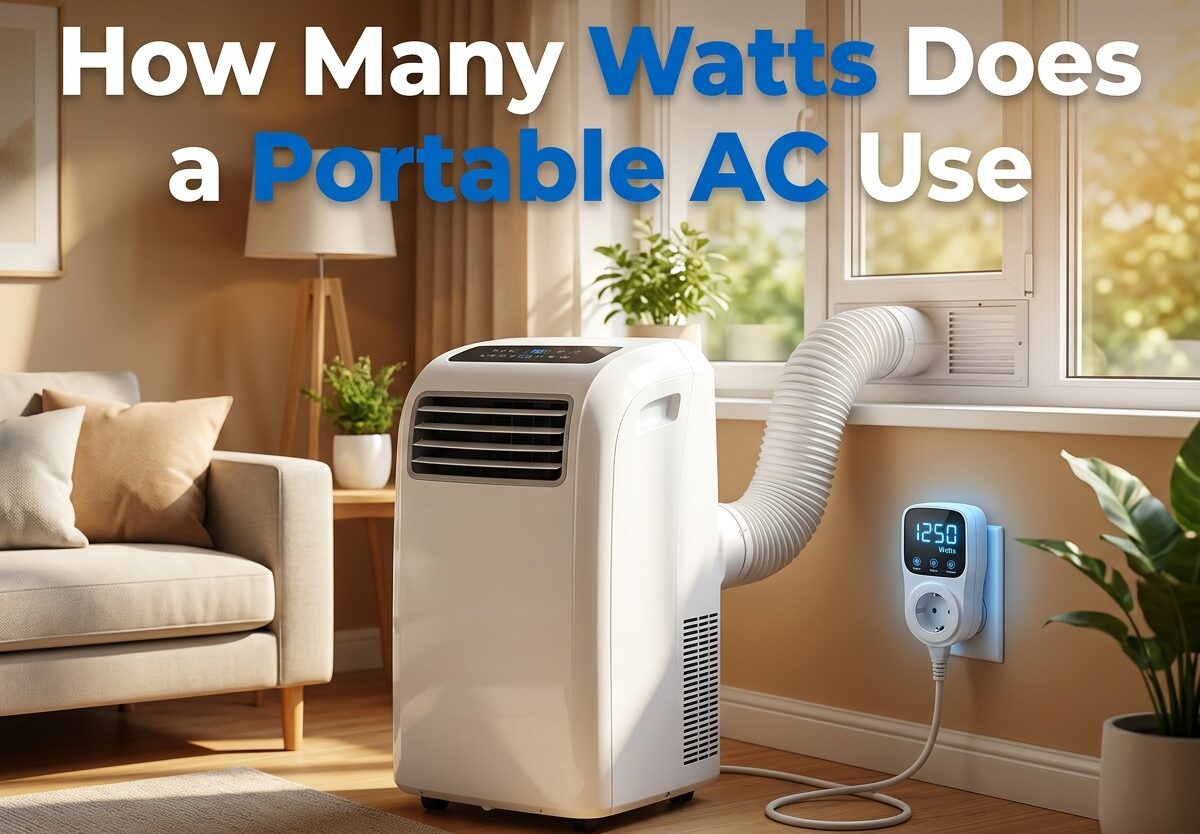
If you’re wondering how many watts does a portable AC use, the short answer is that most portable air conditioners consume between 700 and 1,500 watts per hour during operation. Smaller units around 5,000 BTU draw about 400-600 watts, while larger 14,000 BTU models can use 1,300-1,600 watts. However, there’s an important catch you need to know about.
Understanding your portable AC’s wattage matters for several reasons. You might be calculating electricity costs, sizing a generator for emergency backup, or simply trying to avoid tripping circuit breakers. I’ve researched real-world usage data from actual users and technical specifications to give you accurate information.
How Many Watts Does a Portable AC Take
Portable air conditioners typically use between 400 and 2,000 watts depending on their cooling capacity, measured in BTUs. The average residential portable AC draws about 1,000 watts during normal operation. But here’s what most people don’t realize: your AC doesn’t use a constant amount of power.
The wattage fluctuates based on cooling demand, ambient temperature, and the compressor cycle. When the compressor first kicks on, it can draw 2-3 times the rated running watts for a few seconds. This starting wattage, also called surge watts, is crucial if you’re planning to run the unit on a generator or inverter.
BTU to Watts Conversion Chart
The cooling capacity of air conditioners is measured in British Thermal Units (BTUs), which indicates how much heat the unit can remove per hour. Higher BTU ratings correlate with higher wattage consumption. Here’s a comprehensive breakdown showing both running watts and starting watts for common portable AC sizes:
| AC Capacity (BTU) | Running Watts | Starting/Surge Watts | Typical Room Size |
|---|---|---|---|
| 5,000 BTU | 400-600W | 1,200-1,800W | 100-150 sq ft |
| 6,000 BTU | 500-700W | 1,500-2,100W | 150-200 sq ft |
| 8,000 BTU | 700-900W | 2,100-2,700W | 200-300 sq ft |
| 10,000 BTU | 900-1,200W | 2,700-3,600W | 300-400 sq ft |
| 12,000 BTU | 1,100-1,400W | 3,300-4,200W | 400-500 sq ft |
| 14,000 BTU | 1,300-1,600W | 3,900-4,800W | 500-600 sq ft |
These figures represent typical ranges based on manufacturer specifications and real-world measurements from verified user testing. Your actual wattage may vary depending on the specific model’s efficiency rating and operating conditions.
Running Watts vs Starting Watts
The distinction between running watts and starting watts is one of the most misunderstood aspects of portable AC power consumption. Running watts refer to the continuous power draw once the compressor is operating steadily. This is the number you’ll see on the specification label and what determines your ongoing electricity costs.
Starting watts, also called surge watts or peak watts, represent the brief power spike when the compressor first activates. This surge typically lasts 2-5 seconds and can reach 3-5 times the rated running wattage. Reddit users who have measured their portable ACs with watt meters report startup spikes of 4,500-7,500 watts even on units rated for 1,000-1,500 running watts.
Why does this matter? If you’re using a generator or inverter, it must handle the starting wattage, not just the running wattage. A 2,000-watt generator might run a 10,000 BTU AC under normal conditions but fail when the compressor tries to start and demands 3,000+ watts instantly.
Factors Affecting Portable AC Power Consumption
Several variables influence how many watts your portable AC actually uses in practice. Understanding these factors can help you optimize efficiency and reduce electricity costs.
The Energy Efficiency Ratio (EER) rating is the most significant factor. Units with higher EER ratings produce more cooling per watt consumed. A portable AC with EER 10 will use about 20% less electricity than a similar-sized unit with EER 8, while providing the same cooling output.
Room conditions also affect power draw. Your AC works harder and uses more watts when the temperature difference between inside and outside is greater. Direct sunlight entering the room, poor insulation, and heat-generating appliances all increase the cooling load and power consumption.
Maintenance plays a surprising role. Dirty air filters reduce airflow, forcing the compressor to run longer and work harder. A clogged filter can increase power consumption by 5-10% while reducing cooling effectiveness.
Portable AC Wattage by Size
Let’s break down the wattage requirements for each common portable AC size with real-world context.
5,000 BTU Portable AC (400-600 watts)
These compact units are designed for small bedrooms, home offices, or supplemental cooling. Real user measurements show most 5,000 BTU portables draw around 500-550 watts during normal operation. They’re the most economical choice, costing roughly $0.06-0.08 per hour to run based on national average electricity rates.
8,000 BTU Portable AC (700-900 watts)
The 8,000 BTU size hits the sweet spot for many medium-sized bedrooms and living rooms. Actual wattage measurements from Reddit users consistently show 750-850 watts running, with startup surges around 2,200-2,500 watts. This size typically costs $0.09-0.12 per hour to operate.
10,000 BTU Portable AC (900-1,200 watts)
A 10,000 BTU portable AC is the most common choice for larger bedrooms, small apartments, or rooms with high ceilings. Field testing reveals most units in this class run at 1,000-1,100 watts, with startups demanding 2,800-3,300 watts. Expect hourly operating costs around $0.12-0.16.
12,000 BTU Portable AC (1,100-1,400 watts)
These larger units can cool substantial areas but consume considerable power. Real-world data shows 12,000 BTU portables typically draw 1,200-1,300 watts running. The startup surge often exceeds 4,000 watts, which is important for generator sizing. Hourly costs run $0.15-0.20.
14,000 BTU Portable AC (1,300-1,600 watts)
The largest residential portable ACs approach central air conditioning power consumption. These units frequently draw 1,400-1,500 watts continuously, with startup surges that can trip 15-amp household circuits. Expect to pay $0.18-0.24 per hour for operation.
How Much Does It Cost to Run a Portable AC
Calculating portable AC operating costs requires knowing your electricity rate (measured in cents per kilowatt-hour or kWh) and the unit’s actual power draw. The national average electricity rate in 2026 is approximately $0.14 per kWh, though this varies significantly by region.
Here’s the formula: (Watts ÷ 1,000) × Hours × Electricity Rate = Cost. For example, a 1,000-watt portable AC running for 8 hours would use 8 kWh. At $0.14 per kWh, that’s $1.12 per day or about $33.60 per month if used daily.
A more efficient 8,000 BTU unit with EER 10 running at 800 watts for the same period would cost about $0.90 per day or $27 monthly. Over a cooling season, the efficiency difference between units can add up to $50-100 in savings.
Portable AC vs Other AC Types Wattage Comparison
Portable air conditioners generally use more electricity than other AC types per BTU of cooling. Window units with the same BTU rating typically consume 10-20% less power because they don’t have to exhaust hot air through a hose, which creates backpressure and reduces efficiency.
Central air conditioning is more complex. While a central AC might use 3,500-5,000 watts total, it cools your entire home simultaneously. Per room, central systems are often more efficient than multiple portable units, especially at higher SEER ratings (14-20+ for modern systems).
Mini-split systems offer the best efficiency of all, with many units achieving SEER ratings above 20. A 12,000 BTU mini-split might use only 800-1,000 watts while providing equivalent cooling to a 1,300-watt portable unit.
Generator Sizing for Portable AC
One of the most common questions about portable AC wattage involves generator compatibility. Will a 2,000-watt generator run a portable AC unit? For smaller units (5,000-8,000 BTU), yes—a quality 2,000-watt generator can typically handle the load, but you need to account for startup surges.
For 10,000 BTU and larger portables, I recommend a minimum of 3,000 watts for generator capacity. The startup surge on these units regularly exceeds 3,000 watts, which will trip smaller generators. Inverter generators are ideal for running portable ACs because they produce clean, stable power that’s better for sensitive electronics and compressor motors.
When sizing your generator, add 25-30% above the rated running watts to account for surge, efficiency losses, and other simultaneous loads. If you plan to power lights or a refrigerator alongside your AC, increase your generator capacity accordingly.
How to Find Your Specific AC Wattage
If you want to know exactly how many watts your portable AC uses, you have several options. The quickest method is checking the specification label, usually located on the side or back of the unit. Look for “Power Input,” “Rated Power,” or “Wattage” listed in watts or amps.
If only amperage and voltage are listed, calculate watts by multiplying amps × volts. For example, 10 amps at 115 volts equals 1,150 watts. Keep in mind this represents running watts, not starting watts.
For the most accurate measurement, use a plug-in watt meter. These inexpensive devices ($15-30) display real-time power consumption and can track cumulative usage over time. This is the best way to verify actual wattage versus manufacturer claims and identify efficiency problems.
Tips for Reducing Portable AC Power Consumption
You can reduce your portable AC’s electricity usage with some simple practices. Clean or replace the air filter every 2-4 weeks during heavy use. A dirty filter restricts airflow and increases power consumption by up to 15%.
Set your thermostat to 78°F rather than 72°F. Each degree higher reduces energy consumption by about 3-4%. Use fans to circulate cooled air, which allows you to set the thermostat higher while maintaining comfort.
Close blinds and curtains during peak sun hours to reduce solar heat gain. Insulate the exhaust hose if it runs through a hot area, as this prevents heat from radiating back into your cooled space. Ensure window seals are tight to prevent cool air from escaping.
Frequently Asked Questions
Will a 2000 watt generator run a portable AC unit?
A 2,000-watt generator can run portable AC units up to 8,000 BTU, but you must account for starting surge watts. The generator must handle 2,500-2,700 watts during startup, so choose a generator with rated capacity (not surge capacity) of at least 2,000 watts. For 10,000 BTU and larger units, I recommend 3,000+ watts to handle startup surges that can exceed 4,000 watts.
How many watts does a portable AC take?
Portable air conditioners typically use between 400 and 2,000 watts depending on BTU capacity. Standard residential units (8,000-12,000 BTU) consume 700-1,400 watts during normal operation. Smaller 5,000 BTU units use 400-600 watts, while larger 14,000 BTU models draw 1,300-1,600 watts. Remember that starting watts can be 3-5 times higher than running watts.
Will a 3000 watt inverter run a portable air conditioner?
Yes, a 3,000-watt inverter can run most residential portable AC units including 10,000-14,000 BTU models. The key is ensuring the inverter’s continuous rating exceeds the AC’s running watts (typically 900-1,400 watts) while its surge capacity handles startup spikes of 2,700-4,500 watts. Pure sine wave inverters are recommended for AC compressors to prevent potential damage from modified sine wave power.
How many watts is a 12000 BTU portable AC?
A 12,000 BTU portable AC typically uses 1,100-1,400 watts during normal operation. Real-world measurements from verified users show most units in this class draw around 1,200-1,300 watts running. However, the starting wattage surge can reach 3,300-4,200 watts when the compressor first activates, which is important for generator and inverter sizing.
Does a portable air conditioner use a lot of electricity?
Portable ACs use more electricity per BTU than window units or central systems due to design inefficiencies. A typical 10,000 BTU portable AC consumes about 1,000-1,200 watts, costing $0.12-0.16 per hour to run based on average electricity rates. Running 8 hours daily costs approximately $30-40 per month during cooling season. Higher EER ratings and proper maintenance can reduce these costs by 20-30%.
How much does it cost to run a portable air conditioner for 24 hours?
Running a portable AC for 24 hours costs between $2.88 and $5.76 depending on unit size and electricity rates. A 10,000 BTU unit drawing 1,000 watts consumes 24 kWh daily. At the national average rate of $0.14 per kWh, this equals $3.36 per day or about $100 monthly for continuous operation. Larger 14,000 BTU units cost approximately $5.04 per day, while efficient 8,000 BTU models run around $2.52 daily.
What is the 3 minute rule for AC?
The 3-minute rule refers to waiting at least 3 minutes after turning off an AC before restarting it. This delay allows the refrigerant pressures to equalize, preventing compressor damage from attempting to start against high pressure head. Many modern ACs have built-in delay timers enforcing this rule automatically. Ignoring this guideline and repeatedly cycling power can shorten compressor life and potentially cause premature failure.
Can I use an extension cord with my portable AC?
I don’t recommend using extension cords with portable ACs. If absolutely necessary, use a heavy-duty 14-gauge or 12-gauge cord rated for at least 15 amps and keep it as short as possible (under 25 feet). Lightweight household extension cords can overheat, cause voltage drop, and create fire hazards with high-draw appliances like ACs. The best practice is to plug your portable AC directly into a wall outlet, ideally on a dedicated circuit.
How many watts does a 5000 BTU portable AC use?
A 5,000 BTU portable AC uses approximately 400-600 watts during normal operation, with most units drawing around 500-550 watts running. Starting wattage can spike to 1,200-1,800 watts during compressor startup. These smaller units are the most economical, costing about $0.06-0.08 per hour to run. They’re ideal for small rooms up to 150 square feet and can typically run on a 1,500-watt generator or inverter if surge capacity is sufficient.
How many watts does a 10000 BTU portable AC use?
A 10,000 BTU portable AC typically consumes 900-1,200 watts during operation, with real-world measurements averaging 1,000-1,100 watts. Startup surges can reach 2,700-3,600 watts when the compressor activates, which is critical for generator sizing. These units cost approximately $0.12-0.16 per hour to run and are suitable for rooms 300-400 square feet. For generator operation, I recommend minimum 3,000-watt capacity to handle startup demands.
Conclusion
Understanding how many watts does a portable AC use helps you make informed decisions about electricity costs, generator sizing, and circuit capacity. Most residential portable units consume 700-1,500 watts during normal operation, with startup surges reaching 2,000-4,500 watts depending on BTU capacity.
When choosing a portable AC, consider both the BTU capacity for your room size and the EER rating for efficiency. Higher EER units cost more upfront but save money over time through reduced power consumption. If you’re planning generator backup, always size based on starting watts rather than running watts to prevent overload trips during compressor startup.
For the most accurate information about your specific unit, check the manufacturer’s specifications or use a watt meter to measure actual power consumption. This real-world data will help you calculate precise operating costs and ensure your electrical system can handle the load safely.

Leave a Comment