
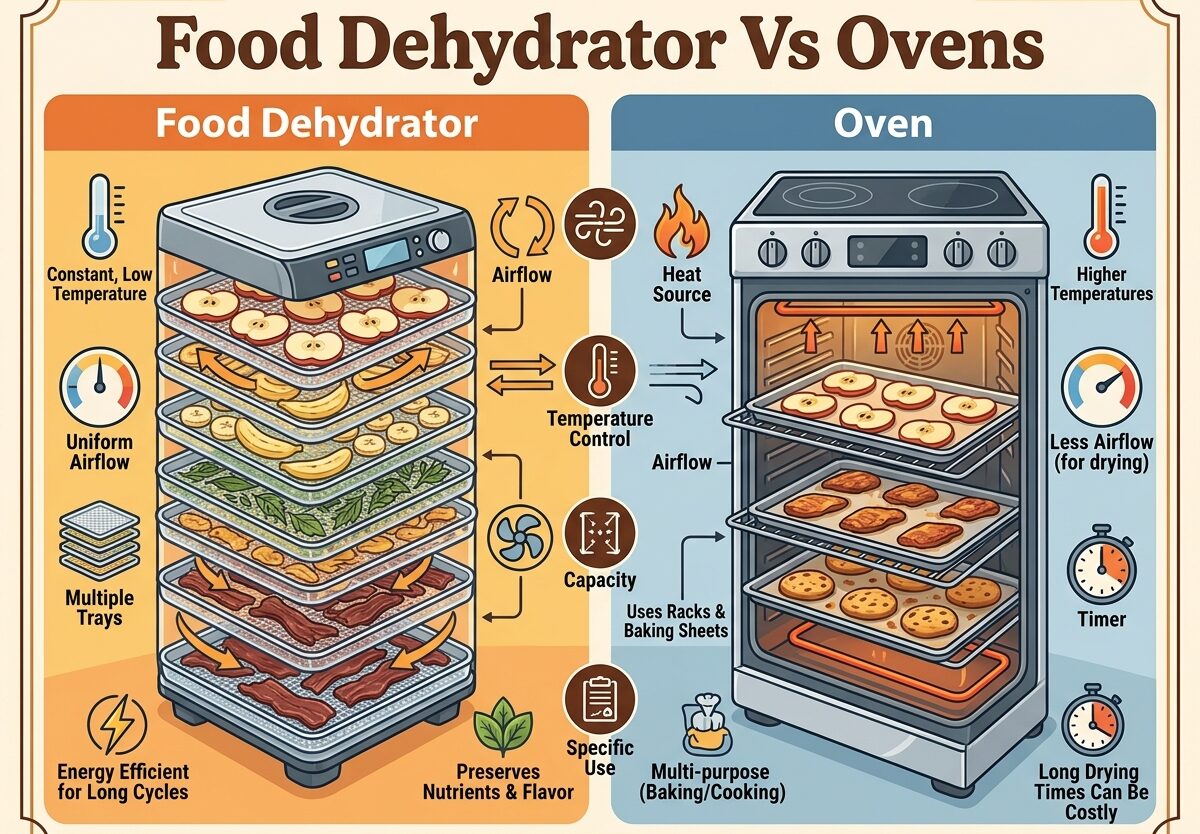
If you’re exploring food preservation methods, you’ve probably wondered about the Food Dehydrator Vs Ovens debate. Both methods remove moisture to preserve food, but they work very differently. After testing both approaches extensively, I’ll break down exactly how each method performs so you can make the right choice for your kitchen.
What is Food Dehydration?
Food dehydration is the process of removing moisture from food to prevent bacterial growth and spoilage. By eliminating 80-95% of water content, dehydrated foods can last months or even years without refrigeration. This preservation method has been used for thousands of years, long before modern appliances existed.
The science behind dehydration is straightforward. Microorganisms need moisture to thrive. When you remove water, these organisms cannot grow or reproduce. This makes dehydration one of the safest and most effective food preservation techniques available to home cooks.
Modern dehydration methods focus on maintaining food quality while removing moisture. The goal is to preserve nutrients, flavor, and texture while extending shelf life. Both dehydrators and ovens attempt to achieve this, but with different approaches and results.
How Food Dehydrators Work
A food dehydrator uses low heat combined with consistent airflow to slowly remove moisture from food. Most models operate between 95-155°F, which is warm enough to evaporate water but cool enough to preserve nutrients and enzymes. The heating element warms the air, while a fan circulates it across multiple trays of food.
The design of a dehydrator is specifically engineered for even drying. Horizontal airflow models have a rear-mounted fan and heating element, pushing air across all trays simultaneously. Vertical stack models have the fan at the base or top, which can cause uneven drying but are more compact. Both styles include vents to allow moisture to escape.
Temperature control is precise in dedicated dehydrators. You can set exact temperatures for different foods, from 95°F for herbs to 155°F for meats. This precision matters because too much heat can cook food instead of drying it, while too little heat encourages bacterial growth.
Most dehydrators include timers that automatically shut off the unit when drying is complete. This feature prevents over-drying and allows for overnight operation without monitoring. The combination of low heat, airflow, and time creates ideal conditions for dehydration.
Food Dehydrator Advantages
Dehydrators excel at consistent, even drying across all trays. The horizontal airflow design ensures every piece of food receives the same amount of warm air, resulting in uniform moisture removal. You don’t need to rotate trays or rearrange food mid-process.
Energy efficiency is a major benefit. Dehydrators typically use 300-1000 watts depending on size, compared to ovens that draw 2000-5000 watts. Because dehydrators run at lower temperatures and are well-insulated, they consume significantly less electricity per hour of operation.
Temperature precision makes dehydrators ideal for delicate foods. Herbs, thin fruit slices, and raw food preparations require low, steady heat that ovens struggle to maintain. The ability to set 105°F for enzyme preservation is something most ovens cannot achieve.
Capacity is another advantage. Most dehydrators have 5-10 trays, allowing you to process large batches simultaneously. You can dry multiple types of food at once without flavor transfer, as long as they require similar temperatures and drying times.
Dehydrators don’t heat up your kitchen. This matters significantly in summer or in warm climates. Running an oven for 8-12 hours can make your entire home uncomfortably warm, while a dehydrator has minimal impact on room temperature.
Food Dehydrator Disadvantages
The main drawback of dehydrators is the time investment. Most foods take 8-24 hours to dry completely, compared to 4-8 hours in an oven. This longer process requires planning ahead and patience. You can’t quickly dehydrate a batch of fruit for an afternoon snack.
Storage space is a consideration for many kitchens. Even compact dehydrators take up significant counter space during operation, and you need storage room when the unit isn’t in use. Vertical stack models are more space-efficient but may dry less evenly.
Initial cost ranges from $40 for basic models to over $300 for premium units. While this investment pays off for regular users, occasional dehydrators might struggle to justify the expense. Budget models often have less precise temperature control and noisier fans.
Limited functionality is another factor. A dehydrator does one thing excellently, but it can’t bake, broil, or roast like an oven. If you have limited kitchen space and appliances, a single-purpose device might not be the best investment.
How Ovens Work for Dehydration
Ovens can dehydrate food, but they’re not designed for this purpose. Most ovens generate heat from 200-500°F, which is far hotter than optimal dehydration temperatures. Even the “keep warm” setting on many ovens runs around 170-200°F, which can cook food rather than dry it.
Convection ovens with a dehydrate setting are the exception. These models can maintain temperatures as low as 100-120°F and include fans for air circulation. If you own a convection oven with this feature, you have a viable dehydration option without buying additional equipment.
Standard ovens require careful monitoring for dehydration. You’ll need to prop the door open slightly to allow moisture to escape, use an oven thermometer to verify actual temperature, and rotate food every hour for even drying. The process is more hands-on and less precise than using a dedicated dehydrator.
The drying mechanism in ovens relies on radiant heat rather than forced airflow. Without a fan, heat naturally rises, causing bottom racks to dry faster than top racks. This creates uneven results unless you manually reposition food during the process.
Oven Advantages for Dehydration
Speed is the oven’s biggest advantage. Because ovens operate at higher temperatures, they remove moisture faster. Most foods dehydrate in half the time compared to a dehydrator. If you need dried fruit or jerky quickly, the oven gets the job done.
You already own an oven, making it a cost-effective option for occasional dehydration. There’s no additional appliance to purchase or store. For people who dehydrate once or twice a year, the oven makes financial sense.
Versatility is another benefit. Your oven can bake, roast, broil, and dehydrate. This multi-purpose functionality maximizes kitchen efficiency. You can start dehydrating in the morning and use the same appliance for dinner preparation later.
Large capacity ovens can handle bigger batches than most dehydrators. A full-size oven accommodates multiple racks of baking sheets, allowing you to process substantial quantities in a single batch. This is particularly useful for preserving harvests from a garden.
Oven Disadvantages for Dehydration
Poor temperature control below 200°F is a significant limitation. Most ovens cannot maintain the low temperatures required for proper dehydration. Food may cook instead of dry, resulting in texture and flavor issues. Even ovens with a dehydrate setting often have temperature fluctuations of 10-20 degrees.
Ovens heat your entire home, especially during long dehydration sessions. In summer, this creates uncomfortable conditions and increases air conditioning costs. Running an oven for 8-12 hours adds substantial heat to your living space.
Energy consumption is higher than dehydrators. Even though ovens work faster, they draw significantly more power. Electric ovens typically use 2000-5000 watts per hour, compared to 300-1000 watts for dehydrators. The total energy cost may be similar or higher depending on your local utility rates.
Uneven drying requires constant attention. Without proper airflow, some pieces dry while others remain moist. You’ll need to rotate racks and flip food regularly to achieve consistent results. This hands-on approach defeats the convenience of set-and-forget dehydration.
Moisture accumulation is a problem in closed ovens. Water evaporating from food has nowhere to go, creating a humid environment that slows drying. Propping the door open helps but releases heat and wastes energy.
Food Dehydrator Vs Ovens: Head-to-Head Comparison
When comparing Food Dehydrator Vs Ovens directly, the main differences become clear. Dehydrators offer superior temperature control, even drying, and energy efficiency. Ovens provide faster results and utilize existing equipment without additional cost.
For food quality, dehydrators consistently produce better results. The low, steady heat preserves nutrients, enzymes, and flavors more effectively. Oven-dried foods often have cooked flavors and textures that don’t rehydrate as well. If you’re making fruit leather, herbs, or raw food preparations, a dehydrator is the clear winner.
In terms of convenience, ovens win for occasional use but dehydrators excel for regular dehydration. The set-and-forget nature of dehydrators makes them ideal for overnight drying or large batches. Ovens require monitoring and rotation but work well for quick projects.
The heating difference is significant. As one Reddit user noted, “The main differences, other than taste, is the oven heats up your house a lot more than a dehydrator. However, the oven is quicker too.” This trade-off between speed and comfort is a key consideration for many home cooks.
For specific foods, each method has advantages. Ovens work well for jerky and tough vegetables that can handle higher temperatures. Dehydrators are better for delicate fruits, herbs, and thin slices that require gentle drying. Many serious food preservers own both and choose based on the specific project.
Cost Analysis: Which is Cheaper?
The cost comparison between dehydrators and ovens involves both upfront investment and ongoing energy expenses. A basic dehydrator costs $40-100, while premium models range from $200-400. Your oven is already paid for, assuming you have a standard kitchen setup.
Energy costs tell an interesting story. Based on forum insights from real users, electric dehydrators cost approximately $1 per day to run continuously. Gas ovens cost about 40 cents per hour to operate. However, dehydrators run longer, so the total energy cost per batch may be similar despite the lower hourly rate.
The calculation depends on your local utility rates and appliance efficiency. Electric ovens are more expensive to run than gas models. Convection ovens with dehydrate settings are more efficient than standard ovens. A dehydrator with good insulation and efficient fan design minimizes energy waste.
For occasional dehydration, the oven is more cost-effective overall. There’s no upfront investment, and the faster drying time reduces total energy consumption. For regular dehydration, a dedicated dehydrator pays for itself through lower energy costs and better results that reduce food waste.
Consider also the hidden costs. Oven dehydration may increase air conditioning bills in summer due to added heat. Poor results from oven drying might lead to wasted food. A quality dehydrator produces consistent results that maximize the value of your food preservation efforts.
Which Should You Choose?
Choose a food dehydrator if you plan to dehydrate regularly, care about food quality, or want to preserve nutrients and enzymes. Dehydrators are ideal for gardeners preserving harvests, health enthusiasts making raw snacks, and anyone interested in long-term food storage. The consistent results and set-and-forget convenience make them worth the investment for frequent users.
Use your oven if you dehydrate occasionally, need results quickly, or don’t want to add another appliance. Ovens work well for occasional jerky making, quick fruit drying, or testing whether dehydration appeals to you. If you have a convection oven with a dehydrate setting, you’ll get better results than with a standard model.
Many serious food preservers eventually own both. They use the oven for quick projects and the dehydrator for large batches or delicate foods. This approach maximizes flexibility while optimizing results for different types of food.
Your decision should consider frequency of use, available kitchen space, budget, and the types of food you want to preserve. Both methods can successfully dehydrate food, but the right choice depends on your specific needs and circumstances.
Frequently Asked Questions
Does an oven work as well as a dehydrator?
An oven can dehydrate food but doesn’t work as well as a dedicated dehydrator for most applications. Ovens struggle to maintain the low temperatures needed for proper dehydration, often cooking food instead of drying it. They also have poor airflow, causing uneven drying. However, convection ovens with dehydrate settings perform much better and can produce good results for many foods.
Is it cheaper to use an oven or dehydrator?
The cost depends on frequency of use and local utility rates. Ovens have no upfront cost but consume more energy per hour (2000-5000 watts vs 300-1000 watts). However, ovens work faster. Electric dehydrators cost about $1 per day to run, while gas ovens cost approximately 40 cents per hour. For occasional use, ovens are cheaper. For regular dehydration, a dehydrator’s lower energy consumption offsets the initial investment.
What are the disadvantages of dehydrating food?
Dehydrating food requires significant time investment, with most foods taking 8-24 hours. The texture and flavor change from fresh, which some people find unappealing. Dehydrated foods need proper storage to prevent reabsorption of moisture. Some nutrients, particularly vitamin C, are reduced during the drying process. The equipment also requires storage space and initial investment if purchasing a dedicated dehydrator.
What foods cannot be dehydrated?
Avoid dehydrating high-fat foods like avocados, butter, or fatty meats as the fat can become rancid. Dairy products generally don’t dehydrate well except when made into powders. Eggs are difficult to dehydrate safely at home. Very juicy fruits like watermelon become paper-thin and offer little yield. Foods with high oil content like nuts and seeds are already shelf-stable and don’t benefit from dehydration.
Conclusion
The Food Dehydrator Vs Ovens comparison reveals that both methods have their place in food preservation. Dehydrators offer superior results for regular users, with precise temperature control, even drying, and better food quality. Ovens provide a cost-effective option for occasional dehydration with faster results but less consistency.
Consider how often you’ll dehydrate, what types of food you want to preserve, and your kitchen setup when making your decision. For gardeners, health enthusiasts, and anyone serious about food preservation, a dedicated dehydrator is worth the investment. For occasional users or those testing the waters, your oven can get you started without additional expense.
Whichever method you choose, proper food dehydration opens up a world of healthy snacks, reduced food waste, and long-term food storage options. Start with simple projects like apple chips or banana slices, and expand your preservation skills as you gain experience.





Leave a Comment