
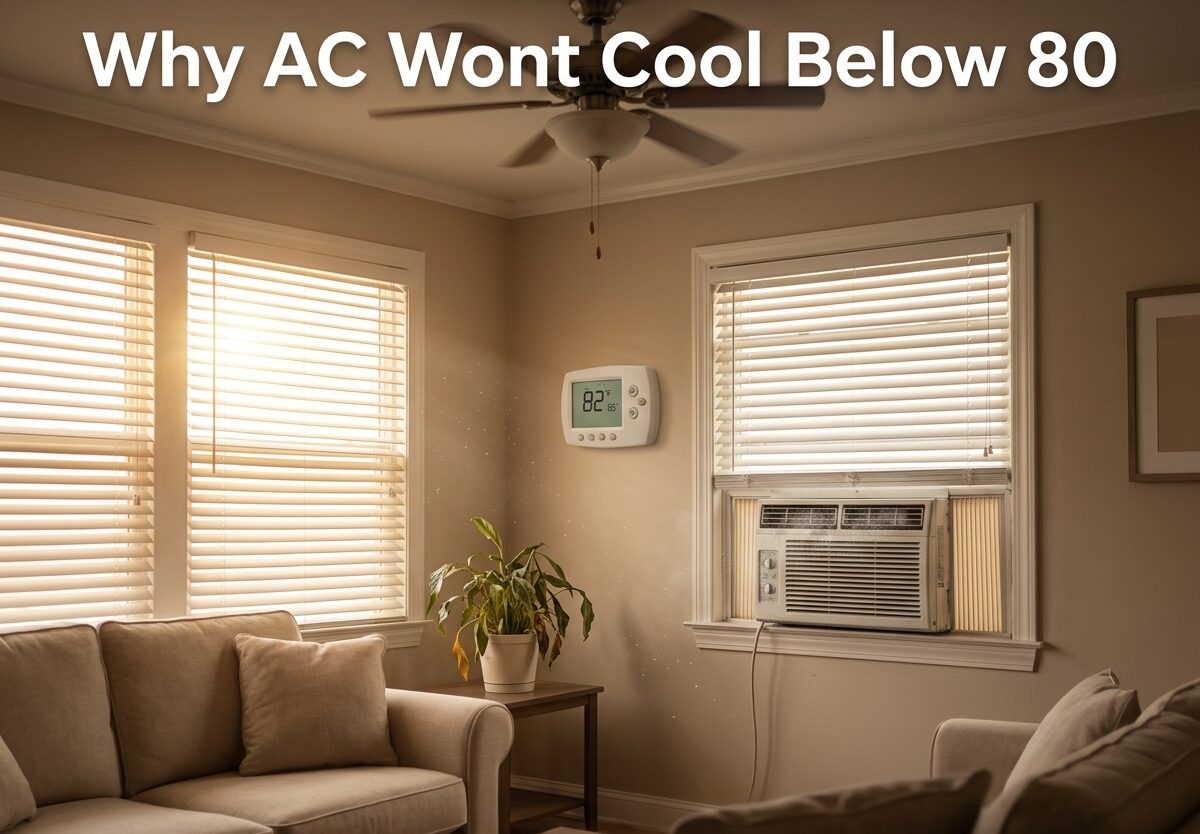
Your air conditioner won’t cool below 80 degrees, and you’re frustrated. I’ve been there – staring at the thermostat wondering why it feels like a sauna inside when the AC is running nonstop. Before you call a professional or suffer through another hot day, let me walk you through what’s actually happening.
The most common reason your AC won’t cool below 80 degrees comes down to one of these issues: a dirty air filter restricting airflow, a blocked condenser unit outside, low refrigerant from a leak, incorrect thermostat settings, or leaky ductwork losing cooled air. But here’s something most people don’t realize – your AC has a natural limit.
Most air conditioners can only cool indoor air about 20-30 degrees below the outdoor temperature. This is called the temperature differential, and it’s a fundamental limitation of how AC systems work. If it’s 100 degrees outside, your AC might struggle to reach 75 degrees indoors, even when everything is working perfectly.
Understanding the Temperature Differential
The temperature differential is the difference between your outdoor temperature and what your AC can achieve indoors. A properly functioning system typically achieves a 20-30 degree temperature drop. This isn’t a malfunction – it’s physics.
When it’s 95 degrees outside, expecting your home to reach 68 degrees might be unrealistic. Your AC would need to overcome a 27-degree differential, which pushes the upper limit of most residential systems. During extreme heat waves, I’ve seen perfectly good AC units struggle to maintain anything below 78-80 degrees.
This limitation is actually built into the design calculations HVAC professionals use when sizing systems. They base their calculations on “design temperature” – typically the 1% hottest summer days for your region. If your area’s design temperature is 95 degrees, your AC is sized to handle that, not 110-degree outliers.
AC Won’t Cool Below 80: Common Causes
Now that you understand the temperature differential, let’s dive into the actual problems that prevent your AC from cooling properly. These are the issues I check first when troubleshooting an underperforming system.
Dirty Air Filter
A clogged air filter is the number one cause of AC cooling problems. I’ve seen filters so dirty they looked like felt blankets. When your filter is clogged, your AC can’t pull enough air through the system to cool it effectively.
Your air filter should be changed every 1-3 months depending on usage, pets, and air quality. A dirty filter doesn’t just reduce cooling – it makes your entire system work harder, increasing energy bills and potentially causing long-term damage to your compressor.
The fix is simple: check your filter monthly. Hold it up to a light source – if you can’t see light through it, it’s time for a replacement. This $10 fix can solve cooling issues that might otherwise cost hundreds in service calls.
Wrong Thermostat Settings
You’d be surprised how often the “problem” is just a thermostat setting issue. I’ve arrived at service calls only to find the thermostat set to “heat” or “fan” instead of “cool.” It happens more often than you’d think.
Check that your thermostat is set to cooling mode and the temperature is actually set below the current room temperature. Also, consider whether your thermostat might be in a bad location – near a heat source, in direct sunlight, or behind a door where it can’t get accurate readings.
Some thermostats need calibration. If your thermostat display shows a temperature that doesn’t match reality, it might be calling for cooling incorrectly. Battery issues can also cause weird behavior – replace the batteries if you haven’t in the last year.
Blocked or Dirty Condenser Unit
The outdoor condenser unit needs to release the heat your AC removes from your home. When it can’t breathe, your system can’t cool properly. I’ve found everything from overgrown bushes to children’s toys blocking condenser airflow.
Walk outside and look at your condenser unit. Is there at least two feet of clearance around all sides? Are the coils visibly dirty or clogged with debris? Condenser coils should be cleaned annually to maintain efficiency.
Gentle cleaning with a garden hose (no pressure washer – you’ll bend the fins) can restore performance. For heavily soiled units, a professional cleaning with commercial coil cleaner might be needed. I’ve seen dirty condensers reduce cooling capacity by 30% or more.
Refrigerant Leak
Your AC doesn’t “use up” refrigerant like a car uses gas. The refrigerant circulates in a closed loop and should never need to be added unless there’s a leak. If your system is low on refrigerant, you have a leak that needs repair.
Signs of a refrigerant leak include ice forming on the refrigerant lines (the copper pipes connecting your indoor and outdoor units), hissing sounds, or reduced cooling despite everything else seeming fine. You might also notice the system runs constantly without reaching the set temperature.
Refrigerant leaks require professional repair. A technician will locate and fix the leak, then recharge the system with the precise amount of refrigerant specified for your unit. Overfilling is just as bad as underfilling – both reduce efficiency and can damage the compressor.
Leaky Ductwork
According to the Department of Energy, the average home loses 20-30% of conditioned air through duct leaks. That means your perfectly cooled air is escaping into your attic, crawlspace, or walls before it ever reaches your living space.
Signs of leaky ducts include inconsistent temperatures between rooms, higher energy bills, and rooms that never seem to cool properly. You might also notice dust around vent connections, which can indicate air escaping.
Professional duct sealing can dramatically improve cooling performance. The technician will seal joints and connections with mastic or metal tape, then test the system to measure improvement. In some cases, duct insulation or redesign might be recommended.
Undersized or Aging AC Unit
Sometimes the problem isn’t a malfunction – it’s that your AC was never sized correctly for your home. HVAC contractors use Manual J calculations to determine the right size based on your home’s square footage, insulation, windows, climate, and other factors. An undersized unit will always struggle to cool adequately.
Age is another factor. Air conditioners typically last 15-20 years with proper maintenance. As they age, efficiency naturally declines. If your unit is over 15 years old and requiring frequent repairs, replacement might be more cost-effective than continued repairs.
A new, properly sized AC unit can dramatically improve comfort and reduce energy bills. Modern high-efficiency systems can achieve better temperature differentials than older units, meaning more cooling even on the hottest days.
Step-by-Step Troubleshooting: What to Check First
Before calling a professional, work through this checklist. I’ve organized it from easiest to most complex, and from most to least likely causes:
Step 1: Check your air filter. Replace if dirty – this solves 30-40% of cooling issues.
Step 2: Verify thermostat settings. Ensure it’s set to cool, and the temperature is set appropriately.
Step 3: Clear debris from around your outdoor condenser unit. Ensure at least 2 feet of clearance on all sides.
Step 4: Check your circuit breakers. Sometimes only the outdoor unit trips while the indoor unit continues running.
Step 5: Look for ice on refrigerant lines. If present, turn off the system and call a professional – continued operation can damage the compressor.
Step 6: Check all your vents and registers. Ensure none are blocked by furniture or closed off.
Step 7: If you’ve worked through these steps and still have problems, it’s time to call a professional HVAC technician.
The 3-Minute Rule for Air Conditioners
You might have heard about the “3-minute rule” for AC operation. This rule states that you should wait at least 3 minutes after turning off your AC before restarting it to prevent compressor damage.
The compressor needs time for pressure to equalize between the indoor and outdoor units. Restarting too quickly can cause the compressor to struggle, potentially tripping breakers or causing permanent damage. If you’ve been cycling your AC on and off frequently, this could be contributing to your cooling problems.
Modern systems often have built-in delay timers to prevent this issue, but older units may not. If you suspect this has been happening, your compressor might have been damaged over time – another reason to call a professional.
When to Call a Professional HVAC Technician
Some AC problems are DIY-friendly, but others require professional expertise and equipment. You should call a technician if you notice any of these warning signs:
Ice forming on refrigerant lines or the outdoor unit
Unusual sounds like grinding, squealing, or rattling
Burning smells or electrical odors
The outdoor unit fan isn’t spinning when the AC is running
Multiple blown fuses or tripped breakers
Refrigerant leaks (indicated by hissing sounds or reduced cooling)
A qualified HVAC technician has the tools and training to diagnose problems safely. They can measure refrigerant levels, check electrical components, and identify issues that aren’t visible during a basic inspection.
Setting Realistic Expectations for Your AC
After reading everything above, you might realize your AC is actually working within its design parameters. This is especially true during extreme heat when outdoor temperatures exceed 95-100 degrees.
Remember the temperature differential rule – most systems are designed to achieve 20-30 degrees of cooling. During a 100-degree day, reaching 75 degrees might be asking too much. Setting your thermostat to 78-80 degrees during extreme heat is often more realistic.
Other factors can affect your comfort even when the thermostat reads your target temperature. High humidity makes warm air feel warmer. Direct sunlight adds heat load. Poor insulation allows heat transfer. These issues might require solutions beyond just AC repair.
FAQs
Why is my air conditioner not cooling my house below 80 degrees?
Your AC may not cool below 80 degrees due to a dirty air filter restricting airflow, blocked condenser unit outside, low refrigerant from a leak, incorrect thermostat settings, or leaky ductwork. Also, most AC units can only achieve a 20-30 degree temperature drop from outside air temperature, so extreme heat can limit cooling capacity.
What is the 3 minute rule for air conditioners?
The 3-minute rule states you should wait at least 3 minutes after turning off your AC before restarting it. This allows pressure to equalize between indoor and outdoor units, preventing compressor damage. Restarting too quickly can cause the compressor to struggle, potentially tripping breakers or causing permanent damage.
Why is my AC set to 74 but reads 78?
Your AC might read warmer than the set temperature due to a dirty air filter, low refrigerant, or your AC being undersized for the space. Other causes include thermostat calibration issues, leaky ductwork, or the unit simply reaching its cooling limit during extreme heat when outdoor temperatures are very high.
Is it normal for AC to not cool below 80?
It can be normal during extreme heat – most AC units are designed to achieve a 20-30 degree temperature drop from outdoor temperature. If it’s 100 degrees outside, reaching 75-80 degrees indoors might be the maximum your system can achieve. However, if this happens during moderate weather (below 90 degrees outside), something likely needs repair.
How can I make my air conditioner cooler?
Start by changing a dirty air filter, clearing debris around the outdoor condenser unit, and checking thermostat settings. Ensure all vents are open and unobstructed. For older units, consider professional maintenance like coil cleaning. If these DIY steps don’t help, a technician can check refrigerant levels and identify other issues.
Conclusion: Getting Your AC Cooling Again
When your AC won’t cool below 80 degrees, start with the basics – check that air filter, verify thermostat settings, and clear any debris around your outdoor unit. These simple fixes resolve most cooling problems and cost next to nothing. I’ve seen countless cases where a $10 filter replacement solved what seemed like a major issue.
Remember the temperature differential rule. Your AC has limits, and extreme heat might make reaching very low temperatures impossible. Understanding this helps set realistic expectations and prevents frustration when your system is actually working correctly.
If you’ve worked through the troubleshooting steps without success, it’s time to call a professional. Refrigerant leaks, electrical issues, and compressor problems require specialized tools and expertise. Addressing problems early prevents more expensive damage down the road.
Regular maintenance – annual professional servicing plus monthly filter changes – keeps your AC running efficiently and extends its lifespan. A well-maintained system can handle cooling demands even on the hottest days, keeping your home comfortable when you need it most.

Leave a Comment