
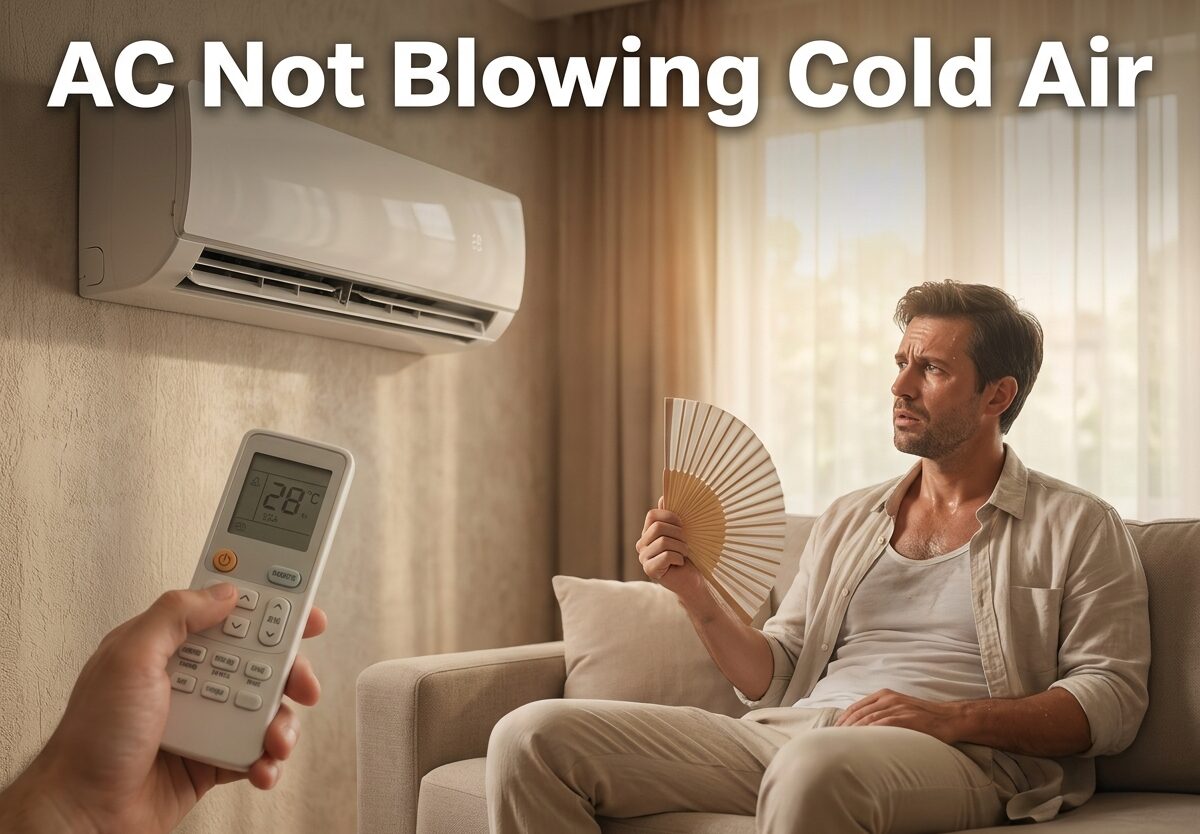
Nothing ruins a summer day like walking into a hot house when your AC is running full blast. You hear the hum, feel the airflow, but the air coming from your vents is warm or room temperature at best. This frustrating problem happens to thousands of homeowners each year, and the good news is that many causes are simple fixes you can handle yourself.
When your AC is not blowing cold air, it usually means something has disrupted the cooling process. Your air conditioner works by absorbing heat from indoor air and releasing it outside through a refrigerant cycle. When any part of this system fails, you get warm air instead of the refreshing cool you expect.
In this guide, I’ll walk you through the 7 most common reasons your AC isn’t cooling, how to diagnose the problem yourself, and when it’s time to call a professional. Most of these issues can be resolved in under an hour, and some cost nothing to fix.
Quick Diagnosis: Is Your AC Running But Not Cooling?
Before diving into specific problems, let’s quickly assess your situation. If your AC is running but not cooling, start with these immediate checks. First, feel the air coming from your vents. Is it completely warm, or just not as cold as usual? Is the outdoor unit running? Has anything changed recently (new thermostat, recent maintenance, storm damage)?
One important thing to know: what is the 3 minute rule for AC? This protective feature prevents your compressor from restarting too quickly after shutting off. If your AC turns off and tries to restart within 3 minutes, it may fail to cool properly while waiting for the safety timer to expire. This is normal behavior, not a malfunction.
Should you turn off AC if it’s not cooling? Yes, if you notice ice building up on your indoor unit or refrigerant lines, turn off the system immediately. Running with frozen coils can cause compressor damage and turn a $200 repair into a $2,000 problem. Otherwise, leave it running while you troubleshoot unless you suspect a serious issue.
7 Common Causes of AC Not Blowing Cold Air
1. Dirty or Clogged Air Filter
A clogged air filter is the number one cause of AC not blowing cold air. I’ve seen this simple issue account for over 50% of service calls that could have been avoided. Your air filter traps dust, pet dander, and allergens, but when it gets too dirty, it restricts airflow across your evaporator coils.
Restricted airflow causes two problems. First, your AC can’t pull enough warm air from your home to cool it down. Second, the reduced airflow causes the evaporator coils to get too cold and freeze over. Once ice forms, cooling stops almost completely. You might even see frost on your refrigerant lines or indoor unit.
Check your filter every 30 days during cooling season. If you hold it up to a light and can’t see through it, it’s time to replace it. Most 1-inch filters need monthly replacement, while thicker 4-5 inch filters can last 6-12 months. This $15 fix can solve your cooling problem and improve your indoor air quality at the same time.
2. Thermostat Set Incorrectly
Your thermostat might be the culprit, and this is the easiest problem to fix. I’ve been to many homes where the AC wasn’t blowing cold air simply because someone accidentally switched it from “cool” to “fan” mode. In fan mode, your AC blows air around your home without actually cooling it.
Check your thermostat settings first. Make sure it’s set to “cool” mode, not “fan” or “off.” Verify the temperature setting is at least 5 degrees below the current room temperature. If your thermostat has batteries, weak batteries can cause erratic behavior or display issues that make it seem like your AC isn’t working when it actually is.
Another common issue: your thermostat might be located in a spot that doesn’t represent your home’s actual temperature. Direct sunlight, heat from electronics, or being too close to a vent can cause your thermostat to think your home is cooler than it really is. Try placing a portable thermometer near your thermostat to compare readings.
3. Frozen Evaporator Coils
Frozen evaporator coils turn your AC into a block of ice that can’t cool anything. This problem usually starts with reduced cooling that gradually gets worse until you feel only warm air from your vents. You might see ice or frost on the refrigerant line connecting your indoor and outdoor units.
Coils freeze when something prevents proper heat absorption. The most common cause is that dirty air filter we just discussed, but low refrigerant levels can also cause freezing. When your AC can’t absorb enough heat from your home, the refrigerant in the coils gets too cold and moisture from the air freezes on the coils.
To fix frozen coils, turn off your AC and turn the fan to “on” position. Let the fan run for 2-3 hours to help melt the ice. You can speed this up by turning off the AC and leaving the system off for 4-6 hours. Once all ice has melted, change your air filter and check for other issues before restarting. If coils freeze again within a week, you likely have low refrigerant or airflow problems that need professional attention.
4. Low Refrigerant or Refrigerant Leak
Your AC doesn’t “use up” refrigerant like a car uses gas. The refrigerant circulates in a closed system and should last the life of your unit. If your refrigerant is low, you have a leak somewhere. This is one of the most common reasons for AC not blowing cold air that requires professional repair.
Signs of low refrigerant include: reduced cooling capacity, hissing sounds from your indoor unit, ice buildup on refrigerant lines (even with a clean filter), and longer run times without reaching your set temperature. Your AC might cool for a few hours then stop as the remaining refrigerant can’t keep up with demand.
Refrigerant leaks are harmful to the environment and can damage your compressor if left untreated. By law, only EPA-certified technicians can handle most refrigerants. A professional will locate and repair the leak, then recharge your system to the exact specification. Expect to pay $200-600 for leak repair and recharge, depending on the leak location and refrigerant type.
5. Blocked or Dirty Outdoor Condenser Unit
Your outdoor condenser unit releases the heat absorbed from your home. If it can’t release heat properly, your AC can’t cool efficiently. This unit needs plenty of airflow to work correctly, and many homeowners accidentally block it without realizing.
Check around your outdoor unit. Are there shrubs, leaves, or other debris blocking airflow? Your condenser needs at least 2 feet of clearance on all sides for proper airflow. Have you stored anything near or against the unit? Even a temporary obstruction can cause cooling problems.
The condenser coils themselves also need cleaning. Dirt, grass clippings, cottonwood seeds, and other debris accumulate on the fins and reduce heat transfer. You can gently clean these coils with a garden hose (no pressure washer needed) and coil cleaner from a home improvement store. Turn off power to the unit first, spray coil cleaner, let it sit 10-15 minutes, then rinse with gentle water spray from top to bottom. Do this annually for best performance.
6. Bad Capacitor or Compressor Issues
Capacitors and compressors are the electrical heart of your AC system. The capacitor starts your compressor and fan motors, while the compressor pressurizes the refrigerant to move heat. When either fails, your AC may run but not cool at all.
A bad capacitor is one of the most common AC failures. Symptoms include: humming from the outdoor unit without the fan running, the compressor not starting, intermittent operation, or your AC taking a long time to start. The good news is that capacitors cost only $15-30 and are relatively easy for a technician to replace. This $150 repair can save you from buying a new system.
Compressor problems are more serious. If your compressor fails, replacement costs $1,500-2,500, and you might want to consider a new system instead. Signs of compressor failure include: loud noises when the compressor starts, the outdoor unit vibrating excessively, circuit breakers tripping when the AC tries to start, or the outdoor unit running but making no cooling effect.
7. Leaky Air Ducts
Your ductwork delivers cooled air throughout your home. If your ducts leak, you’re losing that cold air into unconditioned spaces like your attic, crawlspace, or walls. Leaky ducts can account for 20-30% of your cooling loss, making your AC work harder for less results.
Signs of leaky ducts include: some rooms cooling better than others, higher than normal energy bills, weak airflow from certain vents, and your AC running constantly without reaching your set temperature. You might also notice dust around your vent registers, which can indicate disconnected or leaky ducts.
You can check some ducts yourself, especially those in your attic, basement, or crawlspace. Look for disconnected sections, visible gaps, or crushed ducts. While you can seal small gaps with metal tape or mastic sealant, extensive duct work is best left to professionals. A professional duct test can pinpoint leaks that aren’t visible and ensure your entire duct system is sealed properly.
AC Not Blowing Cold Air: Step-by-Step Troubleshooting Guide
Now that you know the common causes, let’s systematically troubleshoot your AC not blowing cold air. Follow these steps in order, moving to the next only if the previous step doesn’t solve the problem.
Step 1: Check Your Thermostat
Verify your thermostat is set to “cool” mode, not “fan” or “off.” Set the temperature at least 5 degrees below the current room temperature. If your thermostat has a display, check for error codes or low battery indicators. Try replacing the batteries if they haven’t been changed in over a year.
Step 2: Inspect and Replace Your Air Filter
Locate your air filter (usually in the return air duct, inside the blower compartment, or in a wall/ceiling register). Hold it up to a light source. If you can’t see light through it, replace it immediately. Even if it looks somewhat clean, if it’s been more than 3 months, go ahead and replace it.
Step 3: Check Your Circuit Breakers
Your AC has two breakers: one for the indoor unit and one for the outdoor unit. Check your electrical panel for any tripped breakers. Reset any tripped breakers by flipping them fully off, then back on. If a breaker trips again immediately, leave it off and call a professional.
Step 4: Inspect Your Outdoor Unit
Walk outside and look at your condenser unit. Is it running? Do you hear the compressor humming? Is the fan spinning? Clear any debris from around the unit and ensure 2 feet of clearance on all sides. Look for visible damage to the unit or refrigerant lines.
Step 5: Check for Ice Buildup
Look at the refrigerant line connecting your indoor and outdoor units. Is there frost or ice on the copper tubing? Check inside at your indoor unit or air handler for ice on the coils. If you see ice, turn off the AC and let it thaw completely before proceeding.
Step 6: Clean Your Condenser Coils
Turn off power to your outdoor unit at the breaker. Spray coil cleaner on the outdoor unit’s coils, let it sit for 15 minutes, then rinse gently with a garden hose. Don’t use high pressure as this can damage the delicate fins. Let the unit dry completely before restoring power.
Step 7: How Do I Reset My Central AC Not Blowing Cold Air?
After completing the above steps, reset your system. Turn off the thermostat, then turn off both AC breakers. Wait 5 full minutes to allow any capacitors to discharge. Turn the breakers back on, wait 3 minutes for the 3-minute safety timer, then turn the thermostat back to cool. Set your temperature and monitor for 30 minutes to see if cooling improves.
When to Call a Professional HVAC Technician
Some AC problems require professional expertise and specialized equipment. DIY repairs can be dangerous, cause further damage, or void your warranty. Here’s when you should call a professional instead of attempting repairs yourself.
Refrigerant Issues
If you suspect low refrigerant or a refrigerant leak, call a professional. Refrigerant handling requires EPA certification and specialized equipment. A technician will locate the leak, repair it, and recharge your system to the exact specification. Attempting DIY refrigerant work is illegal and can be dangerous.
Compressor Problems
Compressor replacement or repair is beyond most DIY capabilities. If your compressor is failing, you need a professional to diagnose whether repair or replacement makes sense. A new compressor costs $1,500-2,500, while a new system might be $5,000-8,000, so this decision requires professional input.
Electrical Issues Beyond Breakers
If resetting breakers doesn’t solve electrical problems, or if you notice burning smells, sparking, or frequent breaker trips, call a professional immediately. Electrical problems can cause fires and should only be handled by qualified technicians.
Persistent Problems After DIY Attempts
If you’ve tried all the troubleshooting steps and your AC is still not blowing cold air, it’s time to call a professional. Continuing to run a malfunctioning system can cause more extensive damage and higher repair costs. Most HVAC companies charge $75-150 for a service call, with repairs averaging $150-450 depending on the issue.
System Age Considerations
If your AC is over 15 years old and requires major repairs, consider replacement. New systems are much more efficient and can save 20-40% on cooling costs. A professional can help you evaluate whether repair or replacement makes better financial sense.
Prevent AC Problems Before They Start
Preventive maintenance saves money and prevents those hot days when your AC isn’t blowing cold air. Most AC problems can be prevented with simple regular maintenance that takes just minutes per month.
Change your air filter every 1-3 months, depending on filter type and household factors like pets and allergies. Set a reminder on your phone for the first of each month. This single habit prevents over 50% of AC problems and extends your system’s life by years.
Schedule professional maintenance annually, ideally in spring before cooling season begins. A technician will clean coils, check refrigerant levels, test electrical connections, lubricate moving parts, and identify potential problems before they become emergencies. This $100-150 service can prevent $500-2,000 in repairs.
Keep your outdoor unit clear year-round. Trim shrubs and plants back at least 2 feet from the unit. Clear leaves, grass clippings, and debris from around the unit after lawn mowing. In winter, protect the unit but don’t fully enclose it—it needs airflow to prevent corrosion.
Consider a smart thermostat upgrade. Modern thermostats can alert you to problems like short cycling, frozen coils, or filter reminders before they become serious issues. Many can even schedule service automatically when problems are detected.
Frequently Asked Questions
Why is my AC running but no cold air?
The most common reasons your AC runs but doesn’t cool are a dirty air filter, incorrect thermostat settings, or low refrigerant. A clogged filter restricts airflow and can cause coils to freeze. Check that your thermostat is set to cool mode, not fan mode. If these aren’t the issue, you may have frozen coils, a bad capacitor, or a refrigerant leak that needs professional attention.
Should I turn off AC if it’s not cooling?
Yes, turn off your AC if you notice ice building up on the indoor unit or refrigerant lines. Running with frozen coils can damage your compressor and turn a small repair into a major expense. Also turn it off if you hear unusual noises, smell burning, or notice the circuit breaker tripping. For simple cooling issues, you can leave it running while you check the thermostat and filter.
What is the 3 minute rule for AC?
The 3 minute rule is a safety feature that prevents your AC compressor from restarting too quickly after shutting off. Compressors need time for pressure to equalize before restarting. If you turn off your AC and try to restart it within 3 minutes, it won’t start immediately. This protects your compressor from damage and extends its life. Always wait at least 3 minutes between turning your AC off and back on.
How do I reset my central AC not blowing cold air?
To reset your central AC, first turn off the thermostat. Then locate and turn off both the indoor and outdoor AC circuit breakers. Wait 5 full minutes to allow all components to fully power down. Turn the breakers back on, wait 3 minutes for the compressor safety timer, then turn your thermostat back to cool. Set your temperature and monitor for 30 minutes to see if cooling resumes.
How long does it take for AC to blow cold air?
Under normal conditions, your AC should start blowing cold air within 3-5 minutes of starting. If you’re only getting warm air after 10-15 minutes, something is wrong. The time to cool your entire home depends on outside temperature, thermostat setting, and home size. Most homes cool 1-2 degrees per hour once the AC is running properly. If you’re not seeing any cooling progress after an hour, troubleshoot using the steps in this guide.
Can a dirty filter cause AC to not cool?
Yes, a dirty filter is the most common cause of AC not cooling. A clogged filter restricts airflow across your evaporator coils, which prevents heat absorption and can cause the coils to freeze over. Once ice forms, cooling stops completely. Check your filter monthly and replace it when you can’t see light through it. This simple fix solves most cooling problems and prevents costly repairs.
Why is my AC blowing warm air instead of cold?
Warm air from your AC usually means either the compressor isn’t running or the refrigerant system has failed. Check your outdoor unit—if it’s not running at all, check your breakers. If the outdoor unit runs but the fan doesn’t spin, you may have a bad capacitor. If everything runs but you get warm air, you likely have low refrigerant or a refrigerant leak. These issues require professional diagnosis and repair.
Conclusion
Dealing with AC not blowing cold air is frustrating, but most problems have simple solutions. Start with the easy fixes: check your thermostat, replace your air filter, and clear debris from your outdoor unit. These three steps solve over 70% of cooling problems and cost less than $20 total.
For more complex issues like refrigerant leaks, compressor problems, or electrical failures, don’t hesitate to call a professional. The $150-450 service call is far less expensive than causing further damage through DIY attempts. A qualified technician will have your AC blowing cold air again, often in a single visit.
Remember that preventive maintenance is your best defense against AC problems. Change those filters, schedule annual tune-ups, and keep your outdoor unit clear. Your AC will reward you with reliable cooling for years to come, lower energy bills, and fewer emergency repair calls. Stay cool out there!


Leave a Comment