
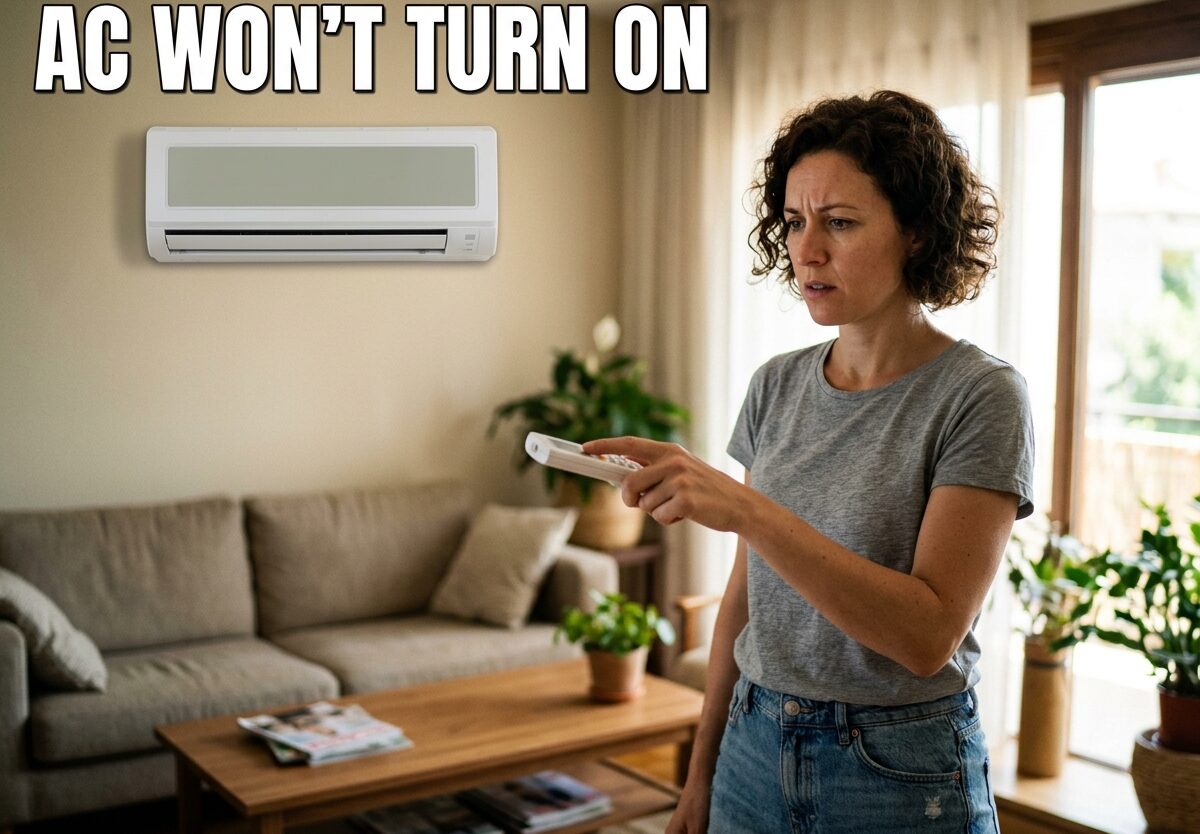
When your AC won’t turn on during a hot day, it’s more than frustrating—it’s an emergency. I’ve spent over 15 years troubleshooting HVAC systems, and I’ll walk you through exactly why your AC won’t turn on and what you can do about it. Most of the time, the issue is something you can fix yourself in under 10 minutes.
Your AC won’t turn on when there’s a break in the power chain, a thermostat malfunction, or a safety feature that’s triggered to prevent damage. The cooling system needs three things to operate: proper power supply from your electrical panel, the correct thermostat signal, and unobstructed airflow through the system.
Quick Troubleshooting: Why Your AC Won’t Turn On
Start here. These are the most common reasons your AC won’t turn on, arranged from easiest to most complex. Check these in order before calling a professional.
- Check your thermostat settings: Make sure it’s set to “COOL” not “OFF” or “HEAT,” and the temperature is set below the current room temperature. This sounds obvious, but I’ve seen it countless times—someone switched modes and forgot.
- Verify the circuit breaker hasn’t tripped: Head to your electrical panel and look for the breaker labeled “AC” or “AIR CONDITIONER.” If it’s in the middle position or flipped to OFF, flip it fully OFF, wait 30 seconds, then flip it back ON.
- Inspect the air filter: A clogged filter can restrict airflow enough to trigger safety shut-offs. If your filter is visibly dirty and you can’t remember the last time you changed it, replace it and try starting the AC again.
- Check the outdoor disconnect switch: Most AC units have a shutoff switch in a metal box near the outdoor unit. Make sure it’s in the ON position. Sometimes these get flipped during maintenance or by accident.
- Look for a blown fuse: Some systems have a fuse in the disconnect box or at the furnace. If the fuse looks blackened or broken, it needs replacement before your AC will turn on.
- Check the condensate drain: A clogged drain line can trigger a float switch that shuts down the AC to prevent water damage. Look for water around your indoor unit or a full drain pan.
- Wait 5 minutes before restarting: If you just turned off the AC, many systems have a built-in delay (the 3-minute rule) to protect the compressor. Wait a full 5 minutes before trying again.
AC Won’t Turn On: Circuit Breaker and Power Problems
Power issues are the leading cause when an AC won’t turn on. I’ve seen hundreds of cases where a simple breaker reset solved the problem, but I’ve also encountered more serious electrical issues that required professional repair.
When your AC breaker trips, it means the circuit drew more current than it could handle. This can happen once in a while during power surges or heavy usage. However, if the breaker trips repeatedly when you try to turn on the AC, there’s likely an underlying electrical problem that needs attention.
Common power-related causes include:
- Tripped circuit breaker: The most common culprit. Check your electrical panel for a breaker in the middle position. Reset it by flipping to OFF, waiting 30 seconds, then back to ON.
- Blown fuse: Older AC systems or those with a fuse block may have a blown fuse preventing power from reaching the unit. Replacing a blown fuse is usually inexpensive, but frequent failures indicate a larger issue.
- Outdoor disconnect switch: This safety switch, located in a metal box near your outdoor AC unit, may have been turned off. Verify it’s in the ON position.
- Electrical panel issues: Loose connections, corroded wires, or a faulty breaker can prevent power from reaching your AC even when the breaker appears fine.
- Poor power supply after storms: Thunderstorms and power surges can trip breakers or damage electrical components. If your AC won’t turn on after a storm, check the breaker first.
Safety warning: If you’re not comfortable working with electrical panels, or if the breaker trips immediately when you try to reset it, call a licensed electrician. Electrical problems can be dangerous and aren’t worth risking your safety over a DIY repair.
Thermostat Problems That Prevent AC From Turning On
Your thermostat is the command center for your entire cooling system. When it malfunctions, your AC won’t turn on even if everything else is working perfectly. I’ve diagnosed thermostat issues that mimicked much more serious problems, causing unnecessary service calls.
Most thermostat problems fall into a few predictable categories. Understanding these can save you time and money when your AC won’t turn on.
Incorrect thermostat settings: This is the simplest and most common issue. Your thermostat must be set to COOL mode, the temperature setting should be at least 3-5 degrees below the current room temperature, and the FAN should be set to AUTO or ON. I’ve seen many cases where someone accidentally switched to HEAT or OFF mode.
Dead batteries: Many programmable and smart thermostats run on batteries. When these die, the thermostat goes blank or becomes unresponsive, preventing your AC from turning on. Replace the batteries and check if the display comes back to life.
Thermostat wiring issues: Low voltage shorts in thermostat wires are a common problem I’ve encountered. If a wire has come loose, been chewed by pests, or has a loose connection at either the thermostat or the furnace, the signal won’t reach your AC unit. A clicking sound from the thermostat without the AC starting often indicates this problem.
Malfunctioning thermostat: Sometimes the thermostat itself fails. Age, power surges, or manufacturing defects can cause thermostats to stop communicating with your HVAC system. If you’ve ruled out other issues and your thermostat isn’t responding, replacement may be necessary.
Quick test: If your thermostat has a FAN ON setting, switch the fan to ON. If the blower starts running but the AC won’t turn on in COOL mode, the thermostat is likely sending signals but there’s an issue with the cooling circuit itself.
Clogged Air Filter: Why Your AC Won’t Start
A dirty air filter can cause your AC won’t turn on problem through a safety mechanism. Modern AC systems have pressure switches and sensors that detect restricted airflow. When airflow drops below a certain threshold, the system shuts down to prevent compressor damage and frozen coils.
I’ve seen filters so clogged with dust and debris that they looked like felt. When airflow is this restricted, your AC struggles to pull in enough air, causing the evaporator coil to get too cold and freeze. The system then shuts down to protect itself from damage.
Signs your air filter is causing AC issues:
- Reduced airflow from vents even when the system runs
- Higher energy bills from the system working harder
- Ice formation on refrigerant lines or the indoor unit
- The AC runs for short cycles then shuts off
- Dust visible around the filter frame when removed
Change your air filter every 1-3 months depending on usage, pets, and household dust levels. If it’s been more than three months and you can’t remember when you last changed it, replace it with a fresh filter. This simple maintenance step prevents many AC problems and improves efficiency.
AC Won’t Turn On Due to Drain Line or Frozen Coil
Your AC produces condensation as it removes humidity from the air. This water needs somewhere to go, so there’s a drain line that carries it away. When this line clogs, water backs up and triggers a safety float switch that prevents your AC from turning on to prevent water damage to your home.
I’ve cleared countless drain lines clogged with algae, dirt, and debris. The safety switch is doing its job—without it, you’d have water overflowing from your indoor unit, potentially causing thousands in damage.
Symptoms of a clogged drain line:
- Water pooling around your indoor AC unit or furnace
- The AC won’t turn on, or it runs briefly then shuts off
- Visible water stains on ceilings or walls near the indoor unit
- A full drain pan beneath the unit
To clear a clogged drain, locate the drain line (usually a PVC pipe near the indoor unit) and use a wet/dry vacuum to suction out the blockage. You can also flush it with a mixture of vinegar and water to kill algae buildup. For stubborn clogs, a professional may need to use specialized tools.
Frozen evaporator coil: When refrigerant levels drop or airflow is restricted, the evaporator coil can ice over. A frozen coil prevents proper heat exchange and can cause the AC to shut down. If you see ice on your refrigerant lines or the indoor unit, turn off the AC and let it thaw completely before attempting to run it again. Common causes include low refrigerant, dirty filters, or blocked vents.
AC Capacitor Failure: When Your AC Won’t Turn On
The capacitor is a small but critical component that gives your AC compressor and fan motors the electrical jolt they need to start. When a capacitor fails, your AC won’t turn on—you might hear a humming sound or clicking, but the motors won’t spin up.
Capacitors are one of the most common AC components to fail. They’re sensitive to heat, age, and power fluctuations. I’ve replaced countless capacitors over the years, and it’s often the culprit when an AC won’t turn on but the thermostat and power seem fine.
Signs of a bad capacitor:
- The AC won’t turn on, or it struggles to start
- A humming sound from the outdoor unit without the fan spinning
- The compressor attempts to start but fails repeatedly
- The capacitor appears bulged or leaking on visual inspection
- The AC sometimes starts and sometimes doesn’t (intermittent failure)
Testing a capacitor requires a multimeter and some electrical knowledge. If you’re comfortable working with electronics, you can check if the capacitor’s microfarad rating matches its labeled rating. However, capacitor replacement is often best left to professionals due to the stored electrical charge—even when disconnected, capacitors can deliver a dangerous shock.
Replacing a capacitor typically costs $100-300 including labor, depending on your location and the capacitor type. It’s a relatively quick repair for a qualified technician, and your AC should be back up and running the same day.
Window AC Won’t Turn On: Unique Considerations
Window air conditioners have some unique issues that can cause them not to turn on. While many troubleshooting steps overlap with central AC systems, there are window-unit-specific problems you should check.
Power supply issues: Window ACs need a dedicated electrical circuit. If yours is plugged into a shared circuit with other appliances, it may not be getting enough power to start. I’ve seen window ACs that wouldn’t turn on because they were sharing a circuit with a refrigerator or microwave.
GFCI outlet tripping: Modern electrical codes require window ACs to be plugged into GFCI (Ground Fault Circuit Interrupter) outlets in certain locations. These outlets have test and reset buttons and can trip, cutting power to the AC. Press the RESET button if the outlet has tripped.
Remote control problems: If your window AC uses a remote, check that the batteries are fresh. Some models won’t respond to manual button presses if the remote is the primary control method. Also, check for anything blocking the remote sensor on the unit.
Overload protection: Many window ACs have built-in overload protection that prevents them from starting if the compressor is too hot. If your AC was just running and won’t restart, wait 10-15 minutes for the compressor to cool down before trying again.
How to Reset Your AC When It Won’t Turn On
Sometimes your AC needs a hard reset to clear errors and restore normal operation. Reset procedures vary by system, but these steps work for most residential AC units.
Complete AC Reset Procedure:
- Turn off the thermostat: Switch your thermostat to OFF mode to stop any cooling signals.
- Flip the breaker: Go to your electrical panel and flip the AC breaker to the OFF position. Wait 30 seconds, then flip it back to ON.
- Reset the outdoor disconnect: If your outdoor unit has a reset button (often red), press it. Otherwise, flip the outdoor disconnect switch to OFF, wait 30 seconds, then back to ON.
- Wait 5 minutes: This allows pressure to equalize in the refrigerant lines and gives the system time to fully power down.
- Turn on the thermostat: Switch your thermostat back to COOL mode and set the temperature below the current room temperature.
- Listen for startup: You should hear the outdoor compressor and fan start within 2-3 minutes.
If your AC still won’t turn on after a complete reset, there’s likely a hardware issue that needs professional diagnosis. Persistent problems after resetting indicate component failure rather than a temporary glitch.
When Your AC Won’t Turn On: Call a Professional
Some AC problems are beyond DIY repair. Knowing when to call a professional saves time, money, and prevents further damage to your system. After troubleshooting the common causes above, if your AC still won’t turn on, it’s time for expert help.
Call a professional HVAC technician when:
- The circuit breaker trips repeatedly when you try to turn on the AC
- You smell burning or electrical odors when attempting to start the system
- The capacitor appears damaged or you’re not comfortable testing it
- You suspect a refrigerant leak (hissing sounds, ice on lines, reduced cooling)
- The compressor attempts to start but fails repeatedly (hard starting)
- You’ve checked all simple fixes and the AC still won’t turn on
Professional diagnosis typically costs $75-150 depending on your location, with repairs ranging from $100 for simple fixes to several thousand for compressor replacement. Ask for an estimate before any work begins, and consider the age of your system—repairs over half the cost of replacement might indicate it’s time for a new AC unit.
Frequently Asked Questions
What would cause my AC to not kick on?
The most common reasons include thermostat set incorrectly (not in COOL mode or temperature too high), tripped circuit breaker, blown fuse, clogged air filter triggering safety shut-off, faulty capacitor preventing compressor startup, or a tripped safety switch from a clogged drain line or frozen coil.
How do I force my AC to turn on?
You cannot safely force an AC to turn on if it’s not starting normally. Attempting to bypass safety features can cause serious damage. Instead, troubleshoot systematically: verify thermostat is in COOL mode with temperature set below room temp, check the circuit breaker hasn’t tripped, ensure the outdoor disconnect switch is ON, replace dirty air filters, check for blown fuses, and clear any clogged drain lines. If these steps don’t work, the issue requires professional diagnosis.
Why is my AC switch not turning on?
Your AC switch (thermostat or disconnect) may not turn on due to dead thermostat batteries, incorrect mode selection (not set to COOL), a tripped breaker at the electrical panel, a faulty or blown fuse in the disconnect box, loose wiring connections, or a malfunctioning thermostat that needs replacement. Check power supply first, then test thermostat batteries, and verify proper settings before calling a professional.
How do I reset my air conditioner?
To reset your AC, first turn the thermostat to OFF. Then flip the AC circuit breaker to OFF, wait 30 seconds, and flip it back to ON. If your outdoor unit has a disconnect switch, flip it to OFF for 30 seconds, then back to ON. Wait a full 5 minutes for the system to reset and pressure to equalize. Finally, switch your thermostat back to COOL mode and set the temperature below the current room temperature. The AC should start within 2-3 minutes.
Why is my AC not working but the fan is running?
When the fan runs but the AC doesn’t cool, the issue is typically with the compressor or refrigerant system. Common causes include a bad capacitor that’s failing to start the compressor, low refrigerant levels from a leak, a failed compressor motor, a frozen evaporator coil blocking airflow, or a faulty contactor that’s not sending power to the compressor. The fan running indicates the thermostat and blower motor are working, but the cooling circuit has failed.
Conclusion
When your AC won’t turn on, start with the basics: check thermostat settings, inspect the circuit breaker, replace dirty air filters, verify the outdoor disconnect is ON, and look for tripped GFCI outlets or blown fuses. These simple fixes resolve most AC startup problems.
If basic troubleshooting doesn’t solve the issue, the problem may be a failed capacitor, refrigerant leak, frozen coil, or electrical fault requiring professional diagnosis. Don’t attempt repairs beyond your comfort level—HVAC systems involve high voltage and specialized components.
Prevent future AC problems by changing filters monthly, clearing drain lines annually, scheduling professional maintenance before cooling season, and addressing issues promptly rather than waiting until complete failure occurs. Regular maintenance extends your AC’s lifespan and prevents those frustrating moments when your AC won’t turn on during hot weather.


Leave a Comment