
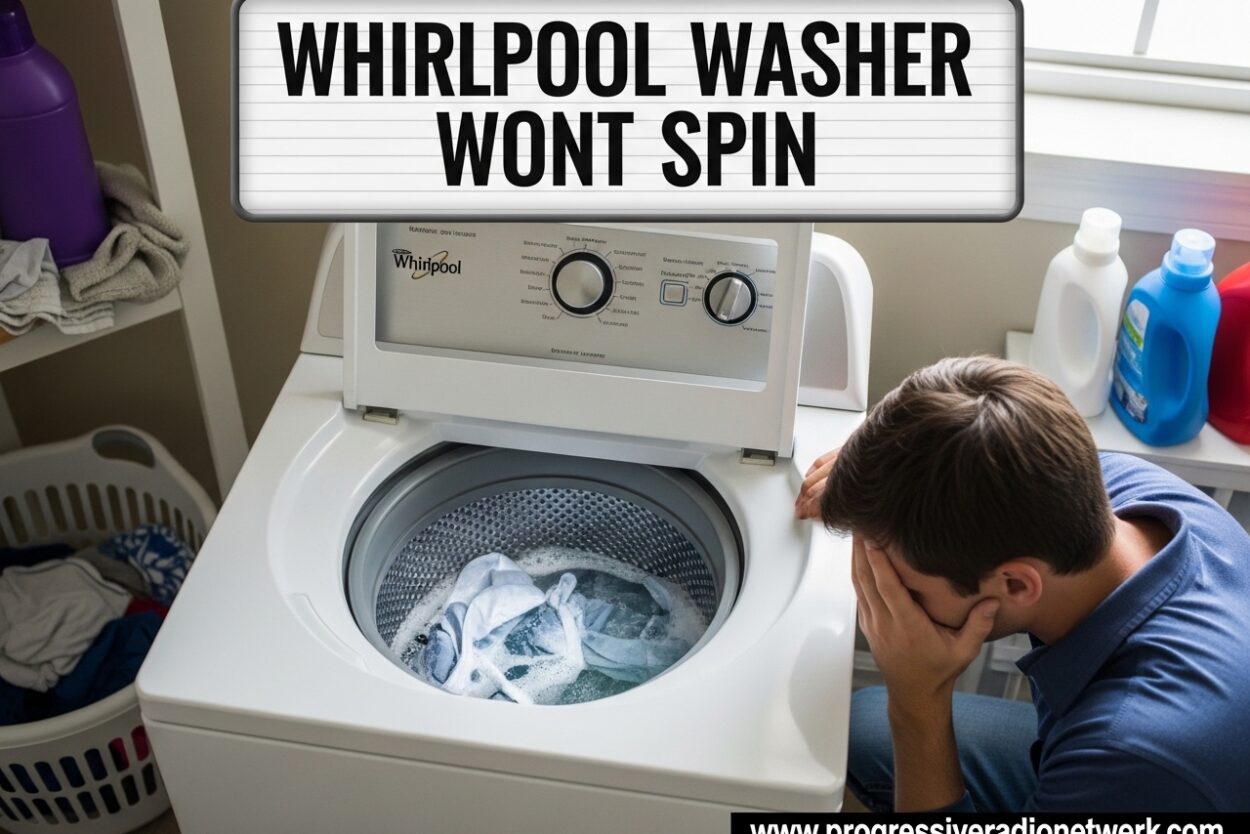
There’s nothing more frustrating than pulling soaking wet clothes out of your Whirlpool washer after a full cycle. When your Whirlpool washer won’t spin, it’s more than an inconvenience—it leaves you with heavy, waterlogged laundry that takes forever to dry. I’ve seen this issue hundreds of times, and in most cases, you can diagnose and even fix the problem yourself without calling a technician.
A Whirlpool washer not spinning is typically caused by an unbalanced load, faulty lid switch, worn drive components, or drainage issues that prevent the spin cycle from engaging. The spin cycle relies on the motor, drive belt (or clutch on direct drive models), and proper water drainage. If any component fails or the load is unbalanced, the washer won’t spin.
Without spinning, clothes remain soaked and cannot be dried effectively. This issue often indicates underlying mechanical problems that can worsen over time. In this guide, I’ll walk you through the 10 most common causes of Whirlpool washer spin failure and exactly how to fix them.
Quick Diagnostic Checklist
Before diving into complex repairs, let’s rule out the simple stuff. These five checks take less than five minutes and solve the problem in about 30% of cases.
1. Check the lid/door: Make sure it’s fully closed and latched. Open it completely and close it again firmly. The washer won’t spin if it thinks the door is ajar.
2. Verify cycle selection: Some cycles like “Delicate” or “Hand Wash” have reduced or no spin. Check your display to confirm a spin cycle is selected.
3. Check for error codes: Look at your washer’s display for flashing lights or error codes. Common codes include F21 (drain issue) and F28 (serial communication error).
4. Inspect the drain hose: Look behind the washer for kinks, bends, or clogs in the drain hose. A blocked drain prevents spinning.
5. Test with a smaller load: Overloading is a common cause. Remove half the clothes and run a spin-only cycle to see if the problem resolves.
If none of these quick checks solve the issue, let’s dive deeper into the specific causes.
Whirlpool Washer Wont Spin: 10 Common Causes
1. Improper Loading or Overloading
An unbalanced or overloaded load is the most common reason your Whirlpool washer won’t spin. Modern washers have sophisticated sensors that detect imbalance and will refuse to spin to prevent damage.
When clothes clump together on one side of the drum, the washer can’t balance itself. The sensor detects this and either won’t engage the spin cycle or will repeatedly stop and start trying to redistribute the load.
Solution: Remove some clothes if the washer is tightly packed. The drum should be loosely filled—think three-quarters full at most. For large items like blankets, wash them alone to prevent bunching. If you hear banging during the wash cycle, pause and redistribute the load manually.
2. Incorrect Cycle Settings
Your Whirlpool washer won’t spin if you’ve selected a cycle with limited or no spin. Many users accidentally select cycles like “No Spin,” “Hand Wash,” or “Drain Only” without realizing it.
Some Whirlpool models also allow you to customize spin speed. If someone accidentally set the spin to “Low” or “No Spin,” the drum won’t reach the RPMs needed to extract water effectively.
Solution: Check your cycle selection. Press the “Spin Speed” button (if available) and ensure it’s set to medium or high. For normal laundry, use the “Normal” or “Casual” cycle rather than “Delicate.” You can also run a “Drain & Spin” cycle separately to test if the spin function works at all.
3. Washer Not Level
If your Whirlpool washer sits on an uneven floor, it can’t spin properly. The machine needs to be perfectly level to distribute weight during the high-speed spin cycle.
An unlevel washer causes the drum to wobble. The imbalance sensors detect this movement and prevent spinning to avoid damaging the machine or causing it to walk across the floor.
Solution: Place a level on top of the washer (front to back, then side to side). If it’s not level, adjust the front leveling feet by turning them clockwise to lower or counterclockwise to raise. For washers with rear leveling feet, you may need to tip the washer forward to access them. Recheck with the level after each adjustment until the bubble is centered.
4. Lid Switch or Door Lock Failure
The lid switch (top-load washers) or door lock (front-load washers) is a safety mechanism that prevents the washer from spinning when open. When this component fails, the washer thinks the door is always open and won’t spin.
A faulty lid switch is especially common on older Whirlpool top-load models. The switch is located under the main top panel and gets activated when you close the lid. Over time, the plastic tab can break or the electrical contacts can fail.
Solution: First, listen for a clicking sound when you close the lid or door. If you don’t hear it, the switch may be broken. For top-load washers, try bypassing the switch temporarily (only for testing) by inserting a small plastic tab into the slot where the lid would normally depress the switch. If the washer spins with the tab inserted, you need a new lid switch.
Replacing a lid switch or door lock typically costs between $50-150 if you hire a professional, but the part itself usually costs less than $30 if you’re comfortable with DIY repair.
5. Drain Hose Issues
Your Whirlpool washer won’t spin if it can’t drain water. The spin cycle and drain cycle work together—water must be removed before spinning begins. If the drain hose is kinked, clogged, or installed incorrectly, water backs up in the drum.
I’ve seen countless cases where moving a washer for cleaning pushed it too close to the wall, crushing the drain hose against the wall. Other times, the hose becomes kinked from being bent at a sharp angle.
Solution: Pull the washer away from the wall and inspect the drain hose running from the back to the standpipe or utility sink. Straighten any kinks and ensure the hose isn’t crushed. The hose should also be inserted into the standpipe at the correct height—typically 36-96 inches from the floor. If it’s too low, water can siphon back into the drum.
Also check for clogs by disconnecting the hose and running water through it. If water flows slowly, use a plumbing snake or straightened coat hanger to clear the blockage.
6. Clogged or Faulty Drain Pump
The drain pump removes water from the drum before and during the spin cycle. When it fails or becomes clogged, water remains in the tub and prevents spinning.
Foreign objects like coins, buttons, socks, and lint frequently accumulate in the drain pump filter. Over time, this buildup restricts water flow. The pump motor itself can also fail, especially on older washers.
Solution: Many Whirlpool models have an accessible drain pump filter behind a small panel at the bottom front of the washer. Place towels on the floor, slowly unscrew the filter cap, and remove any debris. Have a shallow pan ready to catch water.
If the filter is clean but the washer still won’t drain, test the pump by listening for a humming sound during the drain cycle. If you hear nothing, the pump may be dead. A replacement drain pump costs $30-80 and is a moderate DIY repair requiring basic tools.
7. Worn or Broken Drive Belt
Belt-drive Whirlpool washers use a rubber belt to connect the motor to the transmission. When this belt wears out, stretches, or breaks, the motor runs but the drum doesn’t spin.
A failing drive belt often gives warning signs. You might hear squealing during the spin cycle or notice the drum spinning slower than usual. Eventually, the belt can snap completely, leaving the washer unable to agitate or spin.
Solution: Unplug the washer and remove the cabinet or back panel to access the belt. Inspect it for cracks, fraying, glazing (shiny spots), or looseness. A belt should have about half an inch of deflection when pressed. If it’s loose or damaged, replacement is necessary.
Drive belts cost $15-40 and replacement takes 30-60 minutes for DIYers. You’ll need to release the tension, remove the old belt, and route the new belt around the motor pulley, transmission pulley, and idler arm according to your model’s diagram.
8. Clutch Assembly Failure
Direct-drive Whirlpool washers use a clutch assembly instead of a belt. The clutch engages and disengages the spin cycle, and when it wears out, the washer won’t spin even though the motor is running.
Clutch failure is common on washers over 7-10 years old. Symptoms include the washer agitating normally but not spinning, spinning slowly, or making a grinding noise during spin. You might also notice a burning rubber smell if the clutch is slipping.
Solution: Unfortunately, clutch replacement is a challenging repair. It requires removing the transmission, which involves special tools and multiple steps. The part itself costs $40-80, but labor can run $200-300 if you hire a professional.
For DIYers with experience, plan on 2-3 hours for this repair. You’ll need to disconnect the agitator, remove the spin basket, disconnect the transmission, and replace the clutch assembly. If this sounds overwhelming, it’s often more cost-effective to call a technician.
9. Motor Control Board Issues
The motor control board regulates power to the motor during different cycles. When it fails, the washer may not spin, may spin intermittently, or may display error codes related to motor communication.
Motor control boards can fail due to power surges, moisture exposure, or simply age. Electrical components on the board can burn out or solder joints can crack, causing intermittent or complete failure.
Solution: First, check for visible damage on the control board—burn marks, bulging capacitors, or corroded connections. However, some failures aren’t visible to the naked eye.
Testing the motor control board requires a multimeter and electrical knowledge. If you’re not comfortable with electrical testing, this is best left to professionals. A replacement motor control board costs $100-250, plus labor if you hire someone.
Before replacing the board, try a hard reset: unplug the washer for 10 minutes, then plug it back in. This sometimes resets the board’s internal computer and resolves minor glitches.
10. Transmission or Rotor Failure
The transmission (on belt-drive models) or rotor/stator assembly (on direct-drive models) converts motor power into drum movement. When these components fail, the washer won’t spin regardless of other parts working correctly.
Transmission failure usually produces grinding or clunking noises and may affect both agitation and spinning. Rotor failure on direct-drive models can cause the motor to run without moving the drum at all.
Solution: These are among the most expensive repairs. Transmission replacement typically costs $300-500 including parts and labor. For washers over 8-10 years old, this repair often exceeds half the cost of a new washer.
Before committing to this repair, consider your washer’s age and condition. If it has other problems or is nearing the end of its expected lifespan (typically 10-14 years), replacement might be more economical.
How to Reset Your Whirlpool Washer
Sometimes your Whirlpool washer won’t spin simply due to a electronic glitch. A reset can clear error codes and restore normal function. Here’s how to reset most Whirlpool washers:
Method 1: Power Cycle Reset
- Unplug the washer from the power outlet
- Wait 1-5 minutes (this clears the capacitors)
- Plug the washer back in
- Open and close the door firmly six times within 12 seconds
- Run a test cycle
Method 2: Control Panel Reset (For models with dial)
- Turn the dial to “Normal”
- Turn the dial one click counter-clockwise (to “Drain & Spin”)
- Repeat this sequence three times: left to Normal, right to Drain & Spin
- Press the Start button on the final position
- All lights should illuminate and the washer should enter diagnostic mode
- Turn the dial to complete the reset
Method 3: Display Reset (For models with electronic display)
- Unplug the washer for 1 minute
- While holding down the “Power” or “Start” button, plug it back in
- Continue holding for 5-10 seconds until the display resets
- Release the button and test the washer
If your Whirlpool washer won’t spin even after a reset, the problem is likely mechanical rather than electronic, and you’ll need to work through the troubleshooting steps above.
Prevention Tips
Preventing spin problems is easier than fixing them. Here are five habits that will keep your Whirlpool washer spinning smoothly for years:
1. Don’t overload: Follow your model’s capacity guidelines. A good rule of thumb: clothes should move freely in the drum, not be packed tightly. For large items like comforters, use a commercial washer or wash them alone.
2. Level the washer: Check level annually and after moving the washer. An unlevel machine causes vibration that can damage components over time.
3. Clean the drain filter monthly: If your model has an accessible filter, clean it monthly to prevent buildup. This is especially important if you wash items that shed lint or have small pockets that can trap debris.
4. Use the right detergent: High-efficiency (HE) washers require HE detergent. Regular detergent creates excessive suds that can interfere with spinning and damage components over time.
5. Leave the door open between washes: This prevents moisture buildup and mold growth, which can affect door locks and sensors. For top-load washers, leave the lid ajar.
When to Call a Professional
While many spin issues are DIY-friendly, some problems require professional expertise. Call a technician if:
1. The repair requires transmission work: Transmission replacement is complex and time-consuming. Unless you have advanced repair skills, this is best left to professionals.
2. You’re not comfortable with electrical work: Motor control board replacement involves electrical testing and wiring. If you’re unsure about working with electricity, don’t risk it.
3. The washer is under warranty: DIY repairs can void your warranty. If your washer is still covered, use authorized service.
4. Multiple components have failed: If you’ve replaced one part and another immediately fails, there may be an underlying issue that requires professional diagnosis.
5. The repair cost exceeds 50% of replacement cost: As a general rule, if repairs cost more than half the price of a new washer, consider replacement instead—especially if your washer is over 8 years old.
Professional repair typically costs $100-150 for the service call plus parts. Ask for an estimate before authorizing any work, and don’t be afraid to get a second opinion for expensive repairs.
FAQ
What would cause my Whirlpool washing machine not to spin?
The most common causes include an unbalanced load, faulty lid switch, clogged drain pump, worn drive belt, or clutch failure. Less commonly, the motor control board, transmission, or door lock assembly may fail. Start by checking for simple issues like overloading or incorrect cycle settings before moving to mechanical components.
How do I reset my Whirlpool washer that won’t spin?
Unplug the washer for 1-5 minutes, then plug it back in. For models with a dial, rotate it from Normal to Drain & Spin three times, then press Start. For electronic models, hold the Start button while plugging in the washer. A reset often clears minor glitches that prevent spinning.
How do I get my Whirlpool washer to drain and spin?
First ensure the drain hose isn’t kinked or clogged. Clean the drain pump filter if accessible. Check that the standpipe height is correct (36-96 inches). If these don’t work, the drain pump may be faulty and need replacement. A working drain system is required before the spin cycle can engage.
How to reset washer spin?
Reset the spin function by unplugging the washer for a full 5 minutes to clear all capacitors. Then run a dedicated Drain & Spin cycle if your model has one. For persistent issues, perform a master reset by turning the dial between Normal and Drain & Spin three times, or by holding the Start button during power-up on electronic models.
Why does my washer spin when empty but not with clothes?
This typically indicates a worn clutch, weak motor, or overloaded condition. When empty, there’s minimal weight so the washer can spin. With clothes, the extra load exposes the weakened component. Try smaller loads first. If the problem persists, the clutch assembly or motor may need replacement.
What does error code F21 mean on my Whirlpool washer?
Error code F21 indicates a drain problem—the washer is taking too long to drain. This is usually caused by a clogged drain pump filter, kinked drain hose, or faulty drain pump. Clean the filter and check the hose first. If the error persists, the drain pump likely needs replacement.
Conclusion
When your Whirlpool washer won’t spin, start with the simple checks: verify the cycle selection, redistribute an unbalanced load, and ensure the washer is level. These basic fixes solve the problem in many cases. If the issue persists, work through the more complex causes like lid switches, drain pumps, and drive components.
Remember that some repairs like clutch replacement and transmission work are best left to professionals, especially if your washer is still under warranty. For DIYers, start with the easiest fixes first and work your way toward more complex repairs only as needed.
Regular maintenance—proper loading, keeping the washer level, and cleaning the drain filter—can prevent many spin problems before they start. With proper care, your Whirlpool washer should provide reliable service for 10-14 years.



Leave a Comment