
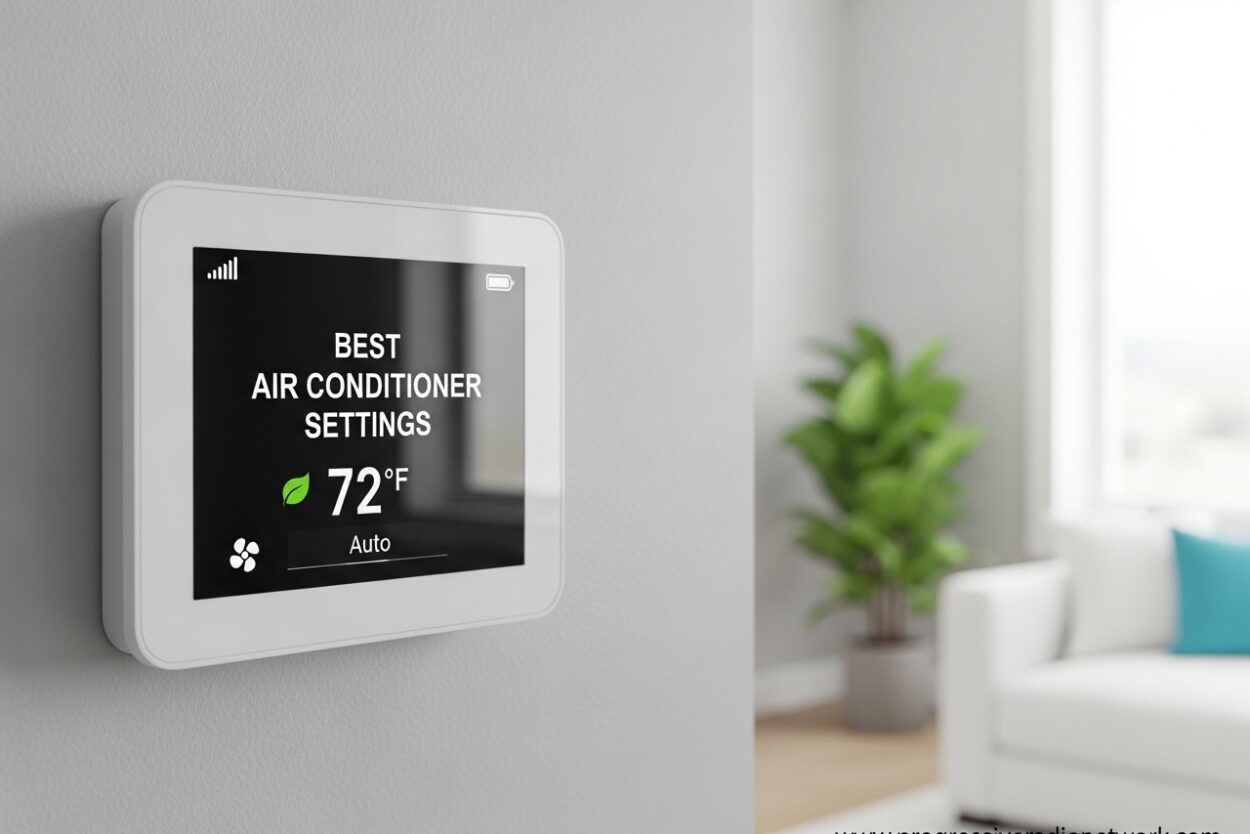
Finding the best air conditioner settings can feel like a guessing game. You want to stay comfortable without watching your energy bill skyrocket. After researching Department of Energy recommendations, HVAC expert guidelines, and real-world user experiences, I’ve identified the optimal settings that balance comfort with efficiency.
The best air conditioner setting depends on your situation: 78°F (26°C) when you’re home and awake, 82-85°F (28-29°C) when sleeping, and 85°F (29°C) or higher when you’re away for more than 4 hours. These recommendations come from the Department of Energy and can save you up to 20% on cooling costs.
What makes these temperatures optimal? It comes down to the 3% rule: for every degree you raise your thermostat above 78°F, you save approximately 3% on cooling costs. Small adjustments add up quickly.
Quick Reference: Best AC Temperature Settings
Here’s your quick reference guide for optimal air conditioner settings in any situation:
- Home and Awake: 78°F (26°C)
- Sleeping: 82°F (28°C)
- Away (4+ hours): 85°F (29°C)
- Away (less than 4 hours): Keep at 78°F (26°C)
- Humid climates: 74-76°F (23-24°C) feels more comfortable
- Dry climates: Can tolerate 78-80°F (26-27°C)
Optimal Temperature Settings for Every Situation
The best air conditioner settings change based on whether you’re home, sleeping, or away. Let me break down exactly what temperature to set your AC in each scenario.
When You’re Home and Awake
Set your thermostat to 78°F (26°C) when you’re home and active. This is the Department of Energy’s recommended setting for balancing comfort and energy efficiency. I know what you’re thinking: 78 degrees feels warm. The key is using ceiling fans and managing humidity.
Ceiling fans create a wind chill effect that makes you feel 4-6 degrees cooler. This means 78°F with a fan running feels like 72-74°F without one. Just remember: fans cool people, not rooms. Turn them off when you leave the room.
Reddit users consistently report preferring 68-72°F when home, but these lower temperatures cost significantly more. If 78°F feels too warm initially, try 76°F and gradually adjust upward over a few weeks. Your body will adapt.
Best Air Conditioner Settings for Sleeping
The ideal sleeping temperature is 82-85°F (28-29°C). This might seem counterintuitive, but here’s why it works: your body temperature naturally drops during sleep, and you need warmer ambient temperatures to maintain comfort. Setting your AC too low at night can actually disrupt sleep quality.
However, individual preferences vary widely. Some people sleep best at 65°F, while others prefer 74°F. The National Sleep Foundation suggests keeping your bedroom between 60-67°F for optimal sleep, but this conflicts with energy-saving recommendations.
The compromise? Use your AC’s sleep mode if available. This gradually raises the temperature overnight while maintaining comfort. Many users find 80-82°F comfortable for sleeping when combined with light bedding and a ceiling fan.
Away Temperature Settings
When you’re away from home for more than 4 hours, set your thermostat to 85°F (29°C) or turn it off entirely. This is where the 4-by-4 rule comes in: if you’re away for 4 hours or more, raise your temperature by 4 degrees above your normal setting.
For shorter absences (less than 4 hours), keep your AC at 78°F. The energy required to cool your home back down from a higher temperature outweighs the savings from turning it up for brief periods.
Never turn your AC completely off during summer unless you’re away for multiple days. Your home will heat up significantly, and your AC will work overtime to remove that heat. This strains your system and can actually use more energy than maintaining a steady higher temperature.
The 4-by-4 Rule: Your Energy Saving Secret
The 4-by-4 rule is one of the most effective energy-saving strategies for air conditioning. Here’s how it works: when you’re away from home for 4 hours or more, raise your thermostat by 4 degrees above your normal setting.
Why does this work? Your AC uses the most energy when it’s removing large amounts of heat. Maintaining a temperature 4 degrees higher than normal requires significantly less energy than constantly cooling to 78°F. When you return home, your AC only has to remove 4 degrees of heat instead of 10-15 degrees.
For example, if you normally keep your home at 78°F, set it to 82°F when you leave for work. If you’re going to be away for the entire weekend (8+ hours), raise it to 85°F. This simple adjustment can save 10-15% on your cooling costs during warm months.
Programmable and smart thermostats automate this process. You can schedule temperature adjustments based on your daily routine without remembering to manually change the setting before leaving.
Understanding AC Operating Modes
Most modern air conditioners have multiple operating modes beyond simple cooling. Understanding these modes helps you choose the best air conditioner settings for different conditions.
Cool Mode
Cool mode is your standard air conditioning setting. The compressor runs continuously until your home reaches the set temperature, then cycles on and off to maintain it. This mode provides the fastest cooling and is best for very hot days.
Dry Mode
Dry mode focuses on reducing humidity rather than temperature. The compressor runs at lower speeds, removing moisture from the air. This is ideal for humid climates where high moisture makes even moderate temperatures feel uncomfortable. Users in the South and Southeast rely heavily on dry mode during muggy summer days.
When humidity is high, 78°F can feel stuffy and oppressive. Running dry mode for 1-2 hours in the morning removes excess moisture, making your home feel cooler at higher temperatures.
Fan Mode
Fan mode runs only the fan without activating the compressor. This circulates air but doesn’t cool or dehumidify. It’s useful for mild weather or for distributing air throughout multi-story homes. However, avoid using fan mode for extended periods in humid climates as it can increase indoor humidity.
Eco Mode
Eco mode optimizes energy efficiency by running the compressor at lower speeds and allowing slightly higher temperatures. This mode uses less energy but takes longer to cool your home. It’s best for maintaining temperature rather than rapidly cooling a hot house.
Sleep Mode
Sleep mode automatically adjusts temperature throughout the night. It typically raises the temperature by 2-4 degrees after you fall asleep and maintains this warmer setting until morning. Some models also slow the fan speed for quieter operation. This mode balances comfort with energy savings during overnight hours.
Fan Settings: Auto vs On
The fan setting question confuses many people: should your AC fan be set to Auto or On? Here’s the straightforward answer: Auto is more energy efficient, but On has specific use cases.
In Auto mode, the fan only runs when the compressor is actively cooling. This saves energy because the fan isn’t running constantly. It’s also better for humidity control since moisture continues to drip from the coils when the fan stops.
On mode keeps the fan running continuously. This uses more energy but provides more consistent temperatures throughout your home. Continuous air circulation helps in multi-story houses where upstairs rooms stay warmer. Some users also prefer On mode because it provides white noise and constant air movement.
For most situations, Auto is the better choice. It saves energy and controls humidity more effectively. Use On mode only if you have specific issues with uneven cooling or prefer constant air circulation.
Humidity Control: The Missing Comfort Factor
Humidity dramatically affects how comfortable your home feels at any given temperature. High humidity makes even 74°F feel muggy and uncomfortable, while low humidity makes 78°F feel pleasant.
The ideal indoor humidity level is 40-50%. Above 60%, humidity makes your home feel warmer than the thermostat reading. Below 30%, air feels dry and can cause respiratory irritation.
In humid climates, controlling moisture is as important as controlling temperature. This is why many users in the South prefer lower thermostat settings—they’re compensating for high humidity. Running your AC in dry mode or using a standalone dehumidifier allows you to stay comfortable at higher temperatures.
A simple test: if your home feels stuffy at 78°F, check the humidity. Reducing humidity to 45-50% often makes 78°F feel as comfortable as 74°F with higher humidity. This saves energy while maintaining comfort.
Thermostat Types: Programmable vs Smart
Your thermostat type significantly impacts how easily you can implement the best air conditioner settings. Let me break down the three main options.
Manual Thermostats
Manual thermostats require you to change temperature settings by hand. They’re simple and reliable but don’t automate temperature adjustments. If you’re disciplined about adjusting your thermostat before leaving and returning home, manual thermostats work fine. Most people forget, however, which wastes energy.
Programmable Thermostats
Programmable thermostats let you schedule temperature changes based on time of day. You can set them to automatically raise the temperature when you leave for work and lower it before you return home. This ensures energy savings without sacrificing comfort.
A typical schedule: 78°F from 6 AM to 8 AM (morning routine), 85°F from 8 AM to 5 PM (work hours), 78°F from 5 PM to 10 PM (evening), and 82°F from 10 PM to 6 AM (sleeping). This schedule maximizes savings while maintaining comfort when you’re home.
Smart Thermostats
Smart thermostats take automation further with learning algorithms, smartphone control, and occupancy sensing. They learn your schedule and adjust automatically, detect when you’re away using motion sensors or phone location, and provide energy usage reports.
Studies show smart thermostats save 10-23% on heating and cooling costs. The biggest benefit? You never have to remember to adjust the temperature. The thermostat does it for you based on your habits and preferences.
Energy Savings: How Much Can You Save?
The potential savings from optimal air conditioner settings are substantial. The Department of Energy reports that you can save up to 10% annually on heating and cooling by adjusting your thermostat 7-10 degrees for 8 hours per day.
More specifically, the EPA estimates that you save approximately 6% on cooling costs for every degree you raise your thermostat above 78°F. Other sources suggest 3% savings per degree. Either way, the impact is significant.
Here’s a real example: if your average summer cooling bill is $170, raising your thermostat from 74°F to 78°F saves 4 degrees × 3% = 12%. That’s $20.40 per month or $60-80 over a typical cooling season. Raise it to 82°F when away (using the 4-by-4 rule), and your savings increase to $40-50 per month.
Multiplied across millions of households, these small adjustments make a massive environmental impact. The collective energy savings from optimal thermostat settings could reduce national energy consumption by hundreds of millions of dollars annually.
Common AC Myths Debunked
After reading hundreds of forum discussions, I’ve identified several persistent myths about air conditioner settings. Let me set the record straight.
Myth: Setting your AC colder cools your home faster. False. Your AC cools at a fixed rate regardless of the set temperature. Setting it to 65°F won’t cool faster than setting it to 78°F—it will just run longer and waste energy. Always set your thermostat to your target temperature.
Myth: Keeping your AC at one constant temperature saves more energy than adjusting it. False. The 4-by-4 rule proves that raising your temperature when away saves significant energy. Your AC doesn’t work harder to cool down from 85°F than it does to maintain 78°F all day.
Myth: Turning your AC completely off when away saves the most energy. It depends. For absences under 4 hours, keeping your AC at 78°F uses less energy than turning it off and cooling back down. For absences over 4 hours, raising to 85°F or turning off saves energy. The key is the 4-hour threshold.
Myth: The 20-degree rule means your AC can’t cool more than 20 degrees below outside temperature. Partially true. Your AC works most efficiently within 20 degrees of outside temperature. Setting it to 70°F when it’s 95°F outside strains the system and wastes energy. In extreme heat, set your thermostat no lower than 75°F.
Maintenance Tips for Maximum Efficiency
Even with the best air conditioner settings, your system won’t perform optimally without proper maintenance. Here are the essential maintenance tasks that ensure energy efficiency.
Air Filter Replacement
Replace your air filter every 1-3 months depending on usage and household factors. Pets, allergies, and dust increase replacement frequency. A dirty filter restricts airflow, forcing your AC to work harder and use more energy. Clogged filters can reduce system efficiency by 5-15%.
Professional Tune-ups
Schedule annual professional maintenance before cooling season begins. HVAC technicians check refrigerant levels, clean coils, inspect electrical connections, and identify potential problems. Regular maintenance extends your system’s lifespan and maintains peak efficiency.
Coil Cleaning
Both indoor and outdoor coils accumulate dirt over time. Outdoor condenser coils can be cleaned with a garden hose—spray from the inside out to remove debris. Indoor evaporator coils require professional cleaning. Clean coils improve heat transfer and reduce energy consumption.
Refrigerant Levels
Low refrigerant levels reduce cooling capacity and increase energy use. If your AC isn’t cooling properly or runs constantly without reaching the set temperature, you may have a refrigerant leak. This requires professional repair.
FAQ
What is the most efficient setting for an air conditioner?
The most efficient air conditioner setting is 78°F (26°C) when you’re home and awake, 82°F (28°C) when sleeping, and 85°F (29°C) when away for more than 4 hours. Every degree above 78°F saves approximately 3% on cooling costs. Use the Auto fan setting for optimal efficiency and consider a programmable or smart thermostat to automate temperature adjustments based on your schedule.
Is 75 too cold for AC?
75°F is below the Department of Energy’s recommended 78°F setting for when you’re home. While 75°F feels comfortable, it costs approximately 9% more to cool to 75°F compared to 78°F. If you prefer 75°F, that’s acceptable—it’s not ‘too cold’—but you’ll pay more for cooling. The difference in cost depends on your electricity rates and how long your AC runs each day. Many users compromise at 76-77°F as a balance between comfort and efficiency.
Does having the AC on 72 instead of 70 make it cheaper?
Yes, running your AC at 72°F instead of 70°F is cheaper. The EPA estimates approximately 6% savings on cooling costs for every degree you raise your thermostat. Raising from 70°F to 72°F saves about 12% on your cooling costs. For a typical $170 monthly cooling bill, that’s roughly $20 in savings. The savings continue with each degree higher: 74°F saves 18%, 76°F saves 27%, and 78°F saves 36% compared to 70°F. These savings add up significantly over the cooling season.
What is the 20 rule for air conditioning?
The 20-degree rule states that your air conditioner works most efficiently when cooling within 20 degrees of the outside temperature. Setting your thermostat more than 20 degrees below the outdoor temperature strains your HVAC system and reduces efficiency. For example, if it’s 95°F outside, set your AC to no lower than 75°F. In extreme heat (100°F+), you may need to set it even higher to prevent system strain. This doesn’t mean your AC can’t cool more than 20 degrees—it can—but it operates most efficiently and uses less energy when the temperature difference is within that range.
Conclusion
Finding the best air conditioner settings is about balancing comfort with efficiency. The Department of Energy recommends 78°F (26°C) when you’re home, 82°F (28°C) when sleeping, and 85°F (29°C) when away for more than 4 hours. These settings can save you 15-20% on cooling costs while maintaining comfort.
The key principles to remember: use the 4-by-4 rule for away periods, set your fan to Auto mode for efficiency, control humidity to improve comfort at higher temperatures, and maintain your AC system regularly. If 78°F feels too warm initially, start at 76°F and gradually adjust upward as your body adapts.
Small changes make a big difference. Even raising your thermostat by just 2 degrees can save 6% on your cooling bill. Start with one adjustment—perhaps programming your thermostat to raise the temperature during work hours—and build from there. Your energy bill will thank you.

Leave a Comment