
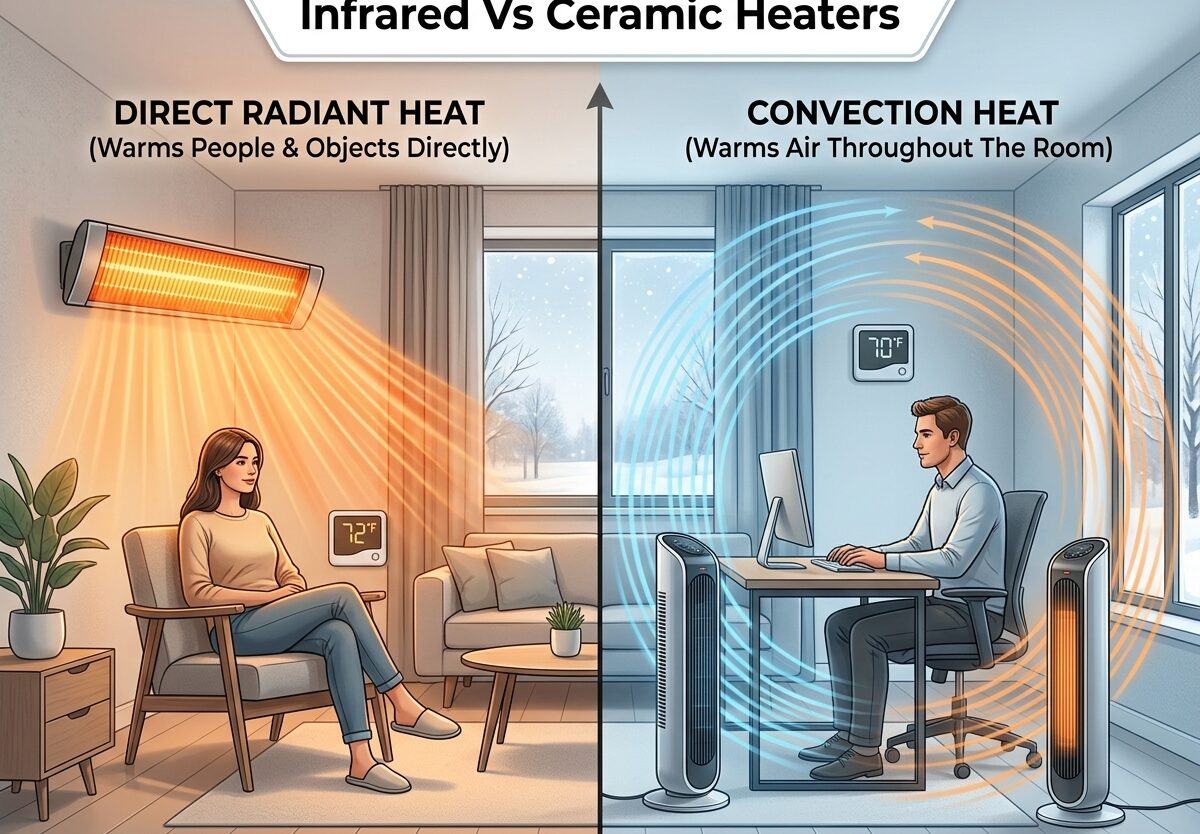
Choosing between infrared vs ceramic heaters comes down to how you want warmth delivered. Infrared heaters heat objects and people directly like sunlight, while ceramic heaters warm the air through convection. I’ve tested both types extensively and the right choice depends on your room size, insulation, and heating needs.
This comparison breaks down everything you need to know about infrared vs ceramic heaters, from how they work to which one saves more money on energy bills.
Quick Comparison: Infrared vs Ceramic Heaters
Here’s the direct answer if you’re in a hurry: Infrared heaters provide instant warmth to whatever’s in front of them and work best for spot heating or poorly insulated spaces. Ceramic heaters heat entire rooms more evenly but take longer to warm up and rely on fans that create noise and circulate dust.
| Feature | Infrared Heater | Ceramic Heater |
|---|---|---|
| Heating Method | Radiant (direct) | Convection (air) |
| Warm-up Speed | Instant (seconds) | Slower (5-15 minutes) |
| Best For | Spot heating, garages, large spaces | Small to medium rooms, bedrooms |
| Noise Level | Silent (no fan) | 45-60 dB (fan noise) |
| Air Quality | Doesn’t dry air or circulate dust | Can circulate dust and allergens |
| Energy Efficiency | Nearly 100% efficient at point of use | Heat loss through air movement |
What is an Infrared Heater?
Infrared heaters use electromagnetic radiation to transfer heat directly to objects and people in their path, similar to how the sun warms your skin on a cold day. Instead of heating the air, infrared waves warm whatever solid surfaces they encounter – furniture, walls, and especially you.
The technology works by passing electricity through a heating element (often quartz tubes or metal sheaths) that emits infrared radiation. This radiation travels unimpeded through the air until it hits a solid object, where it converts into heat. The objects then radiate that warmth back into the room, creating a secondary heating effect.
There are three main types of infrared heaters. Low-intensity models use lower temperatures and larger surface areas, while high-intensity versions concentrate heat in a smaller area. You’ll also find medium-wave options that balance coverage and intensity. The most common portable versions use quartz elements with reflectors to direct the heat outward.
What makes infrared unique is that the warmth is immediate. When you turn it on and step in front of it, you feel warm within seconds. This instant-on capability makes infrared ideal for situations where you need quick, targeted warmth rather than waiting for a whole room to heat up.
How Infrared Heating Works
Infrared heating is fundamentally different from conventional heating. It doesn’t rely on warming air as a medium for heat transfer. Instead, it sends electromagnetic waves that travel at the speed of light until they encounter matter. These waves pass through air without heating it significantly – that’s why infrared heaters can make you feel warm even if the surrounding air remains cool.
The heating elements in infrared heaters reach temperatures between 300-800 degrees Fahrenheit, depending on the model. This heat energy converts to infrared radiation with wavelengths between 1.5 to 10 micrometers – perfectly tuned to be absorbed by human tissue and building materials.
Once absorbed, this energy converts directly to thermal energy at the molecular level. The heated objects then become secondary heat sources, radiating warmth back into the space. This creates a more stable temperature environment because you’re heating thermal mass rather than just air that quickly loses heat.
What is a Ceramic Heater?
Ceramic heaters use convection heating to warm the air in a room. They work by forcing air over heated ceramic plates using a fan, which then circulates the warm air throughout the space. This is the same basic principle as your home’s forced-air furnace, just in a portable package.
The ceramic heating element consists of ceramic plates or cubes with aluminum fins. When electricity flows through the plates, they heat up quickly and transfer that warmth to the surrounding air. The fan pulls cool air from the room, pushes it across the hot ceramic elements, and expels the warmed air back into the space.
Ceramic heaters have become popular because the ceramic elements heat up and cool down faster than traditional metal coils. This makes them more responsive to temperature changes and generally safer – the ceramic cools quickly if the heater tips over or is accidentally covered.
Most ceramic heaters include adjustable thermostats, multiple heat settings (typically 750-1500 watts), and various safety features. You’ll find tower models, compact personal units, and baseboard-style designs. The fan is what makes ceramic heaters effective at whole-room heating, but it’s also the source of their main drawbacks.
How Ceramic Heating Works
Ceramic heating relies on convection currents to distribute warmth. The process begins with electricity flowing through the ceramic plates, which have high electrical resistance. This resistance converts electrical energy into heat, causing the ceramic to reach temperatures of 300-500 degrees Fahrenheit within minutes.
The fan component is crucial – without it, the heat would simply rise to the ceiling due to natural convection. The fan forces the air across the heating elements at a controlled rate, ensuring efficient heat transfer and more even distribution throughout the room. This forced air creates a circulation pattern that gradually raises the ambient temperature.
One characteristic of ceramic heating is what users call the “sawtooth pattern.” The heater cycles on and off to maintain the thermostat setting, creating temperature fluctuations rather than perfectly steady heat. When the heater runs, it warms rapidly; when it cycles off, the room cools until the thermostat triggers it again. This on-off cycling is normal for all fan-based space heaters.
Infrared vs Ceramic Heaters: Head-to-Head Comparison
The fundamental difference between these technologies comes down to heating method. Infrared uses radiant heat transfer – warming objects directly. Ceramic uses convection – warming air that then warms you. This single difference creates cascading effects on everything from comfort to efficiency.
Heating Speed
Infrared heaters win on speed. The moment you turn one on, you feel warmth within seconds. There’s no waiting period because the infrared waves travel at light speed to their target. If you’re sitting directly in front of an infrared heater, you’ll notice the difference almost immediately.
Ceramic heaters need 5-15 minutes to noticeably warm a room. They have to heat enough air to raise the ambient temperature, which takes time even with a powerful fan. During this warm-up period, you’re essentially waiting for the space to reach a comfortable level.
For instant comfort when you walk into a cold room, infrared can’t be beat. But once ceramic heaters have warmed the space, they maintain that temperature more evenly throughout the room rather than creating hot spots directly in front of the unit.
Heat Distribution
Infrared creates directional warmth – you need to be in the heater’s “line of sight” to feel its benefits. This works exceptionally well for spot heating – warming your workspace while you’re at your desk, or heating your favorite chair while you watch TV. But it means areas blocked from the heater’s path stay cooler.
Ceramic heaters provide more uniform room heating. The fan distributes warm air throughout the space, reaching corners and areas that infrared might miss. Once a ceramic heater has warmed the air, every part of the room receives roughly the same temperature (assuming decent air circulation).
This difference explains why infrared excels in large, open, or poorly insulated spaces where heating all the air would be wasteful. Ceramic performs better in smaller, enclosed rooms where you want consistent temperatures throughout.
Energy Efficiency
Both infrared and ceramic heaters convert nearly 100% of incoming electricity into heat – they’re equally efficient in terms of energy conversion. However, how that heat is used creates real efficiency differences in practice.
Infrared heaters are more efficient in poorly insulated spaces because they don’t waste energy heating air that immediately escapes through cracks or poor insulation. They heat objects directly, which retain heat better than air. If you’re using the heater for spot heating rather than whole-room heating, infrared uses less energy because you’re only warming what needs warming.
Ceramic heaters can be more efficient in well-insulated rooms where the warmed air stays contained. The initial energy investment heats the air, which then maintains that temperature with relatively little additional energy. However, in drafty or large spaces, ceramic heaters work continuously to replace escaping warm air, consuming more power.
Noise Level
This is one area where infrared has a clear advantage. Pure infrared heaters have no moving parts and operate in complete silence. The only sound you might hear is an occasional click when the thermostat cycles the heating element on or off.
Ceramic heaters produce fan noise that ranges from 45-60 decibels depending on the model and fan speed. This is roughly equivalent to background conversation or moderate rainfall. While not overwhelmingly loud, the constant whirring can be noticeable in quiet environments like bedrooms or home offices. Some premium models use quieter fans, but all ceramic heaters generate some noise.
For noise-sensitive environments like bedrooms, reading areas, or TV rooms, infrared’s silent operation is a significant advantage. The constant drone of a ceramic fan can become intrusive over time, especially at higher settings.
Pros and Cons of Infrared Heaters
Advantages
- Instant warmth: Feel heat within seconds of turning on
- Silent operation: No fan means zero noise
- Doesn’t dry air: Preserves humidity levels better than forced-air systems
- Doesn’t circulate dust: Better for allergy sufferers
- Efficient spot heating: Direct warmth where you need it
- Works in drafty spaces: Doesn’t rely on heating air that escapes
- Objects retain heat: Creates secondary warmth from heated surfaces
Disadvantages
- Directional heating: Must be in line of sight to feel warmth
- Less effective for whole rooms: Creates uneven heating patterns
- Heat dissipates quickly: Room cools rapidly when turned off
- Surface can get hot: Burn risk if touched during operation
- Not ideal for enclosed rooms: Air-based heating sometimes works better in small, sealed spaces
Pros and Cons of Ceramic Heaters
Advantages
- Even room heating: Distributes warmth throughout entire space
- Thermostat controlled: Maintains set temperature automatically
- Typically lower initial cost: Generally cheaper than infrared models
- Compact designs available: Many portable options
- Quick element response: Heats up and cools down faster than old coil heaters
- Better for small rooms: Efficiently heats enclosed spaces
Disadvantages
- Slower warm-up: Takes time to raise room temperature
- Fan noise: Constant humming or whirring sound
- Circulates dust and allergens: Can trigger allergies
- Dries air: Reduces humidity more than infrared
- Less efficient in large spaces: Wastes energy heating air that escapes
- Temperature cycling: Sawtooth heating pattern with fluctuations
When to Choose Infrared Heaters
Infrared heaters excel in specific scenarios. Choose infrared when you need instant, targeted warmth rather than whole-room heating. They’re ideal for large, open, or poorly insulated spaces where heating the air would be inefficient.
Garages and workshops: Infrared is perfect for these spaces because you can direct heat exactly where you’re working rather than trying to warm the entire garage. The instant warmth means you’re comfortable within seconds of arriving, and the directional heating lets you create a warm zone around your workbench.
Poorly insulated rooms: If your space has drafty windows or poor insulation, infrared won’t waste energy heating air that immediately escapes. Instead, it heats you and the objects around you directly, making the space feel warmer even if the ambient temperature hasn’t changed much.
Spot heating: When you’re mostly stationary – working at a desk, watching TV, or reading – infrared can create a warm zone exactly where you are without wasting energy heating unused parts of the room.
Bedrooms for light sleepers: The silent operation makes infrared ideal for bedrooms. You can run it all night without the constant drone of a fan disrupting your sleep.
Allergy and asthma sufferers: Because infrared doesn’t circulate air, it doesn’t stir up dust, pet dander, or other allergens. This makes it the better choice if respiratory issues are a concern.
Supplemental heating: Infrared works exceptionally well as a backup to your main heating system. You can lower the thermostat and use infrared to warm the specific areas where you spend time, reducing overall heating costs.
When to Choose Ceramic Heaters
Ceramic heaters shine when you need consistent, even temperatures throughout an entire room. They’re the better choice for smaller, well-insulated spaces where air-based heating makes sense.
Small to medium bedrooms: In a typical bedroom (up to 150 square feet with decent insulation), a ceramic heater will maintain an even temperature throughout the space. The thermostat will cycle on and off to keep the room at your preferred temperature overnight.
Home offices: If you work in a small enclosed room, ceramic provides consistent warmth without you needing to stay in one specific spot. You can move around the room while staying comfortable.
Well-insulated spaces: When the room holds heat well, ceramic heaters work efficiently. Once they’ve warmed the air, the insulation keeps that warmth contained, and the heater only runs intermittently to maintain temperature.
When budget is the primary concern: Ceramic heaters generally cost less upfront than comparable infrared models. If initial purchase price matters more than long-term efficiency or noise level, ceramic offers adequate performance at lower cost.
When you prefer gradual warming: Some people find the gradual, gentle warming of ceramic more comfortable than the intense, immediate heat of infrared. If you dislike feeling hot directly in front of the heater, ceramic’s distributed warmth might feel more pleasant.
Cost Analysis: Initial Price and Operating Costs
The initial purchase price typically favors ceramic heaters, which generally cost 20-30% less than equivalent infrared models. A basic 1500-watt ceramic heater might run $30-50, while a comparable infrared unit often costs $50-80. Premium models of both types can exceed $100, but the entry-level ceramic units are typically more affordable.
Operating costs depend entirely on how you use the heater. Both types consume roughly the same amount of electricity when running – about 1.5 kilowatts per hour on high setting. At the national average electricity rate of approximately $0.15 per kilowatt-hour, running either heater on high costs about $0.22 per hour.
For a full 24-hour period, continuous operation would cost roughly $5.28. In reality, heaters cycle on and off based on thermostat settings, so actual costs are lower. A typical usage pattern might involve 4-6 hours of actual heating time per day, resulting in daily costs of $0.88-$1.32.
The efficiency difference affects real-world costs. Infrared can be more economical in poorly insulated spaces because it doesn’t waste energy heating air that escapes. If you’re using it for spot heating rather than whole-room heating, you’ll consume less energy overall. Ceramic heaters in well-insulated rooms can also be efficient because they maintain temperature with intermittent cycling.
Over a heating season, the difference in operating costs between the two technologies is relatively modest – typically $10-30 per month depending on usage patterns and space characteristics. The bigger cost consideration is how effectively the heater meets your needs rather than minor efficiency differences.
Safety and Health Considerations
Both infrared and ceramic heaters include modern safety features like tip-over switches, overheat protection, and cool-touch exteriors. However, some differences exist in their safety profiles and health effects.
Burn Risk
Both heater types can present burn risks, but they manifest differently. Infrared heater grills and emitters can become extremely hot during operation – easily hot enough to cause burns if touched. However, the heat is localized to the front of the unit where the radiation emits.
Ceramic heaters also get hot, but the housing typically stays cooler to the touch than the grill of an infrared unit. The primary burn risk comes from the hot air outlet, which can burn hands if placed directly in front of the vent. Neither type should be operated with flammable materials nearby or left unattended around small children without proper safeguards.
Asthma and Allergy Considerations
This is one area where infrared has a clear advantage for health. Because infrared heaters don’t use fans, they don’t circulate dust, pollen, pet dander, or other allergens throughout the room. For asthma and allergy sufferers, this can significantly reduce symptoms during heating season.
Ceramic heaters continuously move air through their systems, which can stir up allergens that have settled on floors and surfaces. While many models include washable filters that capture some particulates, they still contribute to airborne allergen levels more than silent infrared units.
Additionally, ceramic heaters tend to dry the air more than infrared models because they actively move air over hot elements, accelerating evaporation. This can exacerbate respiratory discomfort for some people. Infrared heating preserves natural humidity levels better because it doesn’t actively process the air.
Fire Safety
Both modern infrared and ceramic heaters include tip-over protection that automatically shuts off the unit if it falls over. Both also include overheat protection that prevents dangerous temperatures. The fire risk from either type is minimal when used according to manufacturer guidelines.
The key safety practice for both types is maintaining clearance from flammable materials. Curtains, bedding, paper, and furniture should be kept at least three feet from any space heater. Neither type should be used with extension cords if possible, and never with power strips or timers not rated for the heater’s amperage.
Environmental Impact
Both infrared and ceramic heaters have similar environmental footprints when operating. They convert electricity to heat with nearly 100% efficiency, and neither produces emissions at the point of use. The environmental impact depends primarily on how your electricity is generated.
Some infrared heaters are marketed as “eco-friendly” based on their ability to heat only occupied zones rather than entire buildings. This targeted heating approach can reduce overall energy consumption compared to central heating systems that warm unoccupied spaces. However, this benefit comes from how you use the heater, not inherent differences in the technology.
From a manufacturing standpoint, both types contain similar materials – metal housings, electrical components, and heating elements. Neither contains hazardous materials that require special disposal. Both can typically be recycled at electronic waste facilities when they reach end of life.
The most significant environmental factor is actually how efficiently you use either heater type. Zone heating (warming only the rooms you’re using) with either infrared or ceramic reduces overall energy consumption compared to heating your entire home. The technology choice matters less than the usage pattern.
FAQ
What heats better, an infrared or ceramic heater?
Infrared heats better for direct, immediate warmth to objects and people in its path. Ceramic heats better for evenly warming entire rooms. The “better” option depends on your needs – choose infrared for instant spot heating or ceramic for consistent room-wide temperature.
Which room heater is best for asthma patients?
Infrared heaters are generally better for asthma patients because they don’t circulate air or stir up dust and allergens. Their silent operation without fans reduces airborne particulates that can trigger asthma symptoms. Ceramic heaters constantly move air, which can distribute allergens throughout the room.
How much does it cost to run a 1500 watt infrared heater for 24 hours?
Running a 1500 watt infrared heater continuously for 24 hours costs approximately $5.28 at the national average electricity rate of $0.15 per kilowatt-hour. In practice, heaters cycle on and off based on thermostat settings, so actual costs are typically lower – around $1-2 per day for normal usage patterns.
What are the downsides of infrared heating?
The main downsides of infrared heating include directional warmth that requires being in the heater’s line of sight, less effective whole-room heating, rapid heat loss when turned off, and hot surface temperatures that pose burn risks. Infrared also creates uneven temperatures in rooms with objects blocking the heat path.
Do ceramic heaters dry out the air?
Yes, ceramic heaters tend to dry out air more than infrared models because they actively move air over hot heating elements, which accelerates evaporation. This can reduce humidity levels and cause dry skin, throat irritation, or respiratory discomfort for some people, especially in already dry climates.
Which heater is quieter, infrared or ceramic?
Infrared heaters are significantly quieter because they have no moving parts and operate in complete silence. The only sound is an occasional click when the thermostat cycles. Ceramic heaters produce constant fan noise ranging from 45-60 decibels, similar to background conversation, which can be disruptive in quiet environments like bedrooms.
Can I leave an infrared heater on all night?
Yes, you can leave an infrared heater on all night if it has modern safety features like tip-over protection and overheat protection. The silent operation actually makes infrared ideal for nighttime use. However, always maintain proper clearance from bedding and curtains, and never leave any space heater running unattended for extended periods.
Are infrared heaters more efficient than ceramic?
Infrared and ceramic heaters convert electricity to heat with similar efficiency (nearly 100%). However, infrared can be more efficient in practice for poorly insulated spaces or spot heating because it doesn’t waste energy heating air that escapes. Ceramic is more efficient in well-insulated rooms where the warm air stays contained.
Conclusion
The infrared vs ceramic heaters debate ultimately comes down to your specific situation. There’s no universally better option – each technology excels in different scenarios.
Choose infrared heaters if you need instant warmth, want silent operation, have allergies or asthma, use the heater in a large or poorly insulated space, or primarily need spot heating rather than whole-room warming. The immediate comfort and allergen-free operation make infrared ideal for bedrooms, garages, and supplementing central heating in specific zones.
Choose ceramic heaters if you need even temperatures throughout a small to medium room, have a well-insulated space, are working with a tighter budget, or prefer gradual warming over intense directional heat. Ceramic’s ability to maintain consistent room-wide temperature makes it suitable for bedrooms, home offices, and other enclosed spaces where you’ll be moving around rather than staying in one spot.
Both technologies have evolved to become safe, efficient, and effective ways to supplement your home’s heating system. By understanding how each works and matching that to your specific needs – room size, insulation, usage patterns, and health considerations – you can choose the heater that will keep you comfortable while operating efficiently throughout the heating season.




Leave a Comment