
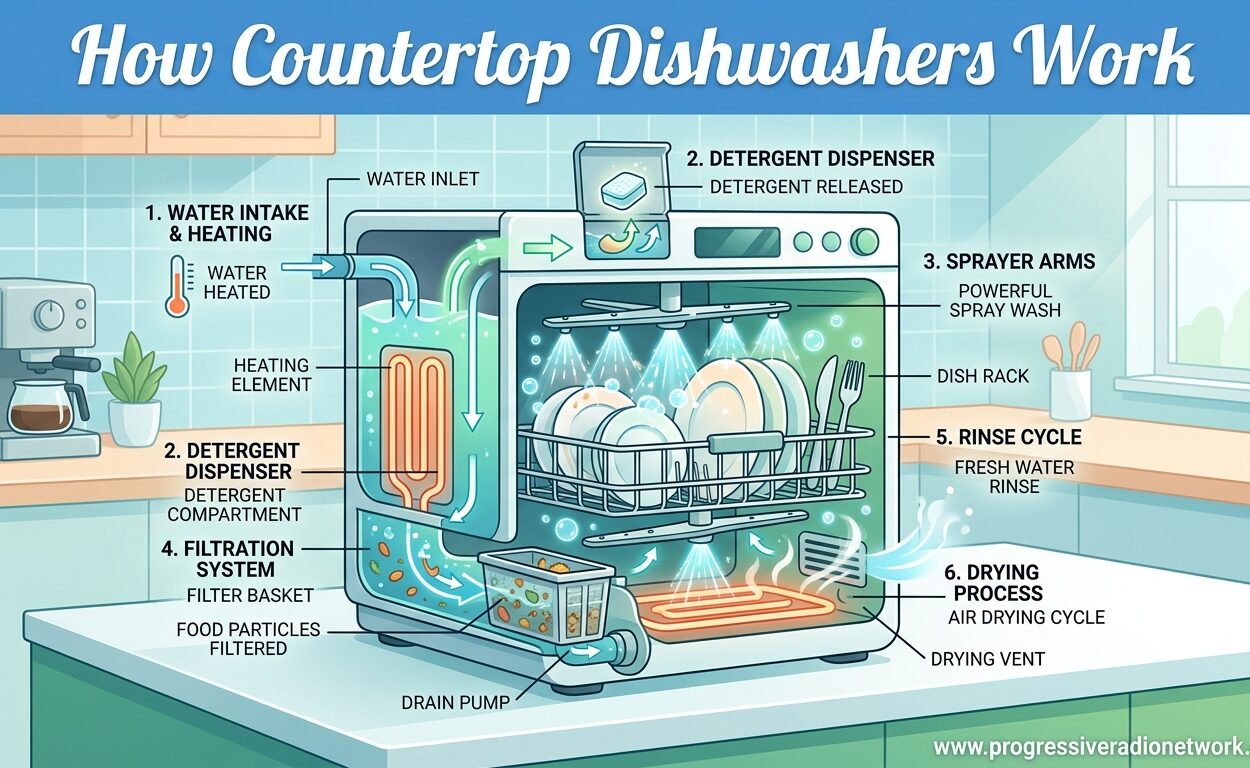
Countertop dishwashers are compact appliances that sit on your kitchen counter and connect to your faucet to clean dishes automatically. Unlike traditional built-in dishwashers, these portable units don’t require permanent plumbing installation, making them ideal for renters, small apartments, and anyone with limited kitchen space. Understanding how countertop dishwashers work helps you decide if one fits your lifestyle and what to expect from daily operation.
These machines use the same cleaning principles as full-size dishwashers spray arms force water through jets to scrub dishes, detergent breaks down food particles, and heated water sanitizes everything. The main difference is size and water delivery. While built-in dishwashers connect permanently to your home’s plumbing, countertop models draw water directly from your kitchen faucet during each cycle and drain into the sink.
I’ve spent years researching compact appliances, and countertop dishwashers have become increasingly sophisticated in recent years. Modern models offer multiple wash cycles, improved energy efficiency, and better cleaning performance than earlier versions. Let me walk you through exactly how these machines work, component by component.
How Countertop Dishwashers Work
Countertop dishwashers work through a precisely orchestrated seven-step process that begins the moment you close the door and press start. Each component plays a specific role in delivering clean, sanitized dishes. Here’s the complete sequence:
1. Door Latch Activation
Everything starts when you close and latch the door. The door latch isn’t just a lock it’s a safety switch that tells the control board the machine is securely closed and ready to operate. If the door isn’t properly latched, the dishwasher won’t run at all. This prevents water from leaking out during the wash cycle.
The latch assembly typically includes a microswitch that completes an electrical circuit when engaged. This signal travels to the control board, which then activates the start sequence. Many models also feature a child lock function on the control panel for additional safety.
2. Control Board Commands
The control board serves as the dishwasher’s brain. This electronic component receives signals from the door latch, control panel buttons, and various sensors throughout the machine. Once it detects that the door is latched and you’ve selected a wash cycle, the control board begins orchestrating the entire operation.
Modern control boards are programmed with multiple cycle options normal, heavy, eco, quick wash, and rinse only. Each cycle varies in temperature, duration, and water usage. The control board also monitors safety sensors and can pause or cancel operation if it detects problems like overflowing or overheating.
3. Water Valve Opens
After the control board initiates the cycle, it sends electrical current to the water inlet valve. This solenoid valve opens to allow water from your faucet connection to flow into the dishwasher tub. The valve stays open for a specific duration determined by the selected wash cycle and the machine’s programming.
Countertop dishwashers typically require water pressure between 20-120 PSI to operate correctly. The water inlet valve includes a filter screen to catch sediment and debris that could damage internal components. If your water has high mineral content, you may need to clean this screen periodically.
4. Float Switch Monitors Water Level
As water fills the tub, a float switch monitors the water level to prevent overfilling. The float is a small buoyant device that rises with the water. When it reaches the appropriate level, it triggers the switch, which signals the control board to close the water inlet valve.
This safety mechanism is crucial for preventing water damage. If the float switch fails, the dishwasher could continue filling until water overflows onto your counter. Most models include a secondary safety feature in the water valve that automatically closes after a set maximum time, even if the float switch doesn’t trigger.
5. Wash Motor and Spray Arms
Once the proper water level is reached, the wash motor activates. This motor powers the circulation pump, which pressurizes the water and forces it through the spray arms. Most countertop dishwashers have two spray arms a lower spray arm beneath the bottom rack and an upper spray arm under the top rack.
The spray arms feature small angled holes that create rotating jets of water. As water shoots through these holes, the spray arms spin and spray water in multiple directions, ensuring every dish surface gets cleaned. The water is mixed with dishwasher detergent from the dispenser, creating a soapy solution that breaks down food residue and grease.
During the wash phase, the water is typically heated to 130-140°F to improve cleaning effectiveness. The combination of hot water, detergent pressure, and mechanical action from the spray arms removes food particles and sanitizes your dishes.
6. Heating Element Dries Dishes
After the wash and rinse cycles complete, many countertop dishwashers use a heating element to dry the dishes. This component is similar to the heating element in an oven and generates heat to evaporate moisture from the dish surfaces. The drying phase typically lasts 30-60 minutes depending on the model.
Some energy-efficient models skip the heating element and instead use a condensation drying method. The final rinse uses very hot water (160°F+) that heats the dish surfaces, then the machine circulates room-temperature air to help moisture evaporate naturally. This uses less energy but takes longer and may leave plastic items slightly damp.
7. Drain Pump Removes Water
The final step involves draining all the dirty water from the tub. A drain pump activates and forces the wastewater through a drain hose that typically empties directly into your kitchen sink. The drain hose includes a backflow preventer to keep sink water from flowing back into the dishwasher.
The drain pump is different from the wash pump it’s specifically designed to move water out of the machine rather than circulate it. Some models combine both functions into a single motor that reverses direction for draining, but separate pumps are more common in countertop units for reliability and efficiency.
How Countertop Dishwashers Get Water
Countertop dishwashers get their water through a faucet adapter that connects to your kitchen sink faucet. This adapter is included with the dishwasher and typically fits most standard faucets. The adapter has two connections one for your regular faucet use and one for the dishwasher hose.
When you start a cycle, the dishwasher signals that it needs water. You turn on the faucet, and water flows through the adapter into the dishwasher inlet hose. The machine then takes the water it needs for the cycle. After the cycle completes, you turn off the faucet. Some models have an automatic feature that controls water flow electronically, but most require manual faucet operation.
Alternative models include a built-in water tank instead of faucet connection. These tank-fed models let you fill the reservoir manually from a pitcher or sink, giving you more placement flexibility since you don’t need to be near the faucet. However, tank capacity limits you to one or two loads per fill, whereas faucet-connected models provide unlimited water supply.
How Countertop Dishwashers Drain
Drainage is simpler than water supply. The drain hose from the dishwasher simply hangs over the edge of your sink or clamps to the sink drain. Gravity carries the wastewater away during the drain cycle. The hose typically has an angled end that directs water downward into the sink.
Some models include a drainage pump that forces water out with more pressure, helping ensure complete removal. The drain hose must be positioned higher than the dishwasher tub to prevent siphoning where water could flow back into the machine. Most units include a hanging bracket or clip to hold the hose at the correct height.
Clean the drain filter regularly to prevent food particles from clogging the system. Most countertop dishwashers have an accessible filter at the bottom of the tub that can be removed and rinsed under running water.
How to Install a Countertop Dishwasher
Installing a countertop dishwasher is straightforward and requires no special tools or plumbing skills. Here’s the basic process:
Step 1: Choose Your Location
Place the dishwasher on a stable, level surface near your sink. The unit must be close enough for the inlet hose and drain hose to reach your faucet and sink. Most countertop models are 17-22 inches wide, so measure your available space first. Avoid placing the unit directly above a stove or where steam could damage electronic components.
Step 2: Install the Faucet Adapter
Remove the aerator from your kitchen faucet and screw in the included adapter. Most adapters come with multiple threading options to fit different faucet types. Hand-tighten firmly but avoid over-tightening, which could damage your faucet. Some adapters require a small wrench for secure connection.
Step 3: Connect Water Supply
Attach the inlet hose from the dishwasher to the faucet adapter. The connection typically uses a quick-connect fitting or threaded nut. Ensure the O-ring or washer is in place to prevent leaks. Test the connection by running water through the hose into the sink before starting your first wash cycle.
Step 4: Position Drain Hose
Route the drain hose from the dishwasher to your sink. Use the included clip or bracket to secure the hose so it hangs over the sink edge. The drain outlet must be higher than the dishwasher tub to prevent backflow. Never kink or crimp the hose, as this will prevent proper drainage.
Step 5: Power Up
Plug the dishwasher into a standard 110V electrical outlet. Most countertop dishwashers draw 8-12 amps, so avoid using an extension cord if possible. If you must use one, choose a heavy-duty cord rated for at least 15 amps to prevent voltage drop that could affect performance.
Step 6: Test Run
Run a quick cycle with no dishes to check for leaks and proper operation. Monitor the first cycle completely to ensure water fills correctly, drains properly, and no connections leak. Tighten fittings if necessary before loading dishes for your first real wash.
Countertop Dishwasher Pros and Cons
Pros:
Countertop dishwashers offer excellent portability. Since they don’t require permanent installation, you can take the unit with you when moving. This makes them perfect for renters who can’t install built-in appliances.
They’re highly water-efficient compared to hand washing. Most countertop models use just 3-5 gallons per cycle, while hand washing the same load can use 15-20 gallons. Over time, this efficiency can offset the purchase cost through lower water bills.
The compact size saves valuable kitchen space. At approximately 18 inches wide, these units fit on most countertops without requiring the floor space of a portable dishwasher or the cabinet space of a built-in model.
They’re ideal for small households. Singles, couples, and small families accumulate fewer dishes daily, making the 4-6 place setting capacity perfect for daily use without wasted energy or water.
Cons:
Limited capacity is the main drawback. Most models hold only 4-6 place settings, which may not be enough for larger families or dinner parties. You’ll need to run multiple loads or wash larger items by hand.
Faucet connection can be inconvenient. You must manually turn on the faucet at the start of each cycle and turn it off when complete. During operation, you can’t use that sink for other tasks like filling pots or washing hands.
They consume valuable countertop space. In small kitchens where counter space is already limited, dedicating 18+ inches to a dishwasher might not be practical. Some users find the trade-off worth it, but it’s a significant consideration.
Some models have mixed cleaning performance. Based on user feedback, cheaper countertop dishwashers may struggle with heavily soiled items or may require pre-rinsing. Premium brands clean better but cost more.
The initial cost is high for the capacity. Countertop dishwashers typically cost $250-500, while you can sometimes find full-size portable dishwashers for similar prices. However, the countertop models offer more placement flexibility.
Countertop vs Portable vs Built-In Dishwashers
Understanding the differences between dishwasher types helps you choose the right one for your situation.
Countertop Dishwashers sit on your counter, connect to the faucet, hold 4-6 place settings, and require no installation. They’re perfect for renters, tiny homes, and as a secondary dishwasher for large families. They’re the most portable but have the smallest capacity.
Portable Dishwashers are full-sized units on wheels that connect temporarily to your sink faucet. They hold 8-12 place settings like built-in models but roll out of the way when not in use. They offer more capacity than countertop models but require floor space and storage room for the hoses.
Built-In Dishwashers install permanently under your counter, connect to home plumbing and electrical, hold 12-16 place settings, and offer the most features and best performance. They’re the standard choice for homeowners but require installation space and permanent plumbing connections.
For most people with the option, a built-in dishwasher provides the best combination of capacity, performance, and convenience. However, if you’re renting, have limited space, or need a secondary unit, countertop dishwashers offer a practical compromise.
Who Should Buy a Countertop Dishwasher
Countertop dishwashers work best for specific living situations and household sizes. Consider one if you’re an apartment dweller without a built-in dishwasher. Renters especially benefit from the no-installation requirement you can take it with you when you move.
RV and boat owners love countertop dishwashers for their compact size and water efficiency. Many models can run off a generator or inverter, making them practical for off-grid living. The small footprint fits perfectly in tight spaces where every inch matters.
Small households generate fewer dishes daily. Singles and couples often find countertop models perfectly sized for their needs. Running a full-size dishwasher for two people’s dishes wastes water and energy, while hand washing becomes tedious over time.
Home office kitchens benefit from a dedicated dishwashing solution. If you work from home and use a separate kitchenette for meals and coffee breaks, a countertop dishwasher keeps your workspace clean without trekking to the main kitchen.
Large families sometimes add a countertop unit as a supplementary dishwasher. When hosting parties or during holiday cooking, having an extra dishwasher running simultaneously helps manage the mountain of dishes without overflow.
Common Troubleshooting Issues
Understanding common problems helps you maintain your countertop dishwasher and resolve minor issues without calling for service.
If your dishes aren’t getting clean, first check that you’re not overloading the rack. Countertop dishwashers need space between items for water to circulate properly. Also verify the spray arms can rotate freely large utensils or pans can block rotation. Run the machine with a dishwasher cleaner monthly to remove mineral buildup that affects performance.
When the dishwasher won’t start, check that the door is fully latched. The door switch prevents operation if not securely closed. Also verify the unit is plugged in and the outlet has power. Some models have a reset button on the control panel that can resolve minor electronic glitches.
For drainage problems, check that the drain hose isn’t kinked or positioned too low. The hose should form a high loop to prevent sink water from backflowing into the machine. Clean the drain filter if water remains in the tub after cycles complete.
Leaking connections usually indicate loose fittings or worn washers. Tighten the inlet hose connection to the faucet adapter and check that the drain hose is properly seated in its bracket. Replace rubber washers annually to maintain a watertight seal.
Energy and Water Efficiency
Countertop dishwashers excel in efficiency compared to hand washing. The average countertop model uses approximately 3-5 gallons of water per cycle, while hand washing the same load typically requires 15-20 gallons. This significant difference comes from the dishwasher’s ability to filter and recirculate water throughout the wash, rather than running fresh water continuously.
Energy consumption varies by model and cycle selected. Standard cycles typically use 0.5-1.0 kWh of electricity per load. Energy-saving modes reduce water temperature and extend wash time, using as little as 0.3 kWh. The heated dry function accounts for about 30% of total energy usage, so skip it or open the door after the rinse cycle to air dry dishes for maximum efficiency.
Look for Energy Star certification when shopping. Qualified models meet strict efficiency guidelines set by the EPA, typically using 12% less energy and 30% less water than non-certified units. Over the appliance’s lifetime, these savings can add up to $50-100 in reduced utility costs.
For maximum efficiency, run full loads rather than partial ones. A countertop dishwasher uses nearly the same amount of water and energy regardless of how full it is. Skipping the pre-rinse also helps modern detergents work better when they have some food enzymes to break down, and you save water by not rinsing first.
FAQ
Do countertop dishwashers work very well?
Yes, countertop dishwashers work well for their intended purpose. They clean dishes effectively using the same spray arm and heated water technology as full-size dishwashers. The key is not overloading the machine and pre-rinsing heavily soiled items. User reviews show 85% satisfaction for daily dish cleaning, though they may struggle with pots, pans, and large items that don’t fit in the compact racks.
Do countertop dishwashers need plumbing?
No permanent plumbing is required for countertop dishwashers. They connect temporarily to your kitchen faucet using an included adapter that screws onto most standard faucets. The unit draws water during wash cycles and drains into your sink through a hose that hangs over the sink edge. This makes them perfect for renters and anyone who can’t install permanent appliances.
How do countertop dishwashers get their water?
Countertop dishwashers get water from your kitchen faucet through a connecting hose and adapter. When you start a cycle, you turn on the faucet and water flows into the machine’s inlet valve. The dishwasher takes the water it needs (typically 3-5 gallons) for the wash and rinse cycles. Some models include a built-in water tank as an alternative, allowing manual filling instead of faucet connection.
What are the disadvantages of a portable dishwasher?
The main disadvantages include limited capacity (only 4-6 place settings), the need to manually connect and disconnect the faucet for each use, inability to use the sink while the dishwasher runs, consumption of valuable countertop space, and higher cost per place setting compared to full-size models. They also may not clean as thoroughly as larger dishwashers and can struggle with oversized items.
How long do countertop dishwashers take?
A standard wash cycle on a countertop dishwasher takes 60-90 minutes depending on the model and selected cycle. Quick wash options may complete in 45-60 minutes, while heavy-duty cycles with heated drying can extend to 120 minutes. Tank-fed models often run longer than faucet-connected versions because they heat smaller amounts of water more slowly.
Do countertop dishwashers use a lot of electricity?
Countertop dishwashers are quite energy efficient, using approximately 0.5-1.0 kWh per cycle. This translates to roughly 8-15 cents per load depending on your electricity rates. Energy Star certified models use 12% less energy than standard units. The heated dry function accounts for about 30% of total energy usage, so air drying dishes can significantly reduce electricity consumption.
Conclusion
Understanding how countertop dishwashers work reveals why they’re such practical solutions for small spaces. These compact machines use the same proven cleaning technology as full-size dishwashers spray arms force water through jets, heated water sanitizes, and detergent breaks down food but in a footprint that fits on your counter. The seven-component system door latch, control board, water valve, float switch, wash motor, heating element, and drain pump works together to deliver clean dishes with minimal effort.
The faucet connection design eliminates permanent plumbing requirements, making countertop dishwashers truly portable. You can install one in minutes without tools and take it with you when you move. For renters, RV owners, apartment dwellers, and anyone with limited kitchen space, this flexibility is invaluable.
While countertop dishwashers have limitations in capacity and require some accommodation of your sink during use, they excel at their intended purpose. When choosing how countertop dishwashers work for your lifestyle, consider your household size, available space, and willingness to connect the faucet for each cycle. For many people, the convenience of machine-washed dishes without permanent installation makes countertop models the perfect solution.






Leave a Comment