
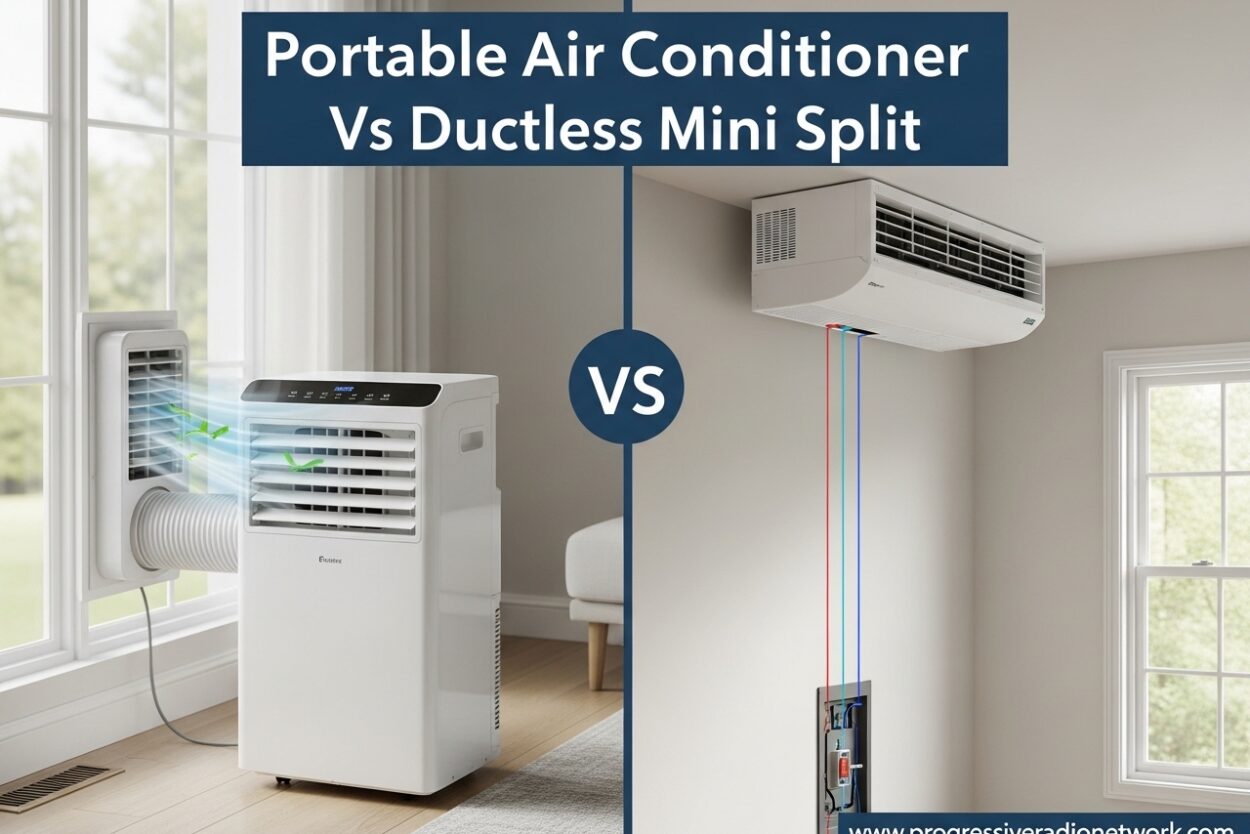
If you’re staring down a hot summer with a room that central AC can’t reach, you’ve probably found yourself stuck between two options. The portable air conditioner vs ductless mini split debate is one I see homeowners struggle with every cooling season. Having spent years researching HVAC solutions and analyzing real user experiences, I can tell you this isn’t just about picking the cheaper option upfront.
The choice between these two cooling systems impacts your comfort, your energy bills, and your wallet for years to come. Portable ACs promise convenience and low upfront costs, while ductless mini splits offer efficiency and performance that comes at a premium. After analyzing hundreds of user experiences and consulting with HVAC professionals, I’ll break down exactly what you need to know to make the right choice for your space.
Portable Air Conditioner Vs Ductless Mini Split: Quick Comparison
Before diving into the details, here’s the reality: portable air conditioners and ductless mini splits serve similar purposes but operate in completely different ways. A portable AC is a self-contained unit on wheels that vents hot air through a window hose. A ductless mini split is a permanent HVAC system with an outdoor compressor and indoor air handler, connected by refrigerant lines.
The difference in performance between these two options is significant. Users consistently report that even with the same BTU rating, mini splits cool rooms faster and more effectively than portable units. One Reddit user summed it up perfectly after switching from a 12,000 BTU portable to a 9,000 BTU mini split: “It’s night and day. The portable barely cooled my basement and I’d still be sweating. The mini split actually keeps me comfortable.”
What Is a Portable Air Conditioner?
A portable air conditioner is a standalone cooling unit contained in a single cabinet on wheels. It’s designed to be moved between rooms as needed, making it appealing for renters or anyone who wants flexibility. The unit pulls warm air from your room, passes it over cooling coils, and expels the heat through an exhaust hose that must be vented out a window or sliding door.
Portable ACs work using the same refrigeration cycle as window units and central air, but everything is packaged into one box. They typically range from 8,000 to 15,000 BTUs and are rated to cool rooms between 250 to 500 square feet. Most models also function as dehumidifiers, and some include heating capabilities.
The setup is simple: position the unit near a window, connect the exhaust hose with the included window kit, plug it in, and you’re cooling. This simplicity is their biggest selling point. However, there’s a catch that many buyers don’t realize until after purchase.
How Portable ACs Really Work
Here’s what the marketing doesn’t always mention: portable air conditioners create negative pressure in your room. By expelling air through the exhaust hose, they’re actively pulling air out of your space. This creates a vacuum effect that draws hot outdoor air back in through cracks, outlets, and any other openings in your room.
Think about it like this. For every cubic foot of air the portable AC blows out the window, another cubic foot of hot air sneaks back in. This is why portable ACs often struggle to maintain temperatures, especially in poorly insulated rooms. You’re essentially in a constant battle against physics, and your portable unit is fighting an uphill war.
Portable AC Pros
Despite the challenges, portable air conditioners do have legitimate advantages that make them the right choice for certain situations.
Low upfront cost: Most quality portable ACs cost between $400 and $900, making them accessible for budgets that can’t handle a mini split investment. You can get cooling tomorrow for under $500 in many cases.
No installation required: This is the biggest advantage. Anyone can set up a portable AC in about 10 minutes. No drilling holes, no mounting equipment, no hiring professionals. You unpack, position the unit, attach the window kit, and you’re done.
Portability: The name says it all. You can move a portable AC from your bedroom during the day to your living room at night. This flexibility is perfect if you only need cooling in one space at a time.
Renter-friendly: Since there’s no permanent installation, portable ACs are ideal for apartments and rental homes. When you move, the unit comes with you.
Works in any room with a window: As long as you have a window or sliding door to vent the hose, you can cool that room. This makes portable ACs versatile for different spaces.
Portable AC Cons
The drawbacks of portable air conditioners are significant and often catch buyers off guard.
Loud operation: Portable ACs are noisy. Really noisy. They typically run between 50 and 60 decibels, which is like having a running shower in your room. The compressor is right there with you, not outside like a mini split. Many users find them difficult to sleep with.
Poor energy efficiency: Portable ACs use significantly more electricity than equivalent capacity mini splits. The constant on/off cycling, the negative pressure issue, and less efficient components all contribute to higher energy bills. Expect your portable AC to be one of the biggest energy hogs in your home during summer.
Limited cooling power: Even with high BTU ratings, portable ACs struggle in real-world conditions. That 14,000 BTU portable might effectively cool like a 9,000 BTU window unit due to the heat gain from air infiltration. Users in extreme heat often report portables can’t get rooms below 75-78 degrees.
Window obstruction: The exhaust hose and window kit block part of your window. This limits natural light and airflow, and some homeowners associations restrict their use.
Moisture management: Many portable ACs require manual emptying of the condensate tank, especially in humid climates. Some units evaporate moisture and vent it out the exhaust hose, but this reduces cooling efficiency and creates even more humidity in already-damp conditions.
Short lifespan: Portable ACs typically last 7-10 years with proper maintenance, compared to 15-20 years for mini splits. The all-in-one design means the compressor runs in dirty indoor air, and the compact components work harder than split systems.
Single-room cooling: A portable AC only cools the room it’s in. You can’t cool multiple rooms with one unit, and the effectiveness drops significantly with doorways and open spaces.
What Is a Ductless Mini Split?
A ductless mini split system is a permanent HVAC solution consisting of two main components: an outdoor condenser unit and one or more indoor air handlers mounted high on a wall. The two are connected by refrigerant lines that require a small hole through an exterior wall, about three inches in diameter.
Mini splits operate using the same technology as central air conditioning, but without the ductwork. The outdoor unit houses the compressor and condenser, while the indoor unit contains the evaporator coil and blower. Refrigerant circulates between the two, absorbing heat indoors and releasing it outside.
Modern mini splits use inverter technology, which allows the compressor to vary its speed based on cooling demand. Instead of blasting at full power and shutting off like portable ACs, mini splits can run at lower speeds continuously, maintaining precise temperature control with remarkable efficiency.
The result is a system that can cool rooms effectively, quietly, and efficiently. Single-zone systems cool one room, while multi-zone setups can have up to eight indoor units connected to one outdoor compressor.
Mini Split Pros
The advantages of ductless mini splits explain why they’re rapidly gaining popularity, especially in homes without existing ductwork.
Superior energy efficiency: Mini splits are incredibly efficient, with SEER2 ratings typically between 18 and 30, compared to 8-12 for portable ACs. This translates to 40-60% lower energy consumption for the same cooling capacity. Over time, these savings can offset the higher installation cost.
Quiet operation: With the noisy compressor outside, mini splits run at just 25-35 decibels indoors. That’s quieter than a library. Many users report forgetting the unit is even running.
Powerful cooling: Mini splits deliver rated cooling capacity without the air infiltration issues of portables. A 12,000 BTU mini split actually cools like a 12,000 BTU unit should. They can maintain temperatures even in extreme heat.
Heating capability: Most mini splits are heat pumps, providing both cooling and heating. This makes them year-round solutions, not just summer appliances. The heating efficiency is equally impressive, with many units rated for operation down to -13 degrees Fahrenheit.
Zoned comfort: Each indoor unit operates independently, allowing different temperatures in different rooms. This eliminates the thermostat wars and prevents cooling empty spaces.
Long lifespan: With the compressor outdoors protected from the elements and quality components throughout, mini splits typically last 15-20 years with minimal maintenance.
Improved air quality: Many mini splits include multi-stage filtration that removes dust, allergens, and other particles from your air. Some models even include plasma ion purification.
Clean appearance: Indoor units are sleek and wall-mounted, taking up minimal floor space. No hoses to trip over and no blocking your windows.
Mini Split Cons
Despite their advantages, ductless mini splits have legitimate drawbacks that make them unsuitable for some situations.
High upfront cost: This is the biggest barrier. A complete single-zone mini split system costs between $3,000 and $8,000 installed. The equipment alone runs $1,500-4,000, with professional installation adding $1,500-4,000 more depending on complexity.
Permanent installation required: Mini splits aren’t DIY projects for most homeowners. Installation requires drilling through exterior walls, mounting equipment, handling refrigerant, and electrical work. Professional installation is strongly recommended and usually required to maintain warranty coverage.
Not portable: Once installed, the system stays. You can’t move it to a different room or take it with you if you move. This makes mini splits a poor choice for renters or anyone planning to relocate.
Appearance concerns: While modern indoor units are sleek, not everyone wants a wall-mounted box in their room. Placement is limited by proximity to the outdoor unit and structural considerations.
Requires exterior access: The refrigerant lines need a clear path to the outdoor condenser. This can complicate installations in apartments, condos, or homes with limited exterior wall access.
Permit requirements: Many municipalities require permits for mini split installation, adding cost and complexity to the process.
Maintenance needed: While less than central air, mini splits do require regular filter cleaning and occasional professional maintenance. Neglecting maintenance can significantly reduce efficiency and lifespan.
Cost Comparison: Portable AC vs Mini Split
The cost difference between these two options is substantial, but the full picture includes more than just the purchase price. Let’s break down the complete cost over five years of ownership.
| Cost Category | Portable AC (12,000 BTU) | Mini Split (12,000 BTU) |
|---|---|---|
| Equipment Cost | $500-$800 | $1,500-$3,000 |
| Installation | $0 (DIY) | $1,500-$4,000 (professional) |
| Initial Total | $500-$800 | $3,000-$7,000 |
| Annual Energy Cost | $250-$400 | $100-$180 |
| 5-Year Energy Cost | $1,250-$2,000 | $500-$900 |
| 5-Year Total Cost | $1,750-$2,800 | $3,500-$7,900 |
As you can see, the portable AC costs significantly less upfront, but the energy savings from a mini split begin to offset the difference after about 8-10 years. If you plan to stay in your home long-term or use the system heavily, the mini split becomes more economical over time.
The “$5000 rule for HVAC” that many industry professionals reference suggests that if the cost of a repair or replacement exceeds 50% of a new system’s value, replacement makes more sense. Applied to our comparison, investing in a mini split makes sense if you’ll own the home for 10+ years or need year-round heating and cooling.
Energy Efficiency Deep Dive
The energy efficiency difference between portable ACs and mini splits is one of the most significant factors in this comparison. This isn’t just about saving money—it’s about environmental impact and actual cooling performance.
Mini splits typically have SEER2 (Seasonal Energy Efficiency Ratio) ratings between 18 and 30, with premium models reaching above 30. SEER2 measures cooling output divided by energy input over a typical cooling season. Higher is better. By comparison, portable ACs usually rate between 8 and 12 EER (Energy Efficiency Ratio), which is a similar but slightly different metric.
What this means in practice: a mini split uses 40-60% less electricity to produce the same amount of cooling. If you’re running your AC 8 hours a day for 4 months during summer, a portable AC might cost $300-400 per year in electricity, while an equivalent mini split would cost $120-180.
The efficiency gap exists for several reasons. Inverter technology in mini splits allows variable-speed operation, avoiding the energy spikes of on/off cycling. The split design places the compressor outdoors where it can reject heat more efficiently. And mini splits don’t suffer from the air infiltration problem that plagues portable units.
From an environmental perspective, the lower energy consumption of mini splits means reduced carbon emissions from power generation. If you’re trying to minimize your carbon footprint, a mini split is the clear winner.
Noise Level Comparison
If you’re sensitive to noise or planning to install a unit in a bedroom, the sound difference between these options matters immensely.
Portable ACs run between 50 and 60 decibels on low speed, and 60-65 dB on high. To put this in perspective, 50 dB is like moderate rainfall, 60 dB is normal conversation volume, and 65 dB is like a running shower. The noise comes from the compressor and fan located right in the room with you. Users frequently report difficulty sleeping with a portable AC, and some describe the constant on-off cycling as disruptive.
Mini splits operate at 25-35 decibels indoors. At 25 dB, you’re below the sound of a whisper. Even at 35 dB, you’re quieter than a library. How is this possible? The noisy compressor is outside, and the indoor unit only contains a quiet fan. Users often report forgetting the mini split is even running, and many say it’s silent enough for bedroom use without disrupting sleep.
If noise is a priority for you, the mini split wins hands down. The 20-30 dB difference is substantial and will be immediately noticeable in daily use.
Installation Requirements
The installation process for these two cooling options is dramatically different, and this alone determines the right choice for many situations.
Portable AC installation is truly DIY-friendly. You’ll need a window or sliding door to vent the exhaust hose, a standard electrical outlet, and about 10 minutes of your time. Most units include a window kit that adjusts to fit various window sizes. The only potential challenge is if you have casement windows or windows that swing out, as standard window kits may not work.
Mini split installation is a professional job that requires specific skills and tools. The process involves mounting the indoor unit on an interior wall, cutting a 3-inch hole through to the exterior, mounting the outdoor condenser on a concrete pad or bracket, running refrigerant lines between the units, electrical connections, and vacuuming and charging the system with refrigerant.
Most manufacturers require professional installation to validate the warranty, and improper installation can cause poor performance, refrigerant leaks, and premature system failure. Installation typically takes 1-2 days and requires coordination between you and an HVAC contractor.
Some mechanically inclined homeowners do install DIY mini split systems, particularly pre-charged models that don’t require vacuuming and refrigerant charging. However, this still requires comfort with electrical work, drilling through exterior walls, and mounting heavy equipment. For most people, professional installation is the smart choice.
Lifespan and Durability
How long your cooling system lasts directly impacts the long-term value equation. This is another area where mini splits have a clear advantage.
Portable ACs typically last 7-10 years with proper maintenance. The all-in-one design means components are packed tightly together, generating heat and stress. The compressor runs in dirty indoor air, which can reduce its lifespan. Many users report portable ACs declining in performance after 3-5 years, with reduced cooling capacity and increased noise.
Mini splits typically last 15-20 years with minimal maintenance. The split design separates the components optimally—the durable compressor is outdoors protected from weather, while the indoor unit contains only the blower and evaporator coil. High-quality mini splits from reputable brands can even exceed 20 years with proper care.
The longevity advantage of mini splits means that while they cost more upfront, you may buy two or three portable ACs in the time one mini split lasts. This further strengthens the long-term value proposition of mini splits for permanent installations.
Real User Scenarios
Let’s look at some specific situations to understand which option makes sense in different scenarios.
Garage Workshop: If you’re cooling a detached garage for woodworking or automotive work, a mini split is often the better choice if you own the space. Garages are challenging to cool due to poor insulation and heat-generating tools. A mini split’s consistent cooling power and ability to maintain temperature in difficult conditions makes it ideal. However, if you rent or only need occasional cooling, a portable AC is more practical.
Home Office: For a dedicated home office you use daily, a mini split provides quiet, efficient cooling that won’t disrupt video calls or concentration. The lower operating costs make sense for year-round use. But if your home office is temporary or you move between rooms, a portable AC offers flexibility.
Bedroom: If you’re a light sleeper, the mini split’s quiet operation is a game-changer. The difference between 60 dB from a portable and 30 dB from a mini split will significantly impact your sleep quality. However, if you’re renting and can’t install permanent equipment, a portable AC may be your only option despite the noise.
Converted Attic: Attics present unique challenges with heat buildup and often lack existing HVAC. A mini split is ideal for permanent attic conversions, providing efficient cooling for a space that’s difficult to condition. However, if the attic conversion is temporary or you can’t modify the exterior wall, a portable AC might be necessary.
Rental Property: As a renter, portable ACs are almost always your best option. The lack of permanent installation and portability between units makes them practical for temporary living situations. Unless your landlord allows and helps with installation, mini splits usually aren’t feasible in rentals.
Climate-Specific Considerations
Where you live impacts which cooling option will serve you best.
Humid climates: In areas with high humidity, both systems handle moisture differently. Portable ACs often struggle in very humid conditions because they’re trying to cool and dehumidify simultaneously, which reduces cooling efficiency. Some models require frequent emptying of water tanks. Mini splits handle humidity more effectively, with most condensing and draining moisture automatically. However, extremely humid climates may require additional dehumidification with either system.
Dry, hot climates: In desert regions with dry heat, portable ACs perform better because they’re not fighting high humidity. The lower humidity also reduces the negative pressure issue since you’re not battling moist outdoor air. However, mini splits still offer superior efficiency in any climate, and the energy savings are even more significant in areas with long cooling seasons.
Mixed climates: If you experience both hot summers and cold winters, the heating capability of most mini splits adds significant value. Having a single system that handles both heating and cooling is convenient and cost-effective. Portable ACs with heating capability exist but are generally less effective and efficient than mini split heat pumps.
Which One Is Right for You?
Based on everything we’ve covered, here’s a straightforward framework to make your decision.
Choose a portable air conditioner if: You’re renting and can’t make permanent modifications, you need flexibility to move cooling between rooms, your budget is limited to under $1,000, you only need cooling occasionally or for short periods, you plan to move within 2-3 years, or installation access is difficult.
Choose a ductless mini split if: You own your home and plan to stay for 5+ years, you value quiet operation, you want the lowest operating costs, you need year-round heating and cooling, you’re cooling a challenging space like a garage or attic, you’re concerned about environmental impact, or you want a permanent, professional solution.
Decision Checklist
Still undecided? Answer these five questions:
- Do you rent or own? Rent = portable AC. Own with 5+ years staying = mini split.
- What’s your total budget? Under $1,500 = portable AC. Over $3,000 = mini split.
- How important is quiet operation? Critical for sleep = mini split. Not important = either.
- Do you need heating too? Yes = mini split heat pump. No = either.
- Will you use it daily for 3+ months? Yes = mini split for long-term savings. No = portable AC for lower upfront cost.
Frequently Asked Questions
What are the disadvantages of a ductless mini split?
The main disadvantages of ductless mini splits are high upfront cost ($3,000-8,000 installed), permanent installation that requires professional mounting and drilling through exterior walls, lack of portability once installed, potential aesthetic concerns about wall-mounted units, and the need for exterior access for refrigerant lines. They also require permits in many municipalities and regular filter maintenance for optimal performance.
Does a portable AC use more electricity than a mini split?
Yes, portable air conditioners use significantly more electricity than mini splits. Portable ACs typically consume 40-60% more energy for the same cooling capacity. For example, a portable AC might cost $250-400 annually in electricity, while an equivalent mini split costs only $100-180. This efficiency gap exists because mini splits use inverter technology, place the compressor outdoors for better heat rejection, and don’t create negative pressure that draws in hot air.
What is the $5000 rule for HVAC?
The $5000 rule for HVAC is a guideline suggesting that if the cost of repair or replacement exceeds 50% of a new system’s value, replacement makes more financial sense than repair. Applied to portable AC vs mini split comparison, this rule suggests that investing in a mini split system (typically $3,000-7,000) is worthwhile if you plan to stay in your home for 10+ years or need year-round heating and cooling, as the long-term value exceeds the upfront cost difference.
Can I install a ductless mini split myself?
While some mechanically inclined homeowners do install DIY mini split systems, professional installation is recommended for most people. Installation requires mounting heavy equipment, drilling through exterior walls, running refrigerant lines, electrical connections, and vacuuming and charging the system with refrigerant. Most manufacturers require professional installation to validate the warranty. Pre-charged DIY systems exist but still require comfort with electrical work and structural modifications.
How long do ductless mini splits last?
Ductless mini splits typically last 15-20 years with proper maintenance, significantly longer than portable ACs which last 7-10 years. The split design places the durable compressor outdoors protected from weather, while the indoor unit contains only the blower and evaporator coil. High-quality mini splits from reputable brands can even exceed 20 years with regular filter cleaning and occasional professional maintenance.
Which is quieter: portable AC or mini split?
Mini splits are significantly quieter than portable ACs. Mini splits operate at 25-35 decibels indoors, which is quieter than a library. Portable ACs run at 50-60 decibels on low and 60-65 dB on high, comparable to a running shower. The difference is substantial because mini splits place the noisy compressor outside, while portable ACs have all components in the room with you. This makes mini splits much better for bedroom use.
Are portable air conditioners worth it for small rooms?
Portable air conditioners can be worth it for small rooms if you’re renting, have a limited budget, need flexibility, or only require occasional cooling. For rooms under 300 square feet, a properly sized portable AC (8,000-10,000 BTU) can provide adequate cooling. However, they’ll still be noisy and less efficient than alternatives. If you own the space and will use the AC daily for multiple years, a mini split offers better long-term value despite higher upfront cost.
What size mini split do I need?
Mini split sizing depends on room size, insulation, climate, and heat load. As a general guide: 9,000 BTU for 250-350 sq ft, 12,000 BTU for 350-500 sq ft, 18,000 BTU for 500-700 sq ft, and 24,000 BTU for 700-1,000 sq ft. However, you should account for factors like ceiling height, sun exposure, number of occupants, and heat-generating appliances. Many HVAC professionals recommend undersizing slightly for better humidity control and efficiency, but oversizing can cause short-cycling and reduced comfort.
Conclusion
The portable air conditioner vs ductless mini split decision ultimately comes down to your specific situation, budget, and long-term plans. If you’re a renter, need flexibility, or have a limited budget, a portable AC provides immediate cooling without permanent modifications. But be prepared for higher energy bills, noise, and reduced cooling performance.
If you own your home, plan to stay for several years, and want the best long-term value, a ductless mini split is the superior choice. The quiet operation, energy efficiency, powerful cooling, and heating capability make it a comprehensive solution that pays dividends over time. Yes, the upfront cost is steep, but the 15-20 year lifespan and 40-60% energy savings make it a smart investment for permanent spaces.
For most homeowners facing this decision, I recommend this simple guideline: if you’ll use the system daily for more than 3 years and can afford the installation, choose the mini split. You’ll be happier with the performance, quieter operation, and lower energy bills. If your situation is temporary or the budget won’t stretch that far, a portable AC will get the job done despite its limitations.
Leave a Comment