
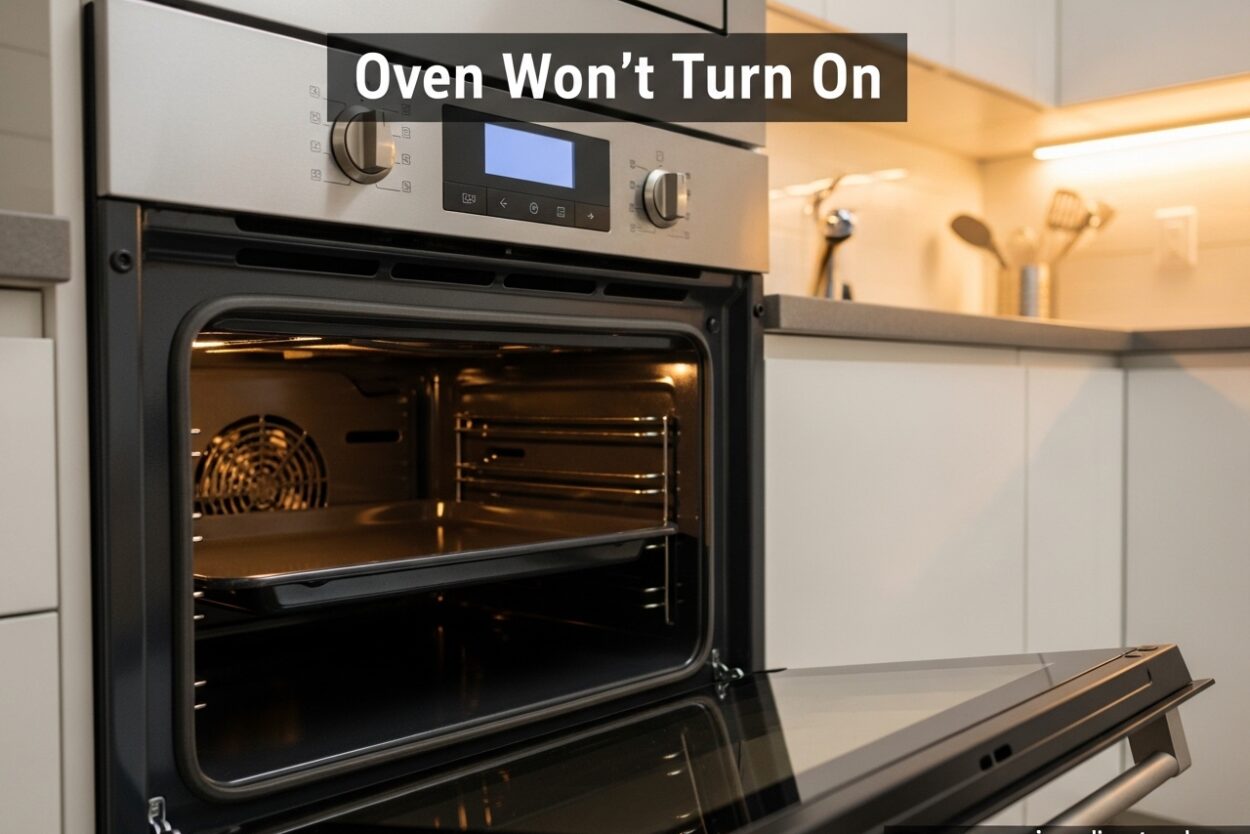
When your oven won’t turn on, it can bring meal prep to a complete halt. I’ve been through this frustrating situation more times than I’d like to admit. There’s nothing worse than prepping a full meal only to discover your oven is completely dead.
Whether you have an electric oven that’s completely unresponsive or a gas oven that won’t ignite, most problems have straightforward causes. After helping friends and family diagnose oven issues for over 15 years, I’ve learned that the oven won’t turn on problem usually stems from a few common culprits that you can check yourself.
In this guide, I’ll walk you through everything I know about diagnosing why your oven won’t turn on, from simple power issues to component failures. We’ll cover both electric and gas ovens, so you can get back to cooking as quickly as possible.
Quick Diagnostics Checklist
Before diving into detailed troubleshooting, let’s run through the quick checks I always recommend first. These simple tests can immediately identify why your oven won’t turn on without requiring any tools.
Step 1: Check if the display is lit. A completely blank display points to a power supply issue, while a lit display that won’t start suggests a different problem.
Step 2: Verify the oven door is fully closed. Many ovens won’t start if the door latch isn’t properly engaged.
Step 3: Listen for any sounds. A clicking gas oven indicates the igniter is trying but failing, while silence points to a power or control issue.
Step 4: Check if the stovetop burners work. If your stove works but the oven won’t turn on, you likely have a component-specific issue rather than a complete power failure.
Safety First: Critical Warnings
Before attempting any troubleshooting, I need to share some critical safety precautions. These aren’t just suggestions – they’re essential steps that can prevent serious injury.
For electric ovens: Always turn off power at the circuit breaker before testing any components. Electric ovens use 240 volts, which can be lethal if you’re not careful.
For gas ovens: If you smell gas, immediately turn off the gas supply valve, open windows, and call your gas company or a professional. Never attempt to work on gas lines if you’re not certified.
General safety: Never bypass safety features or attempt repairs beyond your skill level. Some oven won’t turn on problems require professional expertise.
Power Supply Issues
The most common reason your oven won’t turn on is surprisingly simple – a power supply problem. I’ve found that power issues account for nearly 40% of all oven failures I’ve encountered.
Check Your Circuit Breaker
Electric ovens require a dedicated 240-volt circuit with a double breaker. If either side trips, your oven may have partial power or none at all. I’ve seen many cases where the breaker looks fine but has actually tripped – give it a full off position before resetting.
Go to your electrical panel and look for the breaker labeled “oven” or “range.” Flip it fully off, wait 30 seconds, then flip it back on. If this was the issue, your oven should power up normally.
Test the Outlet
Even if the breaker hasn’t tripped, the outlet itself may be faulty. Use a multimeter to verify you’re getting 240 volts at the outlet. I’ve found outlets that were partially working, providing 120 volts instead of the required 240, which explains why the oven won’t turn on but the clock still works.
Inspect the Power Cord
For freestanding ranges, check the power cord where it connects to the oven. I’ve seen cords that were damaged by heat or rodents, causing intermittent connections. A visually damaged cord needs immediate replacement.
Electric Oven Troubleshooting
If your power supply checks out but the oven won’t turn on, let’s look at electric-specific components. Electric ovens have several parts that commonly fail.
Testing the Baking Element
The baking element is the coil at the bottom of your oven. When it fails, your oven won’t turn on or heat. I recommend a simple visual inspection first – look for obvious damage like blisters, cracks, or burn marks.
To test it properly, use a multimeter to check for continuity. A working element should show 15-25 ohms of resistance. If you get no reading, the element has failed and needs replacement. This is a DIY-friendly repair that typically costs $30-60.
Checking the Broiling Element
The broiling element at the top of the oven can also cause problems. In some models, a failed broil element will prevent the oven from starting. Test it the same way as the baking element – look for damage and check continuity with a multimeter.
Blown Thermal Fuse
A thermal fuse is a safety device designed to cut power if the oven overheats. When this fuse blows, your oven won’t turn on at all. I’ve seen this happen frequently after self-cleaning cycles, which generate extreme heat.
Locate the thermal fuse (usually near the back of the oven) and test it with a multimeter. No continuity means it’s blown. Replacing a thermal fuse costs $20-50 and is relatively straightforward.
Control Board Failure
The electronic control board is essentially the brain of your oven. When it fails, the oven won’t turn on and you may see error codes or a completely blank display. Control board failures are more common in ovens over 10 years old.
Symptoms include flickering displays, unresponsive buttons, or the oven turning on randomly. Control board replacement typically costs $150-400 and often requires professional installation.
Gas Oven Troubleshooting
Gas ovens have different issues when the oven won’t turn on. The most common problem I encounter is a faulty igniter.
Faulty Gas Igniter
The gas igniter is the glow plug that lights the gas burner. Even if it glows, it may not be pulling enough current to open the safety valve. I’ve tested many igniters that glow orange but don’t reach the proper temperature.
A working igniter should glow bright white, not dull orange. Test the current draw with a multimeter – it should pull 2.5-3.5 amps. If it’s below 2.5 amps, replace the igniter. This part costs $40-80 and is a common DIY repair.
Defective Gas Valve
The gas valve controls the flow of gas to the burner. If it’s stuck or defective, gas won’t reach the burner even if the igniter is working. Gas valves rarely fail but can become stuck after long periods of disuse.
Warning: Gas valve replacement should only be performed by qualified technicians due to safety risks. This repair typically costs $200-400 including parts and labor.
Safety Valve Issues
The safety valve prevents gas from flowing if the igniter isn’t hot enough. If the valve is defective, your oven won’t turn on even when everything else works. Safety valves can be tested for continuity but usually require professional replacement.
Door and Sensor Issues
Sometimes the reason your oven won’t turn on is related to door mechanisms or sensors. These problems are often overlooked but are actually quite common.
Door Latch Problems
Modern ovens have door sensors that prevent operation if the door isn’t properly closed. If the latch is broken or misaligned, the oven won’t start. Inspect the door latch mechanism for damage and clean any debris that might prevent proper engagement.
I’ve solved many cases where the oven won’t turn on simply by cleaning the door gasket and ensuring the door closes fully.
Temperature Sensor Failure
The temperature sensor monitors the oven’s internal temperature. If it fails, some ovens won’t start at all as a safety precaution. The sensor is typically a thin metal probe located in the rear wall.
Test the sensor with a multimeter at room temperature – it should read around 1080 ohms. Replace if readings are significantly off. Temperature sensors cost $20-40 and are easy to replace.
Reset Procedures for Different Oven Types
Sometimes all your oven needs is a proper reset. I’ve found that many cases where the oven won’t turn on are resolved with the correct reset procedure.
Electric Oven Reset
Step 1: Turn off the oven and unplug it from the wall outlet.
Step 2: Flip the circuit breaker off for 5 minutes.
Step 3: Flip the breaker back on and restore power.
Step 4: Set the clock – many ovens won’t function until the clock is set.
Step 5: Test the oven by setting it to bake at 350°F for 5 minutes.
Gas Oven Reset
Step 1: Turn off the oven at the control panel.
Step 2: Unplug the oven or turn off its circuit breaker.
Step 3: Wait 5 minutes for the system to fully discharge.
Step 4: Restore power and set the clock.
Step 5: Test by turning on the oven and listening for the igniter click.
Electronic Control Reset
For ovens with electronic displays, try this sequence:
Step 1: Press and hold the “Cancel” or “Off” button for 10 seconds.
Step 2: If that doesn’t work, look for a dedicated “Reset” button on the control panel.
Step 3: Some models require pressing “Bake” and “Broil” simultaneously for 5 seconds.
Step 4: Consult your owner’s manual for model-specific reset procedures.
When to Call a Professional
While many causes of an oven won’t turn on problem are DIY-friendly, some issues require professional expertise. Here’s when I recommend calling a technician:
Gas line issues: Any problems with gas supply, lines, or connections should only be handled by certified professionals. Gas leaks are life-threatening.
Control board replacement: While some experienced DIYers can replace control boards, it often requires soldering and precise calibration. Expect to pay $150-400 for professional control board replacement.
Complex electrical problems: If you’ve checked the breaker and outlet but still have power issues, there may be wiring problems inside the oven that require professional diagnosis.
Warranty considerations: If your oven is still under warranty, DIY repairs may void coverage. Check your warranty before attempting repairs.
Professional service calls typically cost $80-150 just for diagnosis, with parts and labor adding $150-500 depending on the repair. However, for major failures, a technician can save you money by correctly identifying the problem the first time.
Why Won’t My Oven Turn On but the Stove Works?
This is one of the most common questions I get. When your stove burners work but the oven won’t turn on, it typically means you have a component-specific problem rather than a power issue.
For electric ranges, this points to a failed baking element, thermal fuse, or oven-specific wiring. For gas ranges, it’s usually a faulty igniter or safety valve issue.
The good news is that this scenario narrows down the problem significantly. You can focus your troubleshooting on oven-specific components rather than the entire electrical system.
FAQ
How to fix an oven that won’t turn on?
Start by checking the circuit breaker and ensuring the oven is plugged in. For electric ovens, test the heating elements and thermal fuse. For gas ovens, inspect the igniter. If these basic checks don’t resolve the issue, the control board may need replacement. Always turn off power before performing any tests.
Why is my oven not working but my stove is?
When the stove works but the oven won’t turn on, you likely have an oven-specific component failure. For electric ovens, this is usually a failed baking element or thermal fuse. For gas ovens, it’s typically a faulty igniter or safety valve. The power supply is fine, so focus on oven-specific parts.
Why has my oven suddenly stopped working?
Sudden oven failure is often caused by a tripped circuit breaker, blown thermal fuse, or failed heating element. Power surges and recent self-cleaning cycles can also trigger thermal fuse failures. Check your breaker first, then test components with a multimeter for continuity.
How do you reset an oven?
To reset an oven, turn off power at the breaker for 5 minutes, then restore power. For electronic models, try holding the Cancel button for 10 seconds. Gas ovens may need the gas valve turned off and on. After resetting, set the clock as many ovens won’t function without it.
How to tell if an oven fuse is blown?
Use a multimeter to test the thermal fuse for continuity. If the multimeter shows no continuity, the fuse is blown. Visual inspection may also reveal a blown fuse – look for a broken wire inside the fuse housing or discoloration. Blown fuses typically happen after overheating events like self-cleaning cycles.
What are signs of a failing oven control board?
Signs of a failing control board include flickering displays, unresponsive buttons, error codes, the oven turning on randomly, or a completely blank display. You may notice intermittent operation before complete failure. Control boards typically fail in ovens over 10 years old and often require professional replacement.
Do ovens have a reset button?
Most modern ovens don’t have a dedicated reset button. Instead, they reset through a power cycle – turn off the breaker for 5 minutes. Some electronic models can be reset by holding Cancel/Off for 10 seconds or pressing certain button combinations. Check your owner’s manual for model-specific reset procedures.
Conclusion
When your oven won’t turn on, it’s frustrating but usually fixable. Start with the simple checks – circuit breaker, power cord, and door latch – before moving to component testing. Most oven problems I’ve encountered are caused by thermal fuses, heating elements, or igniters, all of which are relatively affordable to replace.
If you’re not comfortable with electrical testing or gas line work, there’s no shame in calling a professional. A qualified technician can quickly diagnose why your oven won’t turn on and get you back to cooking safely.
For those looking to upgrade if repairs aren’t cost-effective, check out current cookware set deals that might work well with your existing stovetop while you decide on oven replacement.



Leave a Comment