
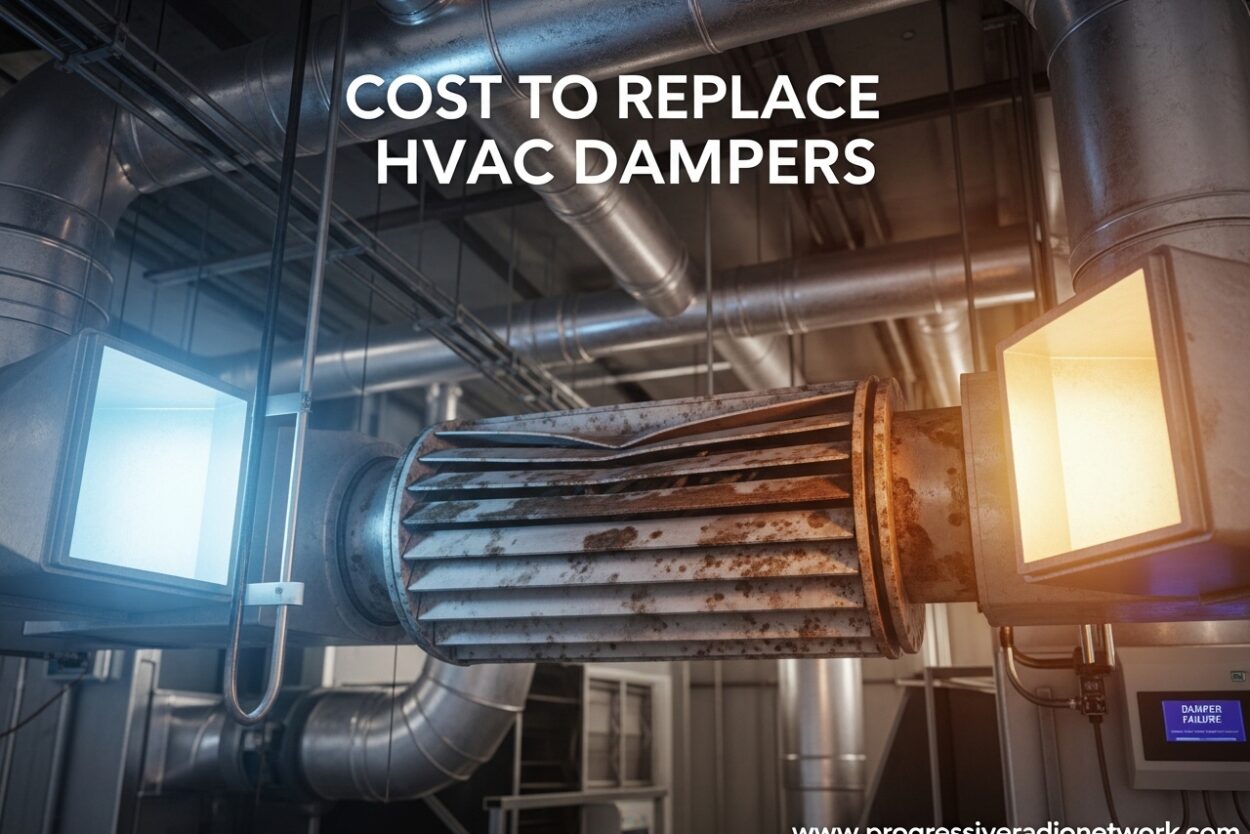
Replacing HVAC dampers typically costs between $100 and $600 per damper, with most homeowners paying around $350 for a professional replacement. The cost to replace HVAC dampers varies significantly based on the type of damper, whether it’s manual or motorized, accessibility, and your location. Motorized zone dampers with actuators cost more than simple manual volume control dampers, often running between $350 and $600 installed.
Understanding replacement costs helps you budget properly and avoid overpaying for what should be a straightforward repair. Many contractors markup damper replacements significantly since the parts themselves only cost $50-$250. The real expense comes from labor, which can range from $75 to $150 per hour depending on your region and the complexity of accessing your ductwork.
What is an HVAC Damper?
An HVAC damper is a movable plate or valve installed inside your ductwork that regulates airflow to different areas of your home. Think of it like a valve for your air system. When the damper is fully open, air flows freely through that duct branch. When closed, it blocks airflow completely. Partially open positions allow you to fine-tune how much conditioned air reaches each zone.
Dampers are typically located near the main trunk line where branch ducts split off, directing air to specific rooms or floors. They’re essential for zoning systems that let you control temperatures independently in different areas. Without functioning dampers, you might experience hot or cold spots throughout your home as air goes where it wants rather than where you need it.
Types of HVAC Dampers
The cost to replace HVAC dampers depends heavily on which type you have. Different damper designs serve different purposes and come at varying price points.
Manual Volume Control Dampers
These simple dampers feature a lever outside the duct that you manually adjust to control airflow. They’re the most affordable option at $50-$150 for the part, making replacement costs around $100-$250 installed. Manual dampers have no moving parts other than the plate itself, so they rarely fail and can last 20+ years.
Motorized Zone Dampers
Motorized dampers connect to your thermostat system and automatically open or close based on temperature settings. These cost $200-$400 for the part and $350-$600 installed. The motor or actuator can fail over time, requiring replacement even if the damper plate itself is fine. Most motorized dampers last 10-15 years before needing attention.
Butterfly Dampers
Butterfly dampers use a flat, circular plate that rotates on a central axis. They’re common in round ducts and cost $75-$200 for parts. Installation runs $150-$350 total. These provide good airflow control but can be prone to leakage when fully closed if not properly sealed.
Parallel vs Opposed Blade Dampers
Parallel blade dampers have all slats moving in the same direction, while opposed blade dampers have slats moving in opposite directions. Opposed blade designs provide better shutoff and airflow control. Both types cost $100-$300 for parts and $200-$450 installed. These are typically found in rectangular ductwork in commercial applications but some high-end residential systems use them too.
Backdraft Dampers
These one-way valves allow air to flow in one direction but prevent backflow. They’re often used in exhaust systems and cost $50-$150 for parts. Installation is straightforward at $100-$250 total. Backdraft dampers rely on gravity or springs rather than motors, making them very reliable with few failure points.
Fire Dampers
Fire dampers are safety devices that close automatically when exposed to high temperatures, preventing fire from spreading through ductwork. These cost $200-$500 for parts and $400-$800 installed due to their critical safety function. Fire dampers must be installed by licensed professionals and require regular inspections to maintain building code compliance.
Cost to Replace HVAC Dampers 2026
The cost to replace HVAC dampers breaks down into parts, labor, and potentially additional work to access your ductwork. Here’s what you can expect to pay for different scenarios:
Manual Damper Replacement
Simple manual volume control dampers cost the least to replace. The damper itself runs $50-$150 depending on size and quality. Labor is typically 1-2 hours at $75-$150 per hour. Total cost: $100-$350 per damper. If your ductwork is easily accessible in a basement or crawl space, you’ll likely pay at the lower end of this range.
Motorized Damper Replacement
Motorized zone dampers cost significantly more due to the electrical components. The damper with motor costs $200-$400 depending on brand and features. Labor takes 1-3 hours and may require an electrician if wiring needs replacement. Total cost: $350-$650 per damper. Smart zoning dampers that connect to WiFi systems can cost even more, up to $800 installed.
Damper Motor Only Replacement
Sometimes the damper body is fine but the motor has failed. Replacement motors cost $80-$200 depending on the brand and model. Labor is typically 0.5-1 hour since the damper doesn’t need to be removed from the duct. Total cost: $150-$350. This is often the most cost-effective repair for motorized dampers.
Multiple Damper Replacement
Replacing multiple dampers at once can reduce per-unit labor costs since the technician is already on site. Expect a 10-20% discount on labor for 2-3 dampers and 20-30% for 4 or more. A full zoning system replacement with 4-6 dampers typically costs $1,500-$3,500 including a new control panel.
Emergency or After-Hours Replacement
If your damper fails during extreme weather and you need emergency service, expect to pay 50-100% more. Emergency rates run $150-$300 per hour for labor. Total emergency replacement cost: $400-$1,200 depending on damper type. Scheduling replacement during regular business hours can save you hundreds.
Signs of a Bad HVAC Damper
Recognizing damper problems early can prevent wasted energy and uncomfortable temperatures in your home. Watch for these warning signs:
Hot and cold spots throughout your home often indicate a damper issue. If certain rooms never seem to reach the right temperature while others are fine, a stuck or broken damper may be directing airflow incorrectly. This is especially noticeable in multi-story homes where upstairs and downstairs temperatures differ significantly.
Inconsistent heating or cooling that cycles on and off frequently can mean dampers aren’t properly regulating airflow. Your system may work harder than necessary to compensate, leading to higher energy bills and reduced equipment lifespan.
Unusual noises coming from your ductwork when the system starts or stops may indicate a problem with the damper motor or linkage. Clicking, squealing, or grinding sounds suggest the damper is struggling to open or close properly.
Visible damage to the damper lever or control box is an obvious sign of trouble. If the manual lever feels loose or won’t stay in position, or if the motor housing on an automatic damper appears cracked or corroded, replacement is likely needed.
Higher than normal energy bills without another explanation can result from dampers stuck in the wrong position. Your system works overtime to compensate for the imbalance, wasting energy and money month after month.
Damper Lifespan and Maintenance
Most HVAC dampers last 15-20 years with proper maintenance. Manual dampers have the longest lifespan since they have fewer moving parts. Motorized dampers typically last 10-15 years before the motor or actuator needs replacement. Fire dampers require regular inspection and testing to ensure they’ll function properly in an emergency.
Annual maintenance can significantly extend damper life. For manual dampers, exercise the lever through its full range of motion once a year to prevent seizing. Lubricate any visible pivot points with silicone-based lubricant. Check that the damper fully opens and closes without sticking.
Motorized dampers benefit from professional inspection during regular HVAC maintenance. Technicians can test motor operation, check electrical connections, and verify proper response to thermostat signals. Listen for unusual sounds that might indicate bearing wear or electrical issues.
Keep damper areas clean and free of dust and debris. Inaccessible dampers in attics or crawl spaces should be checked annually for signs of pest damage or moisture problems that could cause corrosion. Ensure fire dampers remain clear of any obstructions that could prevent proper operation.
DIY vs Hiring a Professional
Replacing an HVAC damper yourself can save significant money but isn’t always practical. Manual dampers in accessible ductwork are often manageable for confident DIYers. The parts cost $50-$150 compared to $100-$350 for professional installation. However, you’ll need sheet metal tools, basic electrical knowledge for motorized dampers, and the ability to work in tight spaces.
Motorized damper replacement involves electrical wiring that requires careful attention to safety. If you’re uncomfortable working with your system’s electrical components, hiring a professional is worth the extra cost. Improper installation can damage your HVAC system or create safety hazards.
Accessibility is the biggest factor in the DIY decision. Dampers in basements or crawl spaces with good access are manageable. Dampers in attics, behind finished walls, or in tight ceiling spaces require professional skills and equipment. The risk of damaging ductwork or creating leaks makes professional installation the smarter choice in difficult-to-access areas.
Consider your warranty situation as well. DIY work on newer HVAC systems may void manufacturer warranties. Professional installation typically comes with a labor warranty, providing peace of mind if something goes wrong. Get multiple quotes before hiring to ensure fair pricing.
Troubleshooting HVAC Damper Issues
Before replacing your damper, try these troubleshooting steps to identify the actual problem:
First, locate the damper in question. Manual dampers have a lever on the outside of the duct. Motorized dampers have a small motor housing attached to the duct. Trace your ductwork from the main trunk line toward the problem area to find the appropriate damper.
For manual dampers, move the lever through its full range. It should move smoothly and stay in any position. If it’s stuck, try applying penetrating oil and working it back and forth gently. If it still won’t budge, the damper may be seized from corrosion or debris and will need replacement.
Test motorized dampers by changing your thermostat to trigger that zone. Listen for the motor sound when the zone should activate. No sound suggests an electrical or motor problem. A sound without proper airflow indicates a mechanical problem with the damper itself.
Check for loose or disconnected wires on motorized dampers. Sometimes the issue is simply a loose connection rather than a failed component. Turn off power before inspecting any electrical connections.
Feel the duct temperature before and after the damper when the system is running. A significant temperature difference across the damper indicates it’s restricting flow. No temperature difference suggests the damper may be stuck open or the problem lies elsewhere in your system.
Factors Affecting Replacement Cost
Several factors influence the final cost of damper replacement beyond just the parts:
Accessibility is the biggest cost factor. Dampers in easily reachable basements cost less to replace than those in attics, crawl spaces, or behind finished walls. Difficult access can double labor time and require additional workers or equipment.
Duct material affects replacement complexity. Sheet metal ducts are easier to work with than flexible ductwork. Some older systems use materials that require special handling or replacement rather than simple damper installation.
Regional labor rates vary significantly across the country. HVAC labor in high-cost areas like coastal cities can run $150-$200 per hour versus $75-$100 in other regions. Get quotes from local contractors to understand your area’s pricing.
System age and condition impact replacement decisions. Older systems may have other issues that should be addressed simultaneously. In some cases, full system replacement makes more sense than investing in extensive repairs on outdated equipment.
Permit requirements vary by location. Some jurisdictions require permits and inspections for HVAC work, adding $50-$200 to your project cost. Check local requirements before starting any work.
Tips to Save on Damper Replacement
Smart planning can reduce your damper replacement costs significantly:
Get multiple quotes from licensed HVAC contractors before proceeding. Prices can vary by 50% or more for the same work. Ask each contractor to specify whether they’re quoting parts, labor, and any additional fees separately for accurate comparison.
Schedule replacement during off-season when HVAC contractors are less busy. Late spring and early fall typically offer better pricing and faster scheduling than peak heating and cooling seasons.
Bundle damper replacement with other HVAC maintenance or repairs. Having a technician address multiple issues during one service call reduces the per-visit cost and may qualify for a package discount.
Consider upgrading to smart zoning dampers if replacing multiple units. The higher initial cost can be offset by improved energy efficiency and comfort. Many homeowners see 10-30% reduction in heating and cooling costs with properly configured zoning systems.
Investigate warranty coverage on existing dampers. Some manufacturers offer extended warranties that might cover replacement costs. Have your model and serial numbers ready when calling manufacturers or contractors.
Frequently Asked Questions
What is the $5000 rule for HVAC?
The $5000 rule states that if the cost of repairs exceeds 50% of the cost of a new system and your system is over 10 years old, replacement typically makes more financial sense than repair. For damper issues specifically, if you’re facing multiple damper replacements totaling over $500 on a system older than 12-15 years, consider whether investing in a new zoning system or full HVAC replacement might be more cost-effective in the long run.
How much does it cost to install a damper in a HVAC system?
Installing a new damper typically costs $200-$600 for manual dampers and $400-$800 for motorized zone dampers. New installation costs more than replacement because it requires cutting into existing ductwork and potentially modifying your system’s design. Motorized dampers also require electrical wiring and control system integration, adding to the complexity and cost.
What is the most expensive part of an HVAC system?
The compressor in your outdoor unit is typically the most expensive single component, costing $1,500-$3,500 to replace. For zoning specifically, the control panel or thermostat system can cost $500-$2,000 depending on complexity. Individual dampers are relatively affordable compared to major system components, which is why replacing them makes sense rather than abandoning your zoning system.
What is the life expectancy of a HVAC damper?
Manual dampers typically last 15-20 years while motorized dampers last 10-15 years before requiring replacement or repair. The motor component on automatic dampers is usually the first part to fail. Fire dampers require regular testing and can last 20+ years but must comply with building codes and inspection requirements regardless of age.
How much does it cost to replace an AC damper?
AC dampers cost the same as heating dampers since they’re typically the same components used for both functions. Manual damper replacement runs $100-$350 while motorized damper replacement costs $350-$650. The term AC damper usually refers to a zone damper in your air conditioning system, which functions identically to heating zone dampers.
What are the signs of a bad damper?
Bad damper signs include hot or cold spots in rooms, inconsistent temperatures, unusual noises from ductwork, higher energy bills, and dampers that won’t move or stay in position. You might also notice your system cycling on and off more frequently as it struggles to maintain temperature. Visible damage to the damper lever or motor housing is an obvious sign of problems.
Can I install HVAC dampers myself?
Manual dampers in accessible ductwork can be DIY-friendly for confident homeowners with basic tools and skills. Motorized dampers require electrical work and are best left to professionals. Consider your experience level, the accessibility of your ductwork, and whether DIY work might void your warranty. If you’re unsure, getting a professional quote is the safer choice.
Conclusion
The cost to replace HVAC dampers ranges from $100-$650 depending on type, accessibility, and whether you choose professional installation. Manual dampers are the most affordable option while motorized zone dampers require a larger investment. Understanding these costs helps you make informed decisions about maintaining your home’s comfort and HVAC system efficiency.
Regular maintenance and prompt attention to damper problems can extend component life and prevent more expensive repairs down the road. Whether you choose DIY replacement or professional installation, functioning dampers are essential for balanced temperatures and energy efficiency throughout your home. Get multiple quotes, consider your system’s age, and don’t wait until extreme weather to address damper issues.


Leave a Comment