
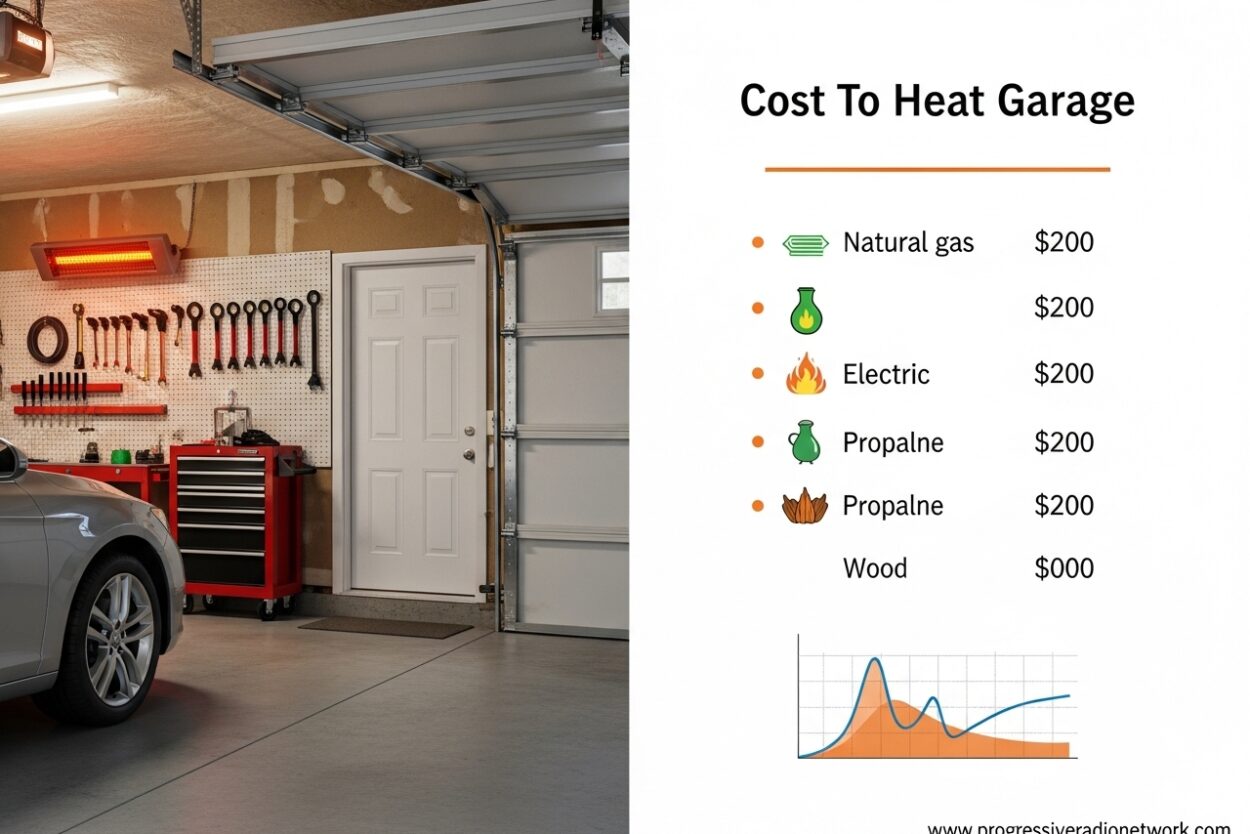
The cost to heat a garage typically ranges from $0.08 to $0.80 per hour depending on your heating method, or $60 to $570 per month for continuous heating. Initial installation costs vary even more dramatically, from $150 for a basic plug-in electric heater to $6,000 for a professionally installed natural gas system. Understanding these costs upfront helps you choose the right heating solution for your needs and budget.
I’ve spent years researching garage heating options, and I’ll tell you that the real cost goes far beyond the heater price tag. Your monthly bills depend on garage size, insulation quality, local energy rates, and how often you actually use the space. Let me break down exactly what you can expect to pay.
What Affects Your Cost to Heat Garage
Several key factors determine your actual garage heating expenses. The most significant is your garage size and insulation quality. A well-insulated two-car garage might cost $50 per month to heat, while an uninsulated three-car space could run $300 or more.
Climate zone plays a huge role too. Homeowners in Minnesota need significantly more BTUs than those in Tennessee, which directly impacts operating costs. Your ceiling height matters as well—most calculations assume 8-10 foot ceilings, but taller spaces require proportionally more heating power.
The fuel type you choose dramatically affects both installation and ongoing costs. Electric heaters cost the least upfront but typically have the highest operating expenses. Natural gas systems cost more to install but offer the lowest monthly costs in most regions. Propane falls somewhere in between.
Your usage pattern might be the biggest factor of all. Weekend warriors who heat their garage for a few hours each Saturday pay significantly less than those maintaining a constant temperature all winter long. I’ve seen users spend anywhere from $20 to $500 per month based on usage alone.
Heating Method Costs: Electric vs Gas vs Propane
Electric garage heaters represent the most affordable entry point, with units costing $150-$600 and most homeowners able to install them themselves. However, they’re typically the most expensive to operate. At the national average electricity rate of $0.16 per kWh, a 5,000-watt electric heater costs about $0.80 per hour to run.
Natural gas heaters offer the lowest operating costs but require professional installation. The heater itself costs $400-$1,200, but installation adds another $1,000-$3,000 for gas lines, venting, and electrical work. The good news? Operating costs typically run $0.15-$0.30 per hour—significantly less than electric options.
Propane heaters work well where natural gas isn’t available. The heaters cost $300-$800 for vented units or $150-$500 for portable propane heaters. Operating costs vary widely based on propane prices in your area but generally fall between $0.30 and $0.60 per hour. You’ll also need to factor in propane tank rental or purchase costs.
Mini-split systems represent the premium option, with costs of $2,000-$6,000 installed. They’re incredibly efficient, though, with operating costs as low as $0.10-$0.20 per hour. I’ve seen forum users report spending just $20-$40 per month to maintain comfortable temperatures in well-insulated two-car garages.
Alternative heating methods include infrared tube heaters ($500-$1,500 installed), radiant floor heating ($2,000-$4,000), and even wood stoves for the rustic aesthetic. Each has different installation and operating costs that make sense for specific situations.
| Heating Method | Installation Cost | Hourly Operating Cost | Monthly Cost (Daily Use) |
|---|---|---|---|
| Electric (DIY) | $150-$600 | $0.60-$0.80 | $180-$240 |
| Electric (Pro) | $600-$1,500 | $0.60-$0.80 | $180-$240 |
| Natural Gas | $1,500-$4,000 | $0.15-$0.30 | $45-$90 |
| Propane (Vented) | $800-$1,800 | $0.30-$0.60 | $90-$180 |
| Mini-Split | $2,000-$6,000 | $0.10-$0.20 | $30-$60 |
| Infrared Tube | $500-$1,500 | $0.25-$0.40 | $75-$120 |
Real-world experiences from garage owners tell the full story. One Reddit user with a 10x30x10 foot garage reported paying about $50 per month for 4-5 months each year using a 220V electric heater that cost less than $200. Another user mentioned spending roughly $6 for every 8 hours of run time—perfect for weekend workshop sessions.
The most dramatic comparison came from a user who switched from a 7,500-watt electric heater to a mini-split system. Their hourly cost dropped from about $1.00 to just $0.20—a savings of $240 per month for daily use. That’s $1,200 saved over a typical heating season.
Garage Heater Running Costs Breakdown
Let’s get specific about operating costs. The formula is straightforward: Heater wattage divided by 1,000 equals kilowatts per hour. Multiply that by your electricity rate to get the hourly cost. For a 5,000-watt heater at $0.16 per kWh, you’re looking at $0.80 per hour.
Gas heaters require a different calculation. A typical 50,000 BTU natural gas heater consumes about 0.5 therms per hour. At $1.50 per therm, that’s $0.75 per hour—but because gas heaters cycle on and off, actual operating costs typically run 30-50% lower. Most users report $0.15-$0.30 per hour in real-world conditions.
Here’s what monthly costs look like for different usage patterns with an electric heater in an average two-car garage:
- Weekend use only (8 hours/week): $20-30 per month
- Evening use (3 hours/weekday): $70-100 per month
- Daily work (8 hours/day): $180-240 per month
- Constant heat (24/7): $500-570 per month
Garage size dramatically affects these numbers. Here are the BTU requirements by garage size for moderate climates:
| Garage Size | Mild Climate | Moderate Climate | Cold Climate |
|---|---|---|---|
| 1-Car (12×20) | 5,000 BTU | 7,500 BTU | 10,000 BTU |
| 2-Car (22×24) | 10,000 BTU | 15,000 BTU | 20,000 BTU |
| 3-Car (32×24) | 15,000 BTU | 22,500 BTU | 30,000 BTU |
| 4-Car (40×30) | 20,000 BTU | 30,000 BTU | 40,000 BTU |
Regional energy rates make a huge difference. At $0.07 per kWh (some areas in the Pacific Northwest), electric heating costs half as much as at $0.30 per kWh (parts of New England and California). That’s a $150 per month difference for typical usage patterns.
One forum user in Saskatchewan reported heating their 32×30 foot garage with spray foam insulation for about $40-50 per month using natural gas. Meanwhile, a user with electric heat in a similar-sized but poorly insulated garage was spending over $300 monthly. The difference? Insulation and fuel type.
Garage Heater Installation Costs
Electric heaters offer the simplest installation. A standard 120-volt plug-in unit requires nothing more than an available outlet. However, larger heaters (4,000+ watts) typically need a dedicated 240-volt circuit, which adds $500-$1,000 if your panel needs upgrading.
Natural gas installation gets expensive quickly. The heater itself costs $400-$1,200, but professional installation runs $1,000-$3,000. This includes gas line installation ($500-$800), venting through the wall or roof ($300-$600), electrical connections ($200-$400), and sometimes permits ($100-$300).
Propane heater installation falls in the middle. Vent units require similar work to natural gas heaters but without the gas line connection. Tank installation adds another $300-$800 depending on whether you rent or purchase the tank and how far it needs to be from the garage.
Mini-split systems require professional installation that typically costs $1,500-$3,000 above the equipment price. This includes mounting the indoor unit, installing the outdoor condenser, running refrigerant lines, and electrical connections. The complexity increases with multiple indoor units or longer line sets.
DIY installation can save significant money but isn’t always practical. Electric heaters are the most DIY-friendly, with many homeowners capable of handling a 240-volt circuit if they’re comfortable with electrical work. Gas installations should always be handled by professionals due to safety risks and code requirements.
Permit requirements vary widely by jurisdiction. Some areas require permits for any gas work, while others only need them for electrical upgrades. Budget $100-400 for permits and inspections, and check with your local building department before starting any installation work.
How to Reduce Your Cost to Heat Garage
Insulation is the single most effective way to reduce heating costs. Adding insulation to walls and ceiling can cut heating expenses by 30-50%. One user reported their monthly heating bill dropped from $180 to $90 after adding R-19 insulation to their garage walls and ceiling.
Sealing air leaks makes a surprising difference. Weather stripping around doors and windows typically costs $50-150 but can reduce heat loss by 15-25%. Use spray foam around electrical boxes, pipes, and any other penetrations in your garage walls or ceiling.
Programmable thermostats prevent wasted energy when you’re not using the space. A basic programmable thermostat costs $30-80, while smart thermostats run $100-250. Both can save 10-20% on heating costs by automatically reducing temperatures when you’re away or sleeping.
Zone heating approaches focus heat only where you need it. Portable heaters let you warm just your work area instead of the entire garage. This targeted approach can reduce costs by 50-75% compared to heating the whole space to the same temperature.
Timing strategies work well for occasional users. Instead of maintaining constant temperature, heat your garage only when you plan to use it. Modern heaters can warm a typical two-car garage from 40°F to 65°F in 30-45 minutes, so you only need to turn it on shortly before heading out to work.
Upgrading to more efficient equipment pays off over time. If you use your garage heavily, investing in a high-efficiency mini-split or natural gas system can offset the higher installation cost within 3-5 years through lower monthly bills.
Is Heating Your Garage Worth the Cost?
Whether heating your garage makes financial sense depends entirely on how you use the space. For occasional weekend projects, a simple electric heater might cost $30-50 per month—a reasonable expense for a comfortable workspace.
Daily users who spend hours in their garage often find the cost worthwhile. Woodworkers, mechanics, and home gym enthusiasts typically pay $100-200 monthly but gain valuable usable space that would otherwise sit unused for half the year.
Car storage heating rarely makes financial sense purely for vehicle protection. Modern cars start fine in cold weather, and the $100-300 monthly cost would pay for multiple car batteries over several years. However, if you work on your car regularly in the garage, the comfort factor might justify the expense.
The ROI calculation changes dramatically if you’re replacing paid workspace. A small commercial shop rental runs $500-1,000 per month in most areas. Even an expensive garage heating setup at $200 monthly costs far less than renting dedicated workspace.
FAQ
Is it expensive to heat your garage?
Garage heating costs vary widely based on size, insulation, and heating method. Electric heaters typically cost $180-240 per month for daily use, while natural gas systems run $45-90 monthly. Weekend users might spend just $20-30 per month. The most expensive scenario is heating an uninsulated garage 24/7 with electric heat, which can exceed $500 monthly.
How much does it cost to turn a garage into a heated garage?
Converting your garage to heated space costs $150-6,000 depending on the heating method. Basic electric heaters cost $150-600 and can often be installed yourself. Natural gas systems require $1,500-4,000 for professional installation including gas lines and venting. Mini-split systems represent the premium option at $2,000-6,000 installed but offer the lowest operating costs.
What is the most affordable way to heat a garage?
The most affordable initial cost is a basic electric heater at $150-600, but operating costs run high at $0.60-0.80 per hour. For long-term affordability, natural gas heating offers the lowest ongoing costs at $0.15-0.30 per hour despite higher installation costs. The cheapest overall solution depends on your usage patterns—electric for occasional use, gas for daily heating.
How much does it cost to run a 1500W heater for 24 hours?
A 1500-watt heater running continuously for 24 hours consumes 36 kilowatt-hours. At the national average electricity rate of $0.16 per kWh, this costs $5.76 per day or about $173 per month. However, garage heaters typically cycle on and off, so actual costs run 30-50% lower in most real-world scenarios.
Should I heat my garage?
Heat your garage if you use it regularly as a workshop, home gym, or hobby space. The comfort and usability gains typically justify $50-200 monthly costs for daily users. However, heating solely for car storage rarely makes financial sense unless you live in extremely cold climates and work on your vehicle frequently. Consider insulation improvements first to reduce ongoing costs.
What size heater do I need for my garage?
For a two-car garage in a moderate climate, you typically need 15,000-20,000 BTUs. One-car garages require 7,500-10,000 BTUs, while three-car garages need 22,500-30,000 BTUs. Cold climates require 50% more heating capacity, while well-insulated garages might need 25% less. Always size up rather than down—it’s better to have excess capacity and run the heater less frequently.
Conclusion
The cost to heat a garage varies from $30 to over $500 monthly depending on your choices. Electric heaters offer the lowest upfront cost but highest operating expenses. Natural gas and mini-split systems cost more initially but provide significant long-term savings for daily users. Insulation quality and usage patterns matter just as much as your heating method choice.
Start by assessing how you’ll use the space and your budget constraints. If you’re a weekend warrior, a simple electric heater might suffice. Daily users should consider the investment in natural gas or a mini-split system. Either way, improving insulation first will reduce your ongoing costs regardless of which heating method you choose.




Leave a Comment