
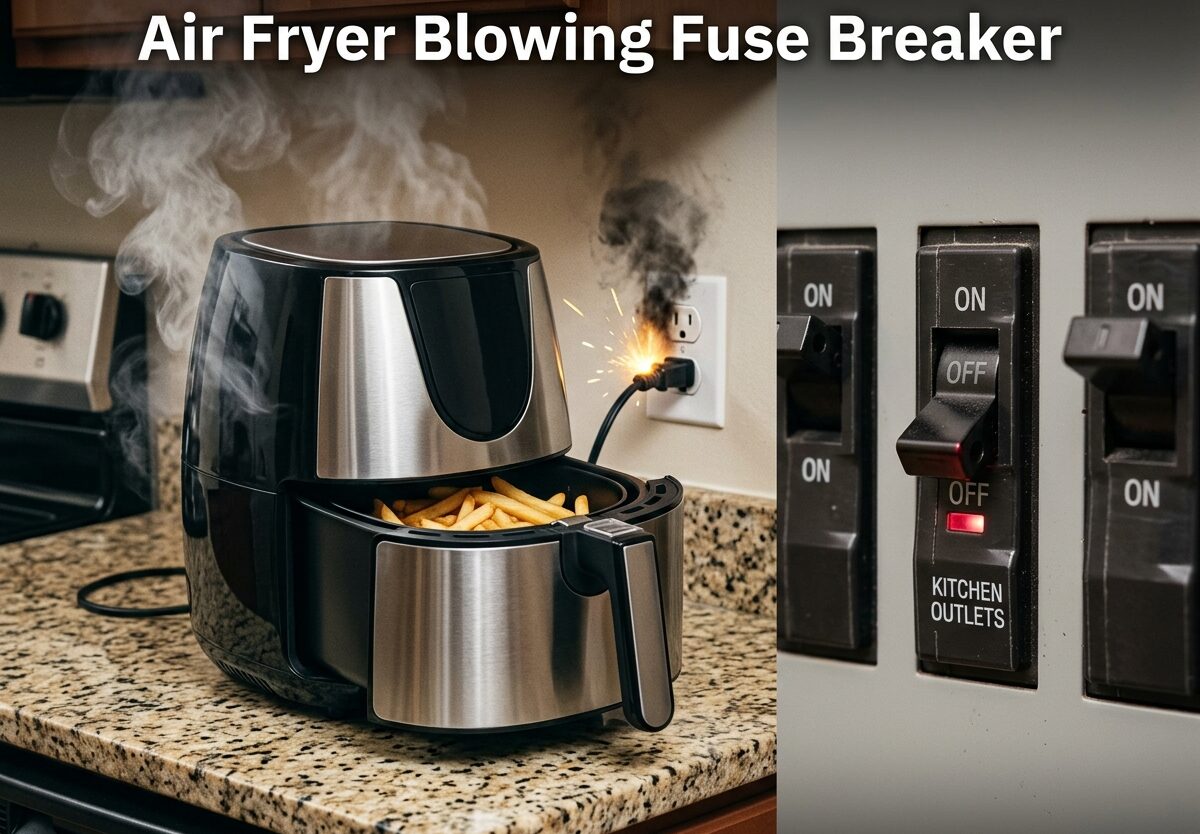
There’s nothing more frustrating than being halfway through cooking dinner when your kitchen suddenly goes dark. Your air fryer has tripped the circuit breaker again, and now you’re wondering if something is wrong with your appliance or your home’s electrical system. This air fryer blowing fuse breaker issue is surprisingly common, and understanding why it happens can save you time, money, and potential safety hazards.
I’ve researched countless user experiences from Reddit forums, electrician discussions, and manufacturer reports to bring you the most comprehensive troubleshooting guide. Whether you own a Ninja Foodi, Gourmia, Cosori, or any other air fryer brand, this guide will help you diagnose the problem and find the right solution.
Why Your Air Fryer Keeps Tripping the Circuit Breaker
Air fryers are power-hungry appliances. Most models draw between 1400 and 1800 watts, which translates to 12-15 amps of current on a standard 120-volt circuit. When your air fryer blows a fuse or trips a breaker, it’s usually doing exactly what it’s designed to do: protect your home from electrical overload.
The most common reason is simple overloading. If your air fryer shares a circuit with other appliances like a microwave, toaster, or refrigerator, the combined power draw can exceed the circuit’s capacity. Most kitchen circuits are either 15-amp or 20-amp, and the National Electrical Code recommends not exceeding 80% of the rated capacity for continuous loads (which cooking appliances qualify as).
That means a 15-amp circuit should handle no more than 12 amps continuously, while a 20-amp circuit tops out at 16 amps. Your 1800-watt air fryer alone draws 15 amps, leaving virtually no room for anything else on the same circuit.
However, overloading isn’t the only culprit. Your air fryer might be tripping the breaker due to a faulty heating element, a failing fan motor, or internal electrical issues. The preheat cycle is particularly problematic – many users report their air fryer trips the breaker right after preheating completes and the main cooking cycle begins. This is when the heating element cycles on and off, creating sudden power surges that can trip sensitive breakers.
Is Your Air Fryer Faulty or Is It the Electrical System?
Determining whether your air fryer is defective or if you have an electrical system issue is crucial for finding the right solution. Here’s a simple diagnostic approach based on real user experiences and electrician recommendations.
First, test your air fryer in a different location. If you have access to a different circuit (ideally in another room), plug it in there and run it through a full cooking cycle. If it works without tripping the breaker, your air fryer is likely fine, and the problem is with your original circuit’s capacity or wiring.
Second, check if the breaker trips immediately upon plugging in, during preheat, or during the cooking cycle. Immediate tripping suggests a dead short or serious fault in the appliance. Tripping during preheat indicates high power draw on an overloaded circuit. Tripping after preheat points to heating element cycling issues or sensitive breaker types.
Third, look for physical warning signs. Does your air fryer’s power cord feel hot to the touch? Do you notice any burning smells? These are serious red flags indicating a faulty appliance that should be unplugged immediately and either repaired or replaced.
Signs Your Air Fryer Is Faulty
Based on hundreds of user reports, these signs indicate your air fryer itself may be the problem:
- The power cord becomes hot during use (not just warm – noticeably hot)
- You smell burning plastic or electrical odors coming from the unit
- The breaker trips every time, regardless of which outlet you use
- The tripping started happening after the air fryer was dropped or damaged
- You see visible damage to the cord, plug, or outlet
One Reddit user shared a compelling story: “My Ninja Foodi air fryer keeps shorting the outlet. I called Ninja and they sent a replacement.” If your air fryer is still under warranty and showing these symptoms, contact the manufacturer immediately.
Signs Your Electrical System Is the Problem
If your air fryer works fine elsewhere or only trips when other appliances are running, the issue is likely your electrical system:
- The breaker only trips when other appliances share the circuit
- The air fryer works fine in different rooms
- Your home has older wiring with shared kitchen circuits
- Multiple kitchen appliances cause the same issue
- The breaker is old or has been recalled
Understanding GFCI and AFCI Breaker Sensitivity
This is a major content gap most other guides miss, but forum users constantly ask about it. GFCI (Ground Fault Circuit Interrupter) and AFCI (Arc Fault Circuit Interrupter) breakers are designed to protect you from electrical hazards, but they can be overly sensitive with high-power appliances like air fryers.
GFCI breakers monitor for ground faults – electricity flowing where it shouldn’t, such as through water or a person. They’re required in kitchens, bathrooms, and outdoor areas. However, air fryers with their high power draw and heating element cycling can create electrical signatures that mimic ground faults, causing nuisance tripping.
AFCI breakers detect dangerous arcing conditions that can cause fires. Like GFCIs, they can misinterpret the normal operation of air fryer heating elements as hazardous arcing, leading to repeated tripping.
Many users on electrical forums report their air fryer works fine on standard breakers but trips GFCI outlets immediately. One user noted: “My Gourmia air fryer trips the GFCI once in a while when I use it, but never on regular outlets.”
The solution isn’t to disable these safety devices. Instead, consider having a licensed electrician install a dedicated circuit for your air fryer with the appropriate breaker type, or identify which outlets in your kitchen are on non-GFCI circuits (if any exist and comply with local codes).
Air Fryer Wattage and Amperage by Brand
Understanding your specific air fryer’s power requirements can help you make informed decisions about circuit usage. Here’s what you need to know about popular brands based on manufacturer specifications and user data:
Ninja Foodi: Most Ninja Foodi models draw between 1460-1760 watts (12.2-14.7 amps). The larger 10-in-1 and 11-in-1 models tend to be on the higher end, while smaller 4-quart models use less power. Ninja Foodi models are among the most frequently mentioned in tripping breaker discussions, likely due to their popularity and high power draw.
Gourmia: Gourmia air fryers typically range from 1500-1700 watts (12.5-14.2 amps). Users frequently report GFCI sensitivity issues with Gourmia models, particularly the 6-quart and larger variants.
Cosori: Cosori air fryers generally operate at 1500-1700 watts (12.5-14.2 amps). The popular 5.8-quart Max XL draws 1700 watts at peak, making it one of the more power-hungry models in its class.
Philips: Philips air fryers tend to be slightly more efficient, with most models drawing 1400-1600 watts (11.7-13.3 amps). However, the newer Premium and XXL models still approach the 1700-watt range.
Air Fryer Power Calculation: To calculate your air fryer’s amperage, divide the wattage by voltage (typically 120V in North America). For example, a 1500-watt air fryer draws 12.5 amps (1500 ÷ 120 = 12.5).
How to Fix Air Fryer Tripping Issues
Now that you understand why your air fryer keeps tripping the breaker, here’s a step-by-step approach to fixing the problem:
Step 1: Identify What’s on the Circuit
Turn off the breaker your air fryer was plugged into, then test which outlets and appliances lose power. You might be surprised to find that your refrigerator, microwave, and kitchen outlets all share the same 15-amp circuit. This configuration is common in older homes but creates major problems when using high-wattage appliances.
Step 2: Use a Dedicated Outlet
The simplest solution is to ensure nothing else is running on the same circuit while you use your air fryer. Unplug other appliances or move your air fryer to an outlet on a different circuit. One Reddit user’s experience is typical: “We just got an air fryer, and if we use it with any other appliance, like the microwave, it flips the breaker. Do air fryers really draw that much current?” The answer is yes, they absolutely do.
Step 3: Check for GFCI/AFCI Issues
If your air fryer only trips GFCI outlets but works fine elsewhere, you’ve identified a compatibility issue. Do not remove or bypass the GFCI protection – it’s there for your safety. Instead, consult an electrician about your options, which might include installing a dedicated non-GFCI circuit (if local codes permit for kitchens) or using a different outlet.
Step 4: Test with Different Outlets
Before assuming your air fryer is defective, test it in multiple outlets throughout your home. Try outlets in different rooms on different circuits. If it works everywhere except one location, you’ve confirmed the issue is with that specific circuit, not your appliance.
Step 5: When to Call an Electrician
Some situations require professional help. Call a licensed electrician if: your home has aluminum wiring (common in homes built 1965-1973), the breaker feels hot to the touch, you notice flickering lights when the air fryer runs, the breaker won’t reset after tripping, or you need a new dedicated circuit installed for your air fryer.
Safety Precautions and Warning Signs
Dealing with electrical issues requires caution. Here are critical safety guidelines every air fryer owner should know:
Never ignore a hot cord: If your air fryer’s power cord becomes hot during use, unplug it immediately. A warm cord might be normal, but a hot cord indicates dangerous resistance that can lead to fire.
Burning smell means stop: Any burning odor, especially electrical plastic smells, means something is wrong. Don’t keep using the appliance hoping the smell will go away.
Check your outlets: Look for discoloration, melting, or loose fit when plugging in your air fryer. These signs indicate the outlet may be failing and should be replaced.
Don’t override safety devices: Never tape down a breaker, replace a fuse with a penny, or otherwise disable your electrical system’s safety features. These exist to protect you from fire and shock hazards.
Avoid extension cords: Air fryers should be plugged directly into wall outlets. Extension cords can overheat due to the high current draw, creating a fire risk. If you must use one temporarily, ensure it’s a heavy-duty 14-gauge or thicker cord rated for at least 15 amps.
Consider your home’s age: Homes built before 1980 may have inadequate kitchen circuits. Modern electrical codes require at least two 20-amp kitchen circuits, but older homes often have a single 15-amp circuit serving the entire kitchen.
FAQs
Why does my air fryer keep tripping my circuit breaker?
Your air fryer likely trips the breaker due to circuit overload. Most air fryers draw 12-15 amps, which can exceed 80% of a 15-amp circuit’s capacity when other appliances share the same circuit. The breaker trips as a safety measure to prevent wiring overheating and potential fire hazards. Try using your air fryer on a dedicated outlet or circuit without other appliances running.
What is the 80% rule for air fryers?
The 80% rule is a National Electrical Code guideline stating that continuous loads (like cooking appliances running more than 3 hours) shouldn’t exceed 80% of a circuit’s rated capacity. For a 15-amp circuit, this means maximum 12 amps continuous draw. For a 20-amp circuit, it’s 16 amps. Since many air fryers draw 12-15 amps, they alone can approach or exceed the 80% threshold, leaving no room for additional appliances.
Would an air fryer be damaged if a fuse blows?
Usually not. When a fuse blows or breaker trips, it cuts power to protect the circuit. Your air fryer should resume normal operation once power is restored. However, repeated tripping could cause wear on the appliance’s electrical components over time. If your air fryer won’t turn back on after a tripping incident, the surge may have damaged internal components and professional repair or replacement may be needed.
Is it safe to use an air fryer with an extension cord?
No, it’s not recommended. Air fryers draw 12-15 amps continuously, which can cause standard extension cords to overheat and create a fire hazard. If you must use one temporarily, only use a heavy-duty 14-gauge or thicker cord rated for at least 15 amps, and keep the cord as short as possible. The safest solution is having an electrician install a properly located outlet.
Should air fryers be on a dedicated circuit?
Ideally, yes. Given that air fryers draw 12-15 amps and the 80% rule limits 15-amp circuits to 12 amps continuous, air fryers work best on dedicated 20-amp circuits. This prevents tripping when other kitchen appliances run simultaneously. Many older homes weren’t built with modern high-power appliances in mind, so adding a dedicated circuit is often the best long-term solution.
Why does my Ninja Foodi trip the breaker but not my microwave?
Your Ninja Foodi likely draws more power than your microwave. While microwaves typically draw 8-12 amps, larger Ninja Foodi models can draw 14-15 amps, especially during the heating cycle. Additionally, some microwave circuits are dedicated 20-amp circuits, while air fryers are often plugged into general kitchen circuits that may already have other loads on them.
Conclusion
Dealing with an air fryer blowing fuse breaker issues is frustrating, but understanding the root cause makes finding the right solution much easier. Whether your problem is circuit overload, GFCI sensitivity, or a defective appliance, there are practical steps you can take to resolve it safely.
Remember that your tripping breaker is doing its job – protecting you from electrical hazards. The key is determining whether the issue is your air fryer or your electrical system, then taking appropriate action. For most people, the solution is as simple as ensuring the air fryer has a dedicated circuit or outlet. For others, it might mean upgrading older electrical systems to handle modern high-power appliances.
If you’re unsure about any aspect of troubleshooting your air fryer blowing fuse breaker problem, consult a licensed electrician. Electrical work isn’t worth risking your safety over. With the right approach, you’ll be back to enjoying perfectly air-fried meals without the unexpected power outages.




Leave a Comment