
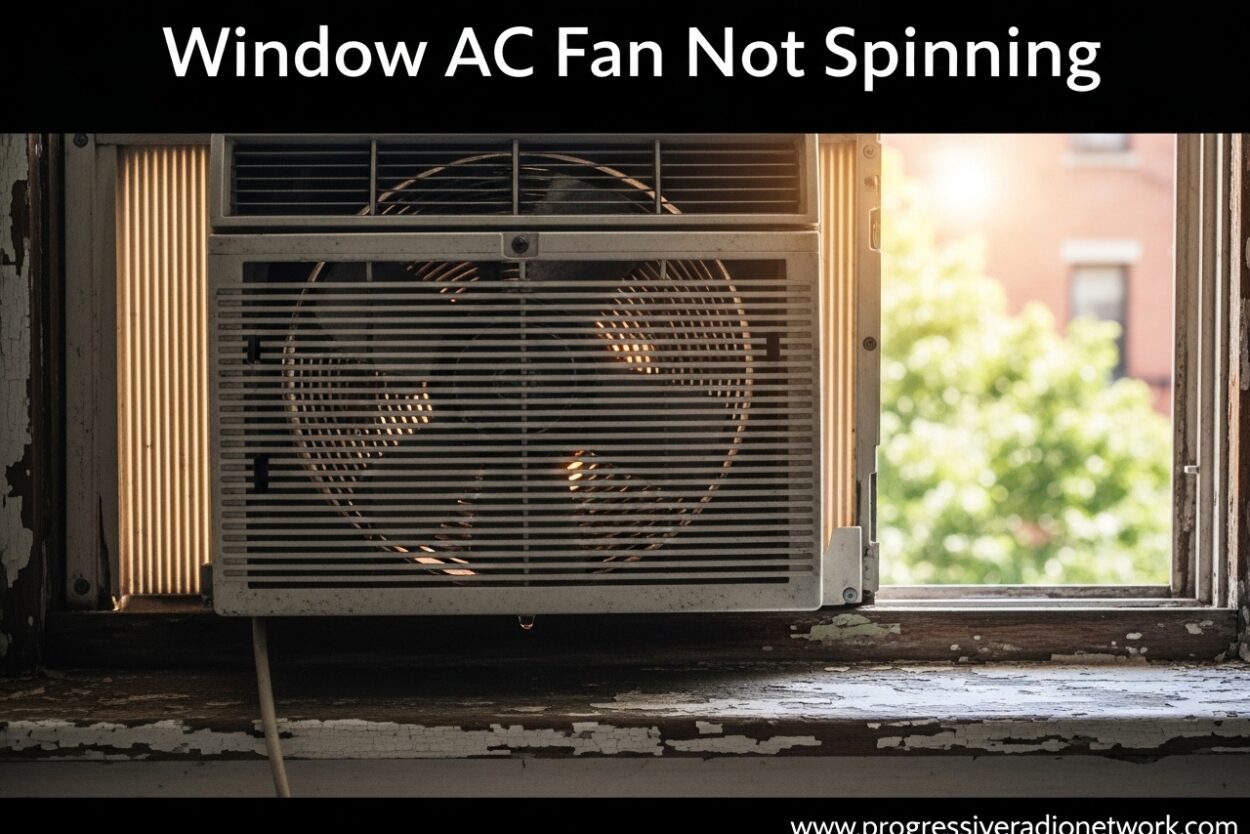
Nothing kills your summer comfort faster than a window AC fan not spinning when you need it most. I’ve seen this problem hundreds of times, and the good news is that most causes are fixable without calling a professional.
Whether your window air conditioner fan not working completely or making a humming noise without starting, this guide will walk you through every possible cause and solution. I’ll help you diagnose whether it’s a simple fix you can handle yourself or time to call an HVAC technician.
After 15 years working with home cooling systems, I’ve learned that about 70% of window AC fan problems come down to one failed part costing less than $50. Let’s figure out what’s wrong with your unit.
Quick Diagnosis: Identify Your Symptoms
Before diving into repairs, let’s pinpoint exactly what’s happening with your window AC fan not spinning. Different symptoms point to different causes:
Fan makes humming noise but won’t spin: This almost always means a bad run capacitor. The motor is trying to start but can’t get the boost it needs.
Completely silent, no sound at all: Points to power supply issues or a failed fan motor. The unit isn’t even trying to start.
Fan spins slowly or inconsistently: Could indicate a failing capacitor, worn motor bearings, or voltage issues.
Fan works on high speed but not low: Usually means the capacitor is failing but not completely dead, or there’s an issue with the fan speed selector switch.
AC fan not spinning but compressor runs: This is a dangerous situation. The compressor can overheat quickly without airflow. Turn off the unit immediately.
Window AC Fan Not Spinning – 7 Common Causes
1. Thermostat Setting Issues
Sometimes the simplest explanation is the right one. Before assuming mechanical failure, verify your thermostat settings are correct.
Make sure the temperature is set lower than the current room temperature. If the thermostat thinks your room is already cool enough, it won’t trigger the fan to run.
Check that the fan setting is on “Auto” or “On,” not “Off.” Some window AC units have separate controls for the compressor and fan. Verify both are set to operate.
Try lowering the thermostat by 5 degrees to see if the fan responds. If it kicks on after this adjustment, your thermostat sensor or control board might be miscalibrated rather than having a mechanical problem.
2. Circuit Breaker Tripped or Power Supply Problem
A window AC fan not working could simply mean the unit isn’t receiving power. Window air conditioners draw significant current and can trip circuit breakers, especially in older homes.
Check your electrical panel first. Look for any tripped breakers and reset them. Window AC units should ideally be on a dedicated circuit, but many homes share the circuit with other outlets.
Test the outlet by plugging in a small device like a lamp. If the outlet is dead, check for a GFCI that needs resetting. Some window AC units are installed in bathrooms or kitchens where GFCI protection is required.
Inspect the power cord for damage. Frayed wires, bent prongs, or a melted plug indicate electrical problems that need professional attention. Never bypass the grounding pin on a three-prong plug.
3. Clogged Air Filter Restricting Airflow
A dirty air filter might not directly cause the fan to stop spinning, but it creates conditions that can lead to fan problems. When airflow is restricted, the evaporator coils can freeze, which eventually causes the fan to struggle or stop.
Most window AC units have washable filters that should be cleaned every 1-3 months during heavy use. Remove the front panel and inspect the filter.
If you see dust buildup that you can’t see through, the filter needs cleaning. Wash it with warm water and mild soap, then let it dry completely before reinstalling.
A severely clogged filter causes the unit to work harder, drawing more current and potentially tripping breakers. It also creates ice buildup on the coils that can physically block the fan blade from spinning.
4. Bad Run Capacitor – #1 Most Common Cause
If your AC fan is humming but not spinning, the run capacitor is almost certainly the culprit. In my experience, this accounts for about 70% of all window AC fan failures.
The run capacitor is a small cylindrical component that stores electrical energy and releases it to give the fan motor the extra boost needed to start. Without it, the motor doesn’t have enough torque to overcome initial resistance.
How to test a capacitor:
First, unplug the unit and locate the capacitor. It’s usually a silver or black cylinder near the motor, often with wires connected to a fan terminal and a common terminal.
CAREFULLY discharge the capacitor by shorting the terminals with an insulated screwdriver. Capacitors can hold lethal voltage even when unplugged.
Use a multimeter with capacitance testing capability. A good capacitor should read within 10% of its rated microfarad (uF) value, which is printed on the side. If it reads significantly lower or shows zero, it’s bad.
Replacement capacitors cost $15-50 and are widely available. Match the uF rating and voltage rating exactly. This is a DIY-friendly repair if you’re comfortable working with electrical components.
5. Failed Fan Motor
If the capacitor tests good but the fan still won’t run, the motor itself may have failed. Fan motors can burn out from age, overheating, or moisture damage.
Test the motor by checking for continuity through the windings with a multimeter. Infinite resistance indicates an open winding and a failed motor. Also check for continuity between the windings and the motor casing—there should be none. If you get a reading, the windings are shorted to ground.
A seized motor will have physical resistance when you try to spin the fan blade by hand. Bearings can seize over time, especially if the unit hasn’t been maintained.
Fan motor replacement is more involved than capacitor replacement. The motor typically costs $80-200, plus you’ll need basic tools and mechanical skills. If you’re not comfortable, this repair is best left to a professional.
6. Frozen Evaporator Coils
Ice buildup on the evaporator coils can physically block the fan blade from spinning. This usually happens gradually—you might notice reduced cooling before the fan stops completely.
Causes of frozen coils include low refrigerant, dirty filters, or running the unit when outdoor temperatures are too low (below 60°F). The coil freezes because there’s not enough warm air flowing over it.
If you see ice on the coils, turn off the unit and let it thaw completely. Don’t try to chip the ice off—you can damage the delicate aluminum fins.
After thawing, check your air filter and replace if dirty. Run the fan-only mode for an hour to help dry out any remaining moisture before trying cooling mode again.
If coils freeze again after cleaning the filter, you likely have a refrigerant leak and need professional service. Window AC units aren’t designed to be recharged by homeowners.
7. Broken or Stuck Fan Blade
Physical damage to the fan blade can prevent spinning. Inspect the blade visually for cracks, breaks, or bent sections that might cause it to rub against the housing.
Sometimes the blade spins freely when tested by hand but binds when powered due to warping or motor misalignment. The blade should have equal clearance all around.
Check for debris that might be obstructing the blade. I’ve found everything from wasp nests to children’s toys stuck in window AC fan housings. Use a flashlight to look deep into the unit.
A replacement fan blade typically costs $20-60. Make sure to match the blade dimensions and shaft diameter exactly. An unbalanced blade will cause vibration and potentially damage the motor.
CRITICAL: Safety First Before You Start
Before attempting any repair on your window AC unit, follow these safety precautions:
Always unplug the unit before opening any panels or touching internal components. Capacitors can hold dangerous electrical charges even when unplugged.
Discharge capacitors by shorting the terminals with an insulated screwdriver. This prevents painful shocks during testing and replacement.
Never bypass safety devices like thermal overload switches or grounding pins. These are there to protect you from fire and electrocution.
Work in a dry area with proper lighting. Water and electricity don’t mix, and poor visibility leads to mistakes.
Know your limits. If you’re uncomfortable with electrical testing or mechanical repair, there’s no shame in calling a professional. An incorrectly installed part can cause more damage than the original problem.
Repair vs Replace: Cost Breakdown for 2026
When your window AC fan not spinning problem requires repair, how do you decide if it’s worth the cost? Here’s what you can expect to pay in 2026:
Capacitor replacement: $15-50 for the part if DIY. Professional repair typically runs $100-200 including the service call. This is almost always worth fixing, especially on units less than 10 years old.
Fan motor replacement: $80-200 for the part, plus $150-300 for professional installation. On units over 8 years old, compare this to the cost of a new window AC ($300-800). If repair exceeds 50% of replacement cost, consider buying new.
Refrigerant recharge: Professional-only repair costing $200-400. If your unit needs refrigerant, it has a leak that will need fixing first. On older window AC units, this usually signals replacement time.
Compressor replacement: Usually not worth it. Costs $400-800+ and the new compressor typically comes with only a 1-year warranty. Better to put that money toward a new unit with a full warranty.
Window AC Fan Not Spinning by Brand
Some brands have unique quirks when it comes to fan problems:
Frigidaire window AC: Known for capacitor issues around the 5-year mark. The capacitor is usually accessible behind a panel on the right side of the unit.
LG window AC: Often uses dual capacitors that run both fan and compressor. These can fail in ways that affect only one component. Test both terminals when checking.
GE window AC: Some models have a known issue with the fan motor mount warping, causing the blade to rub. Check alignment before replacing the motor.
Whirlpool window AC: Many models have the capacitor in the control panel behind the temperature display. You’ll need to remove the entire front cover to access it.
When to Call a Professional
While many window AC fan not spinning issues are DIY-friendly, some situations require professional help:
Refrigerant problems: If your unit has frozen coils and the air filter is clean, you likely have a refrigerant leak. Only EPA-certified technicians can legally handle refrigerants.
Compressor issues: Compressor replacement requires specialized tools and knowledge. It’s rarely cost-effective on window units anyway.
Electrical problems beyond the capacitor: If you find burnt wiring, damaged control boards, or have to trace complex circuits, a professional HVAC technician has the expertise to diagnose and repair safely.
Unit is under warranty: If your window AC is still under warranty, DIY repairs might void coverage. Check your warranty terms before attempting repairs.
Preventing Future Window AC Fan Problems
Regular maintenance prevents most window AC fan issues. Clean your air filter monthly during heavy use, or at minimum every 3 months. This is the single most important maintenance task.
Clear debris from the exterior vents regularly. Leaves, pollen, and dust buildup restrict airflow and cause the unit to work harder than necessary.
Schedule professional maintenance every 2-3 years. A technician can catch potential problems like failing capacitors before they leave you without cooling on the hottest day of the year.
Cover your window AC unit during winter months. This protects it from moisture damage, debris, and ice that can damage fan blades and motors during the off-season.
FAQ
Why is my window AC fan not spinning?
The most common cause of a window AC fan not spinning is a failed run capacitor, which provides the electrical boost needed to start the motor. Other causes include a bad fan motor, tripped circuit breaker, frozen evaporator coils, or a broken fan blade. If the fan makes a humming noise but won’t start, it’s almost certainly a capacitor issue.
Should I turn off my AC if the fan isn’t spinning?
Yes, you should turn off your AC immediately if the fan isn’t spinning. Running the compressor without the fan can cause the compressor to overheat rapidly, leading to expensive damage or complete failure. The fan is necessary to dissipate heat from the compressor. Running without it can destroy the compressor in minutes.
Why is my AC fan not spinning but the compressor is running?
When the compressor runs but the fan doesn’t, you likely have a failed run capacitor or bad fan motor specific to the fan circuit. Some units use separate capacitors for fan and compressor. This is a dangerous situation that causes rapid overheating—turn off the unit immediately to prevent compressor damage.
How do I know if my AC capacitor is bad?
Signs of a bad AC capacitor include the fan motor humming but not spinning, the fan starting slowly or inconsistently, or the fan not working at all. You can test it with a multimeter—the reading should be within 10% of the rated uF value printed on the capacitor. A reading of zero or significantly below rating confirms a failed capacitor.
Can I fix a window AC fan myself?
Many window AC fan problems are DIY-fixable, especially capacitor replacement which costs $15-50 and requires basic tools. However, fan motor replacement, refrigerant issues, and compressor problems typically require professional service. If you’re uncomfortable working with electrical components or discharging capacitors, it’s safer to call a technician.
How much does it cost to fix an AC fan motor?
AC fan motor replacement costs $80-200 for the part alone. Professional installation including service call typically runs $230-500 total. If your window AC unit is over 8 years old and needs a motor, compare the repair cost to a new unit ($300-800). Repairs exceeding 50% of replacement cost usually mean it’s time to buy new.
Conclusion
Most window AC fan not spinning problems come down to a failed $30 capacitor that you can replace yourself in about 30 minutes. Start with the simple checks—thermostat settings, circuit breakers, and air filters—before moving to the capacitor test.
If the capacitor checks out good and the motor tests bad, you’ll need to decide between repair and replacement based on your unit’s age and the repair cost. New window AC units are more energy efficient and come with fresh warranties, making replacement the smart choice for units over 8 years old.
Remember to always unplug your unit before attempting any repairs, discharge the capacitor before testing, and call a professional if you’re unsure about any step. Stay cool this summer!



Leave a Comment