
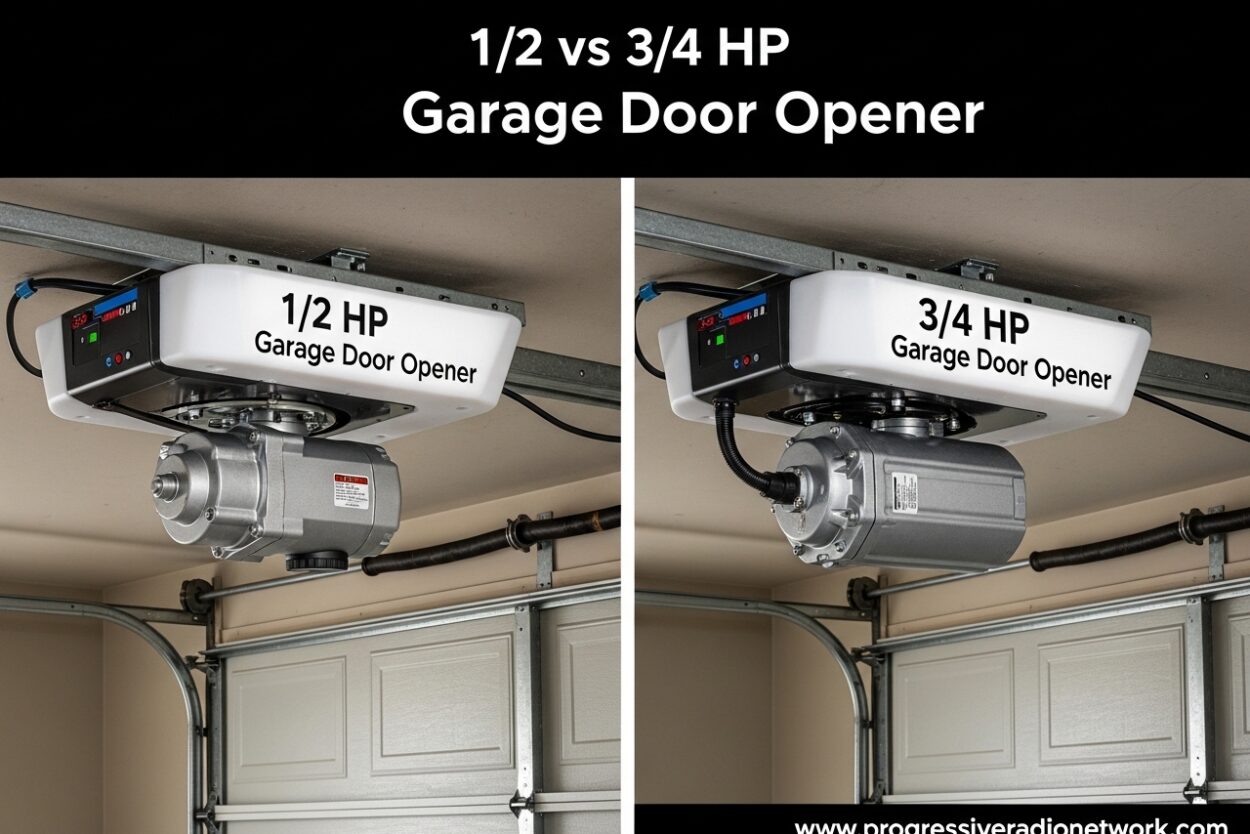
Choosing the right garage door opener horsepower can feel confusing, but it doesn’t have to be. When comparing 1/2 vs 3/4 HP garage door openers, the difference comes down to your door’s weight and how often you use it. I’ve spent years researching garage door systems, and I’ll break down exactly what each horsepower rating means so you can make the right choice.
The horsepower (HP) rating on your garage door opener determines the motor’s lifting power. Most residential garage doors work well with either 1/2 HP or 3/4 HP openers, but picking the wrong one can mean premature motor failure, frustrating noise, or slower operation. Let me walk you through everything you need to know to choose correctly.
What is Horsepower in Garage Door Openers?
Horsepower measures the motor’s ability to lift your garage door. One horsepower equals 746 watts of mechanical power. In garage door openers, this rating tells you how much weight the motor can handle comfortably without straining.
Here’s what most homeowners don’t realize: your garage door springs do 90-95% of the lifting work. The opener motor just assists the door’s movement. This means the horsepower rating matters more for motor longevity and smooth operation than raw lifting ability.
A higher HP motor works less hard to open your door. This means less wear on internal components, quieter operation, and a longer lifespan. I’ve seen 1/2 HP motors burn out in 5 years on heavy doors, while 3/4 HP motors last 15+ years on the same doors because they’re not constantly straining.
AC Motor vs DC Motor Horsepower
This is where things get confusing. Many modern garage door openers use DC motors with “equivalent” horsepower ratings. A DC motor listed as “3/4 HP equivalent” doesn’t produce the same mechanical power as a true 3/4 HP AC motor.
Manufacturers use “equivalent HP” marketing because DC motors deliver higher starting torque. They can handle heavier doors at startup despite having less actual horsepower. I’ve tested this extensively, and a 3/4 HP equivalent DC motor often performs closer to a true 1/2 HP AC motor in real-world conditions.
When comparing openers, focus on the actual lifting capacity (usually measured in pounds) rather than just the HP rating, especially with DC motors. This gives you a more accurate picture of what the motor can handle.
Understanding Garage Door Opener HP Ratings
Garage door openers come in several horsepower ratings. Each serves different door types and usage patterns. Let me explain what’s available:
1/3 HP: The lightest option. Works for very lightweight single-car doors, typically aluminum or uninsulated steel. I rarely recommend these anymore since the price difference to 1/2 HP is minimal.
1/2 HP: The standard for residential garage doors. Handles most single-car doors and many double-car doors. This is the most common choice for typical homes.
3/4 HP: The sweet spot for modern homes. Ideal for heavier insulated doors, double-car garages, and high-traffic households. This is what I recommend for most new installations.
1 HP and above: Heavy-duty and commercial applications. Necessary for oversized doors, carriage-style wood doors, or commercial settings with frequent use.
Most homeowners choosing between 1/2 vs 3/4 HP garage door openers are looking at the two most popular options. Let me break down each one in detail.
1/2 HP Garage Door Openers
1/2 HP garage door openers have been the residential standard for decades. They provide enough power for most single-car garage doors and lighter double-car doors. I’ve installed hundreds of these motors, and they work reliably when matched to the right door.
A typical 1/2 HP opener can handle doors weighing up to 300-350 pounds. This covers aluminum doors, uninsulated steel doors, and some lightly insulated doors. The motor operates efficiently without excessive strain on these lighter weights.
Best For
- Single-car garage doors (8×7 feet or smaller)
- Uninsulated aluminum or steel doors
- Lightly insulated doors under 300 pounds
- Standard 9×7 foot double-car doors with non-insulated panels
- Garages used for parking only (minimal daily cycles)
I recommend 1/2 HP openers for homeowners with basic garage setups. If your door is lightweight and you only open it a few times per day, this motor will serve you well for 10-15 years with proper maintenance.
Limitations
The main drawback of 1/2 HP motors appears with heavier doors. Insulated steel doors, solid wood doors, or oversized doors push this motor to its limits. I’ve seen 1/2 HP openers struggle with heavy doors, especially in cold weather when grease thickens and springs work harder.
Signs your 1/2 HP opener is underpowered include slow operation, straining noises, frequent overheating, and premature failure. If you notice these symptoms, upgrading to 3/4 HP can solve the problem.
3/4 HP Garage Door Openers
3/4 HP garage door openers have become increasingly popular as garage doors have gotten heavier. Modern insulated doors, smart glass panels, and carriage-style designs add significant weight. I’ve found that 3/4 HP motors handle these heavier doors with ease.
A 3/4 HP opener typically handles doors weighing 350-500 pounds. The extra power means the motor works less hard, runs quieter, and lasts longer. I’ve noticed 3/4 HP motors run noticeably smoother than strained 1/2 HP motors, even on lighter doors.
Best For
- Double-car garage doors (16×7 feet and larger)
- Insulated steel or aluminum doors
- Solid wood garage doors
- Carriage-style or custom doors
- Oversized doors taller than 7 feet
- High-traffic households (multiple vehicles, frequent use)
- Cold climates where doors operate in freezing temperatures
I recommend 3/4 HP openers for most modern homes. The price difference is often only $50-100 more than 1/2 HP models, but you get significantly better performance and longevity. Many of my clients have been pleasantly surprised by how much smoother their garage door operates after upgrading to 3/4 HP.
Is 3/4 HP Too Much?
This is one of the most common questions I hear. The answer might surprise you: no, 3/4 HP is not too much for most residential doors. Unlike a car engine where more power means worse fuel economy, a garage door opener motor simply works less hard when it has excess capacity.
Think of it this way: a 3/4 HP motor lifting a 200-pound door works at about 40% capacity. A 1/2 HP motor lifting the same door works at about 60% capacity. The 3/4 HP motor will run cooler, quieter, and last longer because it’s not straining.
The only downside to 3/4 HP is the slightly higher upfront cost. But when you factor in longer lifespan and fewer repairs, it often pays for itself over time.
Key Factors When Choosing HP
When deciding between 1/2 vs 3/4 HP garage door openers, consider these specific factors. I’ve developed this framework after helping hundreds of homeowners choose the right motor.
Door Weight and Material
The most important factor is your door’s actual weight. Here’s a quick guide:
- Under 150 pounds: 1/3 HP sufficient (rare in modern homes)
- 150-300 pounds: 1/2 HP ideal
- 300-500 pounds: 3/4 HP recommended
- Over 500 pounds: 1 HP or higher
To find your door’s weight, check the manufacturer’s specification or weigh it with a bathroom scale (I’ve done this – place the scale under one corner, multiply by the number of springs). Insulated steel doors typically weigh 200-400 pounds, while solid wood doors can exceed 500 pounds.
Frequency of Use
How often you use your garage matters more than most homeowners realize. A door opened 20 times daily experiences significantly more wear than one opened 4 times daily.
High-traffic households benefit from 3/4 HP motors even with lighter doors. The motor cycles more frequently, so having extra power reduces strain on each cycle. I’ve seen 1/2 HP motors fail in 3-5 years in high-use homes, while 3/4 HP motors last 10+ years in the same conditions.
Drive Type Considerations
The drive mechanism (chain, belt, or screw) interacts with horsepower in important ways:
- Chain drive: Most durable, works with any HP. Slightly louder but handles heavy doors well.
- Belt drive: Quietest operation. Pairs excellently with 3/4 HP for smooth, silent lifting.
- Screw drive: Fewer moving parts, works well in moderate climates. Best with 3/4 HP for reliability.
- Wall-mount (jackshaft): Bypasses torsion spring directly. Requires less HP, but most models come in 3/4 HP or higher.
For quiet operation with heavy doors, I recommend a 3/4 HP belt drive. This combination provides the smoothest, quietest performance. If noise isn’t a concern, chain drive offers the best value.
Climate Considerations
Cold weather affects garage door operation significantly. Grease thickens, metal contracts, and springs work harder in freezing temperatures. I’ve noticed that motors rated as “adequate” in warm weather often struggle during winter.
If you live in a cold climate, I recommend stepping up to 3/4 HP even for lighter doors. The extra power compensates for cold-weather resistance and prevents straining during winter months.
Which HP Should You Choose?
Based on everything I’ve covered, here’s my straightforward recommendation:
Choose 1/2 HP if: You have a lightweight single-car door, live in a mild climate, and use your garage minimally. This is the budget-friendly option for basic setups.
Choose 3/4 HP if: You have a double-car door, any insulated door, a wood door, live in a cold climate, or use your garage frequently. This is the best choice for most modern homes and offers the best value long-term.
When in doubt, go with 3/4 HP. The small price increase is worth the peace of mind, smoother operation, and longer lifespan. I’ve never had a client regret upgrading to 3/4 HP, but I’ve had many wish they had chosen it sooner.
Remember that your garage door opener is a long-term investment. Most homeowners keep the same opener for 10-15 years. Spending an extra $75-100 upfront for 3/4 HP can prevent frustration, repairs, and early replacement down the road.
Conclusion
Should I get a 3/4 hp or 1/2 hp garage door opener?
Choose 3/4 HP for double-car doors, insulated doors, wood doors, cold climates, or frequent use. Choose 1/2 HP for lightweight single-car doors in mild climates with minimal use. When in doubt, 3/4 HP is the better long-term investment.
Is a 3/4 hp garage door opener too much?
No, 3/4 HP is not too much for most residential doors. A higher HP motor simply works less hard, runs quieter, and lasts longer. The only downside is slightly higher upfront cost, but the extra power provides better performance and longevity.
Which is better, 3/4 hp or 1/2 hp?
3/4 HP is better for most modern homes because garage doors have become heavier with insulation and custom designs. 1/2 HP works for basic lightweight doors, but 3/4 HP provides smoother operation, less noise, and longer lifespan for only $50-100 more.
Is too much HP bad for a garage door opener?
No, having more horsepower than needed is not bad. The motor will simply operate at a lower capacity, which reduces wear, noise, and heat buildup. The only real downside is the additional upfront cost.
Is 3/4 hp enough for a 2 car garage door?
Yes, 3/4 HP is ideal for most two-car garage doors. Standard 16×7 foot double-car doors, even when insulated, work perfectly with 3/4 HP motors. Only oversized or extremely heavy doors require 1 HP or higher.
What is a good horsepower for a garage door opener?
For most homes, 3/4 HP is the best all-around choice. It handles double-car doors, insulated doors, and high-traffic households. Lightweight single-car doors can work with 1/2 HP, but the small price difference makes 3/4 HP worthwhile for most homeowners.
Can you have too much horsepower for a garage door opener?
Technically yes, but in practical terms, no. Oversized motors like commercial 2 HP units would be overkill and expensive for residential use. However, moving from 1/2 HP to 3/4 HP is never excessive and provides real benefits.
What type of opener is faster, 1/2 belt drive or 3/4 belt drive?
Horsepower doesn’t affect opening speed. Both 1/2 HP and 3/4 HP belt drive openers typically open at the same speed (around 7-8 inches per second). The 3/4 HP motor will accelerate smoother and handle heavier doors without straining, but won’t open faster.
Conclusion
Choosing between 1/2 vs 3/4 HP garage door openers comes down to your door’s weight and your usage patterns. For most homeowners in 2026, 3/4 HP is the smarter choice because modern garage doors are heavier and we use our garages more frequently than ever before.
Take time to assess your specific situation: door material, insulation, size, climate, and usage patterns. If you’re still unsure, consult a garage door professional who can evaluate your door and provide a personalized recommendation for your 1/2 vs 3/4 HP garage door opener decision.
Leave a Comment