
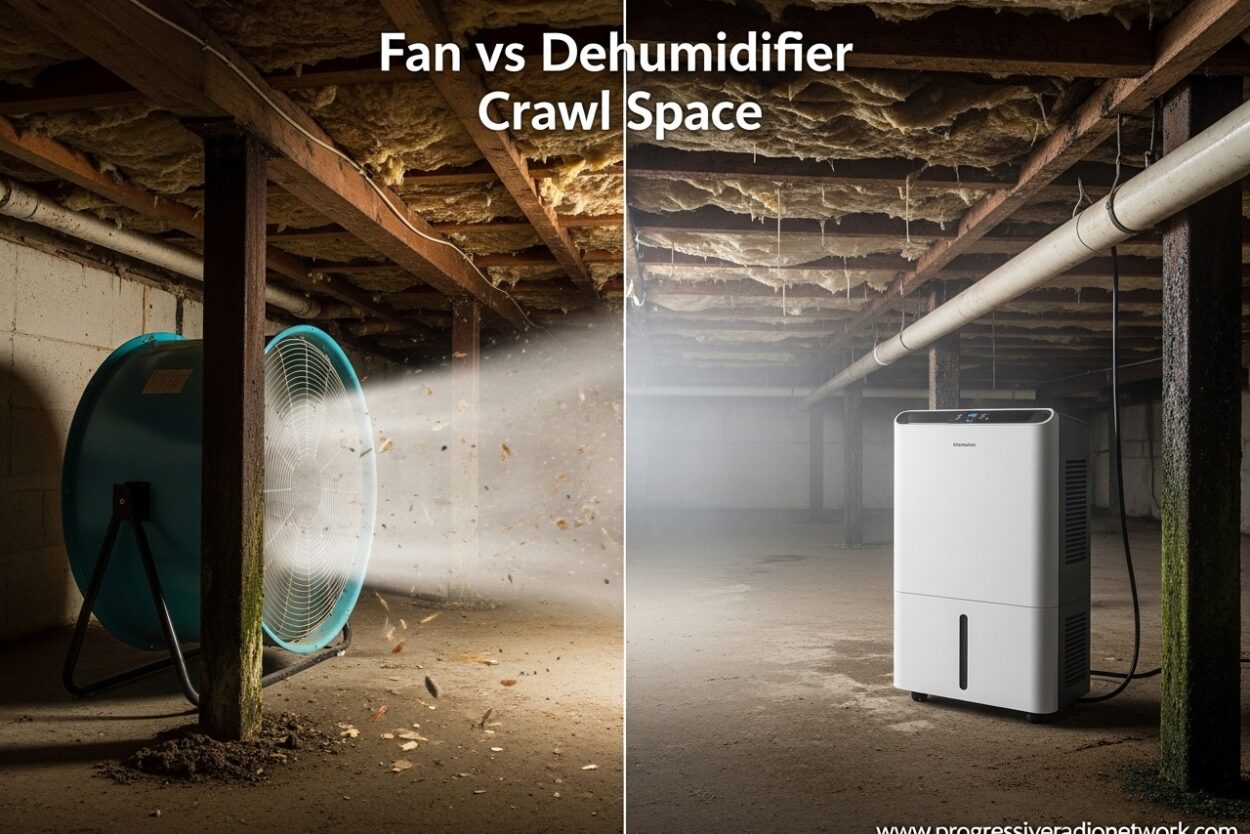
If you’re dealing with a damp, musty crawl space, you’ve probably wondered about the fan vs dehumidifier crawl space debate. Both solutions promise to control moisture, but they work in completely different ways. Choosing the wrong one could mean wasted money and continued moisture problems.
I’ve spent years researching crawl space moisture control, and the answer isn’t always straightforward. The right choice depends on your climate, your crawl space configuration, and what specific moisture problems you’re trying to solve.
In this guide, I’ll break down exactly how each solution works, when to use them, and how to decide which one (or both) will actually solve your moisture issues for good.
What is a Crawl Space Vent Fan?
A crawl space vent fan is a mechanical exhaust fan designed to actively move air through your crawl space and vent it to the outdoors. Unlike passive foundation vents that rely on natural air movement, these fans force air circulation using electric motors.
Think of a vent fan as an exhaust system for your crawl space. It pulls stale, moist air from beneath your home and pushes it outside, creating constant airflow that prevents moisture from stagnating.
Here’s what makes vent fans unique: they’re specifically designed to address soil gases like radon, not just moisture. The EPA recommends ventilation as the primary method for dealing with dangerous soil gases that can seep into your home.
Vent fans are rated in CFM (cubic feet per minute), which measures how much air they can move. The general guideline is 1 CFM of airflow for every 50 square feet of crawl space area. So a 1,500 square foot crawl space would need a fan rated for at least 30 CFM.
These fans typically install in one of your foundation vent openings or through a dedicated hole cut in the rim joist. They’re controlled by a humidistat that activates the fan when humidity levels rise above a set point, usually around 50-60%.
What is a Crawl Space Dehumidifier?
A crawl space dehumidifier is an appliance designed specifically to remove moisture from the air. Instead of just moving air around like a fan, it actually pulls water vapor out of the air and collects it as liquid water.
Here’s how it works: moist air is drawn across refrigerated coils inside the unit. When the air hits these cold coils, the water vapor condenses into liquid droplets (like water on a cold soda can). This water drips into a collection tray or drains through a hose, while drier air is warmed slightly and released back into the crawl space.
Dehumidifiers are rated by how many pints of water they can remove in 24 hours. Common ratings for crawl spaces include 30, 50, 70, and 90-pint capacities. Larger, damper spaces need higher-capacity units.
Unlike vent fans, dehumidifiers don’t need to vent to the outdoors. They’re self-contained units that recirculate air within your crawl space, continuously extracting moisture until the relative humidity reaches your target level (typically 50% or below).
Crawl space dehumidifiers are designed to work in harsh environments. They’re built to handle temperatures as low as 40-50 degrees F, which regular household dehumidifiers can’t manage. They also feature corrosion-resistant coatings to withstand the damp crawl space environment.
Fan vs Dehumidifier Crawl Space: Head-to-Head Comparison
Let’s compare these two solutions directly so you can see the key differences at a glance.
| Criteria | Vent Fan | Dehumidifier |
|---|---|---|
| Primary Function | Air circulation and exhaust | Moisture removal from air |
| Moisture Removal Method | Replaces moist air with drier outdoor air | Condenses water vapor from air |
| Soil Gas Handling | Excellent – exhausts radon and other gases | Poor – does not address soil gases |
| Effectiveness in Humid Climate | Limited – brings in humid outdoor air | Excellent – actively removes moisture |
| Energy Consumption | Low – 50-150 watts typical | Medium to High – 300-700 watts typical |
| Initial Equipment Cost | $150-$400 | $800-$2,500 |
| Installation Complexity | Simple – DIY friendly | Moderate – may need drain line |
| Best Climate | Dry to moderate climates | All climates, especially humid |
| Maintenance Required | Annual cleaning | Filter cleaning, drain line checks |
| Works in Sealed Space | No – needs outdoor air intake | Yes – designed for sealed spaces |
The fundamental difference comes down to this: vent fans move air, dehumidifiers remove moisture. If you live in a humid climate like Florida or the Gulf Coast, bringing in more humid air through a vent fan might actually make your moisture problems worse. In that case, a dehumidifier that actively extracts water from the air is the better choice.
However, if your primary concern is radon or other soil gases, a vent fan is essential. Dehumidifiers cannot address soil gas accumulation – they only condition the air that’s already present.
When to Use a Crawl Space Vent Fan
Vent fans are the right choice in specific situations. Here are the scenarios where a vent fan makes the most sense:
You have radon concerns. Radon is a colorless, odorless gas that causes lung cancer. If you’ve tested your home and found elevated radon levels, a vent fan is often the most effective solution. The fan actively exhausts soil gases before they can enter your living space.
You live in a dry to moderate climate. If you’re in an area where outdoor air is relatively dry (like Arizona, Nevada, or much of the West), venting your crawl space can be effective. The incoming outdoor air is drier than what’s under your home, so replacing the air actually reduces moisture levels.
Your crawl space is vented (not encapsulated). If you have open foundation vents and no vapor barrier, you’re dealing with a vented crawl space design. In this configuration, a vent fan works with the existing design rather than against it.
Budget is a primary concern. Vent fans cost significantly less upfront than dehumidifiers – often 75-90% less. If you need an affordable solution and live in a suitable climate, a vent fan provides basic moisture control without breaking the bank.
You need basic air circulation. Sometimes moisture problems stem from stagnant, still air. If your crawl space suffers from poor airflow but isn’t severely damp, a vent fan can keep air moving and prevent the stagnation that encourages mold growth.
You’re dealing with musty odors but not high humidity. If you smell something musty but your humidity readings are reasonable, the problem might be stagnant air rather than excess moisture. A vent fan exhausts stale air and brings in fresh air to eliminate odors.
When to Use a Crawl Space Dehumidifier
Dehumidifiers shine in different scenarios. Here’s when a dehumidifier is the better investment:
You live in a humid climate. If you’re in the Southeast, Gulf Coast, or any area with high outdoor humidity, a vent fan will constantly pull in moist air. A dehumidifier actually removes moisture from the air regardless of outdoor conditions.
Your crawl space is encapsulated. Modern best practices often involve sealing (encapsulating) crawl spaces with a heavy vapor barrier and closing all foundation vents. Encapsulated crawl spaces need dehumidifiers because there’s no air exchange with outdoors.
You’ve had persistent mold problems. If you’ve dealt with recurring mold or have visible mold growth, a dehumidifier is the more aggressive solution. It maintains humidity levels low enough (below 50%) that mold cannot grow.
Your wood moisture content is high. If you’ve tested the wood in your crawl space and found moisture content above 18-20%, you’re at risk for wood rot and structural damage. A dehumidifier actively pulls moisture from wood joists and subflooring over time.
You want the most effective solution. When it comes to pure moisture removal, nothing beats a dehumidifier. It’s the gold standard for crawl space moisture control because it directly addresses the problem rather than relying on outdoor air conditions.
Temperature is consistently above 50 degrees F. Dehumidifiers need temperatures above 50 degrees F to work efficiently. If your crawl space stays above this threshold (which most do), a dehumidifier will provide consistent moisture control.
Cost Analysis: Initial and Operational
Let’s break down the real costs of each solution over time. The cheapest option isn’t always the most cost-effective when you factor in long-term operation.
Initial Equipment Costs:
- Vent Fan: $150-$400 for a quality unit with humidistat control
- Dehumidifier: $800-$2,500 depending on capacity and features
Installation Costs:
- Vent Fan DIY: $0-$50 (minor materials, basic tools)
- Vent Fan Professional: $300-$600
- Dehumidifier DIY: $0-$100 (condensate pump, drain hose)
- Dehumidifier Professional: $500-$1,000
Annual Operating Costs:
A vent fan typically uses 50-150 watts of power. Running continuously, that’s roughly $50-$150 per year in electricity depending on your local rates.
A crawl space dehumidifier uses 300-700 watts. However, it doesn’t run continuously – it cycles on and off based on humidity levels. Annual operating costs typically range from $150-$400, depending on how damp your crawl space is and how often the unit runs.
Long-Term Value Analysis:
While dehumidifiers cost more upfront, they often provide better value in humid climates because they actually solve the moisture problem. I’ve seen homeowners spend $1,500 on a dehumidifier and avoid $10,000+ in mold remediation and structural repairs.
Vent fans provide excellent value in dry climates where they can effectively control moisture at a low initial and operating cost. But in humid regions, they can end up being money wasted on a solution that doesn’t work.
Square Footage Sizing Guide
Choosing the right size equipment matters. Undersized units won’t control moisture effectively, while oversized units waste money and energy.
Vent Fan Sizing Formula:
Calculate your crawl space’s square footage (length x width). Multiply by 0.02 to get the minimum CFM rating. Or use the simplified rule: 1 CFM per 50 square feet.
- 500 sq ft crawl space: 10 CFM minimum
- 1,000 sq ft crawl space: 20 CFM minimum
- 1,500 sq ft crawl space: 30 CFM minimum
- 2,000 sq ft crawl space: 40 CFM minimum
For severe moisture problems or radon concerns, multiply by 1.5 to 2 for extra capacity.
Dehumidifier Sizing Guide:
- Moderately damp (500-1,000 sq ft): 30-50 pint unit
- Damp (1,000-1,500 sq ft): 50-70 pint unit
- Very damp (1,500-2,000+ sq ft): 70-90 pint unit
- Wet conditions or standing water: 90+ pint unit
In humid climates, size up one category. In encapsulated crawl spaces, you can sometimes size down one category since the space is sealed from outside moisture.
EPA Guidelines for Crawl Space Ventilation
The EPA provides clear guidance on crawl space ventilation that’s important to understand when choosing between a fan and dehumidifier.
For Vented Crawl Spaces:
The EPA’s Indoor AirPlus program recommends providing ventilation that meets or exceeds 1 CFM of airflow for every 50 square feet of crawl space area. This is the standard I mentioned earlier, and it’s based on research showing this rate effectively removes soil gases and moisture.
For Soil Gas Exhaust:
The EPA identifies active soil depressurization (which is essentially what a vent fan does) as the most effective method for dealing with radon and other soil gases. This is why vent fans are strongly recommended when radon is a concern.
When to Seal vs Vent:
Building codes and EPA guidelines have shifted toward sealed crawl spaces in many climate zones. If you choose to encapsulate your crawl space, the EPA recommends mechanical dehumidification rather than ventilation. This is because sealed crawl spaces don’t have air exchange with the outdoors.
Can You Use Both Together?
Yes, and in some situations, this hybrid approach is ideal. A properly designed system uses a vent fan to exhaust soil gases and a dehumidifier to control humidity.
However, you need to position them carefully. Place the vent fan at least 10-15 feet away from the dehumidifier’s intake. If they’re too close, the fan will exhaust the dry air the dehumidifier just created, wasting energy and reducing effectiveness.
The hybrid approach makes the most sense when you have radon concerns combined with high humidity. The vent fan handles soil gas exhaust, while the dehumidifier maintains proper humidity levels.
Frequently Asked Questions
Is a fan or dehumidifier better for crawl space?
The answer depends on your climate and specific needs. In humid climates, a dehumidifier is better because it actively removes moisture from the air. In dry to moderate climates, a vent fan can be effective and costs less. If you have radon concerns, a vent fan is essential to exhaust soil gases. For encapsulated crawl spaces, a dehumidifier is required since there’s no air exchange with outdoors.
Will a fan help dry out a crawl space?
Yes, but with limitations. A vent fan dries your crawl space by replacing moist indoor air with drier outdoor air. This works well in dry climates but can actually increase humidity in humid regions. Think of it this way: a fan moves air around but doesn’t remove water from it. In humid areas, you’re just bringing in more moist air. For effective drying regardless of outdoor conditions, a dehumidifier that actually condenses water vapor from the air is the better choice.
Do I need both a vent fan and dehumidifier?
Sometimes both together is the ideal solution, especially if you have radon concerns combined with high humidity. The vent fan handles soil gas exhaust (which dehumidifiers can’t address), while the dehumidifier actively removes moisture. If you choose both, position them at least 10-15 feet apart so the fan doesn’t exhaust the dry air your dehumidifier just created. For most homeowners in humid climates with no radon issues, a dehumidifier alone provides the best moisture control.
How much CFM do I need for my crawl space fan?
Calculate your crawl space’s square footage (length x width). The EPA guideline is 1 CFM per 50 square feet. For example: 500 sq ft = 10 CFM, 1,000 sq ft = 20 CFM, 1,500 sq ft = 30 CFM, 2,000 sq ft = 40 CFM. If you have severe moisture or radon concerns, multiply by 1.5 to 2 for extra capacity. Always size up rather than down – oversized fans can be controlled with a timer or speed control, but undersized fans won’t get the job done.
Should I seal crawl space vents with a dehumidifier?
Yes, this is the recommended approach for crawl space dehumidifiers. When you install a dehumidifier, you should close and seal all foundation vents so the unit can condition the air without fighting outdoor humidity. This is called crawl space encapsulation when combined with a vapor barrier on the floor. Sealed crawl spaces with dehumidification are now considered best practice by the EPA and building science experts in most climate zones. The only exception is if you’re using a vent fan specifically for radon mitigation.
How long does it take to dry out a crawl space?
It typically takes 2-4 weeks for a properly sized dehumidifier to bring a damp crawl space under control. You won’t see results overnight – the dehumidifier needs time to extract moisture from wood joists, concrete, and accumulated moisture in the space. During the first week, you might see the unit collecting 5-10 pints of water daily. This gradually decreases as the space dries out. Vent fans work faster initially but can’t achieve the same low humidity levels. After the initial drying period, your dehumidifier should maintain humidity below 50% with shorter run cycles.
Conclusion
The fan vs dehumidifier crawl space decision comes down to your specific situation. There’s no single right answer for every home.
If you live in a humid climate or have an encapsulated crawl space, a dehumidifier is almost always the better choice. It actively removes moisture from the air regardless of outdoor conditions and provides the most effective protection against mold and wood rot.
If you’re in a dry to moderate climate with a vented crawl space, or if radon is your primary concern, a vent fan can provide effective moisture control at a much lower initial cost. Just understand that it won’t achieve the same humidity levels as a dehumidifier.
Many homes benefit from both solutions working together – a vent fan for soil gas exhaust and a dehumidifier for humidity control. The key is understanding what problem you’re trying to solve and choosing the equipment that addresses it directly.
Before making your final decision, test your crawl space humidity with a hygrometer and consider testing for radon. These simple tests will tell you exactly which solution (or both) your home needs for effective, long-term moisture control.




Leave a Comment