
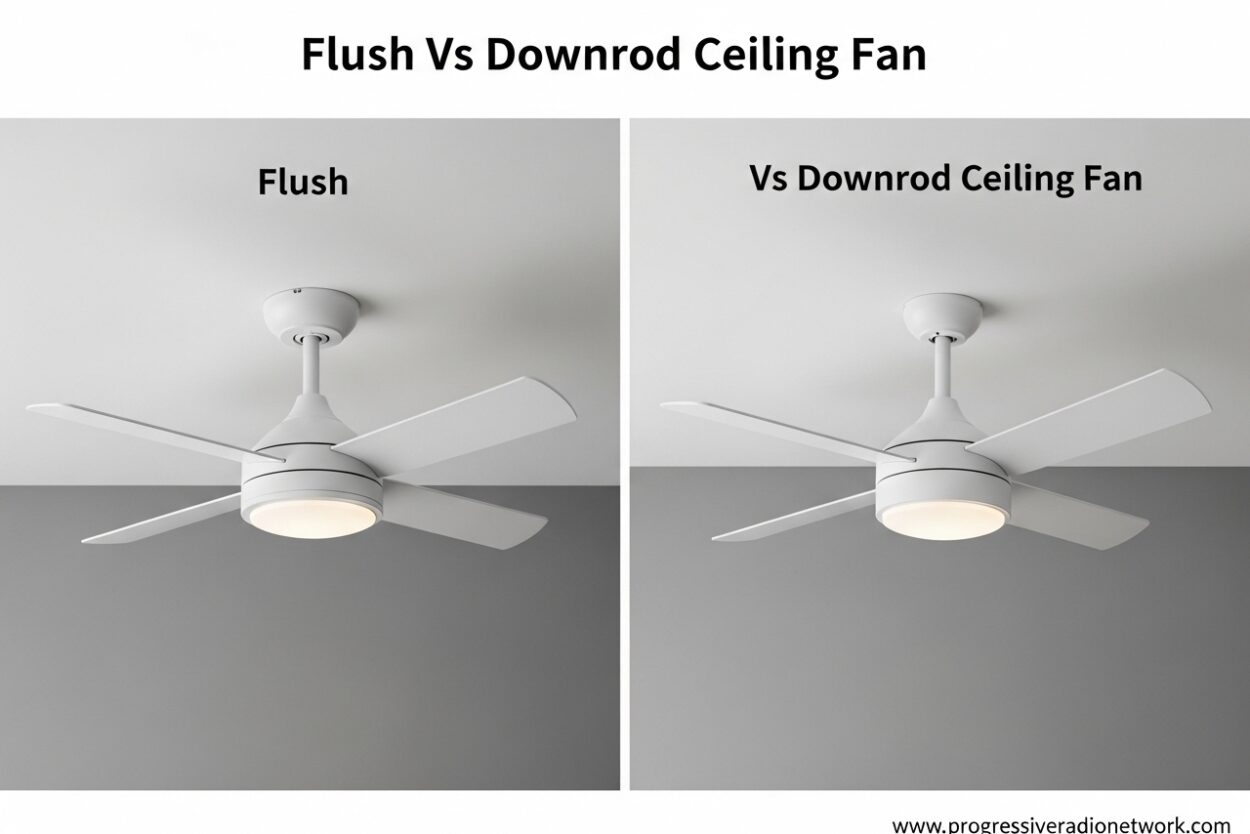
Choosing between a flush mount and downrod ceiling fan is one of those decisions that seems small until you are living with your choice for five years. I learned this the hard way when I installed a beautiful downrod fan in my eight-foot-ceiling bedroom, only to discover that every time I turned it on, I had to duck when I walked underneath. The wrong mount type does not just look awkward. It affects airflow, safety, and how much you actually enjoy using the room.
Ceiling fans come in two primary mount configurations, and the difference between them matters more than most people realize. A flush mount ceiling fan sits tight against the ceiling with no gap. A downrod ceiling fan hangs from a metal rod that positions the blades at an optimal height. Each has specific strengths, and the right choice depends entirely on your ceiling height, room size, and what you prioritize in performance versus aesthetics.
In this guide, I will break down everything you need to know to make an informed decision. We will cover airflow performance, installation complexity, design differences, and even a downrod length calculator so you know exactly what you need. By the end, you will have a clear picture of which fan type works best for your specific situation.
What Is a Flush Mount Ceiling Fan?
A flush mount ceiling fan, also called a hugger fan, mounts directly against the ceiling with minimal clearance between the top of the blades and the ceiling surface. The entire motor housing sits flush against the mounting bracket, leaving only a few inches of space above the blades.
These fans were designed specifically for rooms with low ceilings where headroom is limited. If your ceiling is eight feet or lower, a flush mount fan may be your only safe option. The blades on most hugger fans sit approximately six to eight inches from the ceiling, which means the bottom of the blades still clears the recommended seven-foot safety threshold in most cases.
The key characteristic of a flush mount fan is that there is no downrod separating the motor from the ceiling. This compact design sacrifices some airflow efficiency for the ability to function in spaces where a hanging fan would be impractical or violate building codes. You will find flush mount fans in apartments, condos, older homes with low ceilings, and rooms where ceiling height is at a premium.
What Is a Downrod Ceiling Fan?
A downrod ceiling fan hangs from a metal rod, typically ranging from two to twelve inches in length, that suspends the blade assembly away from the ceiling. This gap allows air to circulate freely above and below the blades, which creates more efficient airflow compared to flush mount designs.
The standard downrod length for a typical eight to nine-foot ceiling is three to five inches. For higher ceilings, you can extend the downrod to six, ten, or even twelve inches to maintain proper clearance. The downrod threads into the ceiling mounting bracket and connects to the fan motor, creating a stable, level hanging position that keeps the blades at an optimal height for both performance and safety.
Downrod fans represent the traditional ceiling fan design and are what most people picture when they think of a ceiling fan. They work best in rooms with nine-foot or higher ceilings, though they can certainly be used in standard eight-foot rooms with appropriate downrod length selection. The additional height allows the blades to move more air with less turbulence, creating a more comfortable environment overall.
Flush Mount vs Downrod: Key Differences at a Glance
Before diving into the details, here is a quick comparison to help you understand the fundamental differences between these two fan types:
| Feature | Flush Mount Fan | Downrod Fan |
|---|---|---|
| Best Ceiling Height | 8 feet or lower | 9 feet or higher |
| Airflow Efficiency | Slightly reduced | Optimal |
| Installation | Easier, single person | Moderate, may need help |
| Price Range | $80 – $300 | $100 – $500+ |
| Visual Profile | Low profile, sleek | Decorative, statement |
| Headroom Clearance | Maximizes space | Requires more vertical space |
| Recessed Light Compatibility | May cause strobing | Avoids strobing effect |
Airflow Performance: Which Fan Moves More Air?
Airflow performance is where downrod fans have a clear advantage, and this is not just marketing talk. Forum discussions consistently reveal that flush mount fans often feel like they lack sufficient airflow even on the highest speed setting. One user described their experience: “I just installed a new ceiling fan (flush mount) and you can barely feel a breeze on high when it is blowing down. I feel more air movement with the direction change.”
The reason comes down to basic physics. When a fan blade spins, it creates a circulation pattern where air is pulled from above the blades and pushed downward. With a downrod fan, there is space above the blades for this circulation to happen efficiently. The air can move freely, creating the cooling draft you expect from a ceiling fan.
Flush mount fans sit much closer to the ceiling, which limits the space available for air circulation above the blades. This restriction means the fan has to work harder to move the same amount of air. While manufacturers compensate with more powerful motors, the physics fundamentally limits how efficiently a hugger fan can perform compared to a downrod model with the same blade span.
CFM (Cubic Feet per Minute) ratings measure airflow efficiency, and you will typically see lower CFM numbers for flush mount fans compared to downrod fans with equivalent blade sizes. This does not mean flush mount fans are ineffective. They still provide valuable air circulation. However, if maximum airflow is your priority, downrod fans deliver better performance per blade inch.
Ceiling Height Suitability: Finding the Right Fit
Ceiling height is the single most important factor when choosing between these fan types, and it is not just about comfort. Building codes recommend maintaining at least seven feet of clearance between the floor and the bottom of the fan blades for safety. This is non-negotiable, and failing to meet this clearance can create a genuine hazard in your home.
For ceilings that are eight feet tall, you have two viable options. A flush mount fan will work well since there is no downrod taking up vertical space. Alternatively, you can use a downrod fan with a very short rod, typically two to three inches, which keeps the blades within safe clearance while still providing some gap for improved airflow. Using a six-inch downrod on an eight-foot ceiling would likely violate the seven-foot rule unless the fan is mounted in a location where people do not walk underneath.
For ceilings nine feet or higher, downrod fans become the clear choice. The extra height allows you to use standard downrod lengths of four to six inches, which positions the blades at the optimal height for both airflow efficiency and safety. In rooms with very high ceilings, such as those with vaulted or cathedral designs, longer downrods of ten, twelve, or even twenty-four inches may be necessary to bring the fan to a functional height.
One consideration that often gets overlooked is what happens when you combine a ceiling fan with recessed lighting. Users on home improvement forums have noted that long downrods can actually help prevent a strobing effect that sometimes occurs when LED recessed lights flicker at certain frequencies and the fan blades appear to stop or move backward. If you have recessed lights in your ceiling, a longer downrod may actually improve your experience rather than detract from it.
Installation Complexity: What to Expect
If you are planning to install your ceiling fan yourself, you will be glad to know that flush mount fans generally offer a simpler installation process. Since there is no downrod to assemble and the fan sits close to the ceiling, one person can typically handle the installation without needing to support heavy components overhead.
The flush mount installation involves securing a mounting bracket directly to the electrical box in your ceiling, then attaching the fan motor housing directly to that bracket. The entire process can take thirty minutes to an hour for someone with basic DIY skills. You will need to know how to connect the wiring, which typically involves matching black to black, white to white, and green or copper grounds.
Downrod fan installation is slightly more complex. You need to assemble the downrod, connect it to the motor, route the wiring through the rod, and then hang the entire assembly while securing it to the ceiling bracket. The additional weight and the need to support the fan while attaching it means having a helper is advisable, especially for larger fans. Budget one to three hours for a first-time downrod installation.
For either type, if your ceiling does not already have an electrical box rated for ceiling fans, you will need to install one. Standard electrical boxes are not designed to support the vibration and weight of a running fan, so this is not a step you can skip. Expect to pay $100 to $200 extra if you need to install a new fan-rated electrical box, and consider hiring an electrician if you are not comfortable working with ceiling wiring.
Design and Aesthetics: How They Look in Your Space
Aesthetics matter, and the visual difference between these two fan types is significant. Flush mount fans have a low profile that appeals to modern, minimalist design sensibilities. They sit close to the ceiling and do not draw attention to themselves. If you want your ceiling fan to be functional without dominating the room’s visual hierarchy, a flush mount makes sense.
Downrod fans, by contrast, make a statement. The rod adds visual interest and can complement your decor style depending on the finish you choose. Downrod fans come in countless styles, from rustic farmhouse designs with wood blade accents to sleek contemporary models with clean lines and matte finishes. The rod itself can be an aesthetic element, with options ranging from simple matte black to decorative brass.
Both types accommodate light kits if you need integrated illumination, though the installation differs. Flush mount fans with lights tend to have a more integrated, streamlined appearance. Downrod fans often feature more elaborate light kit designs since there is more visual space for them to fill. Consider whether you want your fan to disappear into the ceiling or serve as a focal point in the room.
If your room has a vaulted or sloped ceiling, downrod fans are typically the only practical option since the mounting system can be angled to accommodate the slope. Flush mount fans generally require a flat ceiling surface for proper operation and safety.
Price Comparison: What to Expect to Spend
Both fan types span a wide price range depending on quality, brand, features, and design complexity. On the lower end, you can find basic flush mount fans starting around $80 to $120. These budget options work well and provide the core functionality you need without fancy features.
Mid-range flush mount fans, which typically include better motors, remote controls, and more attractive finishes, run between $150 and $300. At this price point, you are paying for improved performance, quieter operation, and better aesthetics. The difference between a $100 and $300 flush mount fan is noticeable in terms of how much air it moves and how quietly it operates.
Downrod fans start around $100 for basic models and can climb well beyond $500 for premium brands with advanced features like DC motors, smart home integration, and designer aesthetics. The additional cost reflects the more complex design and typically the larger blade spans available in downrod configurations. You can expect to pay $200 to $400 for a quality downrod fan that will last many years and provide excellent performance.
Installation costs, if you hire someone, typically run $100 to $200 per fan, regardless of type. The complexity difference does not usually affect labor costs significantly since electricians and handymen charge by the job rather than by the hour for straightforward fan replacements.
Buying Guide: How to Choose the Right Fan for Your Space
Choosing the right ceiling fan comes down to answering a few key questions about your space and priorities. Let me walk you through the decision process step by step.
Step 1: Measure Your Ceiling Height
Start by measuring from your floor to the ceiling. This single measurement will immediately narrow your options.
- For ceilings 8 feet or lower: Flush mount is your primary option
- For ceilings 9 feet: Either type works with careful downrod selection
- For ceilings 10 feet or higher: Downrod fan is the clear choice
Step 2: Calculate the Right Downrod Length
If you choose a downrod fan, selecting the right length ensures proper clearance and optimal performance. Here is a simple calculator based on standard ceiling heights:
- 8-foot ceiling: Use a 2-3 inch downrod (if using downrod at all)
- 9-foot ceiling: Use a 3-4 inch downrod for optimal blade height
- 10-foot ceiling: Use a 5-6 inch downrod
- 11-foot ceiling: Use a 8-10 inch downrod
- 12-foot+ ceiling: Use a 12+ inch downrod or longer
The general rule is that the bottom of the fan blades should sit 8 to 9 feet from the floor for best airflow distribution. Fan blades positioned too low create a feeling of wind rushing past your head. Blades positioned too high may not effectively circulate air down to the living space.
Step 3: Consider Your Room Size
Room size determines what blade span you need. Larger rooms need fans with wider blade sweeps to move enough air effectively.
- Small rooms (under 100 square feet): 36-42 inch blade span
- Medium rooms (100-200 square feet): 44-52 inch blade span
- Large rooms (200-400 square feet): 54-60 inch blade span
- Extra large rooms (400+ square feet): 72+ inch or multiple fans
Step 4: Evaluate Special Considerations
Think about factors that might affect your choice:
- If you have recessed lighting, a longer downrod can reduce strobing effects
- If your ceiling is sloped, you need a downrod fan with a slope kit
- If the room is primarily for sleeping, prioritize quiet operation over maximum airflow
- If the room gets very hot in summer, prioritize airflow efficiency over aesthetics
Frequently Asked Questions
Which is better flush mount or downrod ceiling fan?
When should you use a flush mount ceiling fan?
Use a flush mount ceiling fan when your ceiling height is 8 feet or lower, when you want a low-profile look that does not dominate the room, or when headroom is limited. They are also appropriate in apartments, condos, and older homes with standard or low ceiling heights.
What is the difference between hugger and downrod ceiling fans?
A hugger (or flush mount) ceiling fan sits directly against the ceiling with no downrod, keeping blades close to the ceiling surface. A downrod ceiling fan hangs from a metal rod that positions the blades lower in the room. The downrod creates a gap for better air circulation above the blades, resulting in more efficient airflow.
Why use a downrod on a ceiling fan?
A downrod serves several purposes: it positions ceiling fan blades at the optimal height for airflow (8-9 feet from floor), it provides clearance for safety and comfort, it allows the fan to work properly with higher ceilings, and it can prevent strobing effects when used with recessed lighting. The gap created by the downrod enables better air circulation above the blades.
Is a 6 inch downrod fan too much for 8 foot ceilings?
Yes, a 6-inch downrod on an 8-foot ceiling would likely violate the 7-foot safety clearance requirement and position the blades too low for comfortable use. For an 8-foot ceiling, either use a flush mount fan or a downrod fan with a 2-3 inch rod maximum. The blades should ideally sit 7-8 feet from the floor for safety and optimal performance.
Are flush mount ceiling fans effective?
Flush mount ceiling fans are effective but generally produce slightly less airflow than downrod fans with equivalent blade sizes. They work well in small to medium rooms with low ceilings where headroom is a priority. Modern flush mount fans use more powerful motors to compensate for the reduced blade-to-ceiling gap, making them adequate for most residential applications.
Conclusion
Choosing between a flush mount and downrod ceiling fan ultimately comes down to your specific ceiling height and priorities. If you have eight-foot ceilings or lower, a flush mount fan is often your only practical option, and modern designs perform adequately for most residential needs. Do not dismiss them as ineffective; they serve an important purpose in making ceiling fans accessible for rooms where downrod models simply would not fit safely.
If your ceilings are nine feet or higher, a downrod fan will deliver better airflow performance and give you more design options. The investment in a downrod model typically pays off in improved comfort and more effective air circulation throughout the room.
Before you buy, measure your ceiling height, calculate your ideal downrod length if using one, and consider how the fan’s appearance fits your room’s design. The right choice is the one that balances safety, performance, and aesthetics for your specific situation. With the information in this guide, you now have everything you need to make that decision with confidence.





Leave a Comment