
Choosing between ductless mini-split and central air conditioning is one of the most significant decisions you’ll make for your home comfort. Both systems have distinct advantages that can dramatically impact your energy bills and daily living experience. After researching dozens of HVAC installations and analyzing real homeowner experiences, I’ll break down exactly which system makes sense for your specific situation.
The ductless vs central air conditioner debate ultimately comes down to your home’s existing infrastructure, your budget priorities, and how you prefer to control temperature throughout your living spaces. Neither system is universally better – the right choice depends on whether you value whole-home uniform cooling or zoned temperature control, whether you have existing ductwork, and how much you’re willing to invest upfront versus over time.
What is a Ductless Mini-Split System?
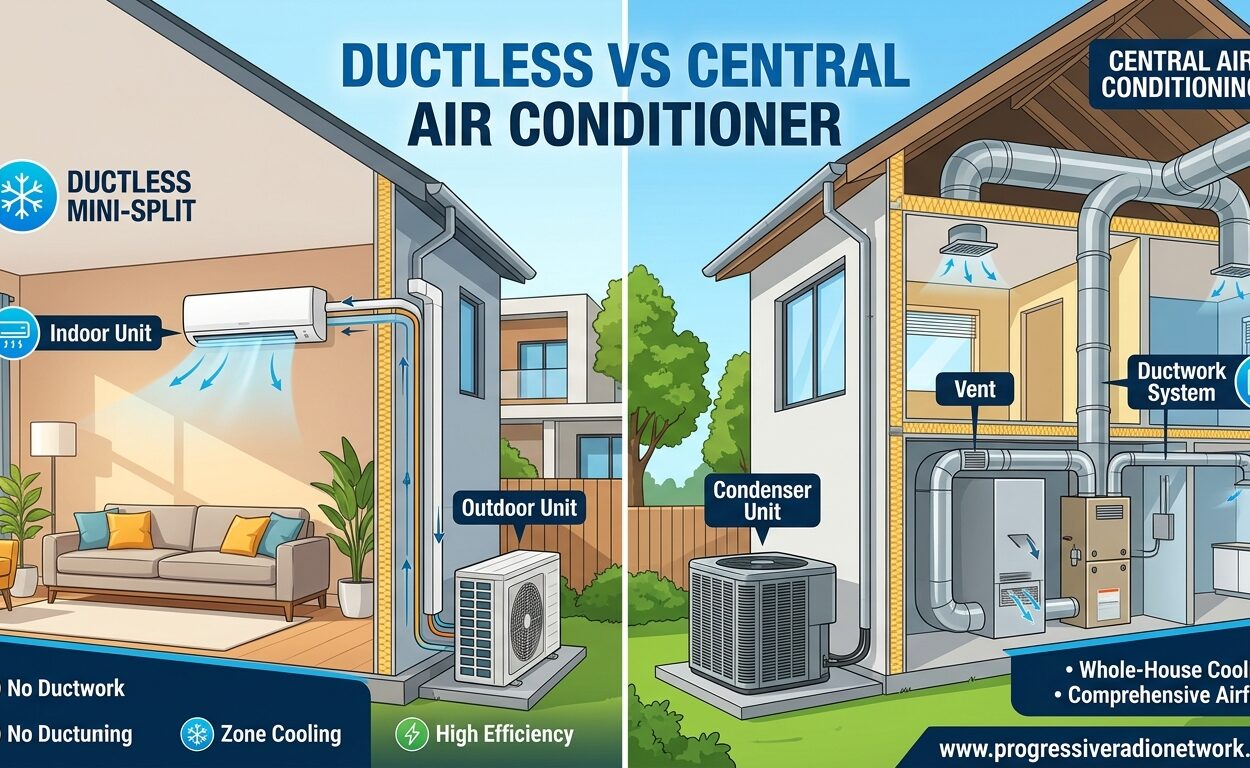
A ductless mini-split system, also called a ductless AC, consists of an outdoor compressor/condenser unit connected to one or more indoor air-handling units mounted on walls or ceilings. These indoor units deliver cooled air directly into specific rooms or zones without requiring any ductwork. The outdoor and indoor units are connected by refrigerant lines, a power cable, and a condensate drain line that typically require only a three-inch hole through an exterior wall.
Ductless systems use inverter technology with variable-speed compressors that can adjust their output precisely to match cooling demands. Unlike traditional systems that cycle on and off at full capacity, mini-splits can operate at 30-50% capacity when full cooling isn’t needed, which significantly improves efficiency. Most systems support up to five indoor units connected to a single outdoor unit, allowing for multi-zone configuration with individual thermostat control in each zone.
What makes mini-splits particularly versatile is their ability to provide both heating and cooling through heat pump technology. This dual functionality means you can replace both your furnace and air conditioner with a single system, potentially simplifying your home’s HVAC setup while maintaining year-round comfort.
What is a Central Air Conditioning System?
Central air conditioning uses a network of ducts hidden in walls, ceilings, or floors to distribute cooled air throughout your entire home from a single central unit. The system consists of an outdoor condenser/compressor unit and an indoor evaporator coil typically located within your furnace or air handler. Cooled air is pushed through supply ducts to each room, while return ducts pull air back to be reconditioned, creating continuous air circulation.
Central systems are designed to provide whole-home cooling using a single thermostat to control temperature. When sized and installed correctly, they maintain consistent temperatures across all connected rooms. The system works by absorbing heat from indoor air and transferring it outdoors through the refrigeration cycle, with the cooled air being distributed via your ductwork to vents in each room.
Unlike ductless systems that cool specific zones independently, central air treats the entire home as one unified space. This means the same amount of cooling energy is distributed throughout, regardless of which rooms are actually occupied. The ductwork also typically connects to your furnace, allowing the same air distribution system to be used for heating during colder months.
Advantages of Ductless Mini-Splits
Energy efficiency stands as the most significant advantage of ductless mini-splits. With SEER ratings reaching up to 27 for the most efficient models (compared to 21 for top-tier central systems), mini-splits can achieve impressive energy savings, especially in homes where they’re replacing window units or used to cool only occupied zones. The elimination of ductwork alone prevents the 20-30% energy loss that typically occurs through leaks and uninsulated ducts in central systems.
Zoning capabilities transform how you manage home comfort. Each indoor unit operates independently with its own thermostat and remote control, allowing family members to set different temperatures in different rooms simultaneously. You can keep bedrooms cool at night while letting unused rooms remain warmer, or cool a home office during work hours without wasting energy on empty spaces. This level of control simply isn’t possible with a single central thermostat.
Installation flexibility makes mini-splits ideal for challenging situations. Homes without existing ductwork, such as older houses, historic properties, or room additions, can be cooled without the massive expense and disruption of installing ducts. The compact indoor units require minimal space and can be mounted high on walls or suspended from ceilings, making them suitable for rooms where traditional ductwork would be impossible. Installation typically takes only 1-2 days per zone compared to weeks for full ductwork installation.
The dual heating and cooling capability provides year-round versatility. Most mini-splits are heat pumps that can both cool and heat your home efficiently, eliminating the need for a separate furnace in milder climates. This all-in-one functionality can simplify your home’s mechanical systems and reduce maintenance requirements.
Improved indoor air quality results from the absence of ductwork where dust, mold, and allergens commonly accumulate. Each indoor unit has its own washable filter that captures particles before air enters the room, and there’s no network of ducts that can become contaminated over time and distribute pollutants throughout your home.
Disadvantages of Ductless Mini-Splits
The higher initial cost represents the biggest barrier for many homeowners. Ductless systems typically cost $6,000-$12,000 per zone installed, compared to $4,000-$8,000 for a central system serving an entire home. While energy savings can offset this difference over 7-10 years, the upfront investment can be daunting, especially if multiple zones are needed for whole-home cooling.
Aesthetic concerns trouble some homeowners who don’t want visible indoor units mounted on their walls or ceilings. While modern designs have become sleeker and more unobtrusive, the units are still visible fixtures that may not match every interior design style. Each indoor unit protrudes 6-8 inches from the mounting surface and requires clear space for airflow, which can limit furniture placement and room arrangements.
Filter maintenance requirements are more demanding than central systems. Mini-split filters typically need cleaning every 2-4 weeks to maintain efficiency and air quality, compared to 1-3 months for central system filters. With multiple indoor units throughout your home, this means tracking and cleaning several different filters regularly. Many homeowners report this becomes tedious after the initial novelty wears off.
Whole-home cooling limitations can be an issue in larger houses. While multi-zone systems can connect up to five indoor units to one outdoor compressor, each unit has a specific cooling capacity measured in BTUs. Very large homes may require multiple outdoor units, which increases complexity and cost. Additionally, mini-splits are most effective at cooling the immediate area around the indoor unit, so large open-concept rooms may need multiple units for even coverage.
Climate performance limitations exist in extremely cold regions. While mini-split heat pumps have improved significantly for heating in cold weather, models older than 3-4 years may struggle when temperatures drop below 15-20°F. In regions with harsh winters, you may still need supplemental heating or a backup furnace, which complicates the all-in-one advantage.
Advantages of Central Air Conditioning
Whole-home cooling capability makes central air ideal for larger houses where consistent temperature throughout is desired. A single system can cool 2,000-4,000+ square feet uniformly, eliminating hot spots that occur with room-by-room cooling approaches. For families that spend time throughout the entire house rather than retreating to specific rooms, central air provides consistent comfort everywhere.
Lower initial cost per square foot cooled is a significant advantage for homes with existing ductwork. If your house already has ducts installed, adding central air costs considerably less than installing multiple mini-split units. The per-room cost drops dramatically as house size increases, making central air more economical for larger homes where multiple ductless zones would be needed.
Better air filtration capabilities result from central systems’ ability to accommodate larger, more sophisticated filters. The single central air handler can house high-efficiency filters that capture particles as small as 0.3 microns, cleaning all the air circulating through your home. All air passes through this filter multiple times per day, providing whole-house air purification that ductless systems can’t match with their smaller individual filters.
Invisibility of the cooling system appeals to homeowners who want their HVAC equipment completely hidden from view. Aside from vents in ceilings or floors and the outdoor condenser unit, the entire system is concealed within walls, ceilings, or mechanical spaces. There are no indoor units mounted on walls or ceilings to impact interior design or limit furniture placement.
Familiarity and resale value advantages shouldn’t be underestimated. Most homebuyers are familiar with and expect central air conditioning, especially in newer homes or regions with hot summers. A house with central air may be easier to sell and command a higher price than one with ductless mini-splits, which some buyers perceive as unconventional or less desirable.
Disadvantages of Central Air Conditioning
Ductwork energy losses significantly reduce efficiency. The Department of Energy estimates that 20-30% of conditioned air is lost through leaks, holes, and poorly connected ducts in typical homes. Even well-maintained ducts absorb some cooling as air travels through unconditioned spaces like attics or crawl spaces. This means your system must work harder and consume more energy to achieve the same cooling effect that a ductless system provides without these losses.
Lack of zoning control forces whole-house cooling even when unnecessary. With a single thermostat controlling the entire system, you can’t direct cooling only to occupied rooms. Cooling empty guest bedrooms, unused basements, or rooms where family members aren’t present wastes energy. While zoning systems exist for central air, they’re expensive to add retroactively and still don’t provide the precise control that independent mini-split units offer.
Installation complexity and disruption are substantial for homes without existing ductwork. Adding ducts requires cutting holes in walls and ceilings, running flexible or metal ductwork through attics, basements, or crawl spaces, and designing the entire duct system to properly distribute air. The process can take 1-3 weeks, creates significant dust and mess, and may require modifications to your home’s structure. In homes without ducts, the installation cost for ductwork alone can reach $15,000-$20,000.
Maintenance requirements include duct cleaning and sealing, which many homeowners neglect. Over time, ducts accumulate dust, pet dander, mold, and other contaminants that distribute throughout your home each time the system runs. Duct cleaning every 3-5 years is recommended, and periodic sealing of leaks is necessary to maintain efficiency. These maintenance tasks add to the long-term cost and are often overlooked until problems develop.
Single-point failure means if the central system breaks down, your entire home loses cooling at once. With ductless mini-splits, a failure in one zone typically doesn’t affect other zones, and you still have partial cooling while repairs are made. Central air system failures are all-or-nothing, potentially leaving you without any cooling during the hottest days when repair technicians are busiest.
Energy Efficiency Comparison
When comparing ductless vs central air conditioner efficiency, several factors beyond just SEER ratings come into play. While top-tier mini-splits achieve SEER ratings up to 27 compared to 21 for the best central systems, real-world efficiency depends heavily on installation quality, usage patterns, and climate conditions.
The inverter technology in ductless systems provides a significant efficiency advantage. Traditional central air systems use single-speed compressors that run at full capacity and cycle on and off to maintain temperature. Each startup consumes substantial energy, and the system can’t adjust output to match actual cooling needs. Mini-split inverter compressors can operate at 30-100% capacity, ramping up or down continuously to match cooling demand precisely. This variable-speed operation can reduce energy consumption by 30-40% compared to single-speed systems.
Duct losses represent a major efficiency penalty for central systems. Even well-sealed ducts in conditioned spaces lose 5-10% of cooling capacity, while ducts running through attics or crawlspaces can lose 20-30%. Ductless systems eliminate these losses entirely by delivering cooled air directly into rooms without any distribution network. In homes with older or poorly maintained ductwork, the efficiency penalty can be even more severe.
Zone cooling capabilities give mini-splits a practical efficiency advantage. By cooling only occupied spaces to desired temperatures while leaving unoccupied rooms warmer, overall energy consumption drops substantially. A family that spends most of their time in a living room during the day and bedrooms at night can save significantly with zone control compared to cooling the entire house uniformly with central air.
Real-world energy cost comparisons from homeowners show typical savings of 20-40% on cooling costs when switching from central air to ductless mini-splits, depending on usage patterns and climate. However, in very large homes where multiple zones would be needed to replicate central air coverage, the efficiency advantage narrows as more indoor units are added.
Cost Comparison: Initial vs Long-Term
Understanding the complete cost picture requires examining both upfront installation expenses and long-term operating costs over the system’s 15-20 year lifespan. The ductless vs central air conditioner decision often comes down to whether you prioritize lower initial costs or lower lifetime costs.
Initial installation costs typically favor central air for homes with existing ductwork. A new central air system costs $4,000-$8,000 including the outdoor unit, indoor coil, and basic installation. If your home already has ductwork, this represents the total investment. Adding ducts to a home without them increases the cost to $15,000-$25,000 or more depending on home size and complexity.
Ductless mini-split systems cost $6,000-$12,000 per zone installed, with each zone serving one room or area. A whole-home solution for a 2,000 square foot house typically requires 3-5 zones, totaling $18,000-$30,000. This higher initial cost is the primary reason many homeowners choose central air when ductwork already exists.
Operating costs favor ductless systems in most scenarios. With 20-40% better efficiency and zone control capability, mini-splits typically save $300-$800 annually on cooling bills depending on climate, usage patterns, and electricity rates. Over 15 years, these savings can reach $4,500-$12,000, offsetting much of the initial price difference.
Maintenance costs are similar for both systems when calculated over their lifespan. Central air requires annual professional maintenance ($100-$200 per visit) plus duct cleaning every 3-5 years ($300-$600). Ductless systems need filter cleaning every 2-4 weeks (DIY) and annual professional maintenance ($100-$150 per indoor unit). Over 15 years, total maintenance costs typically range from $2,000-$4,000 for both system types.
The $5000 rule for HVAC provides a helpful decision framework when replacing existing equipment. Multiply the age of your current system by the cost of needed repairs. If the result exceeds $5,000, replacement is typically more cost-effective than continued repairs. This rule applies equally to both ductless and central systems when deciding between repair and replacement.
Return on investment calculations show ductless systems typically break even after 7-12 years compared to central air when replacing systems in homes with existing ducts. For new construction or homes without ductwork, the ROI timeline shortens to 4-7 years since the ductwork cost for central air is eliminated.
Which System is Right for Your Situation?
Your home’s existing infrastructure often makes the decision straightforward. Homes with ductwork already in place typically benefit from central air replacement unless you specifically want zoning capabilities or the existing ducts are in poor condition. For homes without ducts, adding them can cost as much as the entire HVAC system, making ductless mini-splits the economical choice.
Home size and layout considerations matter significantly. For homes under 1,500 square feet with open floor plans, a single-zone or two-zone mini-split system can often provide adequate cooling at lower cost than central air. Large homes over 2,500 square feet usually benefit from central air’s whole-home capacity, though a combination approach with central air for main areas and mini-splits for additions or hard-to-cool spaces can work well.
Climate affects the decision in several ways. In hot-humid regions with long cooling seasons, the efficiency advantages of ductless systems provide greater savings. In areas with extreme winter cold, central air paired with a furnace may be more reliable than ductless heat pumps, though newer cold-climate mini-splits have improved dramatically. Moderate climates with both heating and cooling needs often benefit most from the dual-function capability of mini-split heat pumps.
Room additions and renovations represent ideal mini-split applications. Adding ductwork to an addition is often prohibitively expensive or structurally impossible. A ductless mini-split provides efficient cooling (and heating) for the new space without requiring modifications to your existing HVAC system. Similarly, converted attics, basements, or garages can be conditioned independently with mini-splits.
Older homes without ductwork, particularly those built before central air was common, are excellent candidates for ductless systems. Installing ducts in historic homes often requires modifications that compromise architectural features or require extensive construction. Mini-splits provide climate control without these disruptions, preserving historic character while adding modern comfort.
Multi-generational households with different temperature preferences benefit significantly from ductless zoning. If family members prefer different sleeping temperatures or if some family members are home during the day while others aren’t, the ability to zone independently improves comfort for everyone without the constant thermostat adjustments that occur with central air.
Maintenance Requirements Comparison
Both systems require regular maintenance to operate efficiently and achieve their expected lifespan, but the specific tasks and frequencies differ. Understanding these requirements helps ensure you choose a system you’re willing to maintain properly.
Central air maintenance primarily focuses on the air handler and ductwork. The evaporator coil and condenser coil need annual cleaning to maintain heat transfer efficiency. Refrigerant levels should be checked yearly, and the blower motor and belts require inspection. Ductwork should be inspected for leaks every 3-5 years and cleaned if dust accumulation is visible. Professional maintenance typically costs $100-$200 annually.
Ductless mini-split maintenance emphasizes the indoor units and their filters. Each indoor unit has a washable filter that requires cleaning every 2-4 weeks to maintain airflow and efficiency. The indoor coils need annual cleaning, and the outdoor unit requires the same attention as central air condensers. Professional maintenance costs $100-$150 per indoor unit annually, meaning homes with multiple zones may have higher maintenance costs than single central systems.
DIY maintenance potential differs between systems. Central air has few homeowner-serviceable components beyond changing air filters. Ductless systems allow homeowners to clean filters themselves, reducing service frequency, though the height of wall-mounted units can make filter access challenging for some users.
Noise Level Comparison
Operating noise differences between systems are noticeable but often overstated. Modern ductless indoor units operate at 19-35 decibels on low settings – quieter than a whisper. Central air vents produce virtually no noise since the air handler is typically located away from living areas, though the system itself produces 50-60 decibels outdoors.
The main difference is noise location. With ductless systems, the quiet fan noise is in the room with the indoor unit, while central air concentrates operational noise in the mechanical area where the air handler is located. Some homeowners prefer the white noise of a mini-split in the room, while others prefer the silent operation of central air vents.
Outdoor unit noise is similar for both systems when properly sized and installed, typically around 55-65 decibels at 10 feet distance. Neither system has a significant noise advantage for exterior noise concerns.
Climate Zone Considerations
Hot-humid regions like the Southeast benefit from ductless systems’ superior dehumidification at part-load conditions. The variable-speed operation allows mini-splits to run longer at lower capacity, removing more humidity than the short cycles typical of central air systems.
Dry hot regions like the Southwest see less difference between system types since cooling requirements are more straightforward. Both systems perform well, though the efficiency advantage of ductless systems can provide meaningful savings during long cooling seasons.
Cold northern regions present heating challenges for ductless heat pumps. While modern cold-climate mini-splits maintain heating capacity down to -13°F, older models lose efficiency below 30°F. In these regions, central air paired with a furnace may be more reliable, or a hybrid system with furnace backup could be optimal.
Moderate climates with balanced heating and cooling needs often benefit most from ductless heat pumps that can efficiently handle both functions year-round, potentially eliminating the need for separate heating and cooling systems.
What is better, ductless or central air?
Neither system is universally better – ductless mini-splits excel in energy efficiency and zoning control, making them ideal for homes without ductwork or those wanting room-by-room temperature control. Central air provides lower initial cost for homes with existing ducts and better whole-home uniform cooling. The right choice depends on your home’s infrastructure, your budget priorities, and whether you value zoned control or whole-home uniformity.
What is the $5000 rule for HVAC?
The $5000 rule helps decide whether to repair or replace your HVAC system. Multiply the age of your system by the cost of needed repairs – if the result exceeds $5000, replacement is typically more cost-effective than repair. This rule accounts for declining efficiency and increasing failure likelihood in older systems, helping you avoid throwing good money after bad on equipment near the end of its useful life.
How much does a mini split cost for a 2000 sq ft house?
A ductless mini-split system for a 2000 sq ft house typically costs $15,000-$25,000 installed, depending on the number of zones needed. Most homes this size require 3-5 indoor units to provide adequate coverage, with each zone costing $5,000-$7,000 including equipment and installation. Factors affecting final cost include system efficiency ratings, installation complexity, brand selection, and your local climate conditions.
Why is my electric bill so high with mini splits?
High electric bills with mini-splits can result from running them constantly at extreme temperatures, improper maintenance with dirty filters restricting airflow, incorrect system sizing, using emergency heat strips excessively, or extremely high local electricity rates. Properly maintained mini-splits should actually lower bills compared to central air – if yours aren’t, check that filters are clean, units aren’t blocked, and you’re using the right temperature settings for your climate.
Conclusion: Making Your Decision
The ductless vs central air conditioner choice ultimately hinges on your specific circumstances rather than one system being objectively superior. Central air remains the economical default for homes with existing ductwork, offering whole-home cooling at lower initial cost and familiarity that most homebuyers expect. Ductless mini-splits provide compelling advantages in efficiency, zoning control, and flexibility for homes without ducts, room additions, or situations where individual room control is valued.
If you have existing ductwork in good condition and prioritize lower upfront costs, central air likely makes the most sense. Consider ductless mini-splits if your home lacks ducts, if you want zone control for different temperature preferences, or if you’re adding onto your home and want to avoid extending ductwork. Many homeowners even combine both approaches, using central air for main living areas and mini-splits for additions, garages, or rooms that are difficult to cool with the main system.
The most reliable approach is to get quotes from qualified HVAC contractors for both system types. Ask about your specific home’s challenges, request calculations showing operating cost differences, and find installers experienced with both technologies. With the right information about your home’s needs and accurate cost projections, you can make a decision that balances upfront investment with long-term comfort and efficiency.





Leave a Comment