
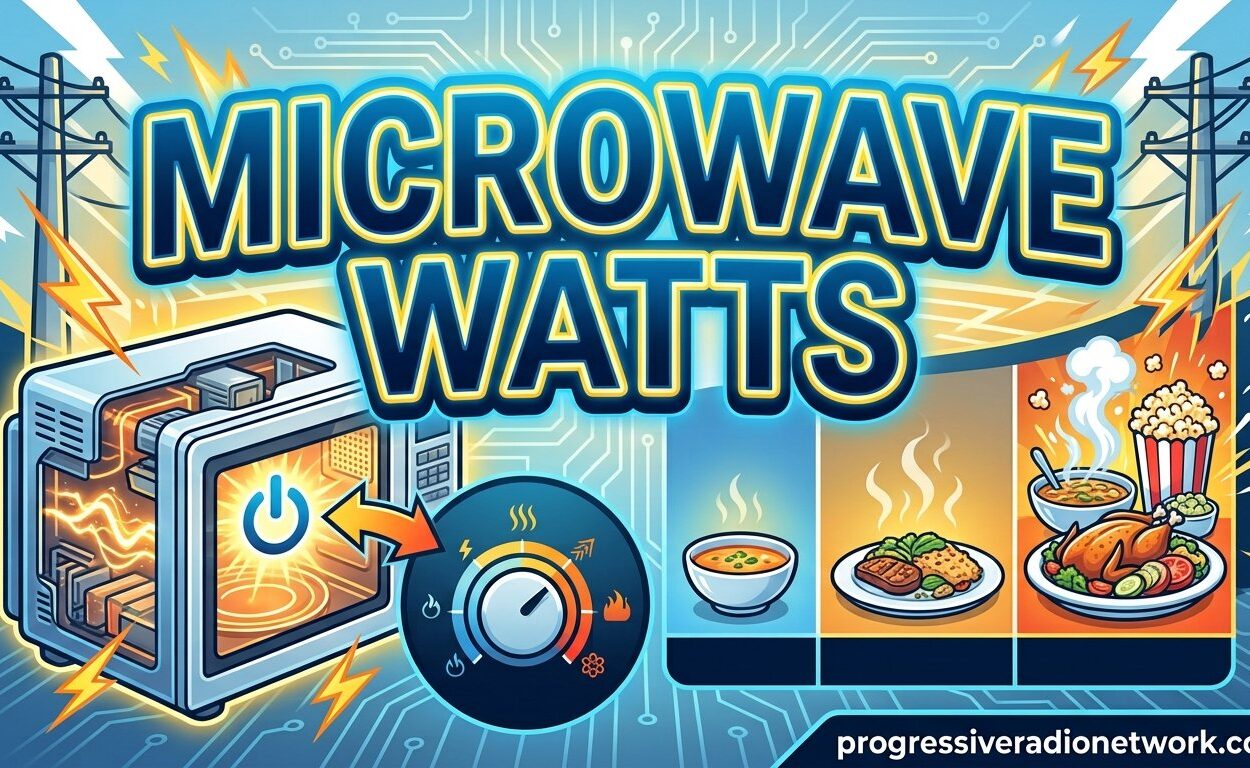
When you are shopping for a new microwave or trying to figure out why your frozen dinner took twice as long as the package suggested, microwave watts are the number that matters most. The wattage rating of a microwave directly determines how fast it cooks, how evenly it heats, and what kinds of food it can handle. Most home microwaves fall somewhere between 600 and 1700 watts, and that range represents a massive difference in real-world cooking performance.
If you have ever wondered why your old dorm microwave struggled to heat soup while your friend’s kitchen model blasts through leftovers in seconds, wattage is the answer. In this guide, we break down everything you need to know about microwave watts so you can choose the right appliance, adjust cooking times, and get better results from every meal. For a broader look at how microwaves compare to traditional cooking methods, check out our microwave vs oven comparison.
What Are Microwave Watts?
Microwave watts measure the cooking power output of your microwave oven. Specifically, this number tells you how much energy the microwave directs into your food per second of operation. A higher wattage means more energy hitting the food, which translates to faster heating and more thorough cooking.
Inside every microwave sits a component called a magnetron. The magnetron converts electrical energy into electromagnetic waves at a frequency of around 2.45 gigahertz. These waves bounce off the metal interior walls and penetrate the food, causing water molecules inside it to vibrate rapidly. That vibration generates friction, and friction creates heat. The more watts your magnetron produces, the more waves it generates, and the faster your food heats up.
One important distinction: the wattage on the front of your microwave is the output wattage, not the input wattage. A 1000-watt microwave actually draws closer to 1400 to 1500 watts from your wall outlet because the conversion process is not perfectly efficient. Most microwaves operate at roughly 60 to 70 percent efficiency, meaning a significant portion of the electricity consumed never reaches your food. This is why a 700-watt microwave might pull 1200 watts from the outlet, as several users on Reddit have pointed out from their own measurements.
Microwave Wattage Ranges Explained
Not all microwaves are built for the same jobs. The wattage range tells you a lot about what a particular model can handle and how it will perform day to day. Here is what you can expect at each tier.
Low Wattage Microwaves (600 to 800 Watts)
Microwaves in the 600 to 800 watt range are typically compact, countertop models designed for small spaces. They are common in dorm rooms, office break rooms, small apartments, and RVs. A 700-watt microwave can handle basic tasks like reheating a cup of coffee, warming soup, or melting butter.
However, low wattage microwaves struggle with anything more demanding. Frozen dinners, raw meat, and large portions take significantly longer to cook. Many users on cooking forums report that 700-watt models leave cold spots in food even after extended cooking times. This happens because the lower energy output cannot penetrate deeply into dense foods before the outer layers cool back down.
Frozen food packaging directions are almost always written for 1100-watt microwaves. If your microwave is rated at 700 watts, you will need to add roughly 50 to 60 percent more cooking time than what the box suggests. A meal that says “cook for 4 minutes” might actually need 6 to 7 minutes in a low-wattage model.
Medium Wattage Microwaves (800 to 1000 Watts)
The 800 to 1000 watt range is where most household microwaves live, and for good reason. These models strike a balance between cooking power, size, and price that works for the majority of kitchens. An 800-watt microwave can reheat leftovers, defrost meat, cook frozen vegetables, and handle most packaged meals without much trouble.
At 900 to 1000 watts, you start to see noticeably better performance. Foods heat more evenly, cooking times shrink, and the microwave can handle larger portions. Many recipes written for microwave cooking assume a wattage of around 1000 watts, making this tier the most compatible with cookbooks and online recipes.
If you use your microwave daily for a mix of reheating and light cooking, anything in this range will serve you well. Most over-the-range microwaves from major brands like GE, Whirlpool, and LG fall into the 900 to 1000 watt category.
High Wattage Microwaves (1000 Watts and Above)
High wattage microwaves, rated at 1000 watts and above, deliver the fastest and most even cooking results available in residential models. These are the microwaves that can defrost a pound of ground beef in under five minutes or heat a large casserole dish without leaving a frozen center.
At 1100 to 1200 watts, you will find the sweet spot for frozen food compatibility. Since most frozen meal instructions are calibrated for 1100-watt ovens, having a microwave in this range means you can follow package directions without doing math. Cooking is faster, more consistent, and less prone to cold spots.
Microwaves rated above 1200 watts are less common in homes but popular in commercial settings and high-end kitchen builds. These models can cook raw meat thoroughly, handle large family-sized portions, and power through defrosting tasks that would take twice as long in a standard microwave. Some convection microwaves and combination units reach 1700 watts or more, combining microwave energy with traditional heating elements for baking and crisping.
Microwave Watts and Cooking Time: A Practical Chart
Understanding how wattage translates to cooking time is one of the most practical things you can learn. The general rule is simple: divide the recipe wattage by your microwave wattage, then multiply the recommended time by that ratio. For example, if a recipe says to cook something for 5 minutes at 1000 watts and your microwave is 700 watts, you would calculate 1000 divided by 700 equals 1.43, then multiply 5 minutes by 1.43 for a corrected time of about 7 minutes.
Here is a quick reference chart showing approximate cooking times for a standard frozen dinner across different wattage levels:
- 600 watts: 8 to 9 minutes (uneven results likely)
- 700 watts: 7 to 8 minutes (some cold spots)
- 800 watts: 6 to 7 minutes (acceptable heating)
- 900 watts: 5 to 6 minutes (good results)
- 1000 watts: 5 minutes (standard recipe time)
- 1100 watts: 4 to 5 minutes (follows package directions)
- 1200 watts and above: 3.5 to 4 minutes (fast and even)
Keep in mind that these times are approximate. Food density, portion size, and starting temperature all affect cooking time. When in doubt, start with less time and add increments of 30 seconds.
How to Find Your Microwave Wattage
Many people use their microwave every day without knowing its wattage rating. If you need to find yours, there are several reliable methods.
Step 1: Check the serial plate. Open your microwave door and look at the interior edge or the back panel. You should find a small metal or sticker label listing the model number, manufacturer, and output wattage. This is the most trusted source, according to users across multiple forums. The wattage is usually listed as “Output” or “Cooking Power” followed by a number like 900W or 1000W.
Step 2: Check the user manual. If you still have the manual that came with your microwave, the wattage will be listed in the specifications section, typically near the front or back of the booklet. If you have lost the physical copy, you can usually find a PDF version on the manufacturer’s website by searching your model number.
Step 3: Look inside the door frame. Some models place the wattage information on a label visible only when the door is open, either on the door itself or on the frame behind the door. Check both locations carefully.
Step 4: Search online by model number. Find the model number on your microwave (usually on the serial plate) and search for it along with the word “wattage” or “specs” on the manufacturer’s website or a retailer page.
Step 5: Use the boiling water test. If all else fails, you can estimate your microwave wattage with a simple test. Place one cup of room-temperature water in a microwave-safe container. Heat it on high power and time how long it takes to reach a rolling boil. If it boils in under 2 minutes, your microwave is likely 1000 watts or higher. If it takes 2.5 to 3 minutes, you are probably in the 800 to 900 watt range. If it takes over 3.5 minutes, your microwave is likely 700 watts or below.
Microwave Power Levels Explained
Most microwaves offer adjustable power levels in addition to their maximum wattage rating. These settings let you control how intensely the microwave operates, which is useful for tasks that require gentler heating. When you set your microwave to 50 percent power, it does not actually reduce the wattage output. Instead, the magnetron cycles on and off, running at full power roughly half the time and resting the other half.
Understanding power levels helps you get better results with specific foods. High power (100 percent) is best for boiling water, reheating beverages, and cooking frozen meals. Medium-high power (70 to 80 percent) works well for reheating leftovers without drying them out. Medium power (50 percent) is ideal for defrosting meat and cooking dense foods like baked potatoes. Low power (20 to 30 percent) is useful for softening butter, melting chocolate, and keeping food warm without continuing to cook it.
Defrost settings typically use 30 to 40 percent power with periodic pauses to allow heat to distribute evenly through the food. Sensor cooking features, found on higher-end models, automatically adjust both power level and cooking time based on steam detected inside the cavity.
Choosing the Right Microwave Wattage for Your Needs
Selecting the right wattage comes down to your cooking habits, household size, and available kitchen space. For a single person or couple who primarily reheats leftovers and makes occasional frozen meals, an 800 to 900 watt microwave will cover your needs without taking up excessive counter space.
Families of three or more, or anyone who frequently cooks full meals in the microwave, should aim for 1000 to 1200 watts. This range handles large portions, defrosts meat efficiently, and aligns with standard recipe directions. If you are replacing an over-the-range unit, most models in this category start at 950 watts.
For those with limited counter space, compact models in the 700 watt range can work as a secondary appliance. Just be prepared to extend cooking times significantly. You might also consider whether a different appliance altogether would serve you better. Our toaster oven vs microwave guide covers the tradeoffs, and our microwave weights guide can help you find a model that fits your space. For those interested in healthier cooking methods, our steam oven vs microwave comparison is worth a read.
On the energy cost side, running a 1000-watt microwave for 15 minutes a day consumes about 6.1 kilowatt-hours per month. At the national average electricity rate, that works out to less than a dollar per month in most states. Higher wattage microwaves use more electricity per minute of operation, but because they cook faster, the total energy consumed per meal is often similar to or lower than a less powerful model.
FAQs
Is a 1000 watt microwave strong?
Yes, a 1000 watt microwave is considered strong and sits at the higher end of standard household wattage. It can handle virtually all common cooking tasks including reheating, defrosting, cooking frozen meals, and preparing recipes designed for microwave use. Most frozen food directions are calibrated for 1100 watts, so a 1000 watt model performs very closely to package instructions.
Are most microwaves 1200 watts?
No, most standard household microwaves are rated between 900 and 1100 watts. While 1200 watt models exist and are becoming more common in premium and over-the-range units, the average countertop microwave falls in the 1000 watt range. Compact models typically range from 600 to 800 watts.
Is a 1000W microwave better than 800W?
A 1000W microwave is noticeably better than an 800W model for most users. The higher wattage cooks food approximately 20 to 25 percent faster, heats more evenly, and aligns more closely with standard recipe directions. An 800W microwave is adequate for basic reheating, but a 1000W model offers more versatility and better performance with frozen foods and larger portions.
Is a 750W microwave good?
A 750W microwave is adequate for basic reheating and simple tasks like warming beverages or melting butter, but it is generally considered low power for most cooking needs. Frozen meals will require significantly longer cooking times than package directions suggest, and you may experience uneven heating. A 750W model works fine as a compact or secondary microwave but is not ideal as a primary kitchen appliance.
Final Thoughts on Microwave Watts
Understanding microwave watts helps you cook faster, adjust recipes accurately, and choose the right appliance for your kitchen. For most households, a microwave in the 900 to 1100 watt range delivers the best balance of power, versatility, and value. If you want to learn more about getting the most from your appliance, our guide on microwave lifespan covers how long you can expect your investment to last.





Leave a Comment