
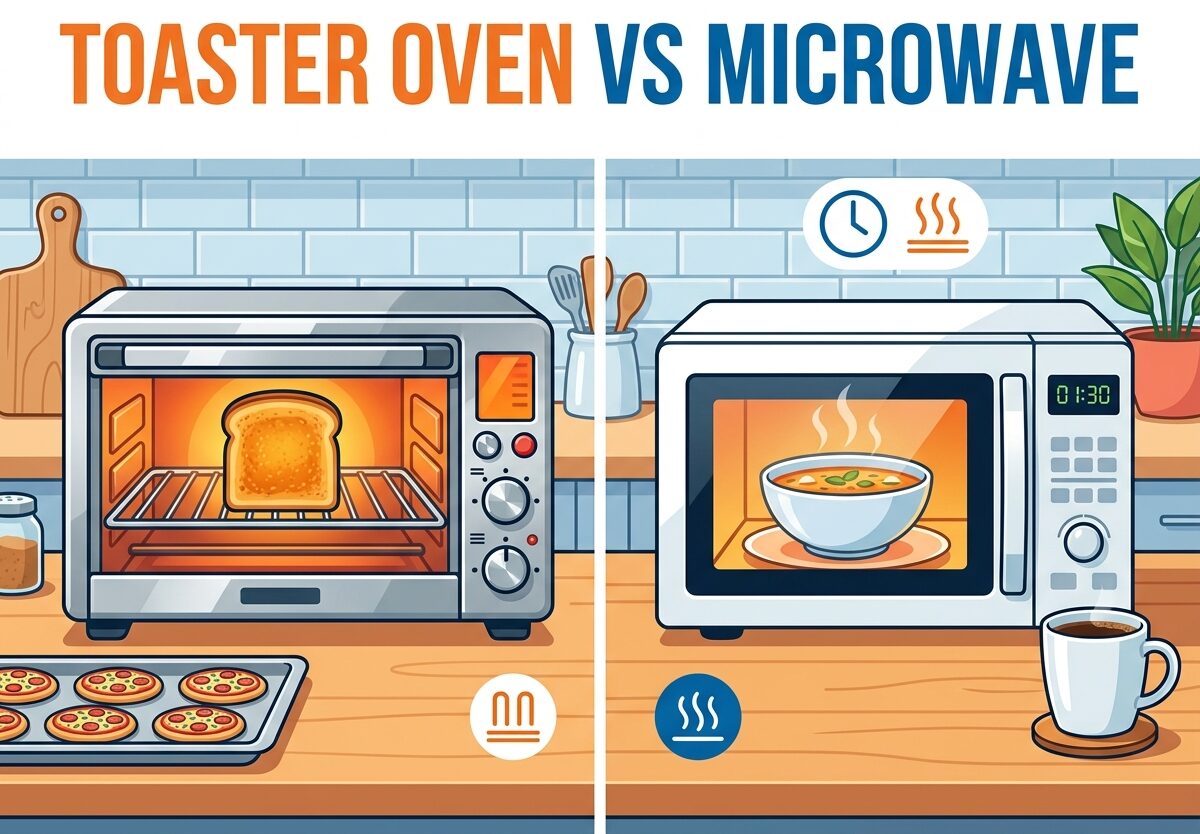
Choosing between a toaster oven and microwave can be confusing when you’re outfitting your kitchen. Both appliances sit on your countertop and promise quick meals, but they work in completely different ways. After testing both appliances extensively and comparing their performance across everyday cooking tasks, I’ll help you understand which one deserves your counter space.
Quick Comparison: Toaster Oven Vs Microwave
Here’s the bottom line upfront: microwaves win on speed and convenience, while toaster ovens deliver superior cooking quality and texture. But there’s more to consider than just cooking time.
- Best for Speed: Microwave – heats food in seconds to minutes
- Best for Texture: Toaster Oven – delivers crispy, browned results
- Best for Liquids: Microwave – perfect for soups, beverages, defrosting
- Best for Versatility: Toaster Oven – bakes, broils, toasts, and air fries
- Best for Energy: Microwave – uses less power for shorter cooking times
- Best for Small Kitchens: Microwave – typically more compact
How They Heat Food Differently
The fundamental difference between these appliances comes down to their heating methods. This isn’t just technical jargon – it directly affects how your food tastes and feels.
Toaster ovens work like miniature conventional ovens. Electric heating coils warm up and produce thermal radiation that cooks food from the outside in. The dry heat surrounds your food, creating that coveted crispy texture and golden-brown finish that microwaves simply can’t achieve. Many models also include convection fans to circulate hot air for even cooking.
Microwaves use a completely different approach. They generate electromagnetic waves that bounce off the metal interior and penetrate your food. These waves cause water and fat molecules to vibrate rapidly, creating friction that produces heat throughout the food. This is why microwave heating works from the inside out – though not always evenly.
This fundamental difference explains why pizza reheated in a toaster oven regains its crispy crust, while microwave pizza becomes soggy. The toaster oven’s dry heat evaporates moisture and browns the crust, while the microwave’s steam-based heating keeps everything moist.
Toaster Oven Vs Microwave: Cooking Speed and Convenience
Speed is where microwaves clearly dominate. Most foods heat in a fraction of the time compared to a toaster oven. Reheating leftover pasta might take 2 minutes in a microwave but 10-15 minutes in a toaster oven (including preheat time).
However, convenience isn’t just about speed. Toaster ovens don’t require you to constantly monitor and stir food to ensure even heating. You can pop in a slice of pizza, set the timer, and walk away – returning to perfectly crisp results. Microwaves often require mid-cooking stirring, rotating, or covering to prevent hot spots and splatter.
The preheat requirement for toaster ovens adds significant time. Most models need 5-10 minutes to reach the desired temperature, while microwaves start working instantly. This makes microwaves superior for quick tasks like melting butter or reheating a cup of coffee.
Energy Efficiency Comparison
Energy efficiency is more nuanced than it appears. While toaster ovens typically use more power (1,200-1,800 watts vs 700-1,200 watts for microwaves), they often cook for shorter periods when baking or broiling.
For simple reheating tasks, microwaves are generally more energy efficient because they complete the job in less time. A microwave might use 0.1 kWh to reheat leftovers, while a toaster oven could use 0.3-0.5 kWh for the same task due to longer cooking time and preheating.
However, toaster ovens can be more efficient than full-sized conventional ovens for small batches. If you’re baking a few cookies or roasting vegetables, a toaster oven uses significantly less energy than heating up your large oven.
Cooking Quality and Texture Differences
This is where toaster ovens truly shine. The dry heat creates textures that microwaves cannot achieve:
- Crispy crusts on pizza, bread, and leftovers
- Browned and caramelized surfaces on meats and vegetables
- Even cooking without hot spots or cold centers
- No rubbery texture that microwaves sometimes produce
Microwaves excel at keeping food moist, but this can work against you. The steam-based heating makes foods soggy rather than crispy. Chicken skin becomes rubbery instead of crispy, bread becomes chewy instead of crusty, and fried foods lose their crunch.
For beverages, soups, and foods that should remain moist, microwaves perform perfectly. The texture issue primarily affects foods where crispiness is desired.
Best Foods for Each Appliance
Understanding which foods work best in each appliance will help you choose based on your cooking habits:
Microwave Perfect For:
- Soups, stews, and chili
- Beverages (coffee, tea, hot chocolate)
- Steaming vegetables
- Defrosting meat and frozen foods
- Popcorn
- Oatmeal and other hot cereals
- Melting butter and chocolate
- Reheating pasta dishes (when moisture is desired)
Toaster Oven Perfect For:
- Pizza (frozen or leftover)
- Grilled cheese and sandwiches
- Toasting bread and bagels
- Baking cookies, brownies, and small cakes
- Roasting vegetables and small cuts of meat
- Reheating leftovers when crispiness matters
- Broiling fish and melting cheese toppings
- Air frying (if equipped with convection)
Size and Capacity Considerations
Counter space is precious in most kitchens. Microwaves typically have a smaller footprint and more compact design, making them easier to fit in tight spaces. However, toaster ovens often provide more usable interior space despite similar exterior dimensions.
Toaster oven capacity is usually measured in terms of how many slices of bread it can hold (typically 4-8 slices) or the size of pizza it can accommodate (9-13 inches). Microwave capacity is measured in cubic feet, ranging from 0.5 to 2.0 cubic feet.
For small kitchens, dorm rooms, or offices, microwaves generally take up less space. However, some compact toaster ovens are designed specifically for tight spaces. If counter space is extremely limited, consider how much you value cooking quality versus quick convenience.
What Cannot Be Cooked in a Toaster Oven?
While toaster ovens are versatile, they have limitations. Here’s what you should avoid:
- Metal containers: Unlike microwaves, toaster ovens can’t handle metal cookware
- Frozen meals in microwave-only packaging: Many frozen dinners explicitly state “do not cook in toaster oven” because the packaging may melt or catch fire at toaster oven temperatures
- Large quantities: Toaster ovens have limited capacity and aren’t designed for family-size portions
- Liquids in open containers: Spillage risk is higher, and heating liquids is inefficient
- Foods requiring rapid reheating: If you need food ready in under 5 minutes, the microwave is better
Disadvantages of a Toaster Oven
Before choosing a toaster oven, consider these drawbacks:
- Slower cooking: Preheating adds 5-10 minutes to every cooking task
- Heat generation: Toaster ovens warm up your kitchen, which can be uncomfortable in summer
- Exterior gets hot: The exterior surfaces become hot during operation, posing a burn risk
- More cleaning required: Crumbs and spills need regular removal to prevent smoking
- Higher energy use: For simple reheating, they use more electricity than microwaves
- Less convenient for liquids: Heating soup or beverages is slower and more cumbersome
When to Choose a Toaster Oven
A toaster oven is the better choice if you:
- Value food quality and texture over speed
- Enjoy baking small batches of cookies, brownies, or other treats
- Eat lots of pizza and want to reheat leftovers properly
- Like the versatility of baking, broiling, toasting, and air frying in one appliance
- Don’t mind waiting a few extra minutes for superior results
- Have counter space to accommodate a larger appliance
- Want to reduce your reliance on your full-sized oven for small tasks
When to Choose a Microwave
A microwave is the better choice if you:
- Prioritize speed and convenience above all else
- Mostly reheat leftovers, beverages, and frozen meals
- Have limited counter space
- Live in a hot climate and don’t want extra heat in your kitchen
- Don’t bake or cook small batches frequently
- Want the simplest possible operation for quick meals
- Need to defrost frozen food regularly
Can a Toaster Oven Completely Replace a Microwave?
Technically, yes – a toaster oven can handle almost any task a microwave can do, except perhaps heating beverages quickly. However, the convenience factor is significant. After testing both extensively, I found that while my toaster oven could reheat leftovers, the extra time and preheating made me less likely to use it for quick meals.
Many users find that having both appliances is ideal. The microwave handles quick tasks like reheating coffee, melting butter, or defrosting meat, while the toaster oven handles tasks where texture matters – pizza, grilled cheese, baking, and proper reheating of leftovers.
For small kitchens, hybrid toaster oven/microwave combo appliances exist. These units combine both technologies in one footprint, though they’re typically more expensive and may have limitations compared to standalone units.
Are Toaster Ovens Better for You Than Microwaves?
From a health perspective, neither appliance is inherently “better.” Both cooking methods preserve nutrients similarly. The nutritional quality of your food depends more on what you’re cooking and how long it’s exposed to heat.
Some concerns exist about microwave radiation, but extensive research has shown that microwave ovens are safe when used properly. The electromagnetic waves are contained within the oven and don’t persist in food. Toaster ovens use conventional heating methods that have been used for centuries without concern.
The health impact comes down to what you cook. Microwaves make it easy to prepare processed frozen meals quickly, while toaster ovens encourage more scratch cooking and baking. Your overall diet matters more than which appliance you use.
Why Do Frozen Meals Say Not to Cook in a Toaster Oven?
You’ve probably noticed this warning on frozen dinner packaging. It’s not just a liability concern – there are real safety issues. Toaster ovens heat differently than microwaves and can reach higher temperatures.
Frozen meal packaging is designed for microwave heating, which typically tops out around 212°F (boiling point). Toaster ovens can reach 450°F or higher, which can melt plastic trays, cause paper packaging to burn, or create uneven heating that leaves food partially frozen while other parts overcook.
For safety, always follow package instructions. If a frozen meal says “microwave only,” respect that warning. Some frozen pizzas are designed for toaster ovens – these typically come on cardboard or crisping sheets specifically made for high-heat cooking.
FAQs
Is using a toaster oven better than a microwave?
Neither is universally better – it depends on your priorities. Choose a toaster oven if you value cooking quality, crispy textures, and versatility. Choose a microwave if speed, convenience, and reheating liquids are your main needs. Many households find having both appliances ideal.
What cannot be cooked in a toaster oven?
Avoid metal containers, frozen meals with microwave-only packaging, large quantities that exceed capacity, liquids in open containers, and any task requiring rapid heating under 5 minutes. Always check package instructions – if it says microwave only, don’t use a toaster oven.
What are the disadvantages of a toaster oven?
Toaster ovens are slower due to preheating time, generate more heat in your kitchen, have hot exteriors that pose burn risks, require more cleaning, use more energy for simple reheating, and are less convenient for heating liquids and beverages.
Why do frozen meals say not to cook in a toaster oven?
Toaster ovens reach higher temperatures than microwaves and heat differently. Frozen meal packaging is designed for microwave heating and can melt, burn, or cause unsafe cooking conditions at toaster oven temperatures. Always follow package instructions for safety.
Are toaster ovens better for you than microwaves?
From a health standpoint, both appliances are similar in terms of nutrient preservation. Microwave radiation concerns are unfounded – microwaves are safe when used properly. The health impact depends more on what you cook than which appliance you use.
Can a toaster oven completely replace a microwave?
Technically yes, but it’s not always practical. Toaster ovens can handle almost any microwave task except quick beverage heating. However, the preheating time and longer cooking makes microwaves more convenient for quick tasks. Many users prefer having both appliances.
Final Verdict: Toaster Oven Vs Microwave
The choice between a toaster oven and microwave ultimately comes down to your cooking style and priorities. If you value speed, convenience, and frequently reheat liquids or frozen meals, the microwave is your best bet. But if you prioritize cooking quality, enjoy baking and broiling, and want to reheat food with proper texture, the toaster oven delivers superior results.
For many households, the ideal solution is having both appliances. The microwave handles quick tasks like reheating coffee and defrosting, while the toaster oven handles tasks where texture matters. If counter space is limited, consider a hybrid combo unit that offers both technologies in one appliance.
Whichever you choose, understanding how each appliance works and what it does best will help you get the most out of your kitchen countertop space in 2026.



Leave a Comment