
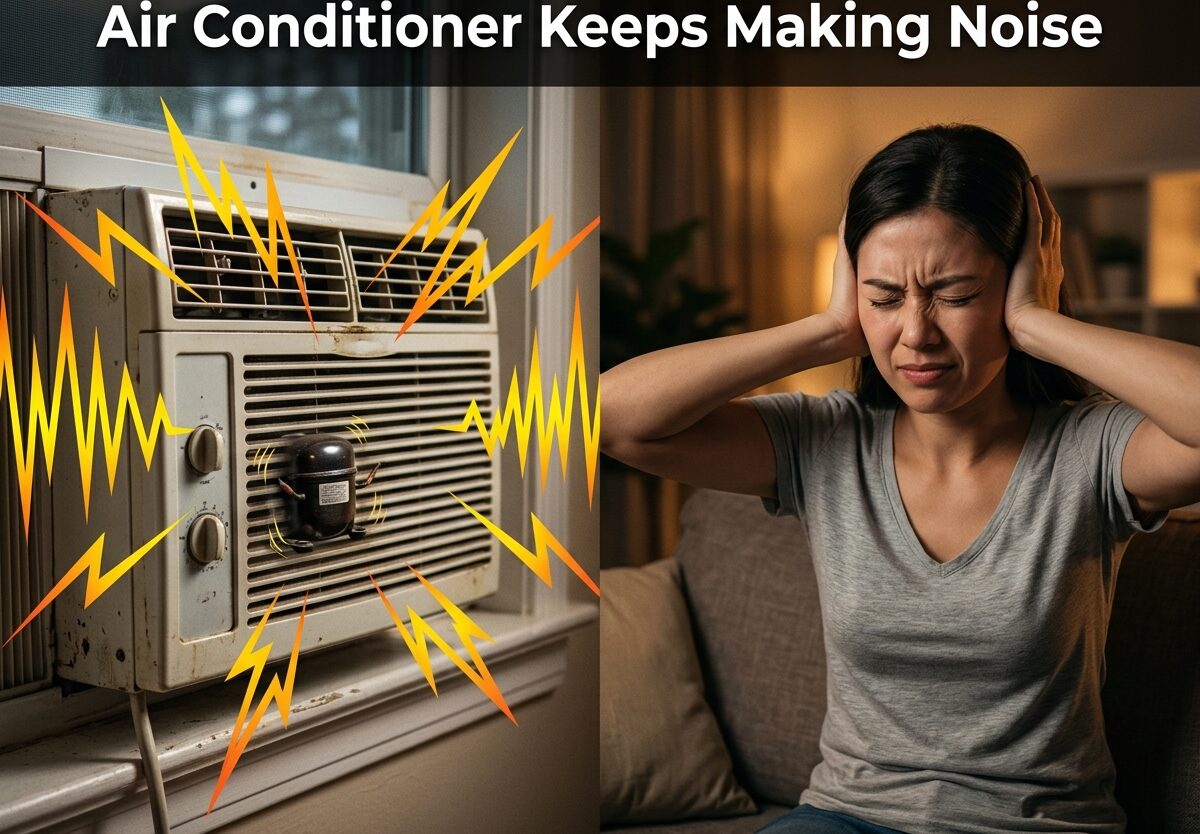
That moment when you’re trying to relax or sleep, and suddenly your air conditioner starts making an unusual sound. It’s not just annoying. It’s your AC trying to tell you something’s wrong. When your air conditioner keeps making noise that doesn’t sound normal, it’s usually a warning sign that needs attention before it becomes a major repair bill.
I’ve spent years researching HVAC issues and talking with homeowners about their AC problems. The truth is, most AC noises start small and get worse over time. Catching them early can save you hundreds, sometimes thousands, in repair costs. In this guide, I’ll walk you through every common noise your AC might make, what causes it, whether you can fix it yourself, and when you need to call a professional.
Here’s what we’ll cover: the difference between normal and problematic AC sounds, what each noise type actually means, DIY troubleshooting steps you can safely try, and clear guidelines on when it’s time to pick up the phone and call an HVAC technician. I’ll also share some insider tips on prevention and the little-known rules that can save you from expensive repairs.
Is Your AC Noise Normal? A Quick Reality Check
Before you worry, let’s establish what normal AC operation sounds like. Every air conditioner makes some noise. The soft whoosh of air through vents, the gentle hum of the compressor starting up, the click of the thermostat engaging. These are all completely normal sounds that indicate your system is working as designed.
Normal AC sounds include: a steady, low-level hum when running; the sound of air moving through ductwork; a click when the thermostat signals the unit to start; and a brief startup whir that settles into consistent operation. If you’ve had your AC for a while, you probably know what “normal” sounds like for your specific unit.
When should you be concerned? Any noise that’s sudden, unusually loud, or progressively getting worse needs attention. If your AC used to run quietly and now it’s making sounds you can hear from across the room, something has changed. The 3-minute rule is a good guideline: if your AC makes unusual sounds for more than 3 minutes after startup, or if the noise changes during operation, it’s worth investigating. Normal startup sounds should settle within a couple of minutes. Anything beyond that suggests a problem.
Trust your instincts here. If a noise sounds “wrong” to you, it probably is. Your AC runs for thousands of hours each year. You know its normal sounds better than anyone. When something changes, there’s usually a reason.
Air Conditioner Keeps Making Noise: Buzzing or Humming Sounds
A buzzing or humming noise from your air conditioner is one of the most common complaints I hear. Unlike the normal hum of operation, a problematic buzz often sounds electrical or strained, like something is struggling to work properly. This type of noise can range from a faint buzz you only notice when nearby to a loud hum that’s impossible to ignore.
What causes buzzing and humming? The most common culprit is a dead or failing capacitor. Capacitors are electrical components that provide the jolt of energy your compressor and fan motors need to start. When a capacitor fails, the motor tries to start but can’t get enough power. It creates a buzzing sound as it struggles. This is especially common in AC units over 5-7 years old, as capacitors naturally degrade with use and heat exposure.
Other buzzing causes include loose wiring somewhere in the system, which is actually a serious electrical hazard. The buzzing you hear might be electricity arcing between loose connections. This isn’t just an AC problem. It’s a potential fire hazard that needs immediate professional attention. Less urgently, a dirty outdoor coil can cause your compressor to work harder and buzz more than usual as it struggles against reduced airflow.
Can you fix a buzzing AC yourself? Capacitor replacement is technically DIY-able if you’re comfortable working with electrical components, but it involves handling high-voltage parts even when the unit is off. For most homeowners, this is a job best left to professionals. The cost for capacitor replacement typically runs $150-300, which is far less than the $1,500-2,500 you’ll spend if a failing capacitor burns out your compressor.
What should you do right now? If your AC is buzzing, turn it off at the thermostat and check your outdoor unit. Listen to pinpoint where the buzz is coming from. Look for any visible signs of damage, debris blocking the unit, or wires that look loose or corroded. If the buzzing started suddenly and is accompanied by a burning smell, turn off the unit immediately and call a professional. This could indicate a serious electrical issue that’s unsafe to ignore.
Rattling Noise: The Debris and Loose Parts Problem
Rattling is one of those AC noises that can range from mildly annoying to concerning. Unlike buzzing, which often indicates electrical issues, rattling typically means something physical is loose, vibrating, or where it shouldn’t be. The sound can be a gentle rattle like loose change in a dryer, or a pronounced shaking that makes you worry something might break loose inside your unit.
The most common cause of rattling is surprisingly simple: debris in or around the unit. Leaves, twigs, dirt, and other outdoor debris can get sucked into your outdoor AC unit and cause all sorts of rattling as they bounce around the fan and components. This is especially common in autumn when leaves are falling, or after storms that scatter debris around your property. I’ve seen everything from tree branches to children’s toys causing AC rattle noises.
Loose screws and bolts are another frequent culprit. Your AC unit vibrates during normal operation, and over time, this vibration can loosen fasteners throughout the system. The cover panels, fan blades, mounting brackets, and internal components can all work loose. Each loose part creates its own rattle, and sometimes multiple loose parts create a symphony of noise.
For window AC units, rattling often comes from loose mounting. Window units need to be securely fastened in the window frame. Over time, the mounting can shift, especially if the unit wasn’t installed perfectly level. The unit’s vibration against the window frame or sill can create significant rattling. Sometimes the issue is as simple as the unit not making proper contact with the window supports.
The good news about rattling? It’s often the easiest AC noise to fix yourself. Start by turning off your AC and visually inspecting the outdoor unit. Remove any visible debris from around and inside the unit (be careful with the fan blades). Check that all access panels are securely fastened. For window units, check the mounting and ensure the unit is stable and level. Tighten any loose screws you can safely access. If the rattle persists after these basic checks, or if it’s coming from inside the unit, you may need a professional to inspect internal components like the fan motor or compressor mounts.
Hissing Noise: The Refrigerant Leak Warning
A hissing noise from your air conditioner is something you should take seriously. Unlike buzzing or rattling, which can sometimes wait a few days, hissing often indicates a refrigerant leak and this is an urgent problem. The hissing sound is literally refrigerant escaping from your system, and every minute it leaks is money lost and potential damage accumulating.
Refrigerant is the lifeblood of your air conditioning system. It’s the chemical that absorbs heat from your home and releases it outside. When refrigerant leaks, your AC can’t cool properly. But the problems go way beyond reduced cooling. Low refrigerant causes your compressor to work harder and run hotter, which can lead to complete compressor failure. A new compressor costs $1,500-2,500, so that hissing noise is potentially a $2,000 problem if ignored.
There’s also an environmental and health consideration. Depending on the age of your AC unit, it might use R-22 refrigerant (being phased out) or the newer R-410A. Either way, refrigerant leaks aren’t great to breathe in, and they’re definitely harmful to the environment. Professional HVAC technicians are certified to handle refrigerant safely for a reason.
What should you do if you hear hissing? First, turn off your AC immediately. Running the system with low refrigerant can cause catastrophic compressor damage. Don’t try to fix a refrigerant leak yourself. Refrigerant handling requires EPA certification, specialized equipment, and expertise. DIY attempts often lead to bigger problems and can actually be illegal.
Call a professional HVAC technician as soon as possible. They’ll use specialized tools to locate the leak, which might be in the coils, connections, or compressor. Repair costs vary widely depending on leak location and severity. A simple leak repair might cost $200-500, while coil replacement can run $1,000-2,000. The technician will also need to recharge your system with refrigerant, which adds to the cost. I know it’s not cheap, but fixing a refrigerant leak promptly is far cheaper than replacing a burned-out compressor or entire AC unit.
Squealing or Screeching: Motor and Bearing Issues
There’s nothing quite like the blood-curdling sound of an air conditioner squealing or screeching. This high-pitched noise is unmistakable, and it usually means something is wrong with moving parts in your system. Unlike some other AC noises that can be intermittent, squealing tends to be persistent and gets worse over time as the problem deteriorates.
The most common cause of squealing is worn motor bearings. Your AC has fan motors (both in the outdoor unit and the indoor air handler), and these motors have bearings that allow smooth rotation. Over time, typically 7-10 years of use, these bearings wear down. The metal-on-metal contact creates the squealing sound. It often starts as a faint squeak that comes and goes, then progresses to constant screeching as the bearings completely fail.
In older AC units (typically pre-2010), a failing fan belt can cause squealing. Much like a car’s fan belt, the AC fan belt can slip, crack, or wear out. The slipping belt creates a squeal that’s often more pronounced when the unit first starts up. Newer AC units typically use direct-drive motors without belts, so this cause is becoming less common but still exists in older systems.
Sometimes squealing indicates compressor pressure issues. If the refrigerant pressure is too high or too low, the compressor can make squealing or screeching sounds. This is usually accompanied by reduced cooling performance. Compressor issues are serious and typically signal that the compressor is failing, which is one of the most expensive AC repairs you can face.
Can you fix a squealing AC yourself? If you’re comfortable with DIY projects and the issue is worn motor bearings, you might attempt to lubricate the bearings. This involves accessing the motor (power completely disconnected), finding the lubrication ports, and applying the appropriate oil. However, many modern motors are sealed and cannot be lubricated. In these cases, the motor needs replacement, which is a job for professionals.
Fan belt replacement in older units can be a DIY project if you’re handy. The belt typically costs $15-30, and there are many tutorials online. However, if you’re not confident working with mechanical systems, this is a job best left to professionals. Professional repair for motor issues typically costs $300-800 depending on whether bearings can be lubricated or the motor needs replacement.
Banging or Clanking: Something’s Loose Inside
Banging and clanking noises from your air conditioner are hard to ignore. These sounds are typically loud, metallic, and concerning. Unlike some other AC noises that might develop gradually, banging often appears suddenly and feels serious. When your AC sounds like there’s a loose part banging around inside, there probably is.
The most common cause of banging is an unbalanced or damaged fan blade. Your AC has fan blades in both the outdoor unit and the indoor air handler. If a blade becomes bent, cracked, or loose, it can hit other components as it spins, creating a banging or clanking sound. Sometimes the blade itself is fine, but the mounting has come loose, allowing the entire fan assembly to wobble and contact surrounding parts.
In the compressor, banging can indicate a loose connecting rod or piston pin inside the compressor itself. This is serious internal damage and means the compressor is failing. Compressors are essentially engines, with pistons moving inside cylinders. When internal components come loose, the compressor makes banging or clanking sounds. This is typically accompanied by reduced cooling performance and often precedes complete compressor failure.
Another cause of banging is deteriorated isolation feet. Your outdoor AC unit sits on rubber feet or pads designed to isolate vibration and absorb shock. Over time, these rubber components crack, compress, or disintegrate. The metal unit then sits directly on the concrete pad, transferring vibration and creating banging sounds during operation. This is especially common in units over 10 years old in climates with extreme temperature swings that accelerate rubber deterioration.
What should you do about banging? First, turn off your AC immediately. Continued operation with a loose fan blade can cause extensive damage as the blade contacts other components. If the issue is a loose or damaged fan blade, this is a relatively straightforward repair that typically costs $150-400. However, if the banging is coming from inside the compressor, you’re likely facing compressor replacement, which costs $1,500-2,500.
Deteriorated isolation feet are an easy fix. A technician can replace the rubber feet for $100-200, and this will dramatically reduce noise and vibration. This is also a good preventative maintenance task for older units, even if they’re not making noise yet. Replacing isolation feet before they completely fail can extend the life of your AC by reducing stress on components.
Clicking Noise: Normal Startup or Electrical Trouble?
Clicking is one of those AC noises that can be completely normal or a sign of trouble. The key is understanding when clicking is expected and when it indicates a problem. Knowing the difference can save you from unnecessary worry, or more importantly, help you catch a serious issue before it causes major damage.
Normal clicking occurs when your thermostat sends a signal to your AC to start up. You’ll typically hear a click from the thermostat itself, and another click from the outdoor unit as the contactor engages to power on the compressor and fan. This clicking is brief, happens at the beginning of a cooling cycle, and is part of normal operation. If you’ve had your AC for years, you’re probably used to these normal clicks and don’t even notice them anymore.
Problematic clicking is different. If you hear rapid or repeated clicking from your outdoor unit, this often indicates a failing component. The most common culprit is a defective relay or failing capacitor. The system is trying to start, the component fails, it tries again, creating a rapid clicking sequence. This is often accompanied by the compressor not starting properly. You might hear clicking without the familiar compressor hum that follows.
Clicking during normal operation (not just at startup) is always a concern. This can indicate a loose electrical connection or a failing component making intermittent contact. Electrical issues should never be ignored, as they can cause bigger problems or create safety hazards. If you notice clicking that correlates with lights flickering in your home, that’s a clear sign of electrical trouble that needs immediate professional attention.
A simple test can help determine if your clicking is normal or problematic. Listen to when the clicking happens. If it’s once at the beginning of a cooling cycle and nothing else unusual occurs, it’s probably normal. If the clicking is rapid, repeated, or happens during operation, you likely have an issue. Also notice whether the clicking is a new development. If your AC never used to click and now it does, something has changed.
What should you do about problematic clicking? If it’s a rapid clicking sequence at startup without the compressor running, this is likely a capacitor or relay issue. Capacitor replacement costs $150-300 and is a straightforward repair. Ignoring this problem will eventually lead to complete compressor failure, which is much more expensive. If the clicking is during operation or accompanied by any electrical issues (flickering lights, burning smell), turn off the AC and call a professional immediately.
Window AC vs Central AC: Different Noise Sources
The type of air conditioner you have significantly affects the noises it might make and what those noises indicate. Window AC units and central AC systems have different components, different installation considerations, and therefore different noise profiles. Understanding these differences can help you diagnose problems more accurately.
Window AC units are self-contained systems with everything in one box. All the noise comes from that single location, typically mounted in a window. Common window AC noise issues include mounting vibration – when the unit isn’t securely fastened, it vibrates against the window frame creating various noises. The solution is often simple: secure the mounting and ensure the unit is level. Window units are also prone to floor vibration – if the unit sits on a windowsill or support that transfers vibration, you’ll hear more noise.
Age is a big factor with window ACs. These units typically last 8-12 years with proper maintenance. As they age, internal components wear and noise increases. An old window AC making unusual noises might simply be reaching the end of its lifespan. Unlike central ACs where individual components can be replaced, window units often aren’t worth repairing when major components fail.
Central AC systems have separate indoor and outdoor components, which can make noise diagnosis trickier. The outdoor unit houses the compressor and condenser fan, while the indoor air handler contains the evaporator coils and blower fan. Noises from the outdoor unit typically indicate compressor or condenser fan issues. Indoor noises usually point to blower problems or ductwork issues.
Split AC systems (common in newer installations) have additional noise considerations. The outdoor compressor unit can be quite far from the indoor air handler, making it harder to correlate noises with system operation. Split systems sometimes have refrigerant line vibration – the copper lines connecting indoor and outdoor units can vibrate and create buzzing or humming sounds if not properly secured.
Location matters for noise perception too. A window AC in a bedroom will be much more disruptive than a central AC with the outdoor unit far from living spaces. Split systems are designed with quiet operation in mind, so unusual noises in these systems are especially noteworthy. If your split AC starts making noise, it’s worth investigating even if the noise seems mild.
DIY Troubleshooting Checklist: What to Check First
Before you call a professional, there are some safe DIY checks you can perform. Not every AC noise requires an expensive service call, and some issues have simple fixes you can handle yourself. However, safety is paramount. Air conditioners involve high voltage and potentially hazardous components. Never work on your AC while it’s powered on, and know your limits.
Start with basic visual inspection. Turn off your AC at the thermostat and the circuit breaker. Look at your outdoor unit. Is there debris around it? Leaves, twigs, and other materials can cause all sorts of noise problems. Clear any debris away from the unit. Look inside through the grill (if you can see) for obvious debris like sticks or toys that might have gotten sucked in. Check that all access panels are secure and tight.
Next, check your air filter. A dirty filter restricts airflow and causes your entire system to work harder, which can create unusual noises. Your filter should be changed every 1-3 months depending on usage and household factors like pets. If your filter is clogged with dust and debris, replace it. This is a simple fix that solves many AC problems, noise included.
For window units, check the mounting and installation. Is the unit securely fastened in the window? Does it sit level and stable? Tighten any loose mounting hardware. Ensure the unit makes good contact with window supports. If the unit vibrates against the window frame, you can add foam weatherstripping to cushion the contact points and reduce noise transfer.
Listen to where the noise is coming from. This diagnostic step can tell you a lot about the problem. Noise from the outdoor unit typically indicates compressor or condenser fan issues. Noise from indoor vents often points to ductwork or blower problems. If you can isolate the noise location, you’ll have valuable information for a technician, or you might discover it’s something simple like a loose register cover.
Check for obvious loose components. With the power off, you can visually inspect for loose screws, bolts, or panels. Tighten anything that’s obviously loose (within reason – don’t disassemble your AC if you’re not qualified). Look for signs of wear, damage, or corrosion. These visual cues can help you or a technician diagnose problems more quickly.
When should you stop DIY troubleshooting and call a professional? If your checks don’t reveal obvious problems, if the noise is electrical in nature (buzzing, clicking), if you suspect a refrigerant leak (hissing), or if you simply don’t feel comfortable working on your AC, it’s time to call a professional. HVAC technicians have the tools, training, and experience to diagnose and fix AC problems safely and effectively. The average service call costs $75-150, which is far less than the cost of DIY mistakes or delayed repairs that lead to bigger problems.
Prevention Strategies: Keep Your AC Running Quietly
The best way to deal with AC noise is to prevent it from developing in the first place. Many noise-causing issues develop gradually over time, and proper maintenance can catch problems before they become noisy (and expensive). A well-maintained AC runs more quietly, more efficiently, and lasts longer.
Regular professional maintenance is the single best prevention strategy. I recommend having your AC professionally serviced annually, ideally in spring before peak cooling season. During a tune-up, a technician will clean coils, check refrigerant levels, inspect electrical connections, lubricate moving parts, and identify potential problems before they cause noise or failure. The cost of annual maintenance ($100-150) is far less than repair costs for neglected systems.
Keep your outdoor unit clean and clear. Ensure at least two feet of clearance around your outdoor AC unit. Trim back plants and shrubs regularly. Keep leaves, grass clippings, and other debris away from the unit. During autumn, pay special attention to falling leaves that can accumulate around and inside the unit. A clean unit runs more efficiently and quietly, with less strain on components.
Replace your air filter regularly. I can’t stress this enough. A clean filter is essential for proper airflow and system efficiency. Check your filter monthly and replace it when dirty. Most filters need replacement every 1-3 months. Good filtration not only prevents noise but also improves air quality and extends your AC’s life.
Address minor noises promptly. If your AC starts making an unusual noise, don’t ignore it hoping it will go away. AC noises almost always get worse over time, not better. A small noise caught early might be a $200 repair. Ignore it for months, and it could become a $2,000 problem. At the first sign of unusual noise, perform your DIY checks and call a professional if needed.
Consider the $5,000 rule. If your AC needs a repair that costs more than $5,000, or if multiple repairs within a few years total more than $5,000, you’re usually better off replacing the system entirely. This rule of thumb helps you avoid sinking money into an aging, inefficient unit that will likely need more repairs. New AC systems are significantly more efficient than even 10-year-old models, so replacement can pay for itself in energy savings over time.
Frequently Asked Questions
Why does my AC keep making weird noises?
AC noises indicate mechanical issues within the system. Common causes include loose parts, dirty components, failing motors, refrigerant leaks, and electrical problems. Each noise type (buzzing, rattling, hissing, squealing, banging) points to different underlying issues that need attention before they cause major damage.
What is the 3 minute rule for air conditioners?
The 3-minute rule states that unusual AC sounds lasting more than 3 minutes after startup indicate a problem. Normal startup sounds should settle within a couple of minutes. If noises persist beyond 3 minutes or change during operation, something is wrong and needs investigation.
What does a dying AC compressor sound like?
A dying compressor typically makes buzzing, humming, or clicking sounds. It may struggle to start, creating rapid clicking sequences as the system attempts to engage. As compressor failure progresses, you might hear banging or clanking from internal components coming loose. These sounds often accompany reduced cooling performance.
Why does my AC sound like it’s struggling?
Struggling sounds usually mean your AC is working harder than it should. Common causes include dirty air filters restricting airflow, dirty coils reducing efficiency, low refrigerant causing compressor strain, or failing components like capacitors and motors. The struggling sound is your system’s way of telling you it needs maintenance or repair.
Is a noisy air conditioner dangerous?
Some AC noises indicate potentially dangerous conditions. Buzzing from loose wiring is a fire hazard. Hissing from refrigerant leaks can be a health hazard and environmental concern. Electrical issues that cause clicking can be dangerous. However, many AC noises like rattling from loose parts aren’t dangerous but do signal problems that need repair.
How much does it cost to fix a noisy AC?
Repair costs vary by issue: capacitor replacement $150-300, fan blade repair $150-400, refrigerant leak repair $200-2000 depending on severity, motor bearing lubrication $150-300, motor replacement $300-800, isolation feet replacement $100-200, and compressor replacement $1500-2500. Annual preventive maintenance costs $100-150 and can prevent many expensive repairs.
Conclusion
When your air conditioner keeps making noise, it’s trying to tell you something. Buzzing and humming often indicate electrical issues or failing components. Rattling typically means loose parts or debris. Hissing is your refrigerant leaking and needs immediate attention. Squealing points to motor or bearing problems. Banging suggests something loose inside the unit. Clicking can be normal or signal trouble depending on when it occurs.
Most AC noises start small and get progressively worse. The sooner you address unusual sounds, the less likely they are to become major problems. Simple maintenance like filter changes, keeping the outdoor unit clean, and annual professional tune-ups can prevent many noise issues from developing in the first place. When you do hear something unusual, use the DIY troubleshooting steps I’ve outlined, but know your limits and call a professional when needed.
Your air conditioner is a complex system with many moving parts working together. When those parts start making noise, it’s a warning sign that shouldn’t be ignored. Addressing AC noise promptly not only gives you peace of mind and quieter operation, but it can also prevent costly repairs and extend the life of your system. Listen to what your AC is telling you. Your wallet and your comfort will thank you.



Leave a Comment