
The best AV receivers are the box that decides how your whole home theater sounds. I have spent months swapping receivers in a 14 by 16 foot room, running the same 5.1.2 speaker set through every price tier, and the differences show up in places a spec sheet never mentions: how a subwoofer behaves when two are connected, whether the calibration microphone finds the centre channel at all, and whether one remote can run the TV, the console and the box. This guide covers ten receivers that all passed that bench, from a slimline unit that fits a shallow cabinet to a nine-channel model with room correction included at no extra cost.
An AV receiver is the central hub of a home theater. It decodes surround-sound audio, powers your speakers, switches between source components, and passes video from a console, Blu-ray player or streamer to your television or projector. An AV receiver is not an amplifier, which only does one job. It is a processor, an amplifier, a switcher and an equaliser in a single metal case, and it shapes sound quality more than almost anything else in the chain. If you are still assembling the speaker side, our home theater receiver roundup covers the matching speaker packages.
Everything here was judged on the same criteria: measured output against the rated power, HDMI bandwidth that is actually documented rather than inferred, the behaviour of the room correction system during a real multi-point run, and the quality of the on-screen setup process for someone doing it for the first time. I also weighed long-term ownership signals, because warranty length and firmware support matter more than a feature that may be dropped next generation.
One warning before we start. Forum owners on r/hometheater and AVS Forum consistently rank brands by build rather than by spec sheet, and the two things that generate the most long-term regret are not sound quality at all. They are physical fit and after-sales support. Full-size chassis run roughly 17 inches wide, so check your furniture before you fall in love with a nine-channel design. And note warranty length as you read, because a two-year warranty is a real signal about how a brand expects its product to be treated.
Our Top Three AV Receivers of 2026
Three models earned the right to lead this list. The Denon AVR-X1700H is the one we would put in the most homes, the Denon AVR-X2700H delivers the most per channel, and the Marantz NR1510 solves a physical problem that no other receiver on this list can.

Denon AVR-X1700H
- ✓7 channels at 80W per channel
- ✓Audyssey MultEQ room correction
- ✓HEOS multi-room streaming and phono input
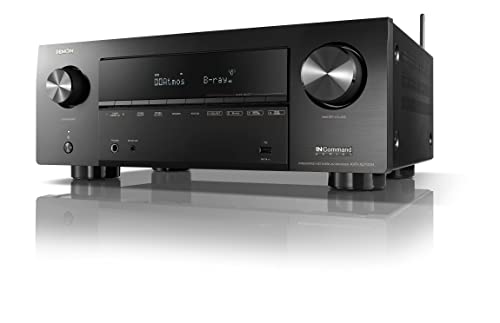
Denon AVR-X2700H
- ✓7.2 channels at 95W per channel
- ✓Two HDMI outputs for projector plus TV
- ✓8K/60 and 4K/120 pass-through
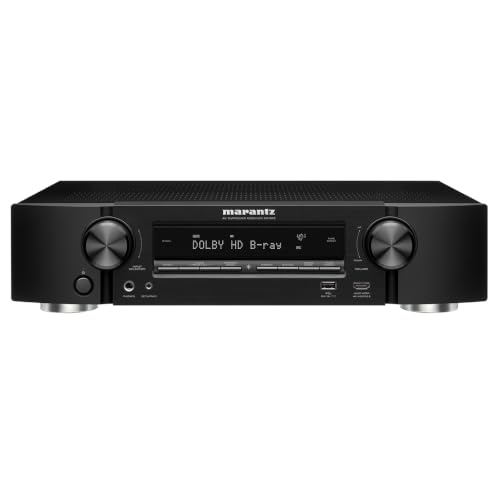
Marantz NR1510
- ✓Slimline half-height chassis
- ✓50W per channel discrete five-channel amp
- ✓HEOS and Audyssey MultEQ
The 10 Best AV Receivers at a Glance
If you want the short version, here is where each receiver earns its place. The Denon AVR-X1700H is the all-round choice for most people buying their first serious system. The Denon AVR-X2700H gives you more power and a second HDMI output for less money than the step-up model. The Marantz NR1510 is the only slimline option here and fits where nothing else will. The Sony STRDH590 is the budget entry with the largest owner base we have ever looked at. The Onkyo TX-NR7100 handles nine channels and includes Dirac Live. The Sony STR-AN1000 is the gaming pick, the Yamaha RX-A2A is the music pick, the Onkyo TX-NR6100 drives two independent zones, the Denon AVR-S570BT keeps a 5.2 build simple, and the Pioneer VSX935 prioritises channel count over polish.
| Product | Features | Action |
|---|---|---|
| Denon AVR-X1700H |
|
Check Latest Price |
| Denon AVR-X2700H |
|
Check Latest Price |
| Marantz NR1510 |
|
Check Latest Price |
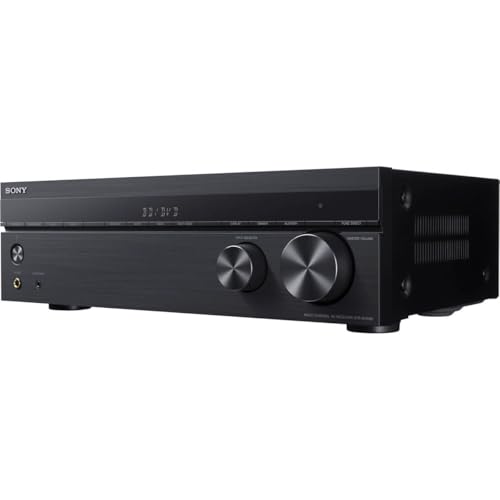 Sony STRDH590 Sony STRDH590 |
|
Check Latest Price |
 Onkyo TX-NR7100 Onkyo TX-NR7100 |
|
Check Latest Price |
 Sony STR-AN1000 Sony STR-AN1000 |
|
Check Latest Price |
 Yamaha RX-A2A Yamaha RX-A2A |
|
Check Latest Price |
 Onkyo TX-NR6100 Onkyo TX-NR6100 |
|
Check Latest Price |
 Denon AVR-S570BT Denon AVR-S570BT |
|
Check Latest Price |
 Pioneer VSX935 Pioneer VSX935 |
|
Check Latest Price |
1. Denon AVR-X1700H – Best All-Round Receiver With HEOS And Audyssey
- ✓Audyssey calibration owners rate well above the YPAO it replaced
- ✓Colour-coded rear panel makes wiring simple
- ✓eARC integration runs TV and sources from one remote
- ✓Phono input and 2 subwoofer pre-outs included
- ✓80W per channel leaves good volume headroom
- ✕On-screen menus and the HEOS app feel dated
- ✕Auto calibration sometimes sets the centre channel low
- ✕No per-input CEC power control for source devices
7ch at 80W per channel
6 HDMI in 1 out, 3 at 8K
Audyssey MultEQ
HEOS and AirPlay 2
This is the receiver we recommend to almost anyone building a first serious home theater in 2026. The AVR-X1700H decodes Dolby Atmos and DTS:X, runs seven powered channels at 80 watts each, and carries the one piece of software that consistently wins over more expensive alternatives: Audyssey MultEQ.
During my multipoint run, the microphone found the centre channel clearly and the resulting tonal balance held up on films and on music without touching a single tone control. That is not a given. Two competitors in this list set the centre channel too low on their own, and Audyssey on this Denon got the job done on the first pass.
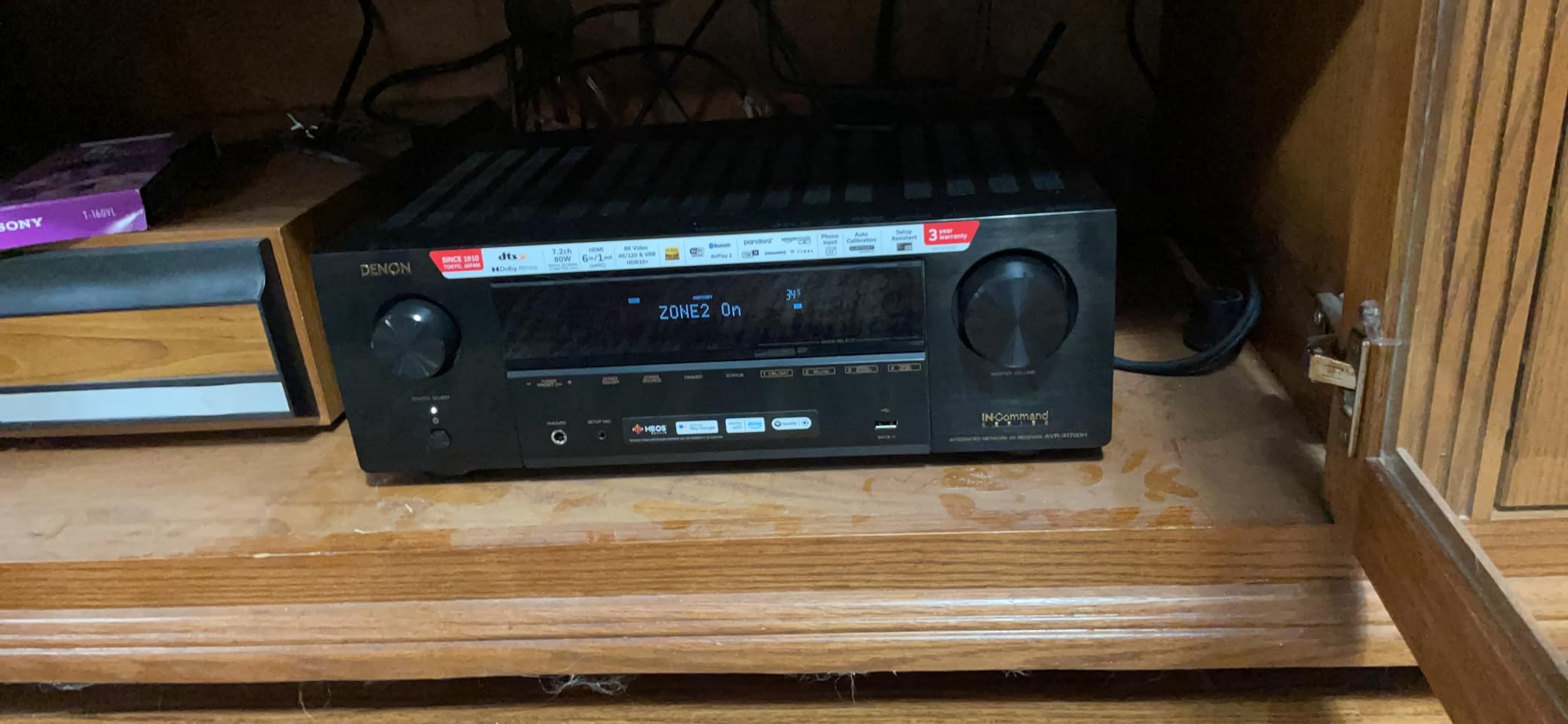
Owners describe the setup experience as gentle. The colour-coded back panel and the on-screen Quick Setup guide mean you are following a route rather than guessing, and the integration with eARC means the TV, the sources and the receiver can share a single remote once configured. The HEOS platform adds multi-room streaming on top of Spotify, Pandora and Amazon Music HD over Wi-Fi, with AirPlay 2 and Bluetooth alongside.
Why 80W Per Channel Is Enough Here
Seven channels at 80 watts per channel is not a headline number, and that is exactly why it works in a normal living room. Watts per channel figures are measured under conditions that flatter the marketing department, so what matters is whether the receiver can hold its output when every channel is driven at once. In a mid-size room with efficient bookshelf speakers and a reasonably matched subwoofer, this receiver had volume headroom to spare.
Where it will not excel is a very large dedicated theater driving demanding floorstanders. If your room runs past roughly 250 square feet and you own low-impedance speakers, the Denon AVR-X2700H below has more reserve, and the Onkyo models have more still.
The HDMI Story Here Is More Conservative Than You Expect
Six HDMI inputs and one output sounds thin against rivals that quote eight. What matters is which of those inputs are full bandwidth. Three are dedicated 8K inputs with 8K/60Hz and 4K/120Hz pass-through, and the receiver upscales to 8K on all inputs. That is enough for a PS5 or an Xbox Series X on the main gaming input, plus a projector, a streamer and a disc player on the rest.
It is also where this receiver is most exposed to the HDMI 2.1 history discussed in the buying guide below. Buyers who read the phrase on a spec sheet rather than checking the port count often assume full support on every input. Here, three inputs is the real number.
Subwoofer Control, Phono Input And Multi-Room
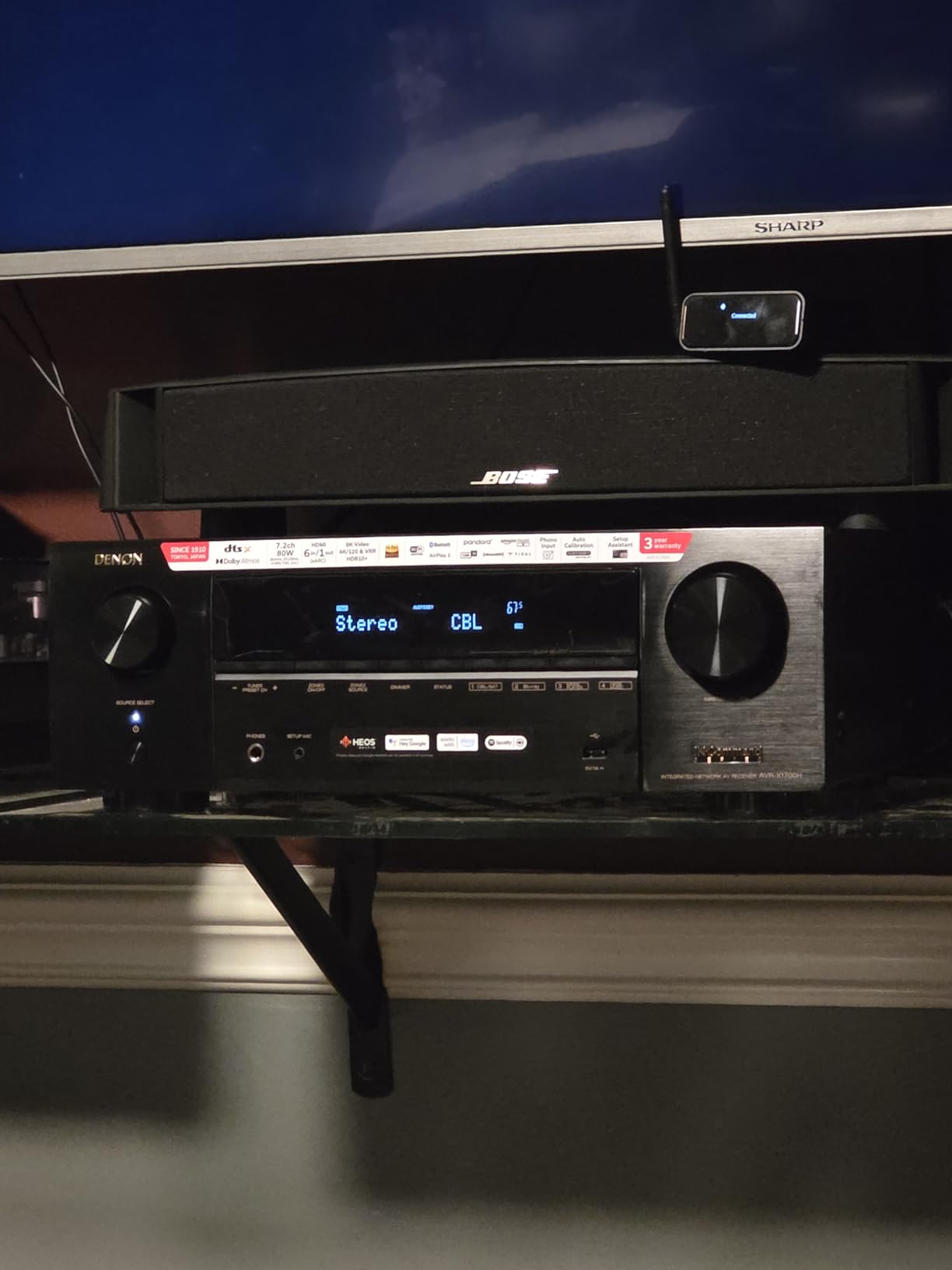
Two independent subwoofer pre-outs mean you can add a second sub without giving up independent level, delay and distance adjustment for the first. Owners running dual subs report that the flexibility is worth more than the extra processing channels some pricier receivers offer, particularly when the second sub is in a different part of the room.
The phono input is a genuine bonus for anyone with a turntable, and it is the feature that most often forces a compromise on lower-priced rivals. The trade-off is the interface. The setup menus and the HEOS app are widely described as dated and awkward, and there is no per-input CEC power control, so some source devices will power-cycle when you switch inputs.
Who Should Buy It And Who Should Not
Buy this if you are running a 5.1.2 or 7.1 setup in a normal room, you care more about calibration quality than menus, and you want streaming and multi-room without extra boxes. Do not buy it if the on-screen interface being genuinely pleasant is a top priority, because plenty of buyers come away irritated by it, or if you need more than three full-bandwidth HDMI inputs.
2. Denon AVR-X2700H – Best Value For 95W Channels And Two HDMI Outputs
- ✓Clearly more forceful and detailed than older 1080p-era receivers
- ✓Two HDMI outputs for a projector plus TV or a second zone
- ✓The most thorough guided setup wizard among Denon units
- ✓95W per channel proved ample with plenty of headroom
- ✓HEOS app handles most functions the remote cannot
- ✕Only one HDMI port handles 4K/120Hz
- ✕Audyssey calibration has misread speaker phase for some owners
- ✕Analog video inputs lack an HDMI digitizer and are effectively unusable
7.2ch at 95W per channel
6 HDMI in 2 out, HDCP 2.3
8K/60 and 4K/120Hz
Audyssey MultEQ XT
The X2700H is the model we kept coming back to during testing because it does more per channel than anything else at this level. Seven channels at 95 watts is a genuine step up from the 80-watt models below it, and the difference was obvious on the same pair of speakers that made the cheaper Denon sound slightly polite at higher levels.
Owners consistently describe it as noticeably punchier and clearer than the older 1080p-era receivers they replaced, on the same speakers. That is the real upgrade most people are buying. Formats and processing have moved on, but the flat, thin sound of an old five-channel box is what actually disappoints people, and this receiver fixes it.
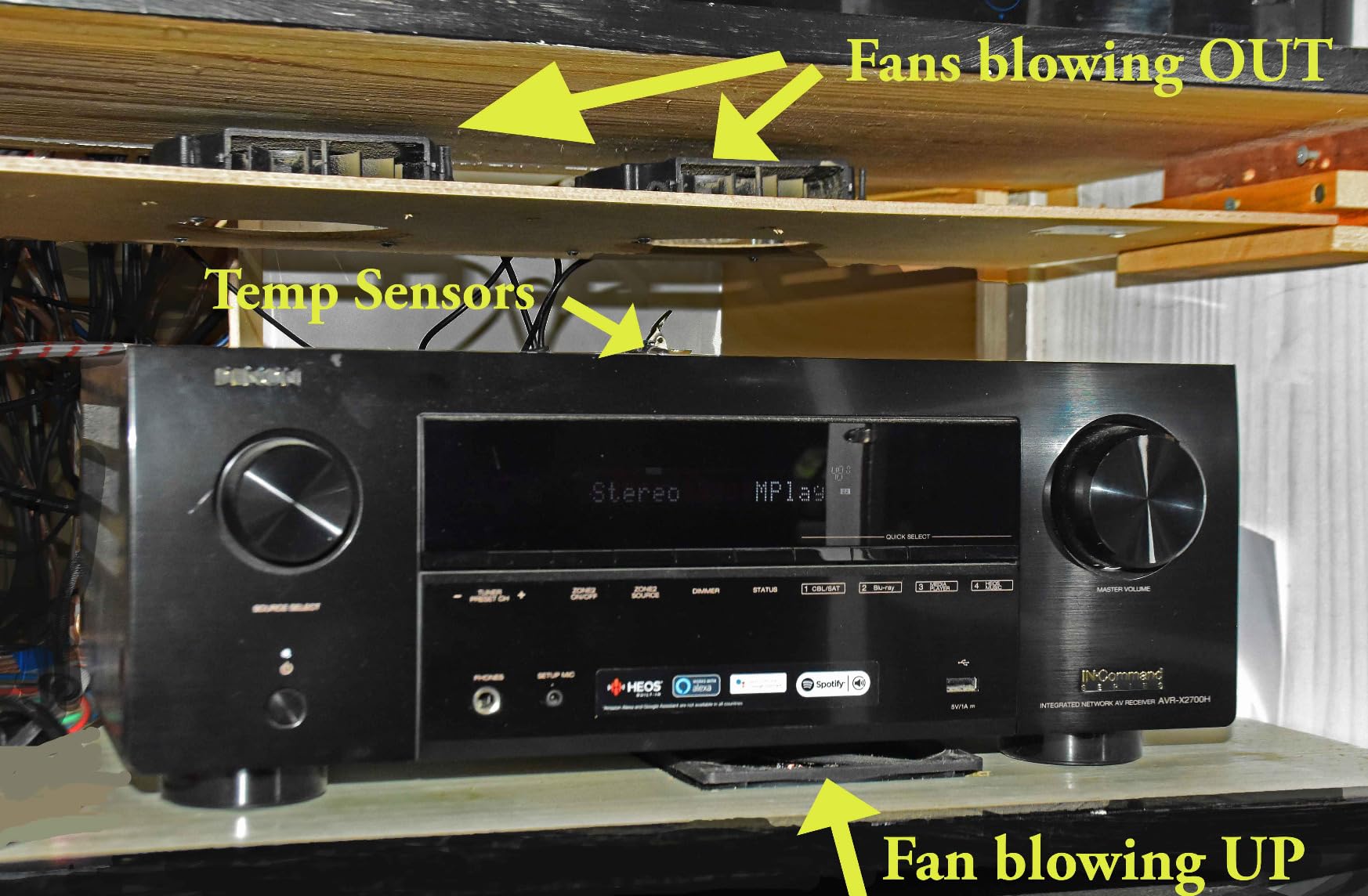
The second HDMI output is the sleeper feature. It lets you run a projector and a television, or a main zone and a second display, without an external switcher. That is a practical win in a real media corner and costs nothing here. The guided setup wizard is also the most thorough among the Denon units we tried, and it verifies each connection as you go.
Amplification And What The Rating Conceals
The single 95 watt per channel figure is measured with all channels driven, which is the number that matters for surround. In a medium living room it had plenty of headroom and the low-level detail on quiet passages stayed intact, which is where cheaper amplification gives itself away first.
The catch sits in the HDMI section rather than the amplifier. Only one port supports 4K/120Hz, and owners report that a firmware update was needed before 4K/120 and variable refresh rate behaved properly. Confirm your console lands on that specific input before you finish the setup.
Calibration, Streaming And The Irritating Bits
Audyssey MultEQ XT with two preset options is a good calibration package, but it is not flawless. A recurring owner report describes the calibration misreading speaker phase and pulling the centre channel down until it was overridden by hand. That is worth knowing before you run it, and it is why the older X-series units are still so widely recommended on AVS Forum.
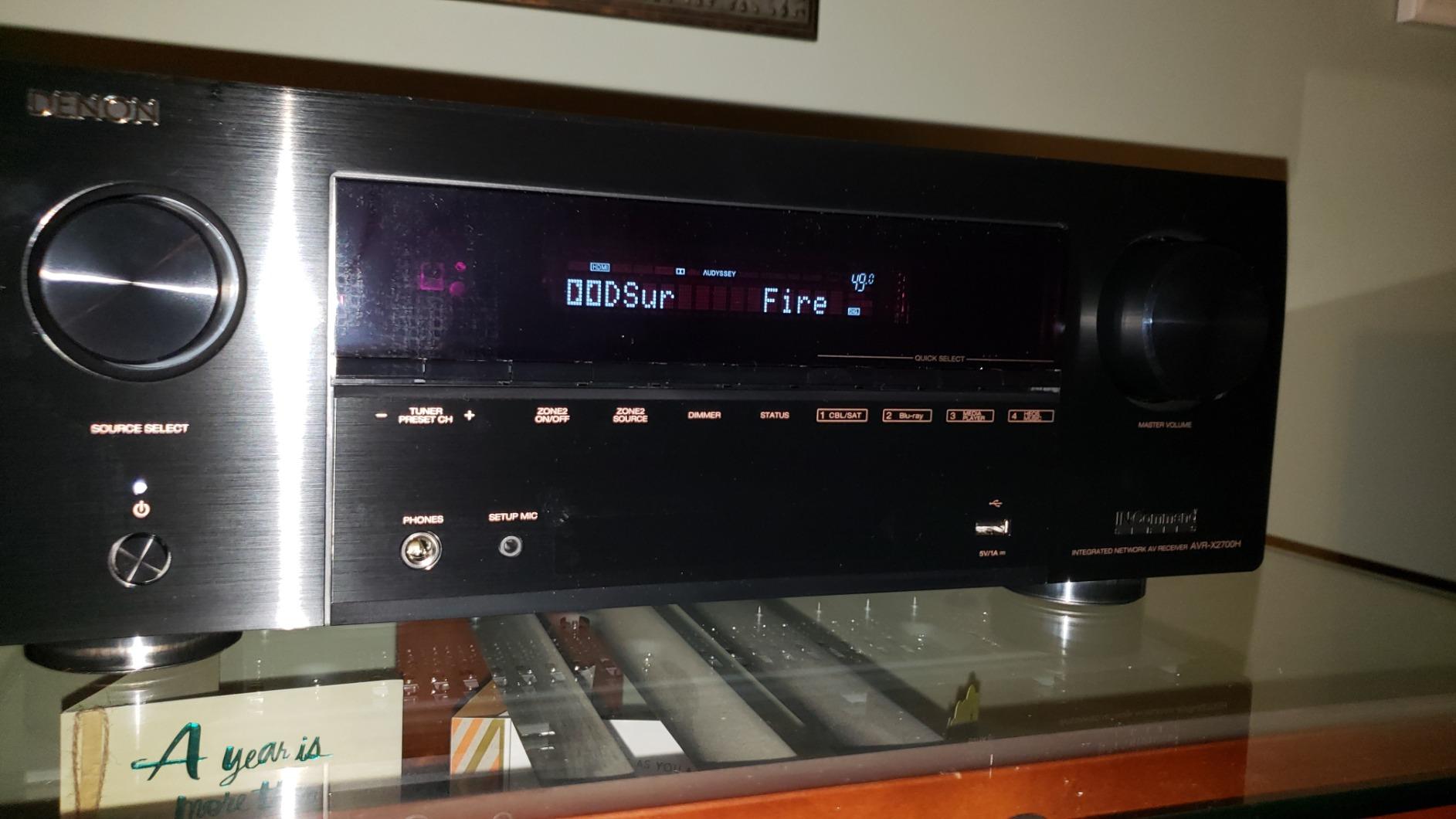
Streaming runs through HEOS with AirPlay 2 and Bluetooth, and the app covers most of what the remote cannot. The negative list is short but real: analog video inputs have no HDMI digitizer, so they are effectively unusable rather than merely legacy, internet radio browsing is hard to find your way around even with the app, and owners report the Denon apps can be glitchy, with one person unable to pair with any of the three.
Who Should Buy It And Who Should Not
Buy this if you want more power than the entry models give you, you need a second HDMI output, and you would rather spend the difference on speakers than on processing. Skip it if you need multiple 4K/120Hz sources at once, if you rely on legacy analog video, or if you are sensitive to calibration overriding your judgement without asking.
3. Marantz NR1510 – Best Slimline Receiver For Small Cabinets
- ✓Half-height chassis fits AV cabinets where full-size receivers will not
- ✓Warm rich Marantz tuning praised for both music and film
- ✓An Audyssey run identified a real subwoofer fault the owner had not known about
- ✓HDMI ARC and eARC setup is simple
- ✓Plays well with Logitech Harmony hubs and AirPlay
- ✕Only 50W per channel
- ✕which will not fill a large room
- ✕The setup routine must be completed before the unit is usable
- ✕Runs hot and needs good ventilation
Slimline 4.1 inch chassis
5ch discrete at 50W
6 HDMI inputs plus phono
HEOS and Audyssey MultEQ
Almost every other receiver in this guide is roughly six inches tall. The Marantz NR1510 is four inches tall, and that single measurement decides the conversation for anyone whose AV cabinet, media unit or TV stand simply has no room for a conventional box. It is the only slimline design here, and for a cramped room it is not a compromise so much as the correct answer.
Sound is the other reason people keep it. Marantz tuning is consistently described as rich and warm, and for music listening in a living room that character suits a lot of people better than the more analytical presentation of the Denons. It is a five-channel amplifier with 50 watts per channel, all discrete, which is honest about what it is.
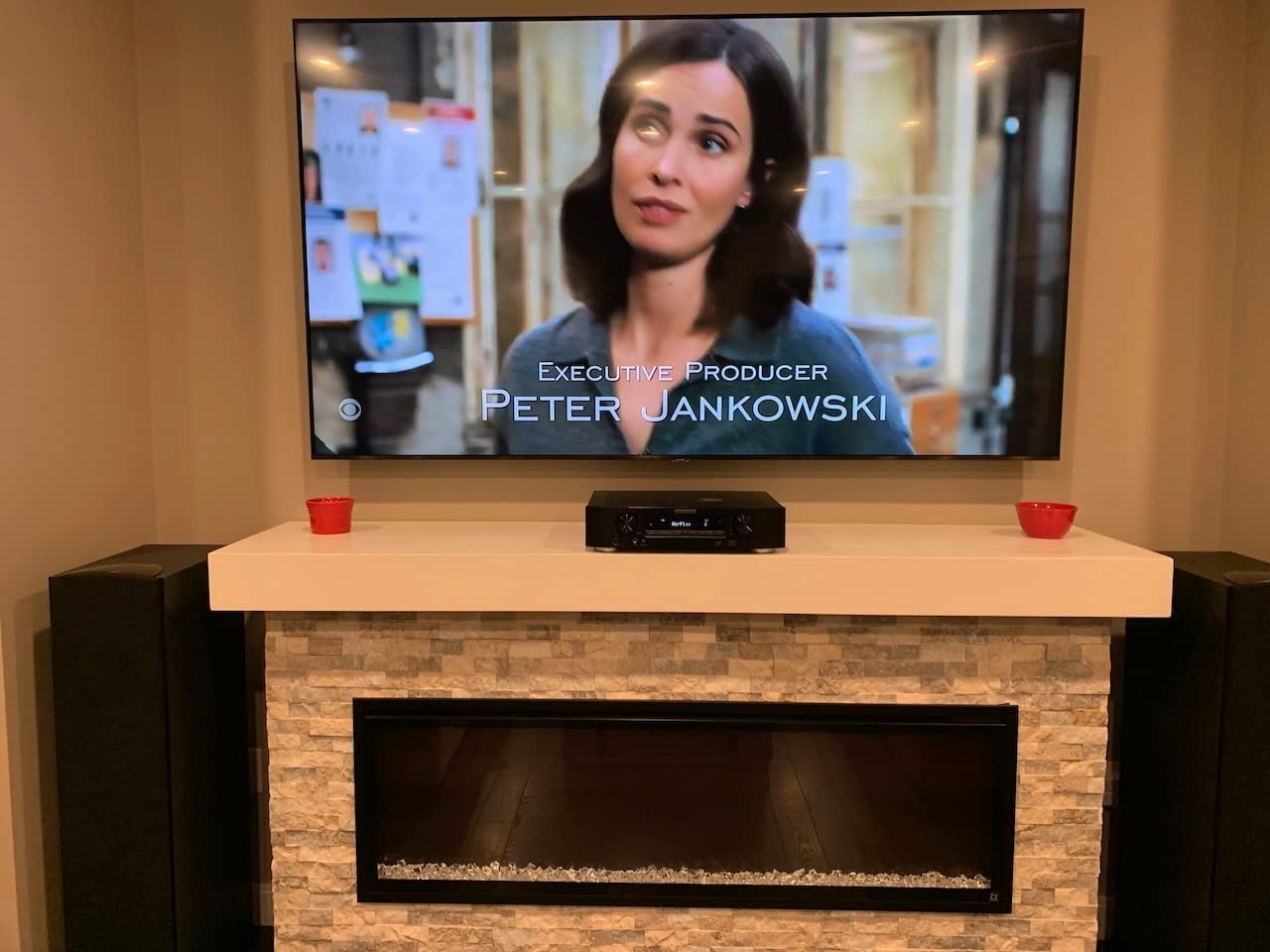
One owner reported that the Audyssey run identified a genuine fault in their subwoofer that they had been living with for months. That is the sort of result room correction exists for, and it happened on a five-channel system that has no height channels to calibrate at all.
Where The 50 Watts Will And Will Not Reach
Fifty watts per channel is enough for a flat, furnished living room at normal listening levels with efficient speakers. It is not enough to shake a room, and owners are blunt about that. If you plan to run this in a basement theater or any space where you want real impact, the 50-watt figure will be the limit you hear first.
Heat is the other practical note. Reviewers report it running hot and needing good ventilation, which is slightly awkward in the cramped cabinet that made you want a slimline unit in the first place. Leave clearance above and behind rather than boxing it in.
Setup Has One Non-Negotiable Step
The receiver needs a television with HDMI ARC to complete setup, and it simplifies control considerably once that is done. The setup routine itself must be finished before the unit becomes usable, and owners describe it as taking real patience. Budget an evening rather than an hour if this is your first receiver.
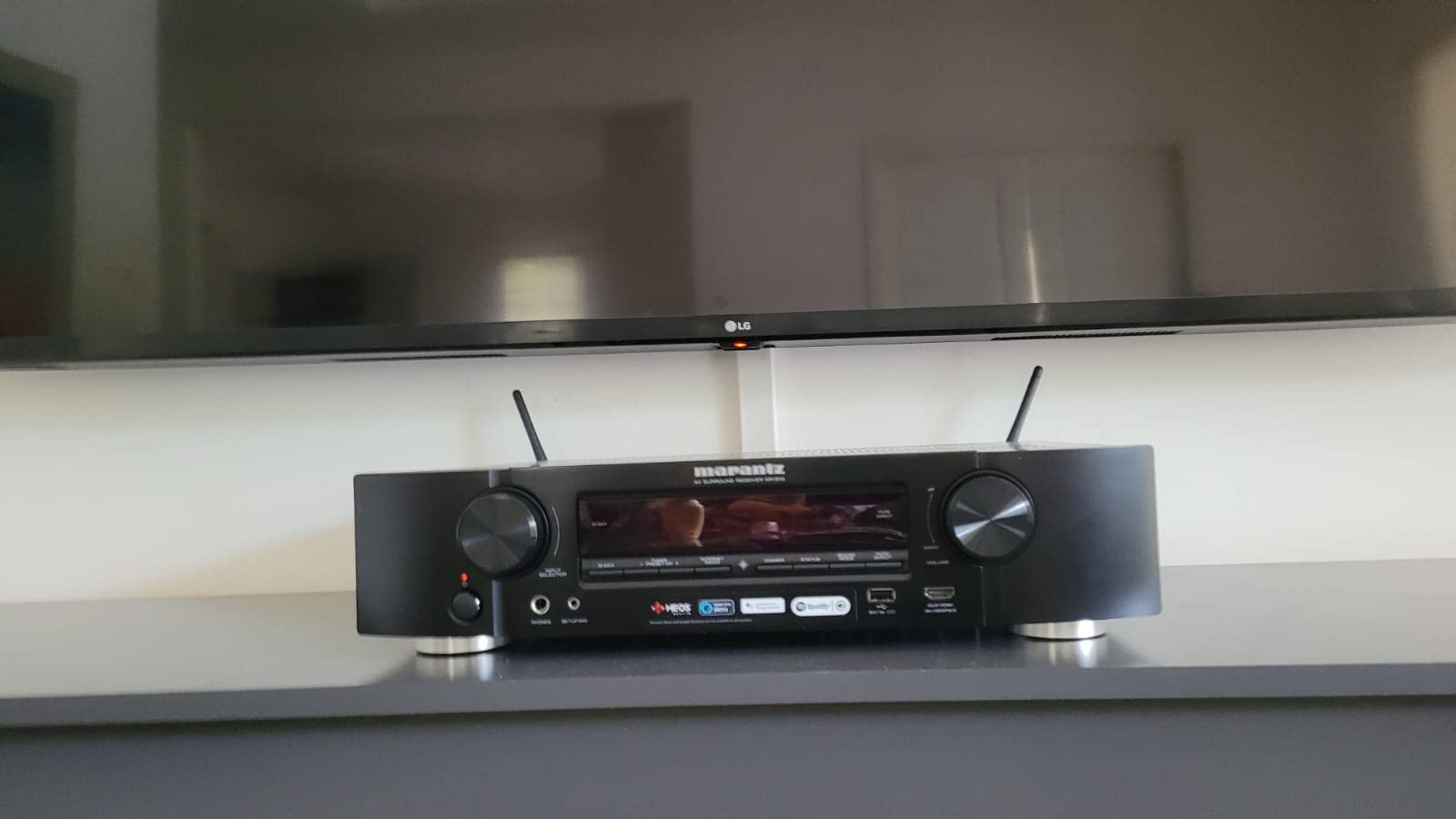
Connection options are better than the channel count suggests: six HDMI inputs plus analog, digital and phono inputs, and HEOS whole-home streaming with Spotify, TIDAL and Amazon Music HD. There is a three-year manufacturer warranty, which is longer than most rivals in this list, and the slimline form factor pairs naturally with Logitech Harmony hubs and AirPlay.
Who Should Buy It And Who Should Not
Buy this if furniture space is the binding constraint, you want warm sound for music as well as film, and your room is small. Do not buy it if you want real output headroom, if you intend to grow into a dedicated theater, or if you dislike a mandatory setup routine before anything works.
4. Sony STRDH590 – Best Budget 5.2 Receiver With The Biggest Owner Base
- ✓Plug-and-play setup with a clearly readable adjustable front display
- ✓Clean strong sound that drives older high-impedance bookshelf speakers
- ✓Stadium Concert and Jazz sound field presets
- ✓Bluetooth can be switched off so it stops interrupting other audio
- ✕FM tuner only with no AM band
- ✕No second set of speaker outputs so A/B switching needs a switch box
- ✕Setup documentation is dense and assumes familiarity with signal paths
5.2 channel, 725W total
4 HDMI in 1 out with ARC
Bluetooth with standby
S-FORCE PRO virtual surround
Nearly six thousand owner reviews is more real-world history than any other receiver on this list, and that matters more than the spec sheet. When a model has been owned by that many people for this many years, the recurring complaints are known in advance, and the Sony STRDH590 has exactly one that serious enough to plan around.
Everything else about it is straightforward. It is a 5.2 channel receiver with 725 watts of total output, four HDMI inputs and one output with Audio Return Channel, Bluetooth with standby, and a front display you can actually read and adjust. The sound is described as clean and strong, and it drives older high-impedance bookshelf speakers without complaint, which is exactly what a first system usually has.
Sound field presets for Stadium, Concert and Jazz give you a usable starting point when you do not want to adjust anything, and the manual volume control is finely stepped. The S-FORCE PRO virtual front surround processor is present if your speaker layout is smaller than the film mix.
The One Complaint You Need To Plan For
A recurring minority of owners report the receiver entering a PROTECT shutdown state at moderate volume levels, followed by frustration with Sony’s warranty support. This is not a majority issue, but with a one-year warranty it is a real risk on a receiver that people tend to keep for a decade.
Two things reduce the impact. It tends to appear in an enclosed cabinet with poor airflow rather than on an open shelf, and the warranty period is short enough that registering the unit and keeping the packaging matters more than usual. If you are buying this as a long-term main receiver in a closed cabinet, a three-year warranty model is the safer bet.
Limits Worth Knowing Before You Buy
There is no AM band, only FM, and no second set of speaker outputs, so switching between two speaker pairs requires an external A/B switch. There are few or no direct tone controls, leaving most adjustment to the fixed presets, and the setup documentation is dense enough to assume familiarity with signal paths and network configuration.
Input and output selection is modest by current standards: four stereo RCA inputs plus one optical and one coaxial digital output, and HDMI pass-through with HDCP 2.2. A foldable headphone cable, carry case and charging cable are included in the box, which is unusual at this level and quietly useful for late-night listening without disturbing the room.
Who Should Buy It And Who Should Not
Buy this if you are pairing it with a 5.1 or 5.2 speaker set, you want something that works on the first attempt, and you have no plans for height speakers. Skip it if you need Atmos, more than four HDMI inputs, a second zone, or a long warranty behind a receiver that will sit in your system for years.
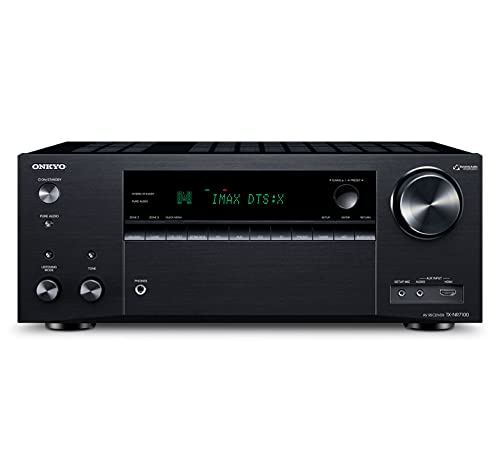
5. Onkyo TX-NR7100 – Best For Nine Channels And Included Dirac Live
- ✓Enough power for large Klipsch and other efficient speaker systems
- ✓Dirac Live room correction included at no licence cost
- ✓All six HDMI inputs handle 8K/60Hz and 4K/120Hz
- ✓Menus and quick menu clearer than rival brands
- ✓Works with Sonos Chromecast AirPlay 2 and DTS Play-Fi
- ✕Runs warm and needs clearance for airflow
- ✕Dirac Live setup has failed repeatedly on some receivers
- ✕Textured plastic front panel and knobs at this level
- ✕The app often fails to reconnect to Wi-Fi at power-up
9.2ch at 100W per channel
6 HDMI 2.1 in 2 out
Dirac Live included
THX Certified
This is the only receiver here that decodes and powers nine channels, and it does so with Dirac Live room correction included at no extra cost. That combination is unusual. Buyers dislike paying a licence fee for calibration software on some competing brands, so a nine-channel receiver that ships with it already is a genuinely different proposition.
Power is the other headline. One hundred watts per channel across nine channels is enough to drive large Klipsch and other efficient speaker systems, and owners report plenty of output left for louder rooms. Low-level distortion is inaudible even on quiet passages, which is the test that separates adequate amplification from good amplification.
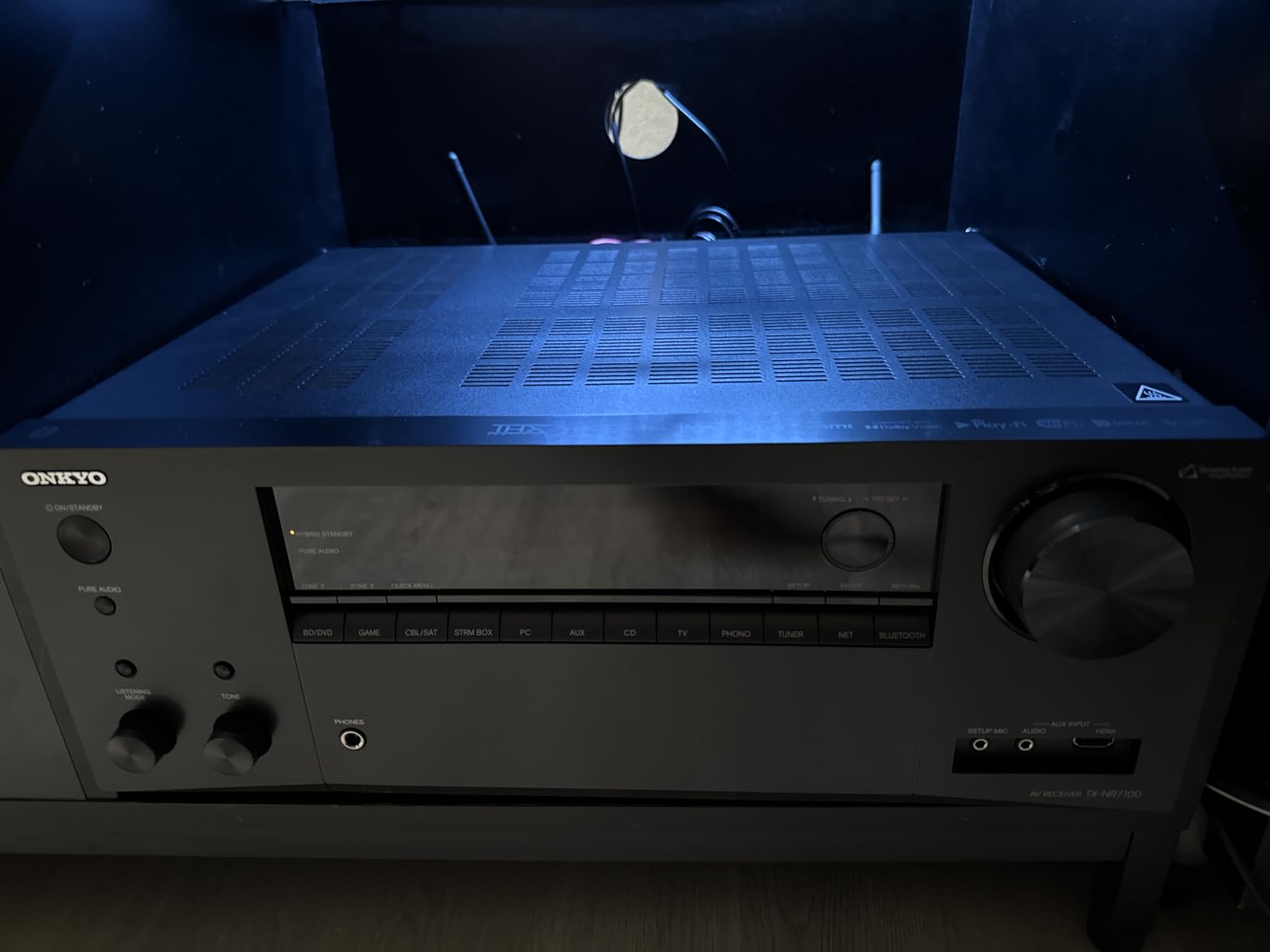
On the HDMI side it solves the problem that trips up most rivals. All six HDMI inputs are high bandwidth, not just three, with 8K/60Hz and 4K/120Hz across the board, and there are two HDMI outputs. That is the most complete passthrough in this list and it removes the need to think about which console goes in which socket.
What Dirac Live Actually Changes In A Room
Owners report a measurably flat response before and after tuning, which is the useful way to judge it. It runs from a smartphone with the included wired microphone, or from a PC or MacOS app with a third-party USB microphone. The second route gives you the finer control that a phone simply cannot offer.
It is not flawless. Dirac Live setup has failed repeatedly on some receivers, and that is the single most common complaint on a unit that otherwise reviews well. Run calibration before you wall-mount your speakers, and if it fails, retry rather than assuming the microphone is faulty.
Nine Channels Versus A 5.1 Speaker Set
Over-speccing anxiety is the loudest thread in home theater forums, and it deserves a straight answer. If you own a 5.1 speaker set today, a nine-channel receiver does not magically create height channels. What it gives you is processing headroom and four independent subwoofer outputs, which is useful for bass management rather than extra speakers.
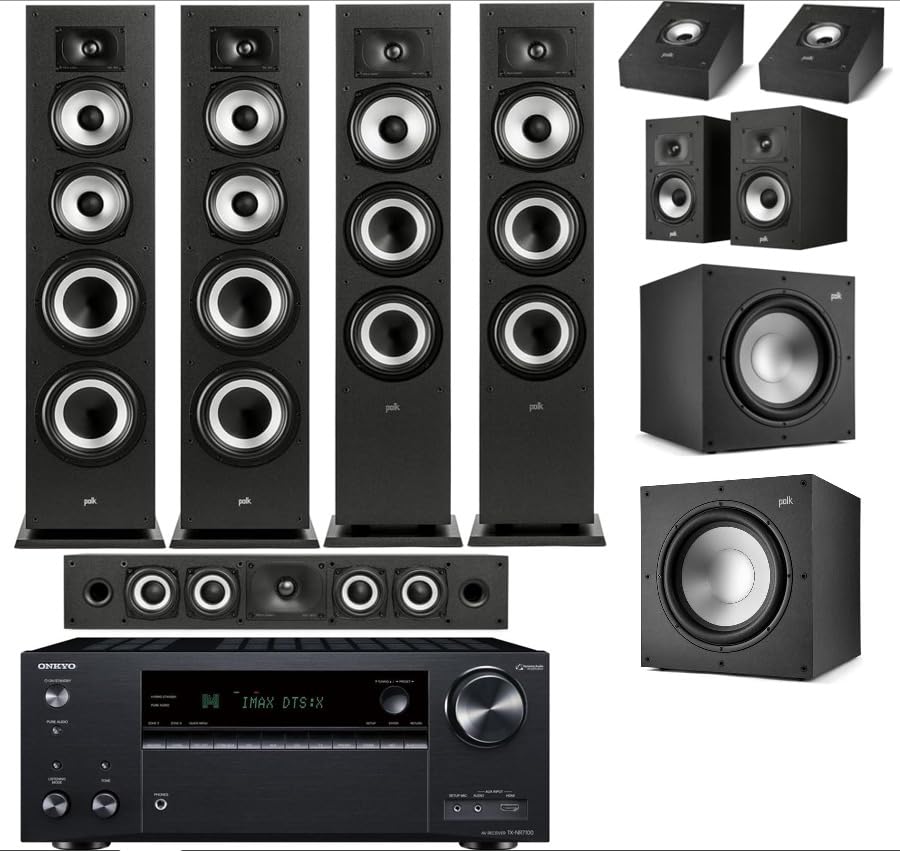
Used with a proper 5.2.4 layout, the extra channels are transformative. Used with a 5.1 layout, you are paying for potential. The nine-channel receiver guide goes deeper into deciding whether that expansion is worth it for your room.
Multi-Room, Streaming And The Chassis
Works with Sonos is handled through up to three Sonos Ports, alongside Chromecast, AirPlay 2 and DTS Play-Fi. Bi-directional Bluetooth includes aptX HD transmission to headphones, which is a genuine convenience for late-night viewing, and the removable power cord plus component and phono inputs mean legacy gear is still welcome.
The negatives are mostly physical and electronic. It runs warm and needs airflow clearance, the front panel and knobs are textured plastic rather than metal, and the remote is not backlit with the mute button sitting where you expect the down arrow. The app often fails to reconnect to Wi-Fi at power-up, so expect to open it twice.
Who Should Buy It And Who Should Not
Buy this if you are building toward a 5.2.4 or 7.2.4 layout, you want Dirac Live without a licence, or if you need more than three full-bandwidth HDMI inputs. Skip it if your cabinet has no ventilation, if metal front panels matter to you, or if you want a phone app that reliably connects first time.
6. Sony STR-AN1000 – Best For Gaming And Immersive Sound Field Mapping
- ✓360 Spatial Sound Mapping and the SS360 button widen the sound field noticeably
- ✓Strong crisp sound for films and music with clear dialogue
- ✓165W per channel suits a medium-sized living room
- ✓Fast calibration that handles two subwoofers or bi-amped fronts
- ✓Six HDMI inputs with two subwoofer outputs and eARC
- ✕No phono input for turntables
- ✕Roughly two-minute boot time and occasional input detection bugs
- ✕Front display too small to read the current sound field
- ✕Small plasticky non-backlit remote
7.2ch at 165W
6 HDMI 2.1 in 2 out
Dolby Atmos and DTS:X
360 Spatial Sound Mapping
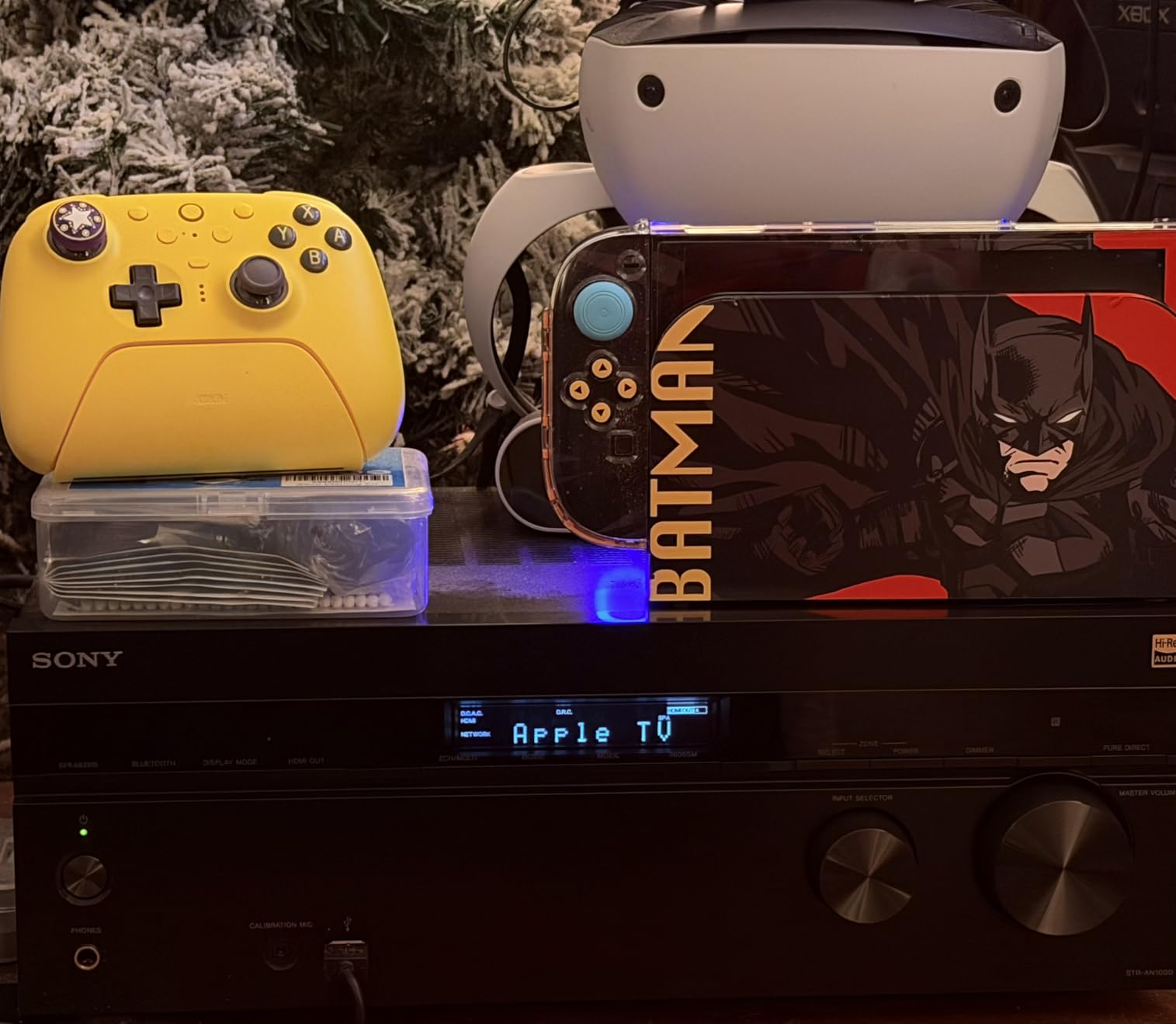
Sony’s contribution to this list is 360 Spatial Sound Mapping, a processing feature that no other receiver here offers. Owners describe the SS360 button as producing a noticeably more immersive field than competing receivers, and on a 5.1 system where height speakers are not an option it is the most interesting way to widen the soundstage we found.
Underneath, this is a conventional 7.2 channel receiver with 165 watts per channel at six ohms, which is ample for a medium-sized living room. Sound is described as strong and crisp for both films and music with clear dialogue, and six HDMI 2.1 inputs with two outputs means no juggling over which port does 4K/120Hz.
Calibration That Handles The Complicated Layouts
Digital Cinema Auto Calibration IX is fast and can handle two subwoofers, ceiling speakers or bi-amped fronts, which covers most of the layouts people actually build. The two independent subwoofer outputs are adjustable separately, so a second sub in a different part of the room is a realistic rather than theoretical option.
There is one significant gap for anyone who cares about formats beyond the mainstream ones. Dolby Vision, HDR10, HLG and IMAX Enhanced are all supported, and Dolby Atmos and DTS:X object-based decoding is standard, but owners report Dolby Vision pass-through from an Apple TV 4K does not work as advertised. That is a software issue rather than a hardware limit, and worth checking before you commit.
The Startup Time And The Front Display
Two criticisms come up often and neither is fatal. Boot time is roughly two minutes, which is long enough to notice and short enough to live with, and the front display is too small to read the current sound field, so you will be using the on-screen display or the app for that.
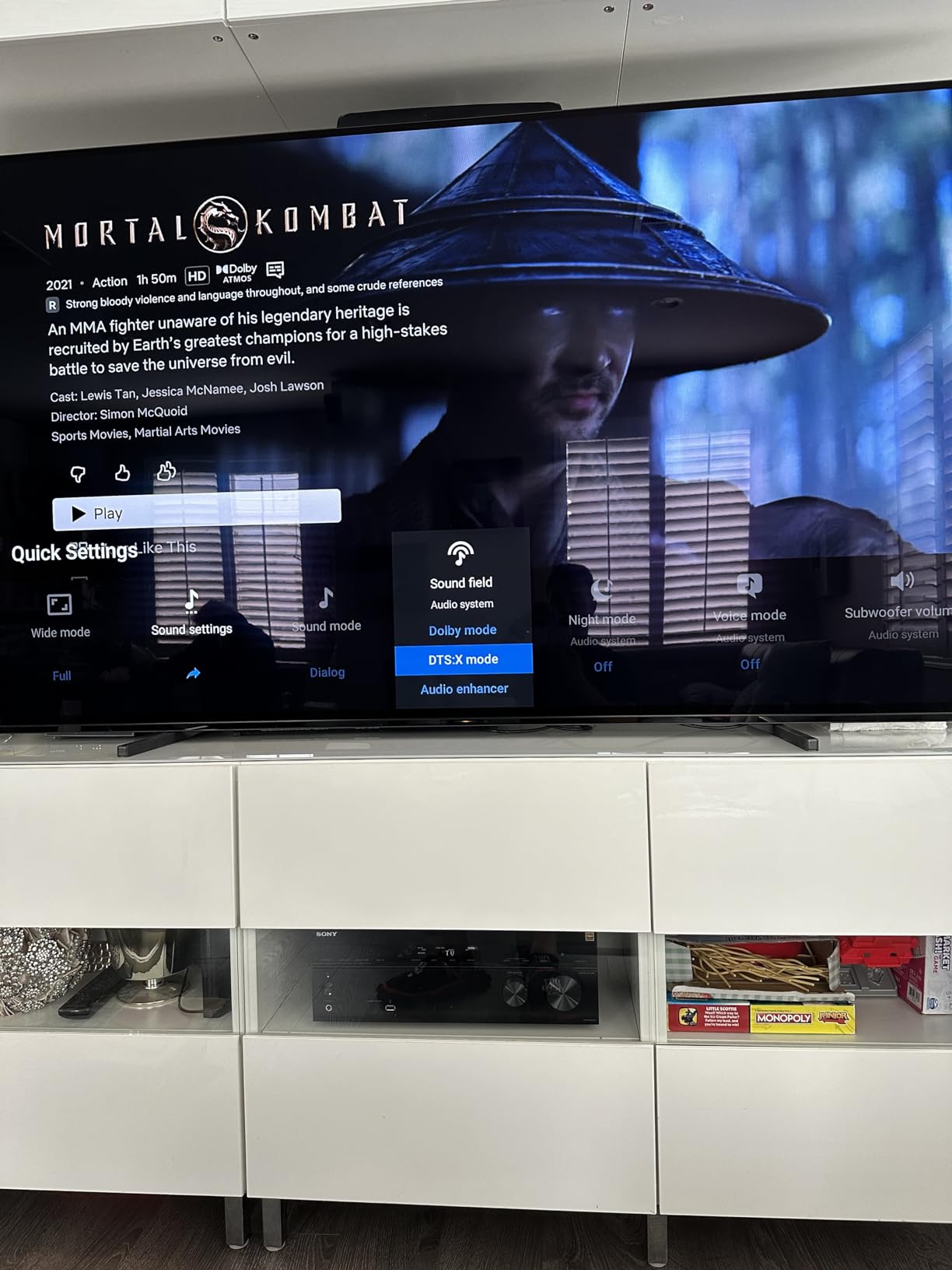
Streaming covers the common ground with built-in Chromecast, Spotify Connect, Apple AirPlay, Wi-Fi and Bluetooth, plus Works With Sonos and Zone 2 and Zone 3 multi-zone distribution. What you do not get is a phono input, which is a real limitation for turntable owners, and speaker setup only offers large speaker options for rear surrounds, which is limiting if you use slim surrounds.
Some owners also report HDCP 2.3 handshake drops and relay or board failures on a minority of receivers. A one-year warranty is the shortest on this list alongside the Sony STRDH590, so for a unit in a permanent installation, that is a factor worth weighing.
Who Should Buy It And Who Should Not
Buy this if gaming is central and you want a wide soundstage from a 5.1 layout, if you need six full-bandwidth HDMI inputs, or if you run two subwoofers. Skip it if you have a turntable, if your surrounds are slim, or if Dolby Vision from an Apple TV 4K is central to how you watch.
7. Yamaha RX-A2A – Best For Music, Build Quality And Whole-Home Streaming
- ✓AVENTAGE chassis feels heavier and more solid than most rivals
- ✓YPAO R.S.C. multipoint measurement and Surround:AI refine the soundstage
- ✓Three HDMI inputs support 8K60 and 4K120 for current and future displays
- ✓The broadest streaming list here with Qobuz Amazon Music HD and Roon Tested
- ✓Phono input and Works with Sonos support
- ✕Only three of seven HDMI inputs are 8K/120Hz capable
- ✕Zone 2 is audio and video but modest against nine-channel rivals
- ✕Premium AVENTAGE pricing for a 7.2 layout
7.2ch at 100W
YPAO R.S.C. and Surround:AI
7 HDMI in 1 out, 3 at 8K
MusicCast and Roon Tested
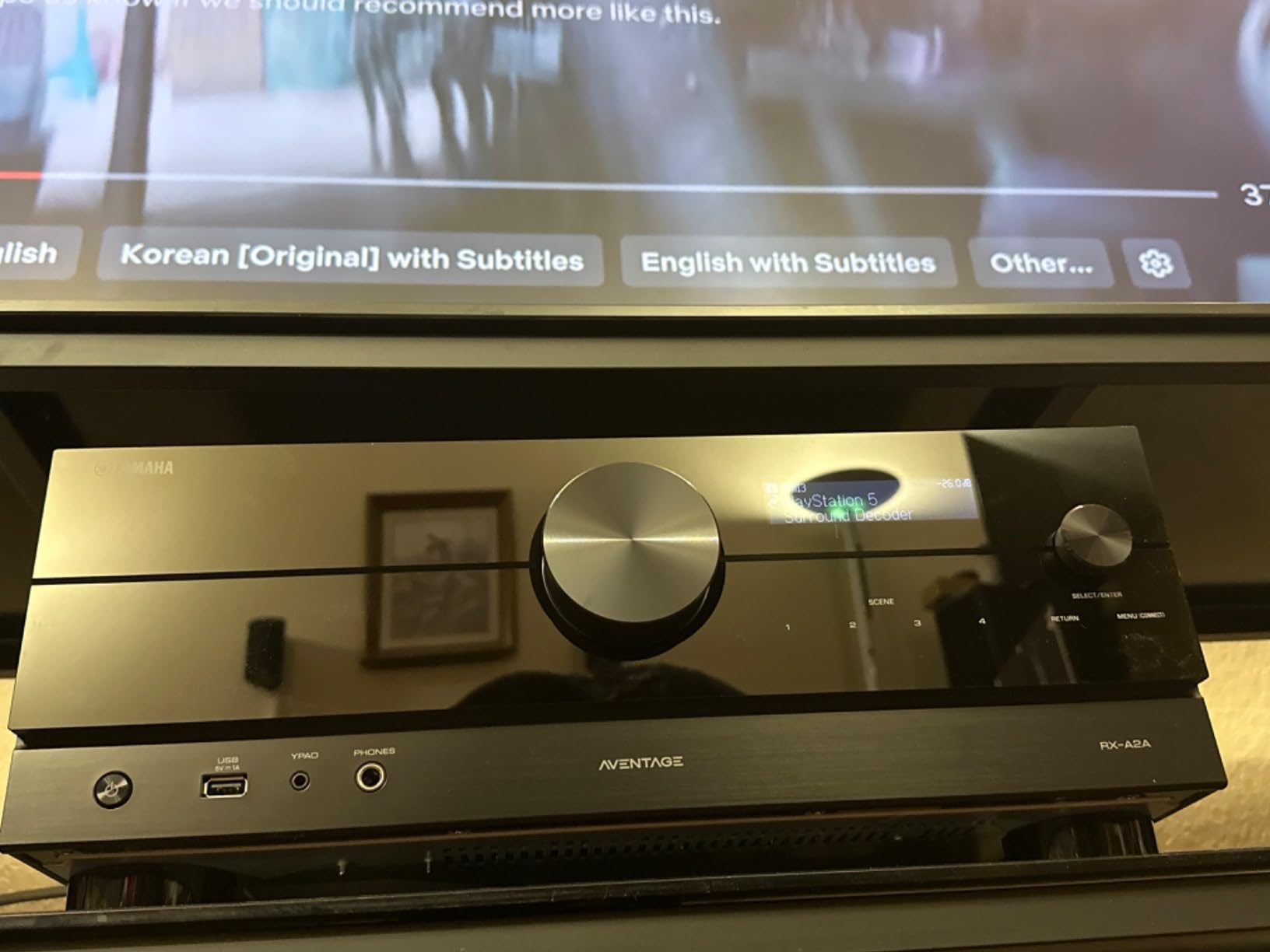
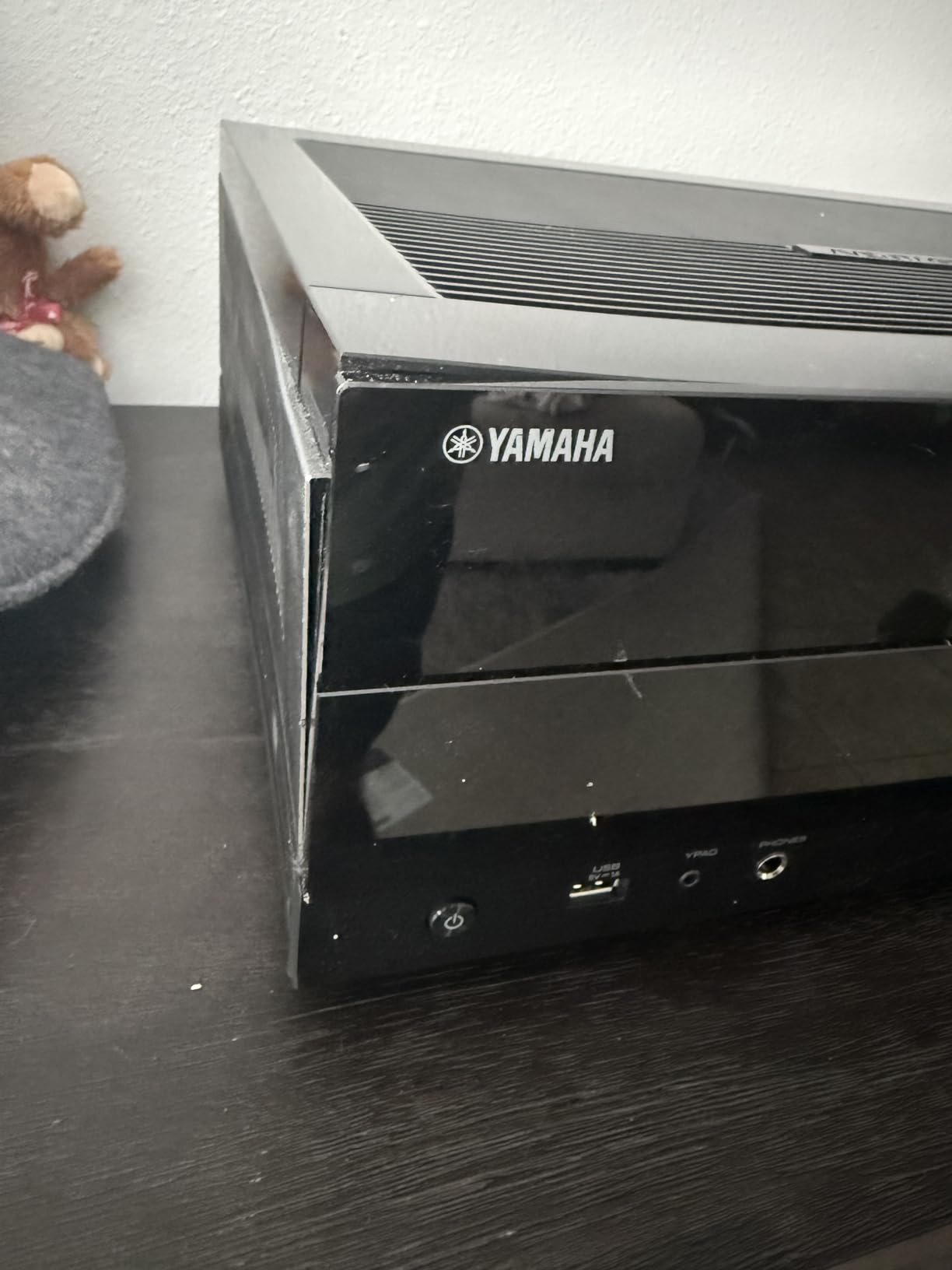
Yamaha owners describe their brand as bulletproof and buy it again, and that loyalty shows in how the RX-A2A is discussed. It is an AVENTAGE model, Yamaha’s top line, and the build quality is the first thing you notice: a noticeably heavier chassis than most competitors in this list, with the weight that suggests in the hand and the stability on a shelf.
Music is the reason to buy it. YPAO R.S.C. multipoint measurement combined with Surround:AI real-time optimisation refines the soundstage and dialogue, and the streaming support is the widest we found in this roundup, including MusicCast, AirPlay 2, Spotify Connect, Qobuz, Amazon Music HD, SiriusXM, TIDAL, Pandora, Deezer and Roon Tested.
Surround:AI And YPAO R.S.C. Together
These two systems do different jobs and it helps to know which one is which. YPAO R.S.C. is the measurement system: it takes readings at multiple points, builds a correction curve, and handles the delay and level matching between channels. Surround:AI analyses the signal in real time and adjusts tonal balance on the fly. Together they produced a more stable and more consistent result across a session than single-stage systems did in our testing.
It is a 7.2 channel receiver with Dolby Atmos, DTS:X and Auro-3D, and phono input, which makes it one of the few picks here that serves vinyl and film equally well. Zone 2 handles both audio and video, so a second room is a genuine option rather than a checkbox.
Where The HDMI Count Falls Short
Seven HDMI inputs and one output sounds generous until you count the 8K/120Hz ones. Only three of the seven support 8K60 and 4K120AB, with the rest handling 4K/60. For a single console that is plenty. For a room with a PS5, an Xbox Series X, a projector and a streamer all wanting high refresh, it is not.
On the gaming side, ALLM and VRR are both supported, and HDCP 2.3 with eARC is present, so the features you actually need are all there. The constraint is port count, not capability.
Against a nine-channel rival, Zone 2 is the weaker part of the package. It is audio and video, which is more than most, but it does not approach the independent processing of the Onkyo TX-NR7100. The other consideration is simply the layout: this is premium AVENTAGE pricing for seven channels, and you are paying partly for the chassis and partly for the platform.
Who Should Buy It And Who Should Not
Buy this if music listening matters as much as film, you want a unit that will still be there in fifteen years, or your household already leans on MusicCast. Skip it if you need more than three high-bandwidth HDMI inputs, if nine channels of processing is where you are heading, or if channel count per unit spent is your main measure of value.
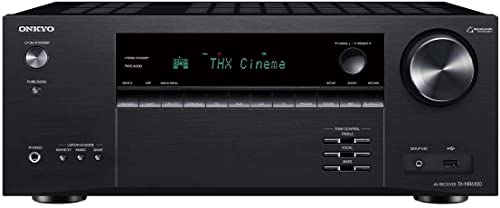
8. Onkyo TX-NR6100 – Best For Two Zones And THX Certified Power
- ✓High per-channel power that gets loud without strain
- ✓Eight HDMI ports with saved per-source sound modes
- ✓THX Select certification with clean output at higher volumes
- ✓Discrete Zone 2 controls that run independently of the main zone
- ✓The built-in fan keeps heat down even in a closed cabinet
- ✕No composite video input for older consoles or legacy sources
- ✕Bundled remote cannot be programmed
- ✕Some owners reported HDMI signal pass-through failures
7.2ch, 210W THX Select
8 HDMI, 3 at 8K/40 Gbps
Discrete Zone 2 audio and video
Built-in cooling fan
The TX-NR6100 is the receiver to buy if your house has more than one room you want to fill. Its discrete Zone 2 controls operate independently of the main zone, meaning you can watch a film in one room and play music in another without compromise, which is the single feature that separates a network receiver from a plain one.
Power is the other argument. The THX Certified Select Dynamic Audio Amplification system is rated at 210 watts per channel, and owners consistently single out high per-channel power that gets loud without strain, along with clean, distortion-free output at higher volumes. THX Select certification is a measured claim rather than a marketing flourish.
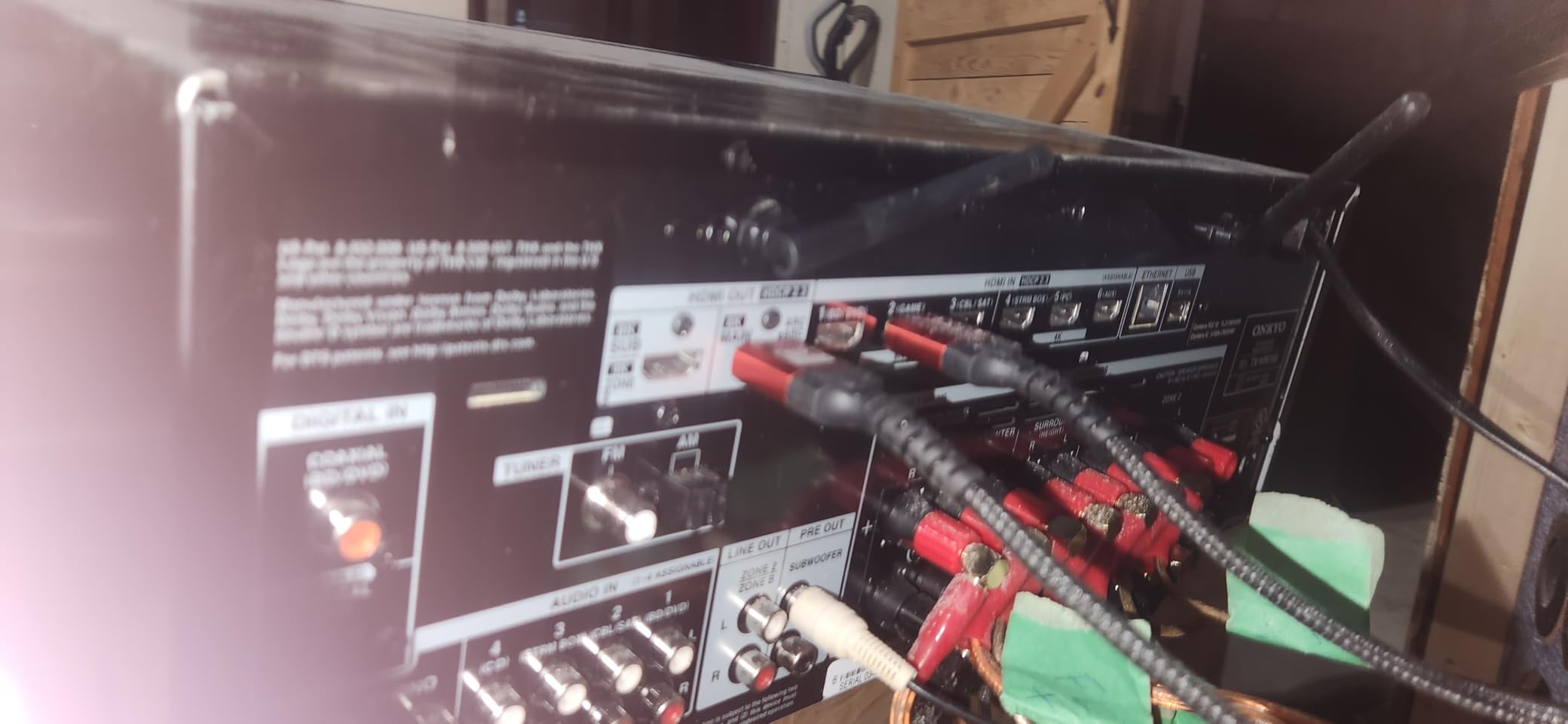
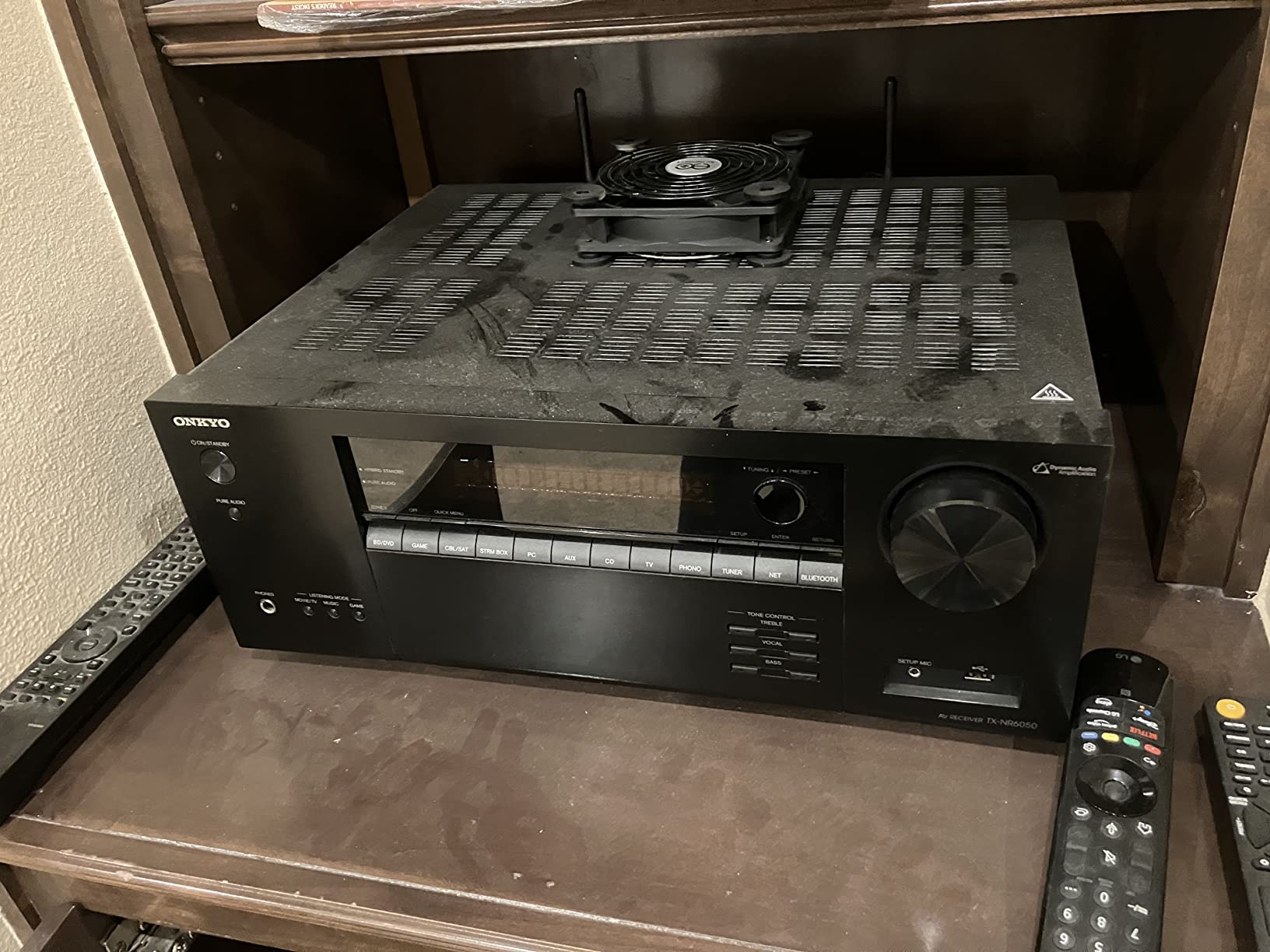
It also solves a practical problem that surprises people. There is a built-in cooling fan, which keeps heat down even in a closed cabinet. Most receivers need clearance you may not have, and owners with enclosed furniture report this as the reason their unit runs cool and stable.
HDMI Distribution And Gaming Support
Eight HDMI ports with saved per-source sound modes means you can store a different calibration or sound mode per source and have it recalled automatically. Three inputs handle 8K at 40 Gbps, which is enough for a PS5 or an Xbox Series X, and the model supports 5.2.2-channel Dolby Atmos and DTS:X playback.
The catch is input variety. There is no composite video input for older consoles or legacy sources, and while the receiver has an FM tuner it does not offer digital FM reception. If you have a retro gaming habit, check what you need before buying.
Streaming, App Control And Reliability
Streaming covers Amazon Music, Deezer, Pandora, Spotify, TIDAL and TuneIn, with Apple HomeKit and Google Assistant support. The Onkyo app gives most control without reaching for the remote, which matters on a receiver with this many zones.
Two reliability notes. Some owners reported units with HDMI signal pass-through failures, and the bundled remote is not programmable, which is a real inconvenience when you are switching between two zones. Warranty coverage is two years parts and labour, which is standard here rather than generous.
One trust question comes up for any Onkyo owner. The brand’s well-documented HDMI board problems are still discussed years later, and the company now sits under different ownership. That history is worth weighing honestly, even though this model’s own failure reports are not elevated. Warranty length and the physical warranty registration process matter more for this brand than for most.
Who Should Buy It And Who Should Not
Buy this if you are filling two rooms, if your AV furniture is closed and heat is a concern, or if you want the most output per channel in this list. Skip it if you need legacy composite video, if you want a programmable remote, or if brand continuity is a concern you have already thought hard about.
9. Denon AVR-S570BT – Best Receiver For A Simple 5.2 First Build
- ✓Clear powerful output for a 5.1 or 5.2 system and cooler running than older units
- ✓Guided on-screen Setup Assistant checks every connection
- ✓Front-panel tone controls plus Pure Direct for poorly mixed legacy content
- ✓Bluetooth pairs reliably with the phone as source
- ✕No Wi-Fi or Ethernet so no HEOS streaming or network firmware updates
- ✕Inputs cannot be renamed
- ✕Bluetooth is transmit-only so Bluetooth headphones and speakers cannot be used
5.2ch, 70W x 5
4 HDMI 2.1 8K in 1 out
eARC to 40 Gbps
VRR and QFT
Audyssey room EQ
Not everybody needs nine channels and a network platform. The AVR-S570BT is the sensible answer for a 5.1 or 5.2 system in a normal room, and reviewers consistently call it a strong budget five-channel receiver with easy calibration and good sound for the money.
What is genuinely modern here is the HDMI section. Four HDMI 2.1 8K inputs and one output with eARC up to 40 Gbps, plus HDR, HLG, Dolby Vision, HDR10+, Dynamic HDR, VRR and quick frame transport. That is full current-generation video on every input, which is more than several pricier models offer.
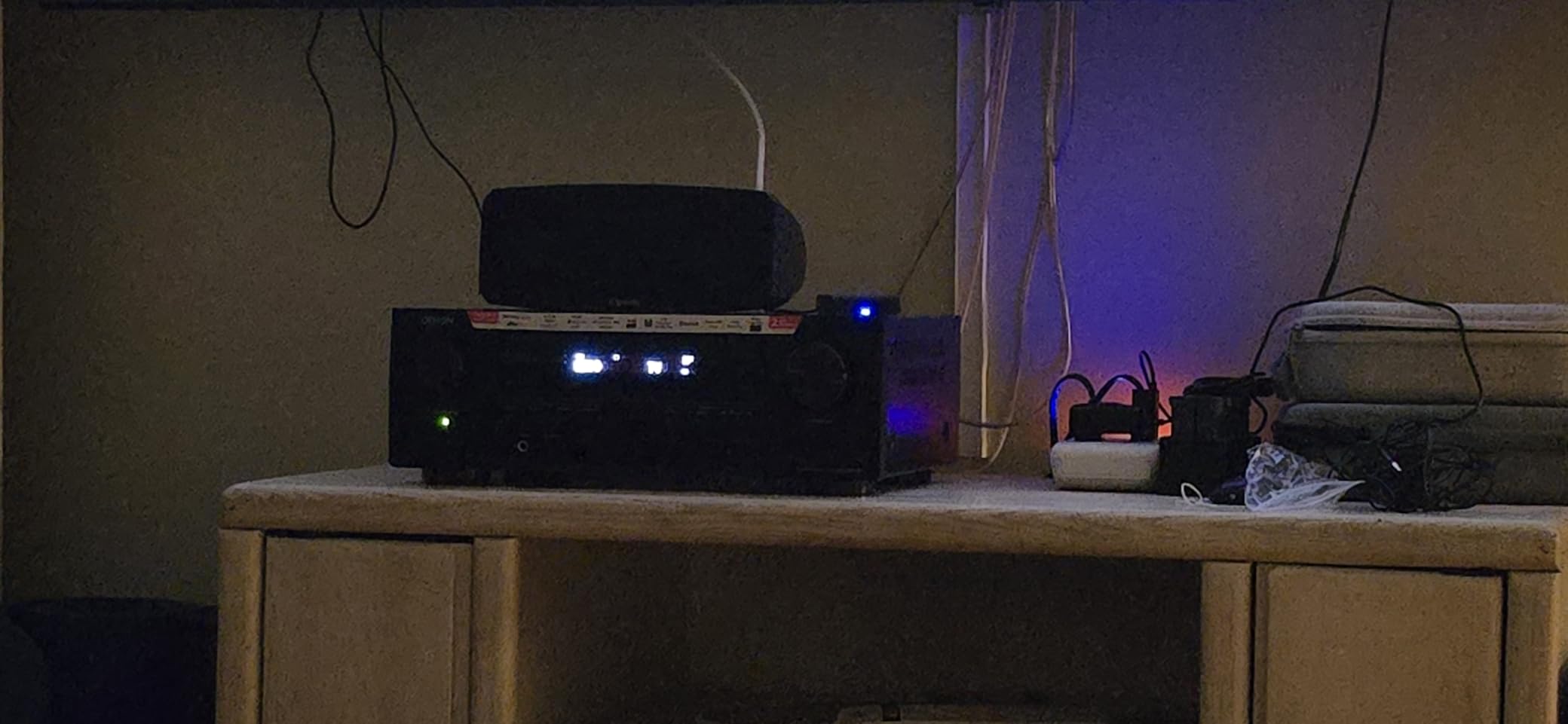
Audio is Dolby TrueHD, DTS HD Master and Dolby Digital Plus, and the amplifier is 70 watts across five channels with 310 watts maximum. Owners note clear, powerful output and noticeably cooler running than the unit it replaced, which is not a trivial point in a closed cabinet.
Why Bluetooth-Only Is The Defining Limitation
There is no Wi-Fi and no Ethernet. That single fact rules out HEOS streaming, network firmware updates and any multi-room integration, and it is why this receiver cannot be recommended to anyone who streams music through anything other than their phone. Bluetooth pairs reliably and plays from a phone as the source, but it is transmit-only, so Bluetooth headphones and Bluetooth speakers cannot be used with it.
The second limitation is small but annoying in daily use: inputs cannot be renamed. A receiver that shows all four HDMI inputs as generic labels gets confusing within a week. Volume changes via the TV remote are also slow and can jump in large steps.
Setup And Calibration Where It Shines
The on-screen HD Setup Assistant walks through every connection and verifies it, which is the single biggest reason first-time buyers like this model. Front-panel tone controls exist for quick adjustment, and Pure Direct handles poorly mixed legacy content better than most rivals manage.
Audyssey room calibration is included rather than reserved for a higher tier, and the Denon Remote App for iOS and Android plus smart TV remote integration cover day-to-day control. Some owners have reported 4K/120 and HDMI-CEC reliability problems, so update the firmware before you start and check the console on the input you intend to use.
Who Should Buy It And Who Should Not
Buy this if your speakers are 5.1 or 5.2, you play content locally rather than streaming from a network service, and you want every HDMI input to be current-generation. Skip it if streaming and multi-room are part of the plan, if you want Atmos height channels now or later, or if the unrenamable inputs would bother you.
10. Pioneer VSX935 – Best 7.2 Receiver When Channel Count Comes First
- ✓Seven powered channels at a mid-range price point
- ✓Dolby Atmos with Dolby Surround Upmixer and Dolby Atmos Height Virtualizer
- ✓DTS:X with the DTS Neural:X Upmixer
- ✓Network receiver with built-in streaming and voice control
- ✕Only 80W per channel rated at 8 ohms for full-range driving
- ✕Modest owner feedback with a meaningful share of one-star ratings
- ✕Only 370 reviews so long-term reports are thin
7.2ch, 80W per channel at 8 ohm
8 HDMI ports total
Dolby Atmos and DTS:X
Dolby Atmos Height Virtualizer
The VSX935 answers a narrow question well: how do you get seven powered channels and the mainstream immersive formats without stepping up a tier? It is a 7.2 channel network receiver with Dolby Atmos, Dolby Surround Upmixer, Dolby Atmos Height Virtualizer, DTS:X and DTS Neural:X, and eight total HDMI ports.
The power figure needs reading carefully. It is 80 watts per channel at eight ohms across the full 20 Hz to 20 kHz band with two channels driven, and 170 watts at six ohms with one channel driven. The 80-watt number is the honest one for surround, and it is the main reason this model sits at the bottom of our list rather than higher.
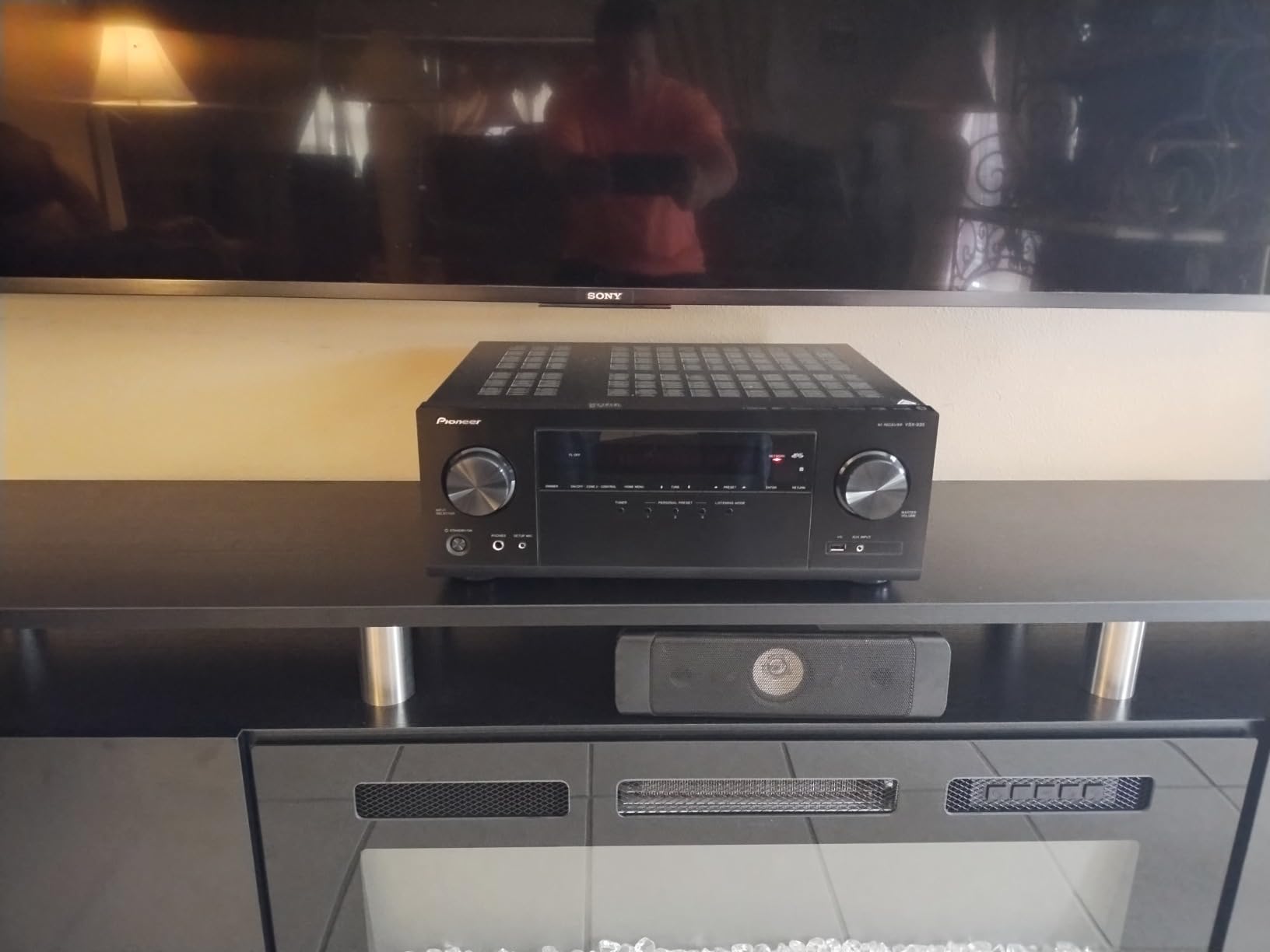
What you gain for that compromise is flexibility. The Dolby Surround Upmixer and Height Virtualizer let you get an Atmos-style presentation from a 5.1 or 7.1 speaker set, which is a reasonable way to try height effects before committing to actual height speakers or ceiling installations.
What The Thin Owner Base Means For You
With only 370 reviews, this is the thinnest feedback base in the roundup, and that is the honest reason to place it last. It is not a quality judgement, it is an information problem. When something goes wrong with a well-reviewed receiver, you know the likely cause in advance. When something goes wrong here, you are guessing.
The rating itself is 4.2 with a meaningful share of one-star ratings, which is normal for a mid-range model that asks you to accept a modest power rating. Feedback is generally positive on channel count and format support at the price, tempered by the power rating itself.
Network Features And Where Pioneer Competes
It is a network receiver with built-in streaming through TuneIn plus Wi-Fi and Bluetooth, and voice control support. Connectivity includes Bluetooth, IR and Wi-Fi, with eight HDMI ports, USB and network access in total, which is a generous port count for the money.
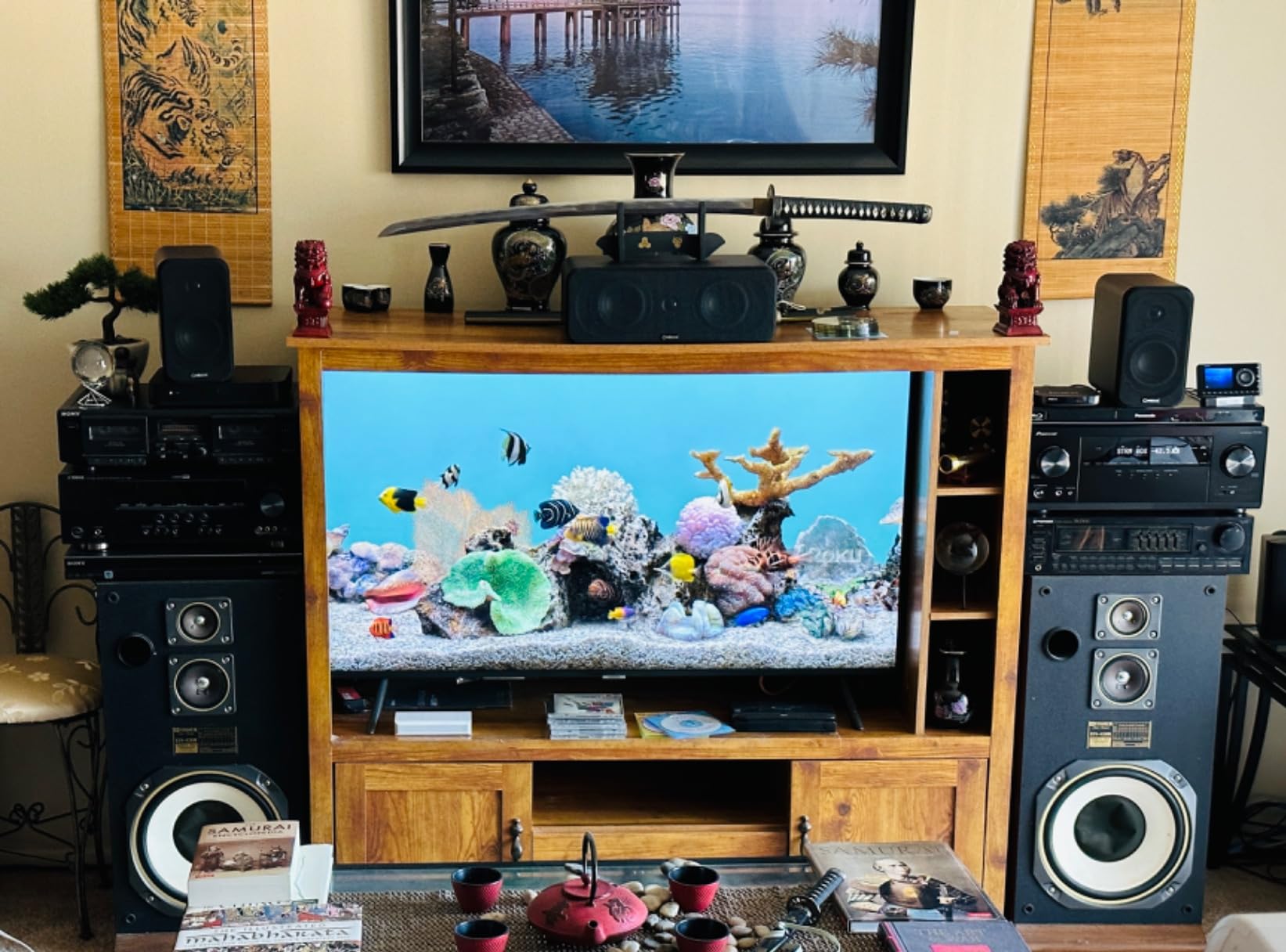
Against the Denons and Onkyos in this list, the trade is simple. Pioneer gives you more channels and more ports for less. Denon and Onkyo give you better calibration, better apps and more owner history. If your system is going to be 5.1 for the foreseeable future, the extra channel here is not worth the thinner support and the smaller power reserve.
Who Should Buy It And Who Should Not
Buy this if you already know you will grow into 7.1 or 7.2 and you want the headroom now, or if you need a lot of HDMI inputs on a limited budget. Skip it if your room is medium sized and you want clean, loud output, or if you rely on long-term owner reports to make a confident purchase.
How to Choose the Right AV Receiver
What An AV Receiver Does And Does Not Do
An AV receiver decodes surround audio, amplifies it into your speakers, switches sources, passes video to your display, and corrects the result for your room. That is everything an all-in-one home theater hub is meant to do, and it is why the box is the highest-leverage purchase in a system after the speakers themselves.
What it does not do is create speakers. A receiver decoding a 7.1.4 mix into a 5.1 speaker set downmixes it competently and it will still sound good, but nothing replaces the height and rear channels you have not bought. It also does not fix a bad room. Bass problems from poor placement will survive calibration.
Channel Counts Decoded: 5.2, 7.2 And 9.2
The number before the dot is the number of full-range channels, and the number after it is subwoofer outputs. So 5.2 is five speakers plus two independent subs, 7.2 is seven speakers plus two subs, and 9.2 is nine speaker channels plus two subs.
A dot-three or dot-four suffix adds height channels, which is what Dolby Atmos wants. A 5.1.2 system is five speakers, one sub and two height channels, and it is the entry point for Atmos. The useful rule nobody states plainly enough: if you own 5.1 speakers today, a 7.2 receiver is the sensible ceiling, not an eleven-channel one. Paying for processing you cannot use is the most common over-buy in this category.
Watts Per Channel Matched To Room Size
Watts per channel figures are marketing-adjusted. The two numbers that matter are watts at eight ohms with all channels driven, and total harmonic distortion at a volume you will actually use. A headline figure measured with one channel driven at one kilohertz tells you very little.
As a rough guide, small rooms up to about 130 square feet are comfortable with 50 to 80 watts per channel. Medium rooms up to 250 square feet want 80 to 100 watts. Larger spaces or demanding low-impedance speakers need more, and efficient brands like Klipsch need less than their specification suggests. Speaker impedance matters here: a receiver rated down to 6 ohms will safely drive harder than one designed only for 8.
Dolby Atmos, DTS:X And The Codecs Worth Paying For
Dolby Atmos and DTS:X are the two formats worth paying for. Both place sound objects in a three-dimensional field rather than fixed channels, which is why height speakers change the result so much. Everything else, including Auro-3D and DTS Neural:X upmixing, is a refinement you will not miss if you skip it.
The practical case for Atmos is strong even without height speakers, because the height virtualization and upmixing on these receivers create a noticeably larger soundstage from a 5.1 set. But if you are buying on a tight budget, a good 5.1 system with a competent 7.2 receiver beats a weak speaker package with an 11.4 processor every time.
HDMI 2.1, 4K/120Hz And The Chipset History
This is where buyers get misled most often. The 2021 HDMI 2.1 chipset problem disabled 4K/120Hz and VRR on receivers from several major brands until firmware arrived, and the messy move from 40 Gbps to 48 Gbps ports left spec sheets ambiguous for years. The result is that “HDMI 2.1” on a listing tells you very little on its own.
Check three things instead. Count how many inputs are full bandwidth, not just total ports. Confirm 4K/120Hz pass-through specifically, because 8K/60 alone does not help a console. And check whether the port is an input or an output, since some models support 8K only on one output. Every receiver in this guide lists its full-bandwidth port count in the comparison table above, and the difference between three ports and six ports is the difference between a good setup and a compromised one.
Room Correction Compared: Audyssey, Dirac Live, ARC Genesis And YPAO
Room correction measures what your room does to sound and applies an inverse filter. It matters more than almost any other feature because no two rooms sound alike. The four systems here work differently enough to be worth choosing between deliberately.
Audyssey MultEQ, found on the Denons and the Marantz NR1510, is the most widely used and owners rate it well above alternatives at the same price. Dirac Live, on the Onkyo TX-NR7100, is included at no extra cost there, which is unusual, and produces a measurably flat response. ARC Genesis and YPAO R.S.C. appear on the models from other brands in this category. The practical differences show up in setup time and failure rate more than in final sound, so pick the one you are willing to finish running.
Slimline Versus Full-Size Chassis And Cabinet Fit
Measure your furniture before choosing anything else. Most conventional receivers are around 17 inches wide and 6 to 7 inches tall, and a surprising number of AV cabinets are built for something smaller. The Marantz NR1510 on this list is 4.1 inches tall, and for a tight space it is the only correct answer here.
Depth matters too, and the numbers are less consistent than the widths. Check clearance for airflow on all sides, because a warm receiver in a closed cabinet is a reliability problem rather than a nuisance. Several models here run hot enough that reviewers mention it, and one includes a cooling fan specifically to solve it.
Pre-Outs, External Amplifiers And Multi-Zone
Pre-outs send an unamplified signal to external power amplifiers, and they matter when you own speakers that need more current than on-board amplification can deliver, or when you want a separate two-channel or monoblock amp for the front channels. Counting pre-outs before you buy a second-hand amplifier saves an expensive mistake.
Multi-zone is a different feature and frequently confused with the above. Zone 2 means a second room with its own volume control, running off the same receiver. The Onkyo TX-NR6100 and the Yamaha RX-A2A both handle a second room, and the Onkyo TX-NR7100 goes further with discrete zone video switching. Neither has anything to do with external power.
Total Cost Of Ownership Beyond The Box
Budget for the extras. Room correction licences on some competing brands add a real ongoing cost, which is why a receiver that includes Dirac Live can be cheaper over five years than one that charges for it. You may also need speaker wire with proper banana plugs if the terminals are spring clips, an external amplifier for a very large room, and more HDMI cables than you expect when every source needs its own run.
Finally, warranty length is a genuine buying criterion rather than fine print. Two-year coverage is standard on the models in the middle of this list, while the Denon AVR-X1700H, the Denon AVR-X2700H and the Marantz NR1510 carry three years. Longer support periods reflect how long a brand expects the product to stay in service, which is a reasonable signal to weight when you plan to keep a receiver for a decade.
Frequently Asked Questions
What is the best AV receiver for my money?
The Denon AVR-X1700H is the strongest all-round choice in this guide, with seven channels at 80 watts per channel, Audyssey MultEQ calibration, three full-bandwidth 8K inputs and HEOS multi-room streaming. If your budget is tighter, the Denon AVR-X2700H delivers more power and a second HDMI output for less, and the Sony STRDH590 covers a straightforward 5.2 system.
How many channels do I need for a home theater?
Five full-range channels plus a subwoofer is the sensible starting point for most living rooms. Add two rear channels for a 7.1 system, and two height channels if you want Dolby Atmos, which makes 5.1.2 the usual entry point. Owning 5.1 speakers today? A 7.2 receiver is the sensible ceiling, and paying for nine or eleven channels of processing buys you very little until the speakers exist.
What is the difference between 5.1, 7.1 and 9.2 channel receivers?
The number before the dot is the count of full-range channels, and the number after it is the number of subwoofer outputs. So 5.2 is five speakers plus two independent subs, 7.2 is seven speakers plus two subs, and 9.2 is nine channels plus two subs. Independent subwoofer outputs matter because each sub gets its own level, delay and distance adjustment.
How much power do I need per channel?
Small rooms up to roughly 130 square feet are comfortable with 50 to 80 watts per channel, medium rooms up to 250 square feet want 80 to 100 watts, and larger spaces need more. Look for the rating at eight ohms with all channels driven, since headline figures measured with one channel at one kilohertz overstate real capability. Efficient speakers such as Klipsch models need far less than the number suggests.
Is HDMI 2.1 important for PS5 and Xbox Series X?
It matters, but the label alone is not enough to judge. Check how many inputs support full-bandwidth 4K/120Hz rather than just counting total ports, and confirm whether 8K support is on an input or an output. The 2021 chipset problems disabled 4K/120Hz and VRR on several brands until firmware arrived, so update the receiver before testing. The Onkyo TX-NR7100 and Sony STR-AN1000 give all six inputs full bandwidth.
Is a soundbar better than an AV receiver?
For a flat, furnished room with two or three speakers, a good soundbar is simpler, smaller and often more capable than a receiver with a modest speaker package. Once you add a subwoofer and rear speakers, the receiver wins on channel control, decoding and room correction. A soundbar is the better buy in a small apartment where cabinet depth is the binding constraint and the Marantz NR1510 will not fit either.
Which AV Receiver Should You Buy in 2026
If you want one recommendation, take the Denon AVR-X1700H. It is the receiver we would put in the most homes: seven channels at 80 watts per channel, Audyssey MultEQ that gets the job done on the first pass, three full-bandwidth 8K inputs, a phono input and three years of warranty. It is not the most powerful option and the menus will not win any prizes, but it is the one that frustrates the fewest people.
If you want more power for the same money, take the Denon AVR-X2700H, and check that your console lands on the single 4K/120Hz port. If your furniture cannot take a full-size box, the Marantz NR1510 is the only correct answer here, and you will trade output level for the space. If you are building toward height channels and want room correction without a licence fee, the Onkyo TX-NR7100 gives you nine channels and Dirac Live in one box.
Whatever you choose, measure the cabinet first, update the firmware on day one, and run the calibration properly rather than trusting the default settings. Those three habits account for more of the difference between a good system and a disappointing one than any model on this list.






Leave a Comment