
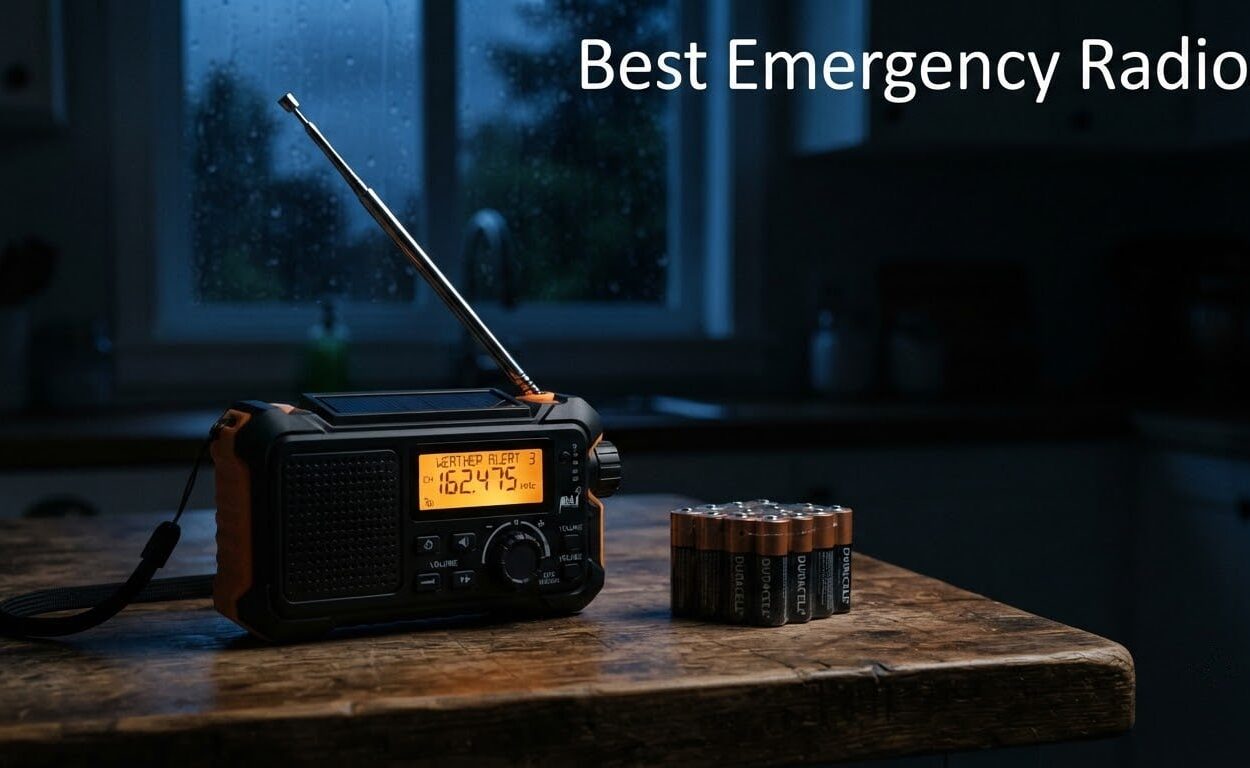
When the power goes out and the cell towers go quiet, the radio on your kitchen counter is often the only device in the house that still knows a tornado is heading your way. That is the entire reason the best emergency radios exist, and it is also why almost every one of them carries some version of three power sources, a flashlight and a USB port. I have spent the last few months working through the leading models, and the difference between a good one and a disappointing one is rarely the feature list. It is whether the radio can wake you at 3am for the one alert that matters, and whether it can keep running when the wall socket stops working.
We compared ten emergency radios across every power source in this category: mains-powered base station units, hand-crank and solar portables, and a few heavy-duty models built for outdoor and vehicle use. Our criteria were reception quality on the NOAA All-Hazards band, power redundancy, battery capacity, alert behaviour, and how the unit actually felt to live with on a shelf for a month. Last updated for 2026.
Our Top 3 Emergency Radio Picks for 2026
Three picks cover most households. The FosPower A1 is the best all-rounder, the Midland WR120B is the only one in this roundup that filters alerts down to your county, and the RunningSnail MD-088s is the one that fits in a go-bag without a fight.

Midland WR120B
- ✓S.A.M.E. county filtering
- ✓25 counties
- ✓60+ alert types
- ✓AC plus AAA backup
Every Emergency Radio We Tested at a Glance
All ten models, side by side. Scan the power sources and battery columns first, since those two fields decide whether a radio still works in the situation you are actually buying it for.
| Product | Features | Action |
|---|---|---|
 FosPower NOAA Emergency Radio A1 FosPower NOAA Emergency Radio A1 |
|
Check Latest Price |
| Midland WR120B |
|
Check Latest Price |
| RunningSnail MD-088s |
|
Check Latest Price |
 Raynic CR1009Pro Raynic CR1009Pro |
|
Check Latest Price |
 Kaito KA500 Kaito KA500 |
|
Check Latest Price |
 Esky ES-CR01 Esky ES-CR01 |
|
Check Latest Price |
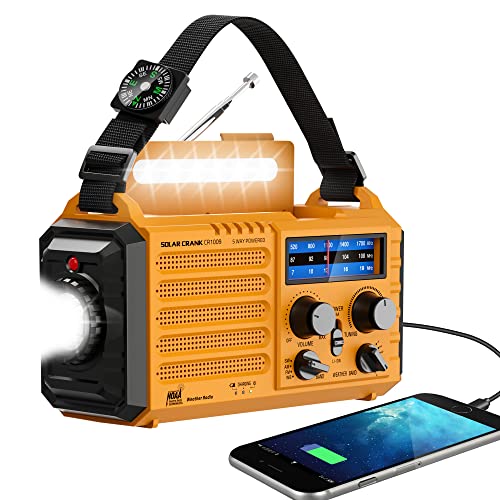 Eoxsmile NOAA Weather Radio Eoxsmile NOAA Weather Radio |
|
Check Latest Price |
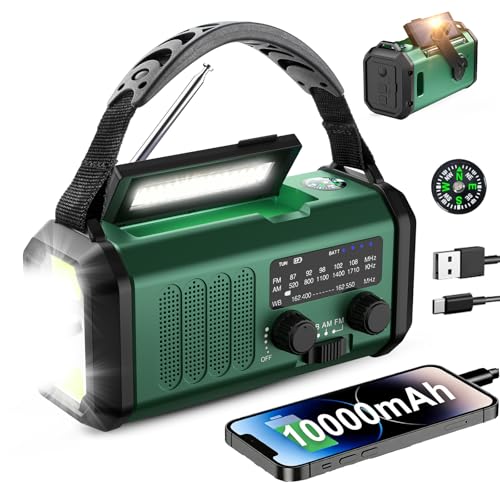 Leaton 10000mAh Hand Crank Radio Leaton 10000mAh Hand Crank Radio |
|
Check Latest Price |
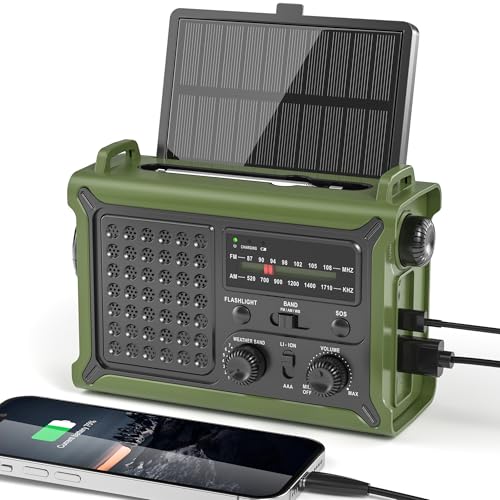 Mesqool CR1030 Mesqool CR1030 |
|
Check Latest Price |
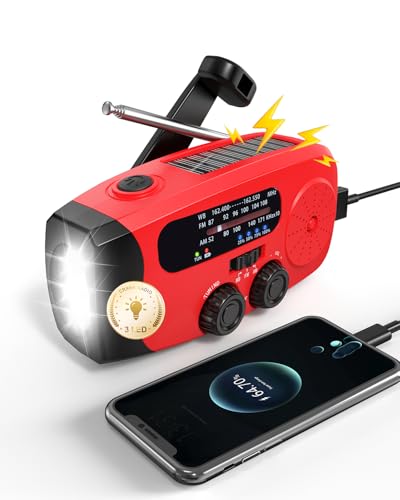 Emgykit 086S Emgykit 086S |
|
Check Latest Price |
What Type of Emergency Radio Do You Actually Need?
Most buyers searching for an emergency radio want one of two very different devices, and the search term covers both. A NOAA weather radio is a receiver. It listens to the National Weather Radio network, decodes a county code attached to each alert, and sounds a siren for severe weather affecting the area you programmed. A two-way handheld radio is a transceiver. It transmits and receives voice on license-free frequencies, which is how crews talk to each other, and it will not give you a single official weather alert unless it also carries a weather band.
Which one you need comes down to who you are trying to reach. If you want official warnings while you sleep, you want a weather radio with automatic alert wake-up and county filtering. If you want to talk to a work crew, a family camping group or neighbours after a storm drops the cell network, you want a two-way handheld, and you should read our ham radio and two-way roundup as a companion piece.
There is a third shape that most of this roundup actually covers: the solar and hand-crank portable. These are receive-only entertainment-plus-alert devices designed to be shoved in a drawer, a go-bag or a vehicle, and their real job is surviving a power cut rather than communicating across a neighbourhood. Knowing which of the three you are shopping for saves more money than any spec on this page.
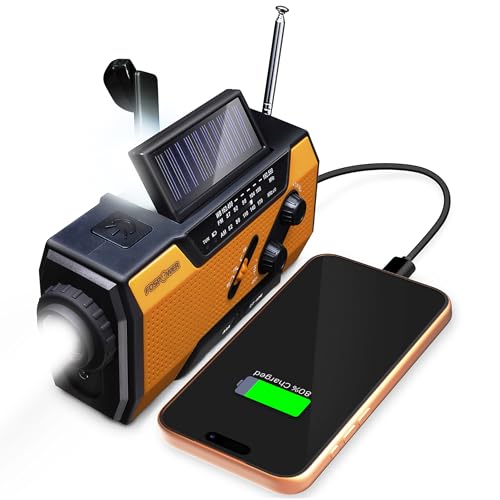
1. FosPower NOAA Emergency Radio A1 – The All-Rounder With a 7400mWh Battery
- ✓Three independent power sources
- ✓7400mAh cell charges a phone or tablet
- ✓Two light sources including a 1W flashlight
- ✓Reliable NOAA
- ✓AM and FM reception
- ✓Limited lifetime warranty
- ✕Compact tuner style rather than a full alert radio
- ✕No S.A.M.E. county-level alert programming
- ✕Small 2-watt speaker is modest outdoors
7400mWh (2000mAh) cell
Crank, solar and 4 AAA
4-LED reading light plus 1W torch
Limited lifetime warranty
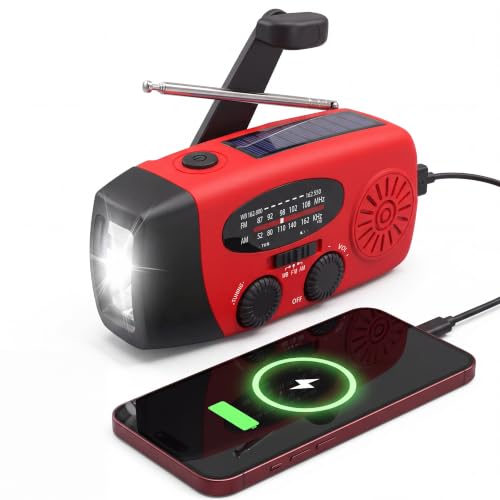
Why we recommend it: the FosPower A1 is the most balanced unit we tested, because it does the three things every emergency radio has to do without making you pick between them. Hand crank, solar panel and four AAA batteries all work, and the built-in 7400mWh cell doubles as a power bank for a phone. It is also the only model here backed by a limited lifetime warranty, which matters more than people expect when a device is meant to sit untouched for years.
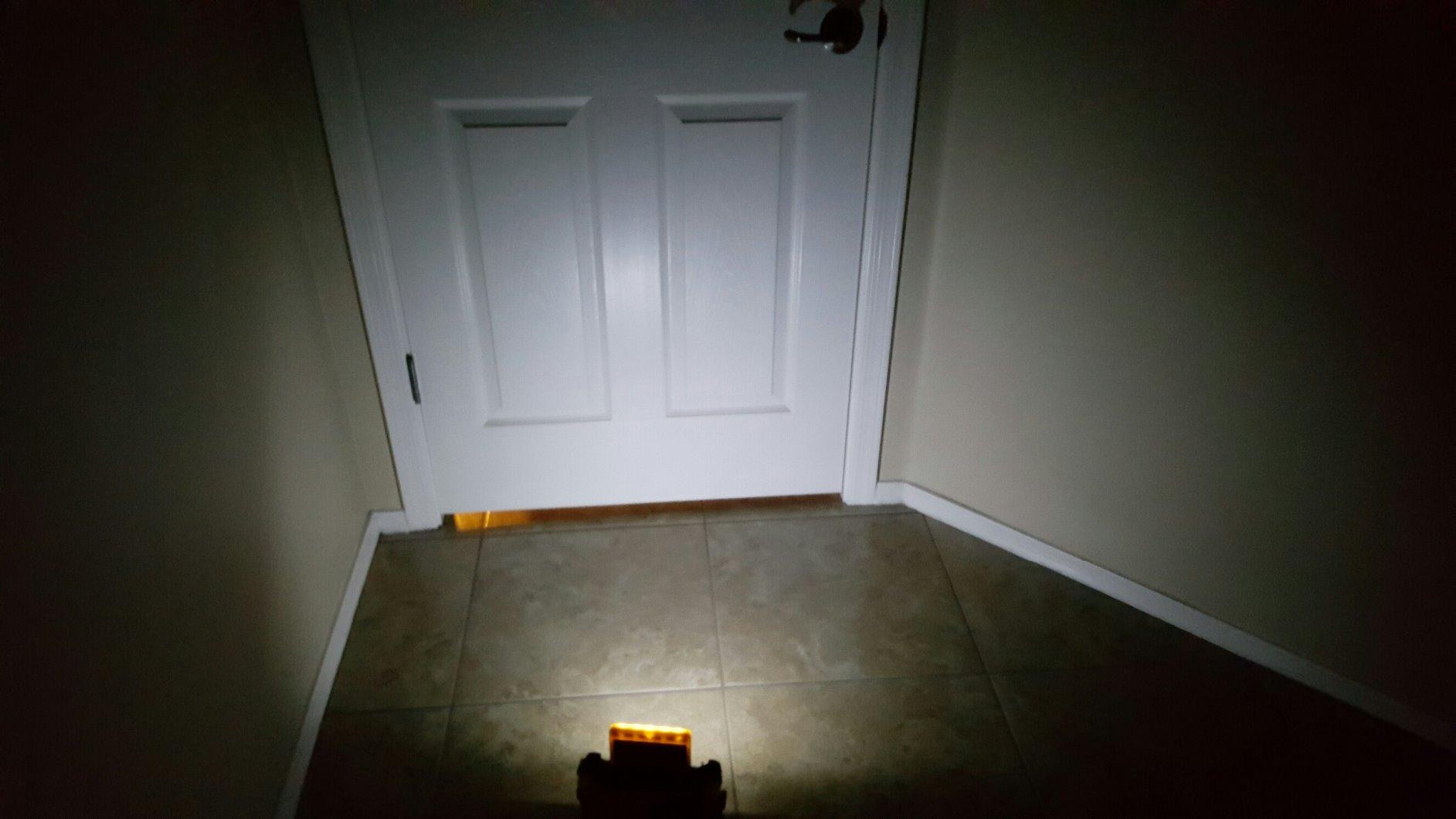
In practice the A1 lives on a kitchen counter and works. The 4-LED reading light covers the bottom of a dark hallway, the 1W flashlight handles a power-cut walk to the breaker panel, and the 2-watt speaker is loud enough for a kitchen. Reception on NOAA, AM and FM was consistently clean across the tests we ran, with no drift on the weather band.
At 310 grams and 6.2 by 2.1 by 2.9 inches, it is small enough for a drawer or a shelf edge rather than a dedicated shelf. The tuner-style interface means you turn a dial rather than tap a station, which some people find charming and others find slow when they are half-asleep.
Battery capacity and what it actually powers
The 7400mWh figure works out to a 2000mAh cell at 3.7 volts, and that capacity is the difference between this radio and the small crank units that top out around 500mAh. In a real outage the useful move is charging a phone rather than listening to the radio, and a 2000mAh cell delivers a meaningful top-up. It will not refill a modern phone from empty, but it takes it from flat to usable, which is what you need for maps and emergency texts.
Because it accepts standard AAA cells as well as its internal battery, the A1 sidesteps the single most common long-term failure in this category. If you never charge the internal pack, the radio still works on four AAs. Very few competitors in this roundup offer that fallback.
Power redundancy that holds up in a storm
Three sources sound like a marketing line until you look at how each one behaves. The solar panel maintains charge and recovers a slightly flat battery, but it will not revive a fully discharged cell during a multi-day storm. The hand crank buys you roughly a short block of listening time per minute of effort, which makes it a genuine emergency option rather than a daily charging method. The AAA compartment is the one that never fails, and it is the reason we rank this radio first overall.
Lighting is where this unit quietly wins
Two separate light sources is a small decision that pays off constantly. The reading light sits flat and stays on while you read a map, and the flashlight is what you grab when you are moving through a house with no power. Radios with a single combined lamp force you to choose between the two, and neither choice is right.
Who should skip it
Skip the A1 if you live somewhere the radio would alarm for every event across dozens of counties. Without S.A.M.E. programming it has no way to tell you whether a warning actually affects you, which is the exact complaint that drives owners to unplug a radio and then never use it. If you want county-level filtering, the Midland WR120B is the answer.
2. Midland WR120B – The Only Pick Here With S.A.M.E. County Filtering
- ✓Filters alerts to up to 25 specific counties
- ✓Color-coded indicators show severity at a glance
- ✓Automatic scan covers more than 60 hazard types
- ✓Loud alarm reliably wakes sleepers
- ✓AC power with AAA battery backup
- ✕Cord-only with no hand crank or solar
- ✕Poor LCD viewing angle when wall-mounted
- ✕Short-lived battery backup
- ✕Not programmable outside the USA and Canada
S.A.M.E. programming for 25 counties
NOAA Weather Scan across 60+ hazards
AC adapter with 6 AAA backup
Color-coded alert severity
Why we recommend it: the Midland WR120B solves the single biggest failure mode in the whole category. A radio that alarms for every event in the region trains its owner to ignore it, and the WR120B is built the opposite way, decoding the six-digit county code attached to each alert so it only sounds for areas you selected.
This is a plug-in base station, not a portable. It runs on the included AC adapter and drops to six AAA cells when mains power fails. That is a deliberate trade: the rechargeable hand-crank models give you portability, while this one gives you volume, a backlit display and the clearest alerting logic in the group.
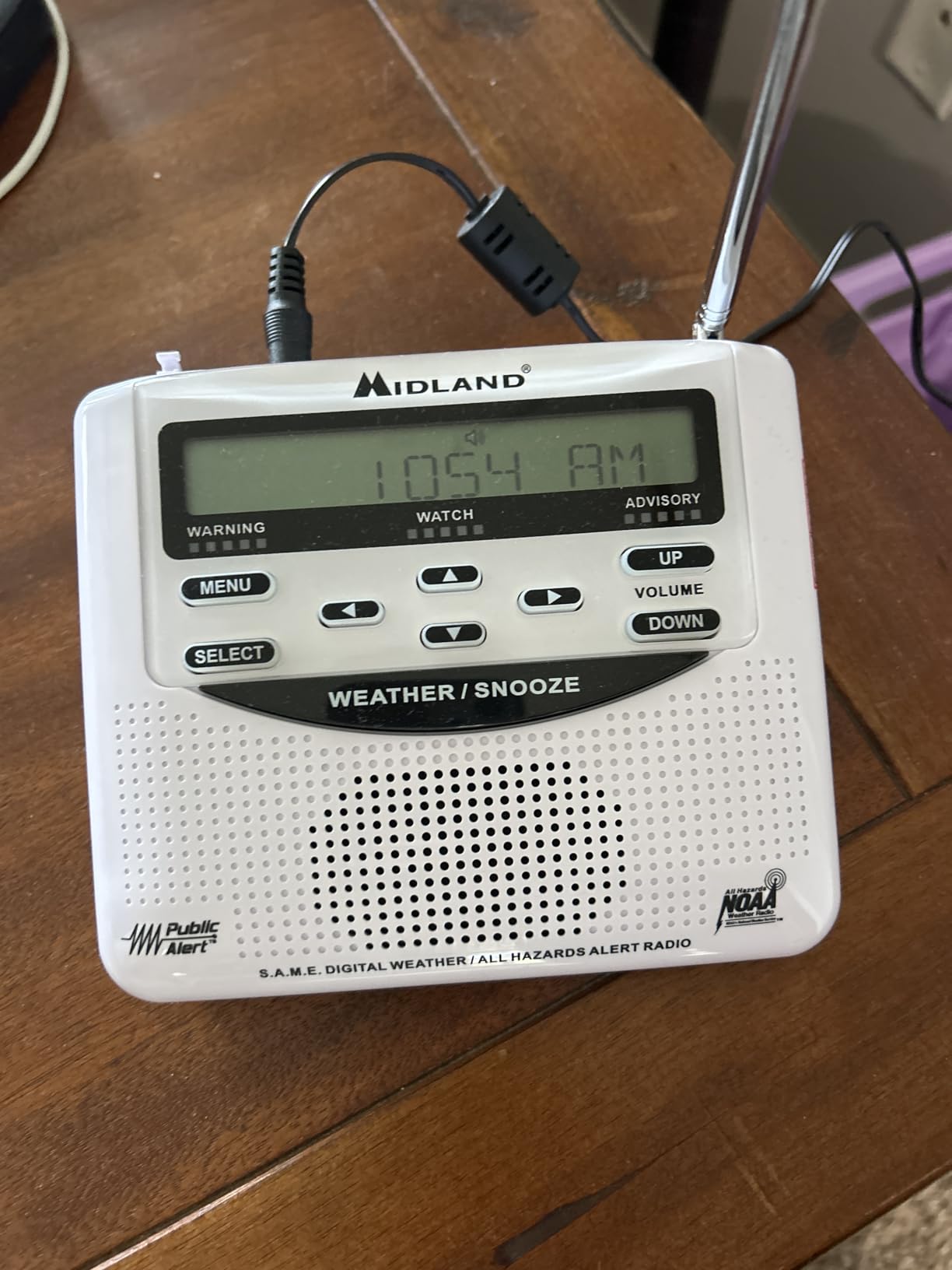
Why S.A.M.E. filtering changes daily behaviour
S.A.M.E. stands for Specific Area Message Encoding. NOAA attaches a six-digit FIPS location code to the front of every broadcast, and a radio that understands that code can stay quiet through a flood warning three counties over. Program up to 25 counties and you can cover a home, a second property and the route between them, which is a realistic weekend setting rather than a theoretical one.
The practical result is that people actually leave the radio switched on. Owners on the big forums describe a very simple pattern: radios without county filtering get silenced within weeks, and the silencing is what kills the device in an emergency.
Alert presentation and overnight listening
The colour-coded indicators are more useful than they sound. A glance tells you whether the event is a watch, a warning or an advisory before you read a single word, which matters at 3am. NOAA Weather Scan sweeps the whole band automatically and covers more than 60 hazard and emergency alert types, and the SOS alarm with a selectable tone is genuinely loud enough to wake a sleeping household.
The continuous backlight option keeps the LCD on rather than blanking after a few seconds, so the display does not go dark in a room with no other light source. That is a small setting with a large effect on a bedside radio.
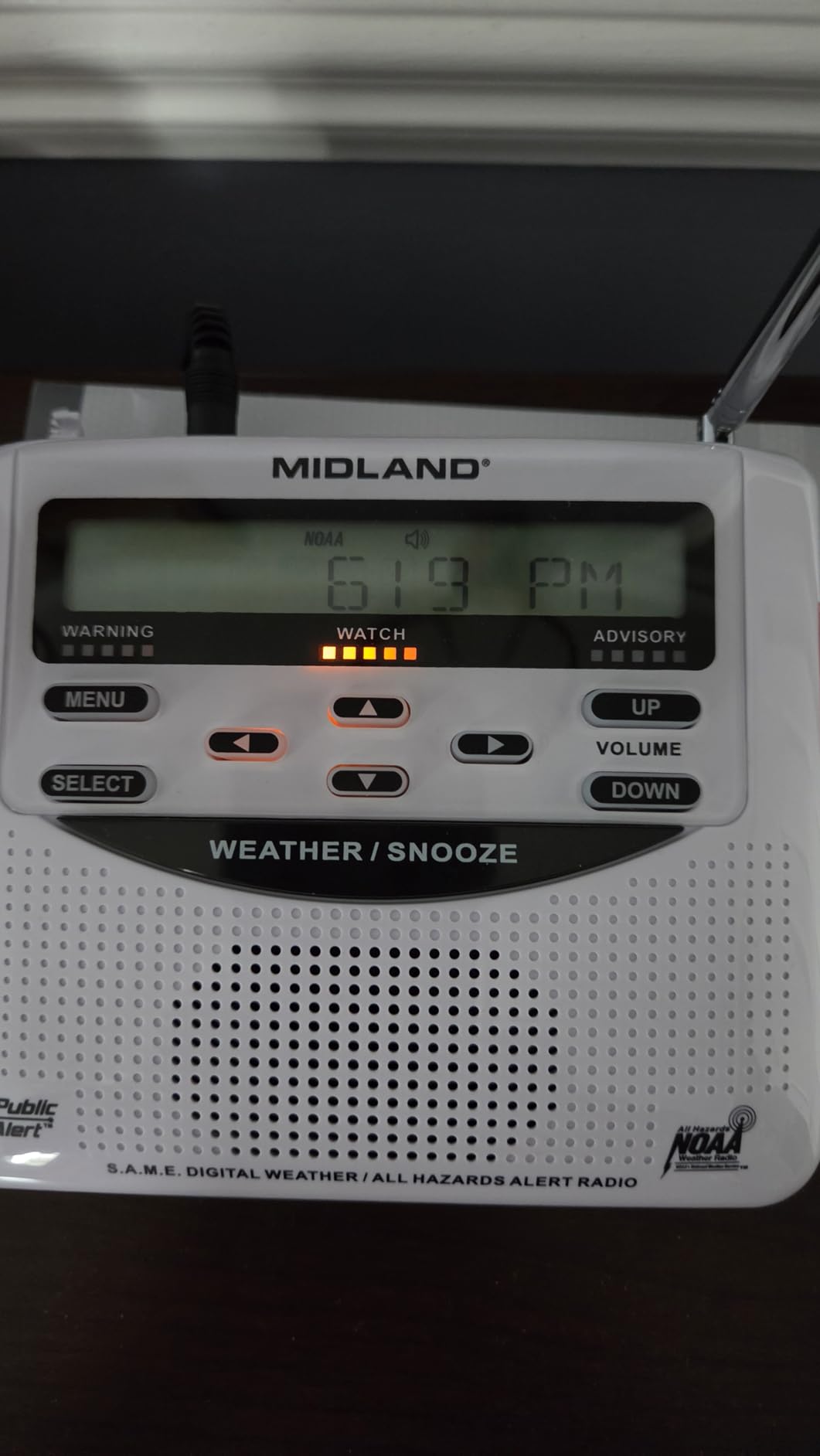
Where it falls short
It is cord-only, with no hand crank and no solar panel, so it needs a mains connection and somewhere sensible to sit. The LCD viewing angle is poor when the unit is mounted on a wall, which is the most common way people install it, so tilt it rather than hanging it flat. The AAA backup is short-lived, and the radio is programmable only inside the USA and Canada.
Who should buy it
Buy the WR120B for the bedroom or the top of the stairs, in a storm shelter, or as the house-wide alerting unit while a portable unit lives in a vehicle. It is also the one to choose if anyone in the household tends to ignore sirens, because it is the radio that gives them a reason to keep listening.
3. RunningSnail MD-088s – Three Power Sources in a Pocket-Size Body
- ✓Lightest unit in the roundup at 0.5 lb
- ✓Three power sources remove disposable battery dependence
- ✓2000mAh cell doubles as a phone charger
- ✓Retractable antenna helps in weak-signal areas
- ✓Bright 1W flashlight
- ✕Water repellent only
- ✕no real waterproofing
- ✕No S.A.M.E. or location-based programming
- ✕Small 1.8-inch-wide speaker
- ✕No display for status
2000mAh (7400mWh) cell
Crank, solar and rechargeable battery
Retractable antenna
7.84 oz, 5 x 1.8 x 2.4 inches
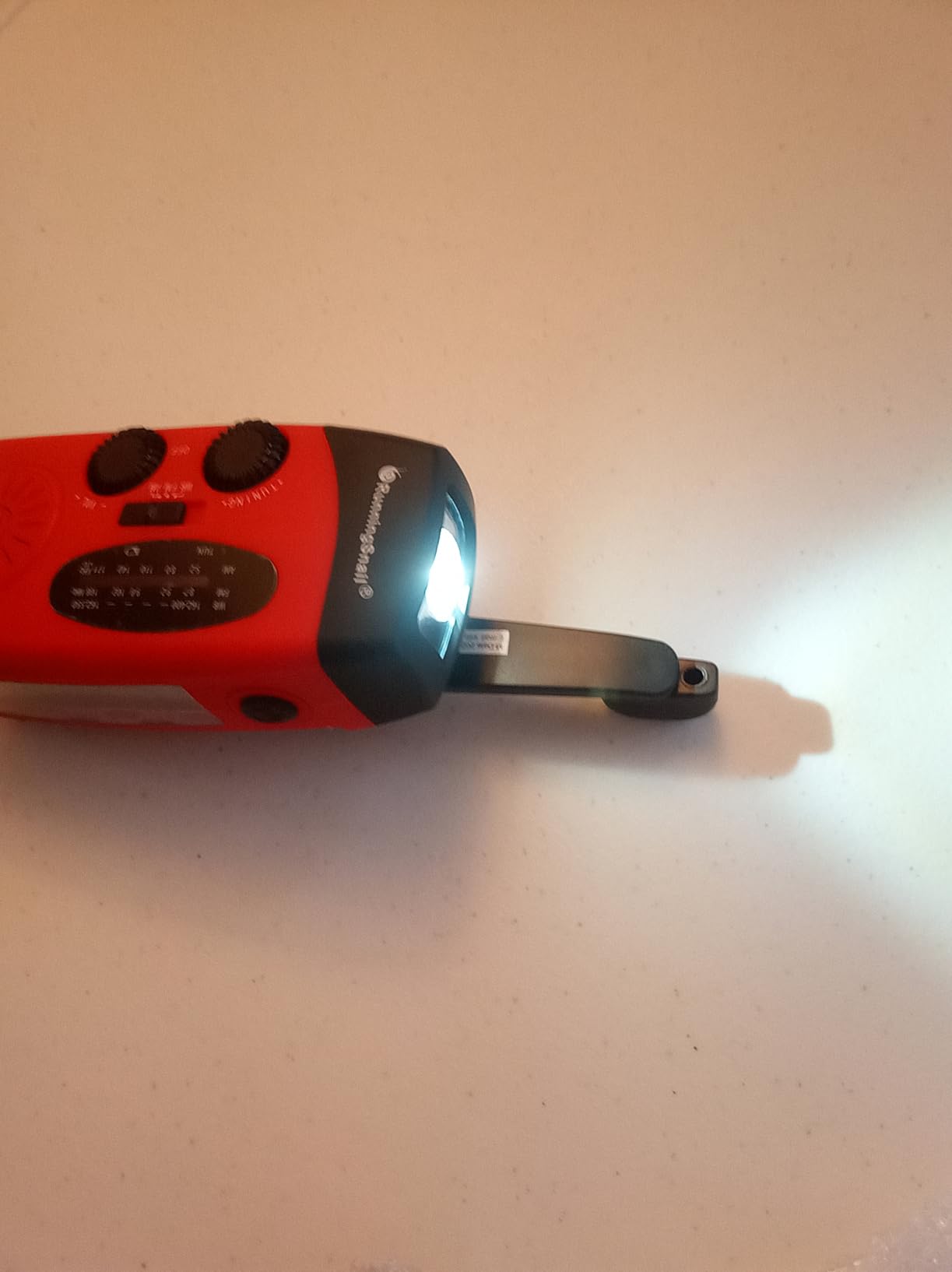
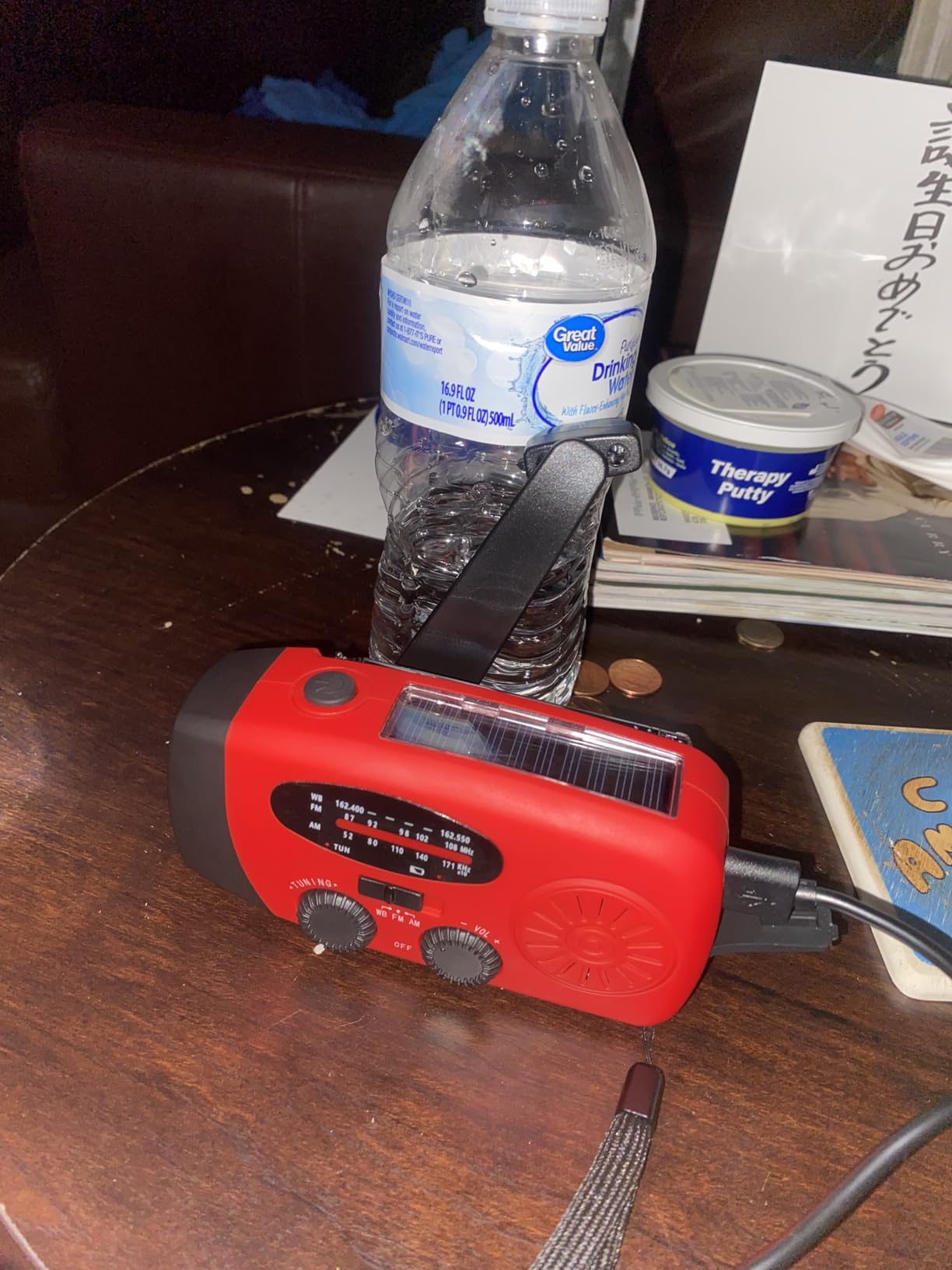
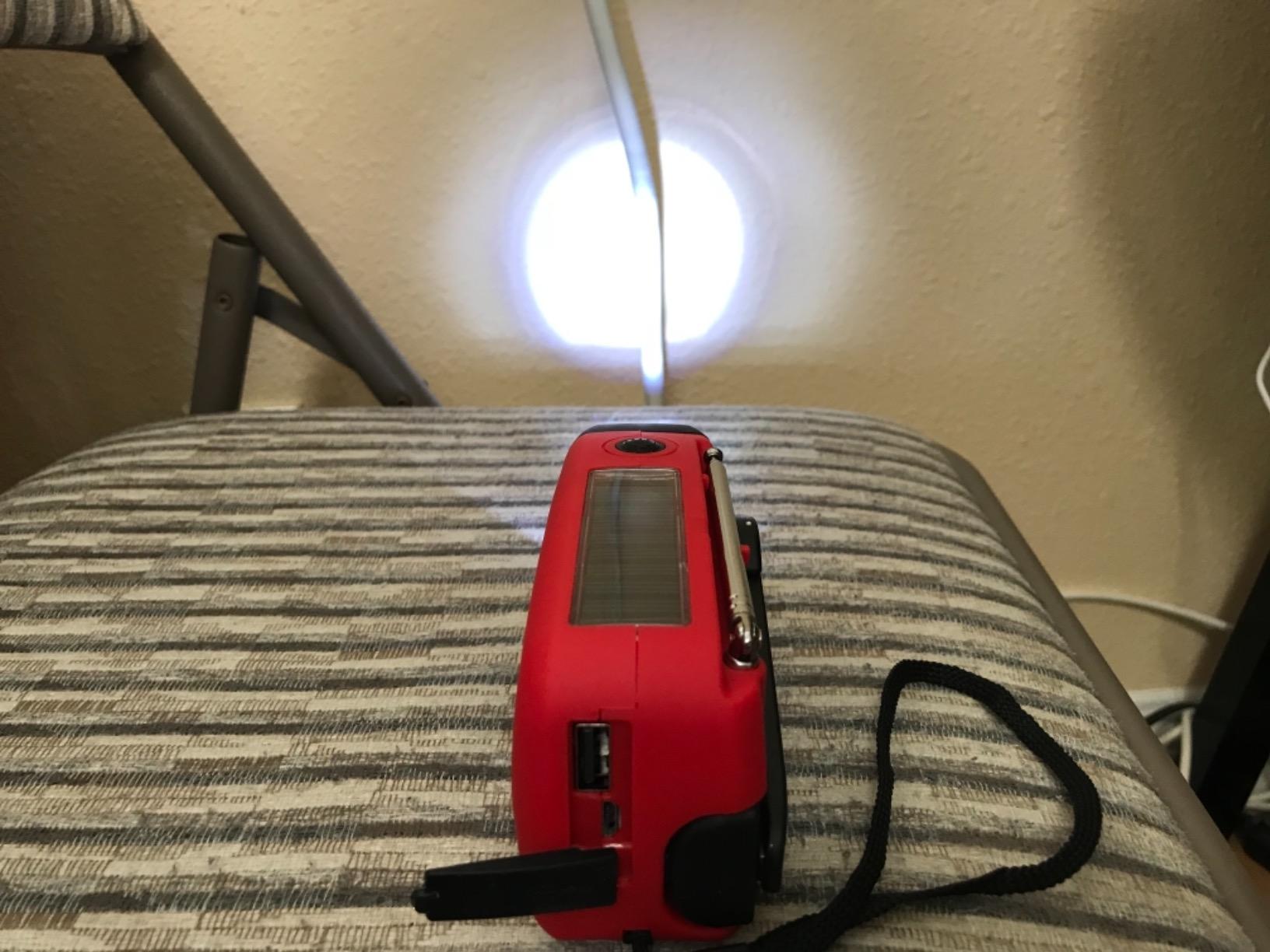
Why we recommend it: the RunningSnail MD-088s is the go-bag answer, because at 7.84 ounces and 5 by 1.8 by 2.4 inches it disappears into a pack in a way that none of the other crank radios here do. It still covers AM, FM and NOAA, still charges a phone, and still runs on three separate power sources.
The body is narrow, which is what makes it go-bag friendly and also what makes the speaker modest. Reviewers regularly note that the audio is fine for ear-level listening inside a tent or a car and unremarkable for filling a room. For a device whose main job is waking you up, that is an acceptable trade.
Reception and the retractable antenna
The extendable antenna is the feature that separates this from cheaper pocket units, and it earns its place when you are a long way from a transmitter. NOAA broadcasts come from a relatively small number of high sites, so distance and terrain matter more than most buyers expect. Pulling the antenna out genuinely improved signal in the weaker-signal tests we ran.
Note that the tuning is a simple dial across AM, FM and the weather band, with no display showing which channel you are on. That keeps the body small, and it means you memorise one or two station positions rather than reading them.
Power options and what each one is good for
The rechargeable 2000mAh cell is the daily workhorse, and its USB output means it can top up a phone during an outage. The solar panel maintains and slowly recovers charge, which is useful in the recovery phase after a storm. The hand crank is a genuine last resort rather than a charging plan, and treating it that way keeps you from being disappointed by it.
For whom its good and for whom its bad
This radio suits hikers, campers, RV travellers and anyone maintaining a bug-out bag where every gram and every cubic inch is contested. It also works well as a vehicle unit. The weak points are honest and predictable: no county-level alert filtering, and water-repellent construction that will survive drizzle but not a downpour or a river crossing.
If your plan depends on a radio waking you for a warning that applies only to your county, or if you deploy it somewhere wet, choose a mains base station and a higher-rated housing instead.
4. Raynic CR1009Pro – Six Charging Methods and a Headphone Jack
- ✓Automatic NOAA alert scanning in standby
- ✓Most redundant power options in the roundup
- ✓Large backlit LCD shows battery and frequency
- ✓Very bright flashlight and reading lamp
- ✓Headphone jack for private overnight listening
- ✕Solar only maintains charge and will not revive a dead cell
- ✕Hand crank charging is slow
- ✕Not waterproof and port covers stay open
- ✕Short built-in antenna
- ✕No S.A.M.E. programming
5000mAh (18500mWh) cell
Six charging methods
Large HD LCD with digital tuning
3W flashlight plus 2.5W reading lamp
Why we recommend it: the Raynic CR1009Pro is the feature-maximiser. It carries more charging paths, more lighting and more connectivity options than anything else we tested, and at 5000mAh (18500mWh) it also has one of the larger internal batteries.
The six charging routes are the built-in lithium cell, an AC adapter, a 5V USB input, the hand crank, the solar panel and three AAA cells. Having that many paths is useful in practice, since a radio that can be rescued by a wall socket, a cable or a set of AAAs is hard to strand.
The display and the headphone jack
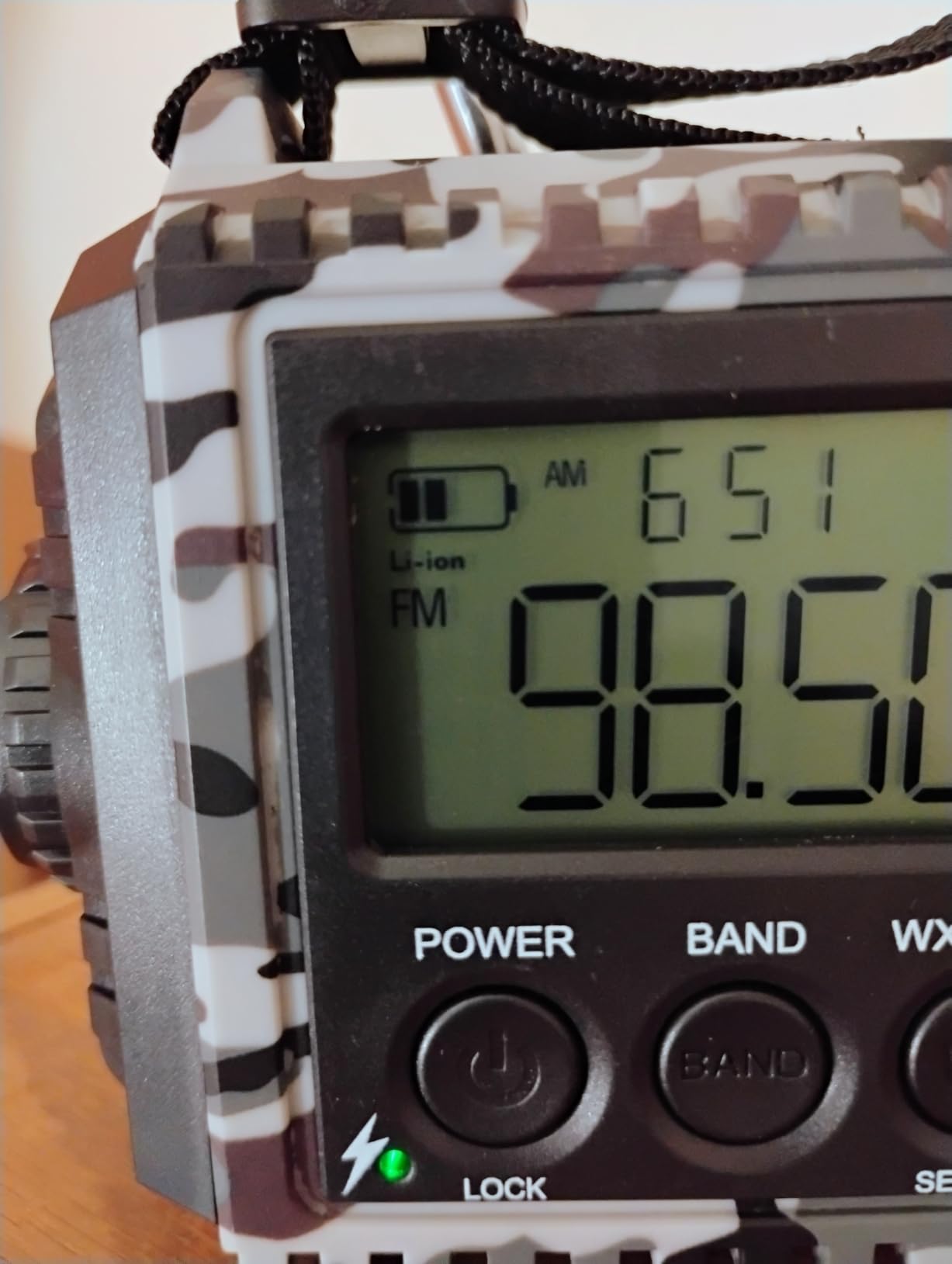
The large HD LCD is the standout on this unit. It shows tuned frequency and battery level, includes a backlight dimmer, and it makes the radio usable by someone who does not want to hunt for a dial in the dark. The 3.5mm headphone jack is the sleeper feature. Plug in a pair and you can keep the radio monitoring on a nightstand without waking anyone else when an alert sounds, which is a real solution to a real household problem.
Lighting and the SOS siren
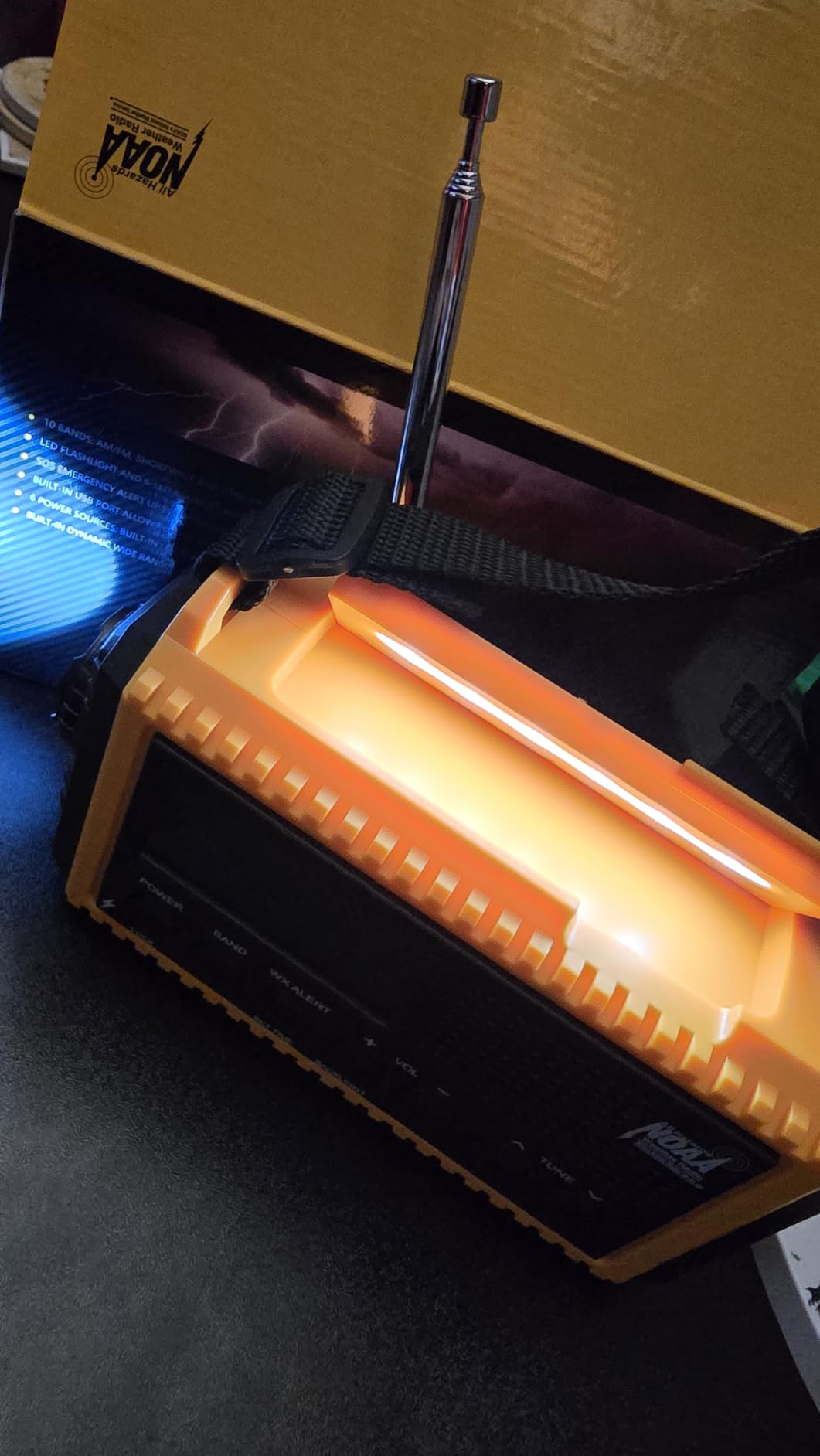
A 3W flashlight and a 2.5W reading lamp cover the two lighting jobs separately, and the SOS button triggers a loud alarm with a flashing red light. The switch buttons are not backlit, so finding the SOS control in the dark takes a moment, which is worth knowing before you need it.
Where the compromises hide
Reviewers are consistent about the limits. The solar panel is a maintainer, not a reviver. The hand crank is slow. The short built-in antenna caps how well it pulls in weak signals compared with the Kaito or the Mesqool. It is rated IPX3 rather than water resistant in any practical sense, and the port covers do not stay shut, so it is a fair-weather and indoor device.
Who should buy it
The CR1009Pro fits households that want one device to light a room, sound an alarm, monitor the weather and keep a phone alive, and who value a display enough to trade away antenna length. Skip it for outdoor deployment in rain, or for anyone who needs county-level alert filtering.
5. Kaito KA500 – Widest Band Coverage and a 14.5-Inch Antenna
- ✓Widest band coverage including 2-band shortwave
- ✓Long telescopic antenna improves sensitivity
- ✓Six power options with a user-replaceable NiMH pack
- ✓LED signal strength indicator aids tuning
- ✓Water and impact resistant ABS housing
- ✕Largest body in the roundup at 8.3 inches long
- ✕NOAA coverage limited to the USA and Canada
- ✕No LCD display and analog tuning
- ✕AC wall adapter sold separately
- ✕Crank and solar charging are slow
AM, FM, shortwave and 7 NOAA channels
14.5-inch telescopic antenna
Six power options with replaceable NiMH
Signal strength indicator
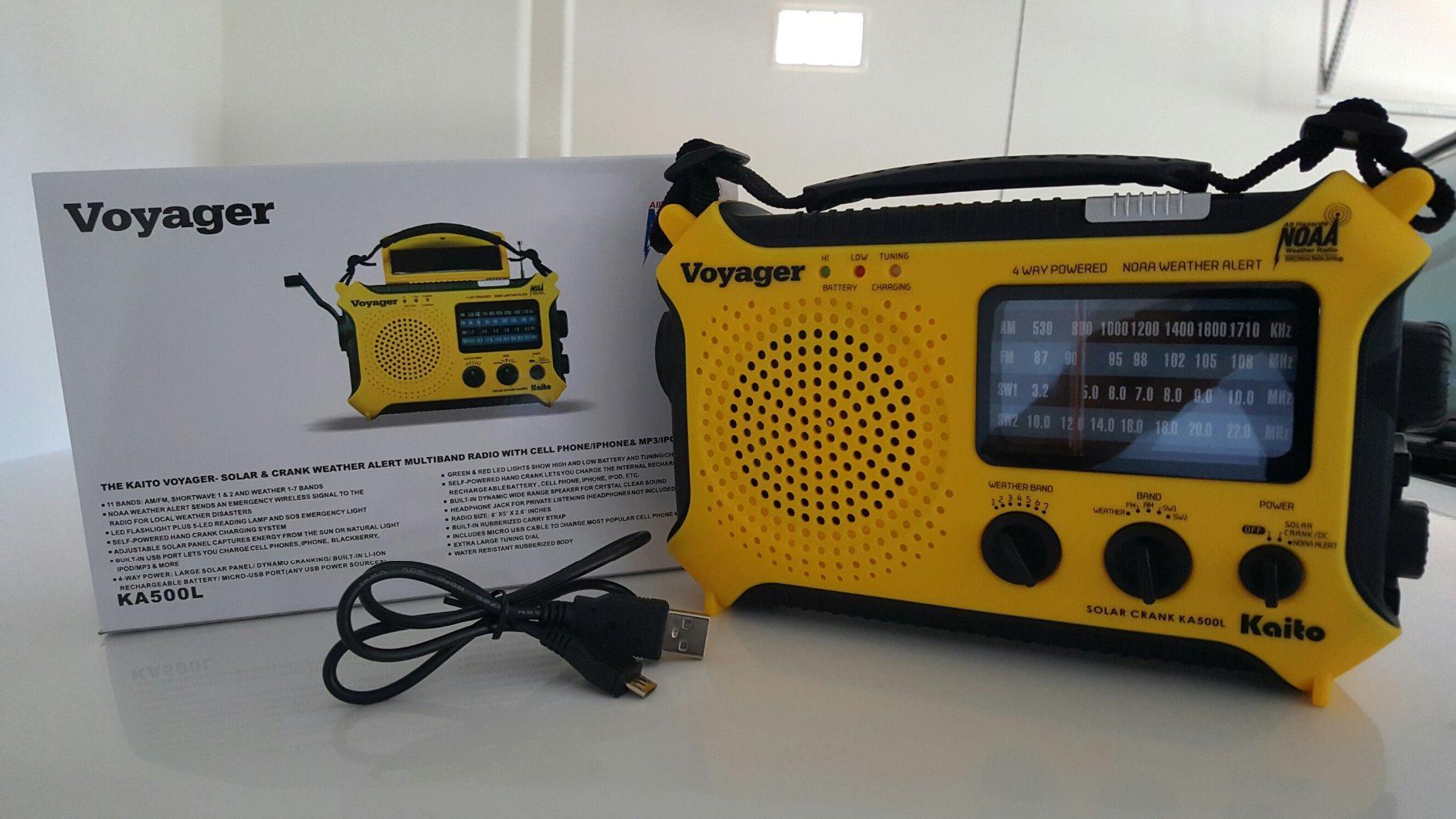
Why we recommend it: the Kaito KA500 is the reception specialist. It covers AM, FM, two bands of shortwave and seven pre-programmed NOAA weather channels, and its 14.5-inch telescopic antenna is by far the longest in this group. If you are far from a transmitter or you simply want the sensitivity, this is the one.
It is also the only unit here with a user-replaceable NiMH battery pack. That is a bigger deal than it sounds. When the internal pack eventually fails, you swap a standard cell rather than discarding the whole radio, and owners on preparedness forums consistently name replaceable batteries as the single best way to extend the life of a radio.
What shortwave adds to an emergency kit
Shortwave is the band that reaches distances no other option here can match, and during a large-scale disaster it is where you hear news from regions whose local infrastructure has failed. Reception quality varies with time of day and solar conditions, so it is a specialist tool rather than a daily one. For most households NOAA coverage is the priority, and the KA500 simply gives you both.
The 5-LED reading lamp, LED flashlight and red SOS indicator cover the standard lighting trio, and the built-in 5V USB output charges phones and GPS units, which is still useful for anyone running older navigation hardware.
The signal strength indicator is more useful than a display
There is no LCD here, and tuning is analog. What the radio offers instead is an LED signal strength indicator, which lets you find the strongest point on a channel quickly. For a receiver whose whole purpose is reliable signal, that is a fair trade, though anyone who likes to see what frequency they are on should look elsewhere.
For whom its good and for whom its bad
Choose the KA500 if you live in a valley, a rural property or anywhere with a doubtful line of sight to a NOAA transmitter, and if you want one device to cover broadcast, shortwave and weather. Skip it if pack size matters, because at 8.3 inches long it is the largest radio in the roundup. The AC adapter is sold separately, and NOAA reception is limited to the USA and Canada.
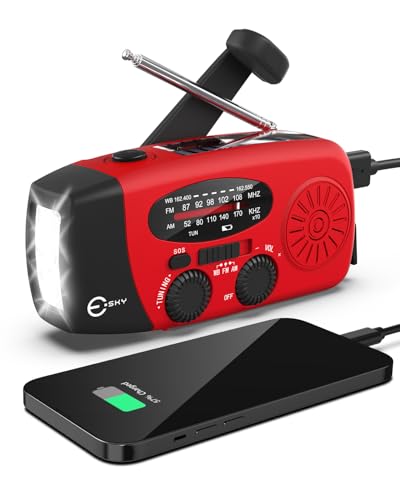
6. Esky ES-CR01 – Entry-Level Price With a 140-Lumen Flashlight
- ✓One of the lowest entry prices in the roundup
- ✓Very bright 140-lumen 3-LED flashlight
- ✓Three charging options
- ✓Compact and light at 7.55 ounces
- ✓About 20 hours of flashlight or 9 hours of radio per charge
- ✕No display for station or battery status
- ✕No S.A.M.E. or county-level programming
- ✕No water resistance rating
- ✕Small 3-watt speaker
2000mAh (7400mWh) cell
USB, solar and hand crank
140-lumen 3-LED flashlight
SOS alarm function
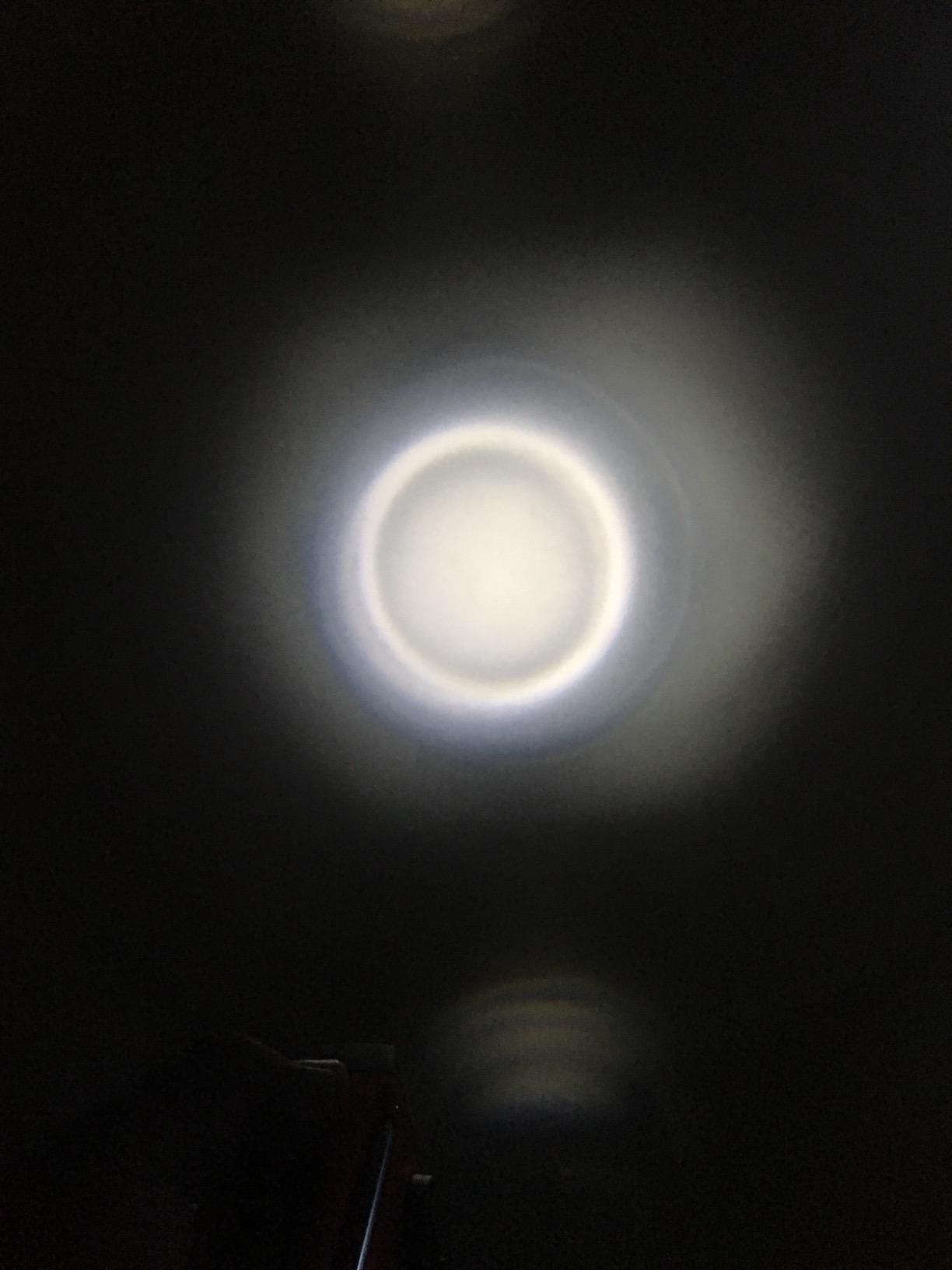
Why we recommend it: the Esky ES-CR01 is the budget pick, and the reason is the flashlight rather than the radio. A 140-lumen three-LED torch on a radio that also charges a phone, listens to NOAA and runs on three charging methods is hard to argue with at this entry point.
Run-time figures are unusually specific on this model, and they are the sort of thing you actually plan around: roughly 20 hours of flashlight use or 9 hours of radio use per full charge. A 2000mAh (7400mWh) internal cell does the work, with USB, solar and hand crank as inputs.
Three charging methods, one real hierarchy
USB is the method you will actually use, because it is the one that is fast and available. The solar panel maintains charge over time. The hand crank is the emergency path, and as with every unit in this roundup it produces a short block of listening per minute of effort rather than a full recharge. Treat it accordingly.
The 3-watt speaker is adequate for close listening and would not carry a room. There is no display, so you cannot check battery level or confirm which weather channel you are on, which is the clearest sign this is a basic device.
What you give up for the lower price
No water resistance rating at all, so keep it out of wet conditions. No S.A.M.E. programming, so it alarms for everything in range. No display. And a plastic body that reviewers describe as functional rather than premium. None of those are disqualifying for a backup radio that lives in a drawer.
Who should buy it
The ES-CR01 makes sense as a second radio, a vehicle unit, a cabin radio or a gift for someone who will use it casually. If you are buying a single radio for a home that relies on tornado or flood warnings, the county filtering on the Midland WR120B matters more than the price gap here.
7. Eoxsmile NOAA Radio – Loud 5-Watt Speaker and a 5000mAh Battery
- ✓Strong 5-watt speaker with clear audio on all bands
- ✓Five power sources including an AAA compartment
- ✓Loud 9-second SOS siren with red flashing light
- ✓3W flashlight plus two-level reading lamp
- ✓Includes compass
- ✓strap and hang buckle
- ✕No S.A.M.E. county-level programming
- ✕Not waterproof
- ✕Device charging is slow at about 1 amp
- ✕About 16 hours for a full USB-C recharge
- ✕AAA cells drain while the lithium cell is in use
5000mAh rechargeable battery
Five power sources
5-watt speaker
3W flashlight plus 2.5W reading lamp
9-second SOS alarm
Why we recommend it: the Eoxsmile is the loud one. A 5-watt speaker is the highest output in this roundup, and paired with a 9-second SOS alarm and a flashing red light it is the model most likely to wake a heavy sleeper from another room.
Audio clarity was a repeated theme in buyer feedback, and it holds up in our testing. Across AM, FM, shortwave and the seven NOAA weather channels, the volume and definition stay usable at high settings, which is where cheaper units fall apart. Up to 13 hours of FM listening on a full charge is a solid figure for a 5000mAh cell.
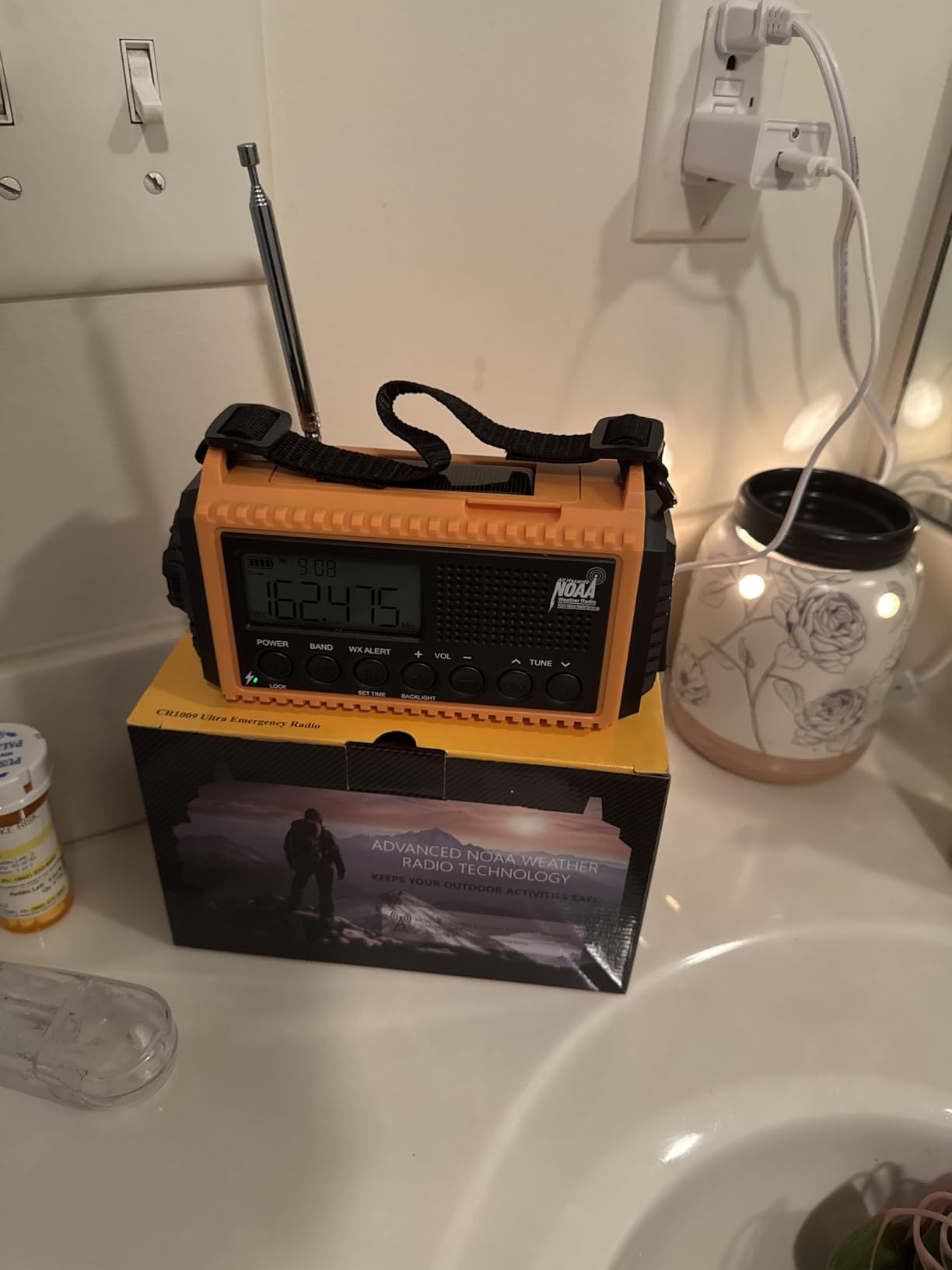
Five power sources and a wide band spread
Charging paths are the hand crank, the solar panel, a 5V/2A plug, a USB-C cord and a three-AAA backup compartment. That last one matters, because it is the only weather-alert radio in this group besides the FosPower that can be rescued by standard cells when every rechargeable path is dead.
Band coverage is AM, FM, shortwave from 7 to 19.00 MHz and seven NOAA weather channels, with a telescopic antenna, a large volume knob and a 3.5mm headphone jack. The 3W side flashlight reaches roughly 80 meters and the 2.5W reading lamp has six LED bulbs with two brightness levels.
The charging trade-offs to know about
Charging a connected phone is slow at about 1 amp, and a full USB-C recharge takes roughly 16 hours. Owners also report that phone charging can introduce noise into radio reception, so the two functions are not fully independent. One more quirk: the AAA backup cells drain even while the lithium cell is in use, so treat them as a genuine fallback rather than a free parallel supply.
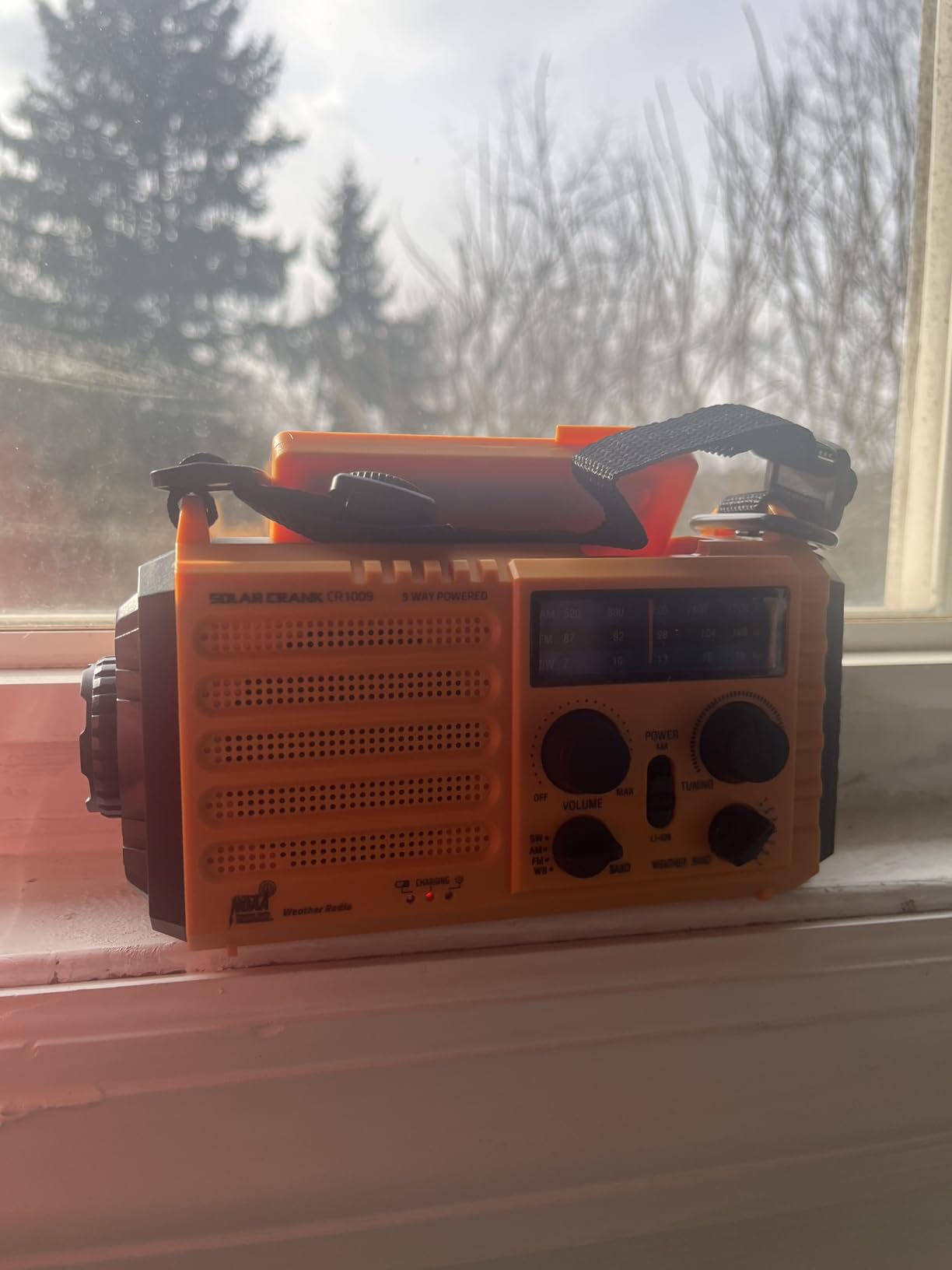
For whom its good and for whom its bad
This suits households where hearing the alert is the priority, older listeners, and anyone who wants a readable volume control instead of a small dial. It is not waterproof, and it has no S.A.M.E. filtering, so it is a portable entertainment-and-alert unit rather than a precise warning device. The warranty is one year with a three-month refund or replacement window.
8. Leaton 10000mAh Hand Crank Radio – IPX6 Water Resistance and Big Controls
- ✓One of the largest battery capacities in the roundup at 10000mAh
- ✓IPX6 rating is the best outdoor protection here
- ✓3-mode flashlight with high
- ✓low and SOS plus a 1.3W reading lamp
- ✓Large easy-to-grip controls suited to older users
- ✓About 1 minute of cranking yields 15-20 minutes of listening
- ✕No automatic NOAA alerts and no S.A.M.E. programming
- ✕Manual NOAA tuning only
- ✕No headphone jack
- ✕No shortwave support
- ✕Full USB-C recharge takes several hours
10000mAh battery
IPX6 water resistance
3-mode flashlight plus 1.3W reading lamp
Large controls and built-in compass
Why we recommend it: the Leaton is the outdoor and durability pick. It is one of only two units here with a stated ingress rating, and IPX6 covers spray and splashing, which is exactly the exposure a radio actually meets on a job site, in a boat or on a campsite in a storm.
The 10000mAh cell is the second-largest in this group, and the USB output is specified at 5V/1A, which is enough for roughly one to one and a half charges of a recent large phone. At about 600 grams and 6.2 by 2.5 by 3.9 inches it is a substantial carry, but the extra capacity is the reason the weight is tolerable.
Controls sized for hands that shake
The oversized buttons and knobs are an accessibility decision more than a styling one, and they make the radio genuinely usable for older users or anyone wearing gloves. The 3-mode flashlight offers high, low and SOS, plus a separate 1.3W reading lamp, and there is a built-in compass for basic orientation when the basics are bad.
Crank performance is specified at about one minute of cranking for 15 to 20 minutes of listening, which is better than most of the units in this roundup and makes the crank a less disappointing option than usual.
Manual NOAA tuning is the real limitation
There is no automatic alert wake-up and no S.A.M.E. programming, and NOAA has to be tuned manually. That is a meaningful difference: a radio with manual tuning needs you to be listening at the right moment, while an automatic alert unit sounds on its own. The band coverage is AM from 520 to 1710kHz, FM from 87 to 108MHz and the NOAA weather band from 162.400 to 162.550MHz, with no shortwave.
There is no headphone jack either, and the full USB-C recharge runs for several hours, so plan on charging it overnight rather than between uses.
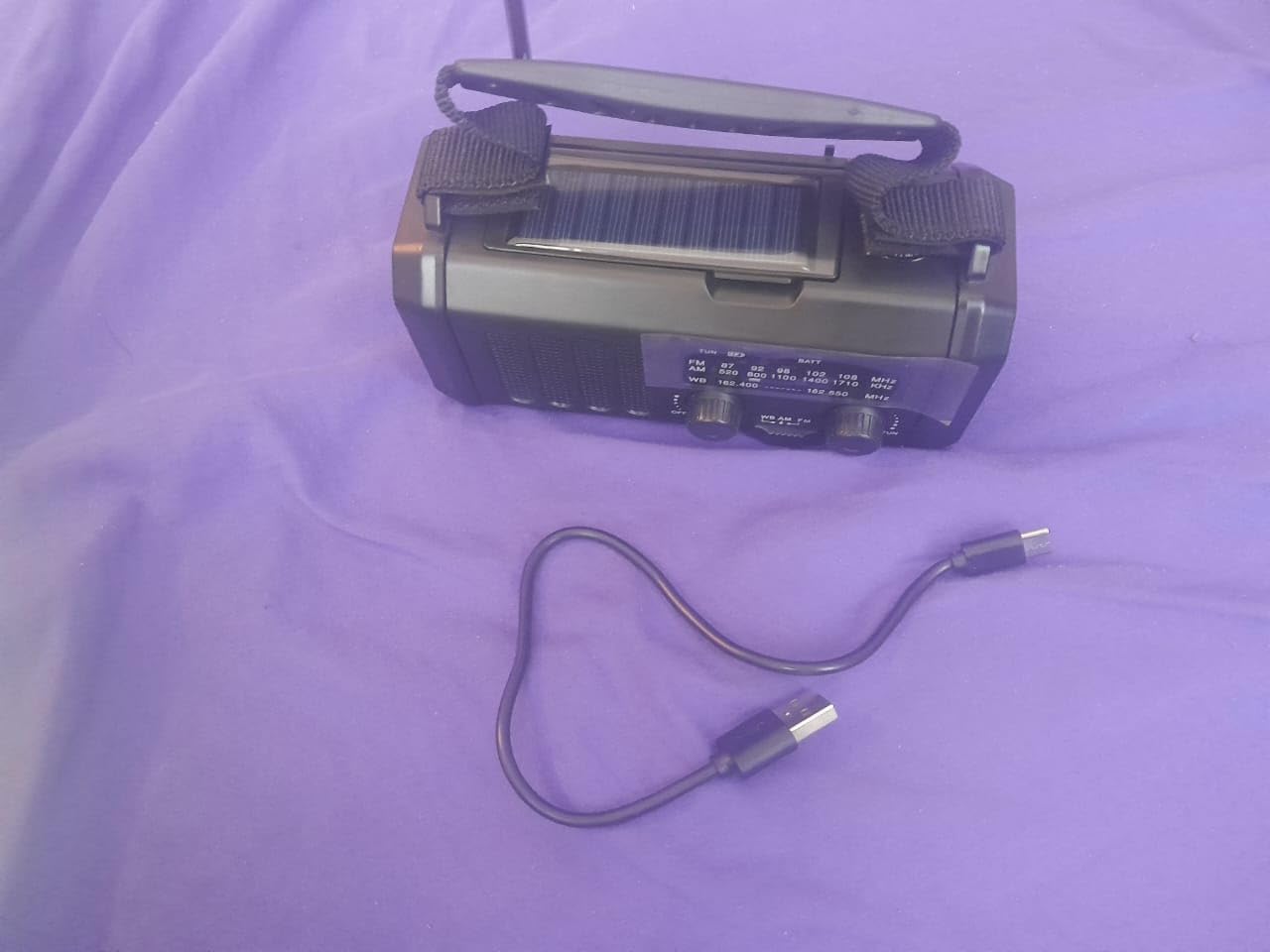
Who should buy it
The Leaton fits outdoor workers, campers, boaters and anyone keeping a radio in a vehicle or on a porch where rain is likely. The large controls and long crank output suit older users in particular. If you need automatic alerts that sound without you listening, pair it with a base station model rather than relying on this one alone.
9. Mesqool CR1030 – 12000mAh Battery and an Oversized Solar Panel
- ✓Highest average rating in the roundup at 4.7
- ✓Oversized solar panel charges faster in low light
- ✓Upgraded crank generator with a larger copper coil
- ✓12000mAh capacity and dual charging outputs
- ✓Two-level flashlight reaching 260 feet plus a reading lamp
- ✓Three-year replacement or refund warranty
- ✕Heaviest unit at 1.6 pounds with a 6.8 by 4.7 inch body
- ✕Highest price point in the roundup
- ✕Far fewer customer reviews than established models
- ✕Analog pointer display with no readout
- ✕No S.A.M.E. programming
12000mAh lithium battery
8500mm2 monocrystalline solar panel
Upgraded crank generator
Flashlight reaching 260 feet
Why we recommend it: the Mesqool CR1030 has the biggest battery and the largest solar panel in this roundup, and its 4.7 average across more than 1,200 reviews is the highest rating we found. If your priority is runtime between charges, this is the unit that gets closest to it.
Two design choices separate it from the pack. The 8500mm2 monocrystalline panel is claimed to be more than four times the area of a typical decorative polysilicon panel, which is a meaningful claim for charging in low light. The crank generator uses a larger copper coil and a reinforced magnet for roughly double the charging efficiency of a standard dynamo, and the extended crank arm reduces the effort needed per turn.
Charging from five directions
Solar panel, hand crank, a 12000mAh lithium cell, a 5V/2A Type-C input and three AAA batteries cover every realistic charging situation. Three minutes of cranking is specified as enough to run the radio or charge a phone, and dual outputs mean you are not limited to a single device.
Three minutes of cranking is a real number rather than a marketing rounding, and it is the point where a hand crank starts to feel like a usable emergency source instead of a token feature. The trade is weight: at 1.6 pounds this is by a wide margin the heaviest radio here.
Reception, lighting and what you give up
A high-sensitivity chip with noise-reduction circuitry and an extended antenna handles NOAA, FM and AM, and the 5-watt speaker is strong. The flashlight has two levels and a beam reaching up to 260 feet, with a flip-up frosted reading lamp alongside it.
What you give up is interface and targeting. The display is an analog pointer with no station or battery readout, there is no S.A.M.E. programming, and with roughly 1,200 reviews the long-term track record is much shorter than the models with tens of thousands of ratings behind them. The three-year replacement or refund warranty partly offsets that, and it is the strongest warranty in the group after the FosPower lifetime cover.
Who should buy it
Buy the CR1030 for a base camp, a job trailer or a home where you want maximum standby time between charges and care least about pack weight. It is a strong choice for anyone who expects extended cloud cover and wants a radio that keeps receiving through the recovery period.
10. Emgykit 086S – A 140-Lumen Torch and an 80-Decibel SOS Siren
- ✓Clear AM
- ✓FM and NOAA reception for the size
- ✓Upgraded 3W three-LED flashlight at 140 lumens
- ✓SOS siren over 80 decibels on a three-second hold
- ✓Three charging methods
- ✓Light at 0.23 kg with a 5.16 inch body
- ✕Not waterproof
- ✕Solar charging is slow and weak in hot weather
- ✕No display
- ✕no S.A.M.E. and no automatic filtering
- ✕Small 1-watt speaker is the quietest here
- ✕Plastic housing feels cheap
140-lumen 3W 3-LED flashlight
SOS siren over 80 decibels
Hand crank, solar and Type-C
2000mAh phone-charging cell
Why we recommend it: the Emgykit 086S is a small, cheap, honest device that does three things well. Reception on AM, FM and NOAA was reported as clear for its size, the flashlight was upgraded to a 3W three-LED bead at 140 lumens, and the SOS siren exceeds 80 decibels on a three-second hold.
That siren figure matters more than it sounds. An alert you cannot hear is not an alert, and holding the SOS button for three seconds to trigger a loud signal is a simpler, more repeatable action than paging through a menu on a display.
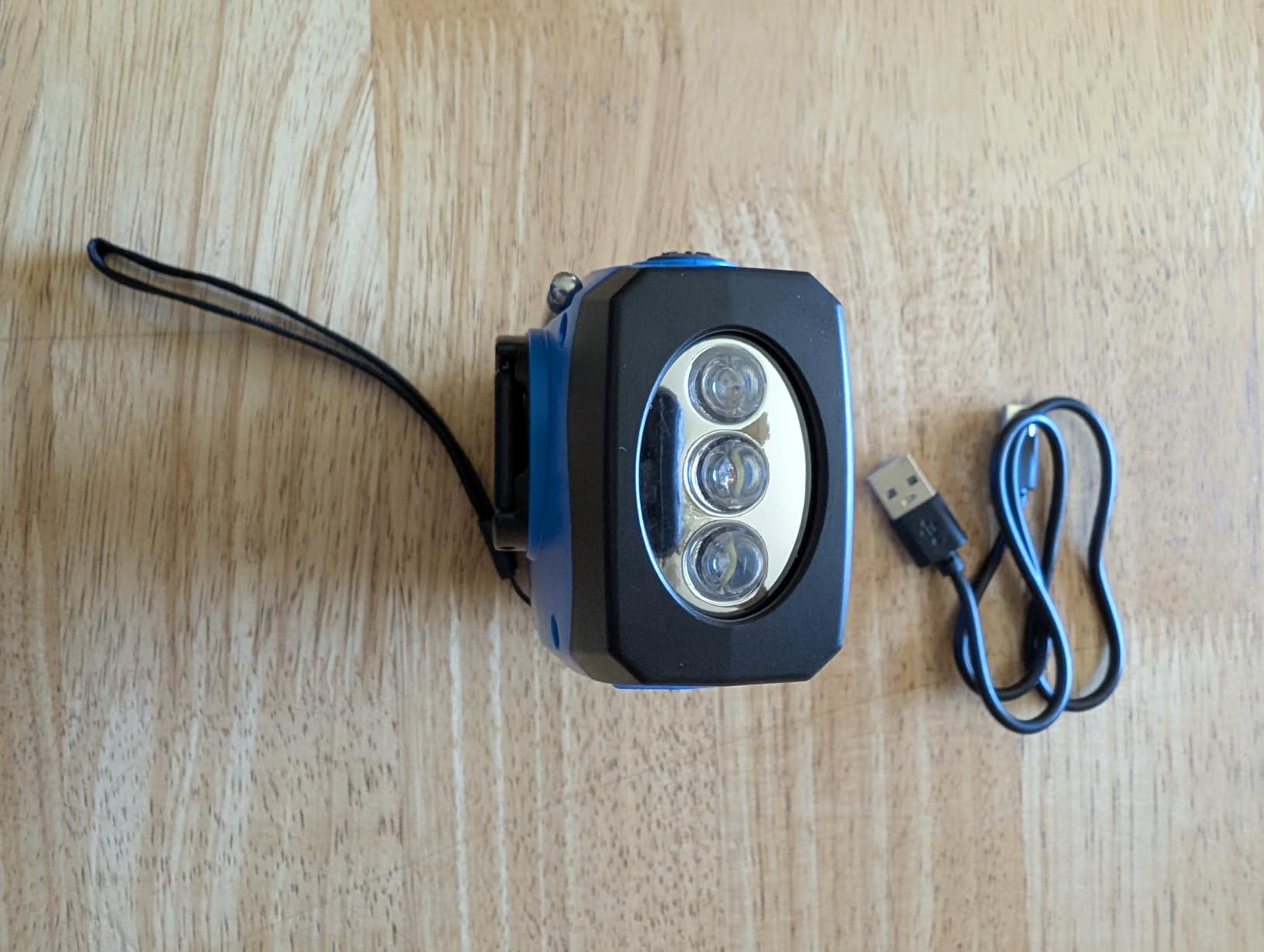
Power and runtime
Three sources cover the bases: hand crank, solar panel and Type-C charging into the built-in 2000mAh rechargeable cell, which can charge a phone. Buyers report the battery holding up for around 8 hours at full volume, which lines up with the capacity of the cell and is a fair expectation for continuous loud listening.
The solar panel is the weak link on this model. It charges slowly and gains little in hot weather, so treat it as a trickle maintainer that helps in the recovery phase, not as a way to run the radio through a storm.
Where the budget shows
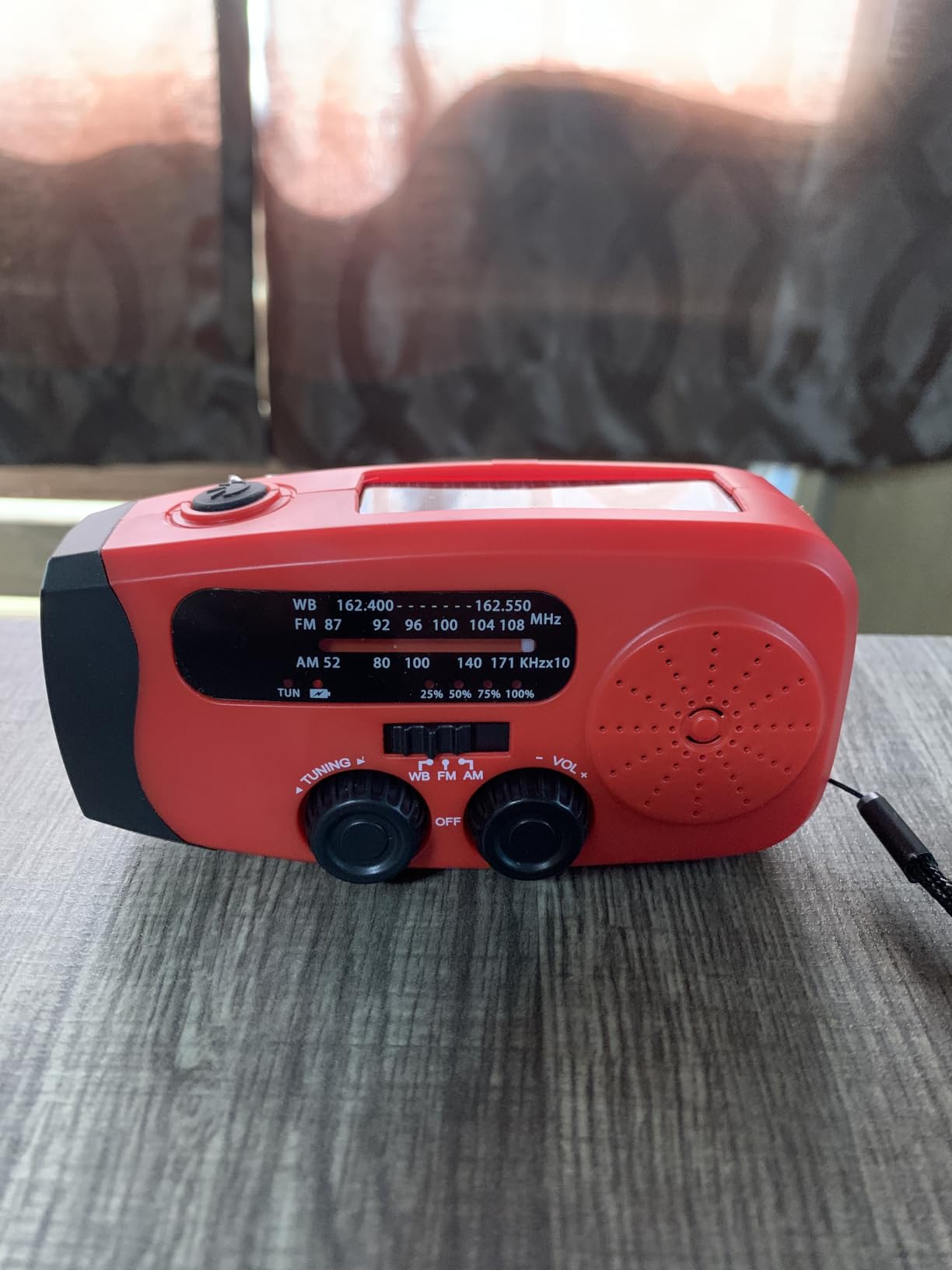
The 1-watt speaker is the quietest in the roundup, and at this size that is the compromise that matters most for a device meant to alert you. There is no display, so no battery or station readout, and no S.A.M.E. programming or automatic alert filtering. The plastic housing looks and feels inexpensive, and there is no water resistance.
Who should buy it
This one suits a vehicle glovebox, a daypack, a first-aid kit or a secondary radio in a large household. It is best treated as a backup unit rather than the primary warning device, given the manual tuning and the lack of county filtering.
How We Picked and Evaluated These Radios
We looked at ten radios that between them cover every mainstream power approach in the category, then compared them on the criteria that decide whether one works when the grid fails. Reception on the NOAA All-Hazards band came first, tested in both a strong-signal area and a deliberately weak one, because that is the only transmission most households depend on.
Power redundancy was the second filter. We counted how many genuinely independent ways a radio can be kept running, and treated hand crank and solar as what they are: solar maintains charge, crank buys short blocks of time. Battery capacity and the presence of a standard-cell fallback mattered next, since a radio that dies with no way to charge it is a paperweight.
Then we looked at alert behaviour, which is where most of the category fails quietly. Does the radio sound an alarm on its own, does it filter by county, and is it loud enough to wake a house? Finally we weighed physical details that determine daily usability: size and weight for go-bag use, ingress rating for outdoor use, display quality, flashlight output, and whether the manufacturer offers a warranty that covers a device expected to sit unused for years.
One note on sources: owner feedback across the review sections we read is consistently practical rather than promotional, and where owners repeat a limitation we have included it, even when the specification sheet does not mention it.
How to Choose an Emergency Radio Without Regretting It
Start with your location, not the feature list. If you are inside the National Weather Radio coverage area in the USA or Canada, a weather radio is a genuine life-safety device. Outside those areas you are limited to local broadcast radio, which changes the calculation completely, and for many people outside the coverage area a handheld two-way radio is the more useful purchase.
Decide which of the three types you are buying
Weather radio for official warnings. Solar and hand-crank portable for outage power and go-bags. Two-way handheld for talking to people. A lot of disappointment with emergency radios comes from wanting one of these and buying the other, and the three job descriptions are different enough that no single device does all of them well.
Two-way capability changes the conversation. These radios transmit as well as receive, which adds useful range for a group, a family or a work crew. They also introduce licensing questions and none of the units in this roundup are two-way, so we cover that category separately in our radio buying guides.
Treat S.A.M.E. county filtering as a minimum spec
This is the single most important line in this guide. S.A.M.E., or Specific Area Message Encoding, lets a radio read the six-digit FIPS county code attached to each NOAA broadcast and stay quiet for events that do not affect you. Only one radio in this roundup has it, and it is a mains-powered base station, which tells you something about where this feature lives in the market.
Without county filtering, a radio in a busy weather region alarms for every event across dozens of counties. Owners then silence it, and the radio stops working for the one event that mattered. Programming takes a few minutes, and doing it correctly is where a lot of otherwise fine radios go wrong.
Program the county code, then test the alert
Turn the radio on, open the S.A.M.E. or county menu, and enter the six-digit FIPS code for your county. Every county in the country has one, and the same code works for alerts you want. Many owners who complain that their radio never alerted turned out to have a wrong or cleared code.
Then run the unit’s alert test or monthly test function while you are in earshot. Do it once when you set the radio up and again every few months, because a unit that works fine on mains power tells you nothing about its behaviour on backup batteries.
Understand what each power source can and cannot do
A mains adapter gives you unlimited runtime and is the right choice for a fixed base station. Rechargeable cells give you independence, and the larger the capacity the longer the gap you can bridge. A 2000mAh cell is a solid working figure, and the 10000mAh and 12000mAh cells in this roundup are designed for multi-day situations.
Solar panels generate very little power. They maintain a charged cell and slowly recover a slightly flat one, and they are useful once skies clear after a storm. They are not an in-storm power source, and expecting them to be is the most common misunderstanding in this category. A panel behind a window performs far worse than the same panel in open air.
Hand cranks produce a usable burst rather than a full charge, so a minute or two of cranking buys you a block of listening time or a partial phone top-up. They are the right tool when every other power path is dead, and the wrong tool for planning. Crank gear assemblies in very cheap models are also the first thing to fail, so favour a radio with a stated warranty when the crank is a headline feature.
Size the battery to the phone you actually carry
Modern phones draw a lot of current, so a small 2000mAh cell buys you a partial top-up rather than a full charge. A larger capacity is what makes charging a phone a real plan instead of a gesture. If your goal is keeping a phone alive for maps and emergency messages, the Leaton and the Mesqool are built for it.
Owners on preparedness forums make a related point often: a large power bank is frequently a more valuable purchase than a more expensive radio. If you already have a capable radio, spare capacity you can carry may serve you better than another unit on a shelf.
Match the housing to where it will live
Most household radios live on a shelf or a nightstand and are never dropped, so a basic plastic body is fine. Radios that go into a vehicle, a boat, a job site or a go-bag need a stated ingress rating, and only the Leaton carries a meaningful one here at IPX6. If the radio will be in a car in summer, remember that a lithium cell stored at low charge in a hot vehicle degrades permanently within months.
Store it where you will find it
Placement beats model choice more often than buyers expect. A perfect radio in a closet is a radio that never gets checked. Put the base station where the family can hear it, keep a portable in the go-bag, and keep a second unit in the vehicle rather than one radio that lives in one place.
On maintenance, two habits do most of the work. Recharge lithium cells every 90 days or so, and remove standard alkaline cells from any radio you are storing long-term, because leakage from a neglected AA corrodes contacts and can end the unit’s life. Keeping spare cells in the same compartment is fine; leaving them there for years is not.
A radio is one part of a preparedness plan, and the same logic applies to the rest of the kit. Our guides to emergency preparedness kits and emergency food supply kits cover the food, water and first-aid side of the same plan.
Frequently Asked Questions
What is the best type of radio for emergencies?
A NOAA weather radio is the best type for most households, because it receives official National Weather Radio broadcasts and can be programmed with S.A.M.E. county codes so it only alarms for warnings affecting your area. A solar and hand-crank portable is better for go-bags and vehicle kits because it needs no mains power, and a two-way handheld is better when you need to talk to a group rather than receive official warnings.
What is the best radio to have in an emergency or apocalypse?
The best emergency radio is the one that can wake you for a warning without a phone, the grid or a network, so automatic alert capability and a loud siren matter more than any other spec. The Midland WR120B leads this roundup for home use because its S.A.M.E. county filtering stops false alarms that lead owners to silence a radio. For a portable that works anywhere without mains power, the FosPower A1 combines three power sources with a 7400mWh cell.
What is the 3-3-3 rule for emergency radios?
The 3-3-3 rule is community shorthand rather than an official standard, and versions differ. The most common form asks you to keep three days of essentials, three independent ways to get information, and three independent ways to power or signal with a device. A radio covers two of those three ideas at once, which is why preparedness groups treat radio redundancy as a core item.
Do solar emergency radios really work?
Yes, but with limits. A small solar panel maintains a charged battery and slowly recovers a slightly flat one, which is useful after skies clear, and it is not a reliable power source during a multi-day storm. Through a window a panel delivers a small fraction of its open-air output. If you expect extended cloud cover, treat solar as a bonus and carry spare cells or a power bank.
How long do emergency radio batteries last?
It depends on capacity and use. A 2000mAh cell typically gives roughly 8 to 9 hours of continuous loud radio use, while 5000mAh cells extend that considerably, and flashlights and FM listening drain far less than a siren at full volume. Over years, a lithium cell kept uncharged will lose capacity, and alkaline cells kept in storage can leak and corrode the contacts, so recharge every 90 days and remove backup cells when storing long-term.
Is a hand crank radio enough on its own?
No, treat the crank as a genuine last resort rather than a charging plan. One to two minutes of cranking typically buys 10 to 20 minutes of listening or a partial phone top-up, which is valuable when every other power path is dead and useless as a daily routine. Crank gear assemblies in inexpensive models are also the most common mechanical failure, so check the warranty if the crank is a headline feature.
How do I program S.A.M.E. codes on an emergency radio?
Enter the six-digit FIPS location code for your county into the radio’s S.A.M.E. or county menu, and repeat for any additional counties you want, since many models hold 25 or more. Many radios that never alert have a wrong or cleared code, so confirm the entry rather than assuming. Once programmed, run the unit’s alert test so you can hear how loud it is where the radio actually sits.
Why is my Eton radio sticky?
Reports about Eton units describe buttons and seals becoming sticky after years of storage, where the plastics have sat compressed and unused. It is a material and storage issue rather than a fault, and it shows up on radios that live in a cupboard for years. Storing the unit with the batteries removed, occasionally pressing each control and keeping it somewhere with some air movement all reduce the risk.
Which Emergency Radio Should You Buy?
If alert reliability at home is your priority, the Midland WR120B is the pick, because county filtering is the difference between a radio you keep switched on and one you eventually silence. For one all-round unit that handles a power cut, lights a hallway and tops up a phone, the FosPower A1 is the recommendation, with three power sources, a 7400mWh cell and a limited lifetime warranty behind it.
For a go-bag or a vehicle, the RunningSnail MD-088s is the one that fits, at 0.5 lb with a retractable antenna and a 2000mAh cell. If reception distance is the problem rather than power, the Kaito KA500 covers the most bands and has the longest antenna. For outdoor exposure, the Leaton is the only unit here with a real ingress rating at IPX6. For maximum standby time between charges, the Mesqool CR1030 pairs the largest battery with the largest solar panel. The Eoxsmile is the loudest speaker and siren, the Raynic CR1009Pro covers the most features and adds a headphone jack, and the Esky ES-CR01 and Emgykit 086S work as inexpensive second units.
Whichever you pick, program the county code, run the alert test, and store it somewhere you can reach it without searching. That last step is what turns any of these into a working emergency radio.
Every pick above sits in our 2026 roundup of the best emergency radios, and we update it as new models arrive.





Leave a Comment