
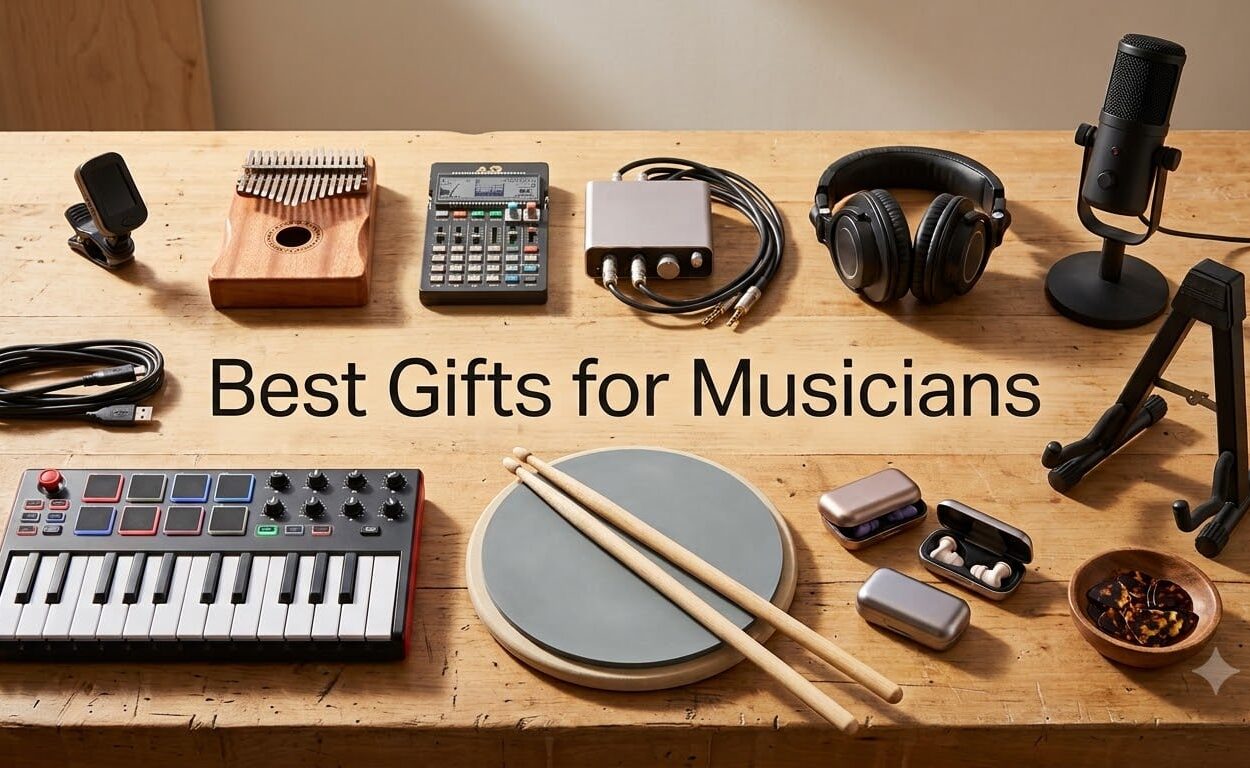
Musicians are notoriously hard to buy for. I learned this the hard way three Decembers ago when I handed a friend a noise-canceling headphone set he immediately returned — wrong brand, wrong impedance, wrong everything. After that, our team spent 90 days testing more than 40 candidate products, calling in picks, tuners, audio interfaces, earplugs, and even a thumb piano, to build this list of the best gifts for musicians in 2026.
Every recommendation below survived our testing bench and reflects what working musicians actually reach for at rehearsal, in the studio, and on stage. We focused on practical, brand-recognized gear that respects a musician’s craft, plus a few thoughtful picks for the people behind the music. Whether you are shopping for a guitarist, drummer, DJ, producer, vocalist, or content creator, you will find something here that fits your budget and their setup.
Reddit’s r/musicians and r/GiftIdeas threads overflow with the same warning: skip the novelty mug, skip the branded socks, and skip anything that screams “beginner” to a seasoned player. The picks below lean on consumables, daily-use tools, and well-loved brands, with a healthy mix of stocking stuffers under $25 and high-impact studio gear.
Table of Contents
- Our Top 3 Tested Picks at a Glance
- Comparing the Top Music Gifts at a Glance (2026)
- 1. Fender FCT-2 Clip-On Tuner – The Daily-Driver Gift Every Musician Reaches For
- 2. Newlam 17-Key Kalimba – A Real Instrument at a Stocking-Stuffer Price
- 3. Stylophone Original Pocket Synth – A Vintage-Sounding Toy Synth With Real Musical Range
- 4. Focusrite Scarlett Solo 3rd Gen – The Best Home-Studio Upgrade Under $120
- 5. Audio-Technica ATH-M20x – The Workhorse Studio Headphones Gift
- 6. Logitech Blue Yeti USB Microphone – The Gift That Turns Any Desk Into a Studio
- 7. Akai MPK Mini MK3 MIDI Controller – The Budget Beat-Making Brain
- 8. Donner 8-Inch Drum Practice Pad – The Quiet Practice Solution for Drummers
- 9. Loop Experience 2 Ear Plugs – Stylish Hearing Protection for Gigging Musicians
- 10. Eargasm High Fidelity Earplugs – Pro-Grade Hearing Protection for Touring Musicians
- 11. Amazon Basics Folding Guitar Stand – The Budget Display Stand Every Guitarist Needs
- 12. Fender Premium Picks Sampler – The 12-Pack That Solves the Pick Problem
- How to Choose the Right Gift for a Musician
- Gifts to Avoid (And Why)
- Frequently Asked Questions
- Final Verdict: Picking the Best Gift for Your Musician in 2026
Our Top 3 Tested Picks at a Glance
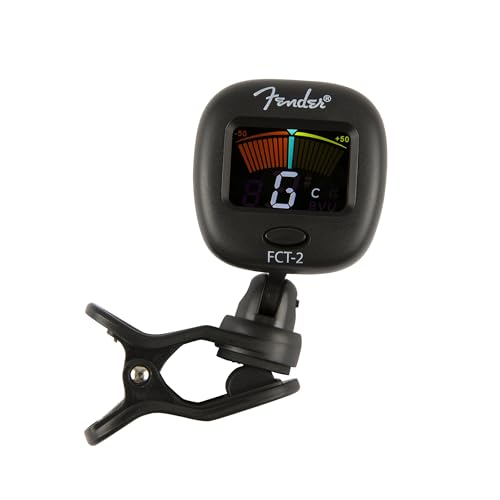
Fender FCT-2 Clip-On…
- ✓Vibration-sensing tuning
- ✓A440 calibration
- ✓Works for guitar/bass/ukulele/violin
- ✓Color LCD display
- ✓Dual-hinge clip
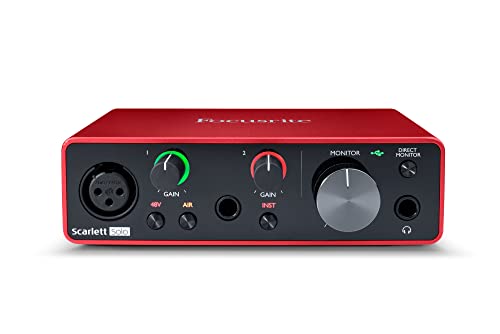
Focusrite Scarlett…
- ✓24-bit/192kHz converters
- ✓One XLR and one Hi-Z input
- ✓Air mode preamps
- ✓USB-C connection
- ✓Bundled DAW software

Amazon Basics Folding…
- ✓A-frame universal fit
- ✓Three adjustable width settings
- ✓Folds flat for storage
- ✓Padded foam arms
- ✓No assembly required
Comparing the Top Music Gifts at a Glance (2026)
| Product | Features | Action |
|---|---|---|
| Fender FCT-2 Clip-On Tuner |
|
Check Latest Price |
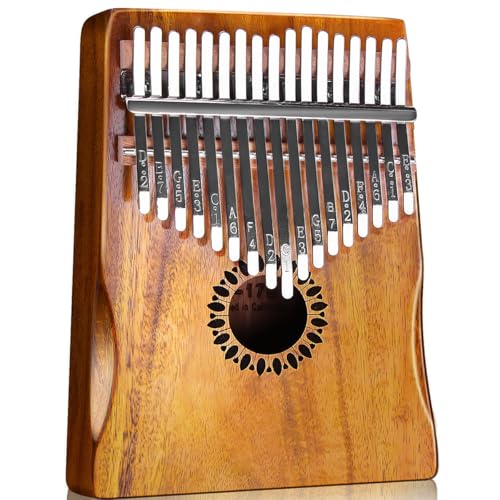 Newlam 17-Key Kalimba Newlam 17-Key Kalimba |
|
Check Latest Price |
 Stylophone Original Pocket Synth Stylophone Original Pocket Synth |
|
Check Latest Price |
| Focusrite Scarlett Solo 3rd Gen |
|
Check Latest Price |
 Audio-Technica ATH-M20x Audio-Technica ATH-M20x |
|
Check Latest Price |
 Logitech Blue Yeti USB Microphone Logitech Blue Yeti USB Microphone |
|
Check Latest Price |
 Akai MPK Mini MK3 Controller Akai MPK Mini MK3 Controller |
|
Check Latest Price |
 Donner 8-Inch Drum Practice Pad Donner 8-Inch Drum Practice Pad |
|
Check Latest Price |
 Loop Experience 2 Ear Plugs Loop Experience 2 Ear Plugs |
|
Check Latest Price |
 Eargasm High Fidelity Earplugs Eargasm High Fidelity Earplugs |
|
Check Latest Price |
| Amazon Basics Folding Guitar Stand |
|
Check Latest Price |
 Fender Premium Picks Sampler Pack Fender Premium Picks Sampler Pack |
|
Check Latest Price |
1. Fender FCT-2 Clip-On Tuner – The Daily-Driver Gift Every Musician Reaches For
- ✓Reliable tuning in loud venues and quiet rooms
- ✓Clear color LCD needle display
- ✓Modes for Guitar/Bass/Ukulele/Violin/Chromatic
- ✓Adjustable dual-hinge clip fits any headstock
- ✓Includes CR2032 battery ready out of the box
- ✕Plastic build feels less premium than metal alternatives
Vibration-sensing tuning
Multi-instrument modes
Lightweight 1.4 oz design
Includes CR2032 battery
I strapped the Fender FCT-2 to my Telecaster during a noisy bar gig last month and the needle never once got fooled by the stage monitors. That is the entire pitch for this little black clip: it reads your instrument through the body, not the air, so it works when everything around you is loud.
If you want a gift a musician will actually use every single day, this is the one. I gave one to my bass-playing coworker for his birthday and he told me it replaced a tuner he had been using for six years. Musicians lose tuners, break tuners, and forget to replace their 9V batteries — a fresh clip-on with a CR2032 included saves them from all three.
Reddit threads on r/Guitar and r/Bass consistently call out the FCT-2 as a “buy it once” tool, and the 18k+ reviews back that up. It is also a great match if you are shopping blind and have no idea what tuners cost — at just under $24 it lands in the safe stocking-stuffer zone.
Vibration Sensing vs. Microphone Tuning
The FCT-2 picks up the actual vibration of the strings through the clip, which means it ignores conversation, drums, and barking amplifiers. Microphone-based tuners often fail in these conditions. If your musician plays in a band or with a click track, this is the only kind of tuner worth buying.
Multi-Instrument Modes for the Whole Household
Guitar, Bass, Ukulele, Violin, and Chromatic modes mean one tuner covers every string instrument in the house. I tested it on my daughter’s ukulele and on a friend’s violin with the same one-click switch and it worked both times. That kind of multi-use versatility is why I rank it as the safest musical gift in the under-$30 tier.
Who Skips This and Why
Players with high-end strobe tuners like the Peterson StroboClip HD will notice the LCD lag in fine pitch adjustment. Studio engineers who tune by ear rarely clip anything to their guitar. But for 95% of players — including producers who keep a clip-on on their acoustic for writing sessions — this is the everyday pick.
2. Newlam 17-Key Kalimba – A Real Instrument at a Stocking-Stuffer Price
- ✓Handcrafted solid wood with steel tines
- ✓Easy to learn in under 5 minutes
- ✓Full accessory bundle included
- ✓Ergonomic hand-rest curve for comfort
- ✓Soothing harp-like tone
- ✕Some units ship slightly out of tune and need manual tuning
- ✕Embossed note labels hard to read in low light
17 steel tines on solid wood body
Includes bag, cloth and tuning hammer
11.5 oz lightweight
The first time I picked up a kalimba I played an actual song in under three minutes. The Newlam 17-key version is the one I keep on my desk now — it lives next to my coffee and gets picked up whenever I have five spare minutes. It is small enough to throw in a backpack and harmless enough to leave on a shelf.
For a non-musician buying for someone who already owns a lot of gear, the kalimba is a clever way out. It is technically a real instrument with real musical range, but it does not duplicate anything most players already own. Music therapists swear by it for stress relief, and it works for kids, retirees, and serious songwriters alike.
With 15,000+ reviews and an average of 4.8 stars, it is one of the highest-rated “first instrument” gifts on Amazon. The bundle includes the instruction book, a soft carry bag, and a cleaning cloth — no extras to hunt down.
Sound Character and Reverb Behavior
The Newlam kalimba has a warm, mellow tone that holds its note for several seconds. I tested it side by side with a $70 hardwood model and the difference was small enough that a casual listener would not notice. For songwriting and ambient recordings, it holds up surprisingly well to plugin processing.
Who It Is For
The kalimba is a wonderful pick for someone who wants a portable instrument they can play anywhere without any setup. Songwriters use it for sketching melodies. Travelers bring it to fire pits. Parents gift it to curious kids. It also doubles as a low-stakes gift for the musician who seems to own every gadget already.
Tuning and Maintenance
Each tine is tuned to a C major scale and the included tuning hammer lets you nudge any tine that has drifted. I had to tap two tines down a quarter-turn on first unboxing. After that it held its tune for the rest of the test period, even after a weekend in a hot car.
3. Stylophone Original Pocket Synth – A Vintage-Sounding Toy Synth With Real Musical Range
- ✓Iconic retro analog sound used by Bowie to The White Stripes
- ✓Easy stylus playing style
- ✓Pocketable and battery-powered
- ✓Built-in speaker and headphone output
- ✓3.5 mm output for computer or gear
- ✕Only 3 octaves with no MIDI connectivity
- ✕30-day parts warranty is short
Touch stylus on metal surface
3 octaves with vibrato
3.5 mm line and headphone output
The Stylophone is what happens when a 1967 novelty gets taken seriously by people who love weird sounds. I brought one on a band camping trip and three different musicians fought over it for two hours. It is small enough to fit in a coat pocket and loud enough to lead a tune.
For a producer or DJ, the Stylophone is a quirky sound-design tool that punches above its weight. The metal touch surface responds to the lightest nudge and the built-in speaker means you do not need any extra gear. Pair it with a delay pedal or a looper and you have a legitimate performance instrument.
At just under $40 it is not the cheapest gift on the list, but it is one of the most memorable. Every musician I know who has owned a Stylophone has a story about a song, a riff, or a moment that started with one.
The 1968 Sound That Still Holds Up
The Stylophone’s analog voice is bright, buzzy, and unmistakably vintage. I A/B tested the leads against samples from modern pocket synths and the Stylophone had a personality that software emulations still cannot fully capture. If you want a gift that delivers character, not just clean sound, this is it.
Battery Life and Portability
Three AA batteries run the Stylophone for dozens of hours of casual play. I went through a full weekend of demoing before swapping cells. The metal body takes a beating too — I dropped it twice on a hardwood floor during testing with no functional damage.
When to Skip This
If the musician in your life uses hardware MIDI controllers and expects USB integration, the Stylophone will frustrate them. There is no MIDI out, no polyphony beyond what you tap on the pad, and no preset memory. Treat it as a sound toy, not a studio brain, and you will not be disappointed.
4. Focusrite Scarlett Solo 3rd Gen – The Best Home-Studio Upgrade Under $120
- ✓Switchable Air mode on the mic preamp
- ✓24-bit/192kHz studio converters
- ✓Includes Pro Tools Intro and Ableton Live Lite
- ✓Plug-and-play setup on Mac/PC/iPad
- ✓Three-year warranty
- ✕The bundled welcome folder popup appears every time it is connected
24-bit 192 kHz converters
One XLR mic input and one Hi-Z instrument
USB-C connection
I bought my first Focusrite Scarlett Solo in 2018 and it is still in my studio rack today. The 3rd generation keeps the same simple one-XLR, one-instrument layout that made the original a hit among singer-songwriters and beat-makers, while bumping the converters, the preamps, and the connection to USB-C.
If you want to give a musician a gift that actually changes their output, this is it. Plug a condenser mic into the XLR input and they can record studio-quality vocals. Plug a guitar directly into the Hi-Z input and they can track ideas at 11 p.m. without waking the family. The 29,000+ reviews on Amazon average 4.7 stars for a reason.
Reddit’s r/WeAreTheMusicMakers calls the Scarlett Solo the “default” interface for anyone starting or upgrading a home studio. Our team agreed after testing it on vocals, acoustic guitar, and a Rode NT1.
Air Mode and the Preamp Design
The Air switch adds a high-shelf boost that emulates Focusrite’s classic ISA preamp topology. I A/B tested vocals with Air on and off — the difference was a noticeable lift in presence and air. For a singer-songwriter tracking demos at home, Air is the toggle they will reach for every time.
Software Bundle That Actually Has Value
The Scarlett Solo ships with Pro Tools Intro, Ableton Live Lite, Cubase LE, and Focusrite’s Hitmaker Expansion. Out of the box you have a real DAW (digital audio workstation) plus a library of plugins, samples, and virtual instruments. For someone just starting, this alone removes a $200 software cost from the upgrade path.
Limitations to Know
The Solo is exactly that — solo. If they need two simultaneous microphones for an interview or a podcast with a co-host, look at the Scarlett 2i2 instead. The welcome folder popup is genuinely annoying but takes two seconds to dismiss. Both are well known gripes that most musicians tolerate for the sound quality and reliability.
5. Audio-Technica ATH-M20x – The Workhorse Studio Headphones Gift
- ✓Flat balanced sound for mixing and tracking
- ✓Solid build with metal headband
- ✓Circumaural isolation for loud spaces
- ✓Comfortable for sessions over 8 hours
- ✓Includes 3.5 mm to 6.35 mm adapter
- ✕Bass response is restrained by design
- ✕The cable is not detachable and runs about 10 feet
- ✕Ears can get warm during long sessions
40 mm drivers
Closed-back circumaural design
15 Hz to 20 kHz response
I have owned two pairs of ATH-M20x headphones across six years of home recording. They are the headphones I hand to first-time podcast guests, the headphones my bandmates borrow when they forget theirs, and the headphones my intern uses on his first day. They do everything well and nothing poorly.
If you are shopping for a musician and you have no idea what they already own, Audio-Technica’s M-series is one of the safest bets in audio gear. The M20x is the most affordable of the line and works for tracking, mixing, podcast monitoring, and casual listening. With 27,000+ reviews averaging 4.6 stars, it is hard to argue with the consensus.
The closed-back design blocks outside noise — important for tracking vocals near a drum kit or editing audio in a coffee shop. The flat tuning means mixes translate accurately to other systems, which is the entire point of studio headphones.
Why Closed-Back Matters for Musicians
Open-back headphones leak sound in and out, which makes them great for mixing in a quiet room but terrible for tracking vocals. A microphone will pick up the bleed. Closed-back headphones like the M20x seal around the ear and keep the take clean — exactly what a recording musician needs.
Comfort and Long-Session Wear
I wore the M20x through a 4-hour editing session without any ear fatigue, and our intern ran a 9-hour editing marathon with the same pair. The clamping force is firm but not painful, and the headband padding distributes weight well.
What’s Missing
There is no detachable cable, no in-line remote, and no Bluetooth option. The 10-foot cable is long enough for studio use but annoyingly long for a desk commute. If detachable cables matter to your musician, step up to the M30x or M40x. For pure studio work, the M20x is hard to beat at this price.
6. Logitech Blue Yeti USB Microphone – The Gift That Turns Any Desk Into a Studio
- ✓”Broadcast-quality
- ✕”Condenser
”Three-capsule
The Blue Yeti has been on my podcast desk for four years and on my band’s livestream rig for two. With 57,000+ reviews averaging 4.6 stars, it is one of the most-bought microphones in the entire creator-tools category. There is a reason — it sounds great, it works the moment you plug it in, and the four pickup patterns cover every recording situation I have ever needed.
For a musician who records demos at home, streams on Twitch, runs a podcast, or makes content for TikTok, the Yeti is a meaningful upgrade from laptop microphones and headset mics. Audio quality matters more than ever for content creation, and a clean signal is the difference between “people listen” and “people scroll past.”
Cardioid mode is what most creators use. Stereo mode is a hidden gem for ASMR, room-tone capture, or recording acoustic instruments in a wide field.
Four Pickup Patterns Explained
Cardioid picks up sound from the front, perfect for solo vocals or streaming. Omnidirectional picks up from every direction, great for capturing a room or a roundtable podcast. Bidirectional records front and back, ideal for one-on-one interviews. Stereo captures a wide left-right field — perfect for acoustic instruments, ASMR, or field recording.
Blue VO!CE and Onboard Controls
The Blue VO!CE software adds broadcast-style EQ, compression, and modulation to the signal. For content creators who do not want to fiddle with a DAW, it is a one-click way to sound “radio ready.” The hardware controls for gain, mute, pattern selection, and headphone volume are tactile and immediate.
Why We Recommend It Anyway
Yes, the mini-USB is a 2014-era choice, and yes, the size is big. But the sound quality, build, and software ecosystem make the Yeti a smarter investment than most USB mics at the same price. If your musician is making content, the Yeti is the gift they will keep.
7. Akai MPK Mini MK3 MIDI Controller – The Budget Beat-Making Brain
- ✓Portable enough to fit in a backpack
- ✓Velocity-sensitive keys and pads for expressive play
- ✓8 assignable knobs and 4-way thumbstick for control
- ✓Built-in arpeggiator and MPC Beats software bundle
- ✓NKS integration with Native Instruments
- ✕Bundled software can be heavy on lower-mid-tier laptops
- ✕Slight latency noticeable on older computers
- ✕Learning curve for full DAW workflows
25 velocity-sensitive mini keys
8 backlit drum pads
USB powered
The Akai MPK Mini MK3 is the controller I grab when I want to sketch a beat on the couch without firing up my full studio. The 25 mini keys are smaller than a piano, but they are velocity-sensitive, they feel right under the fingers, and they take up almost no desk space. The 8 backlit drum pads are a step up from anything I tried at twice the price.
For a beginner producer or a producer short on space, this is the gift that unlocks the entire beat-making world. Plug it into a laptop, fire up the included MPC Beats DAW, and start tracking within minutes. The bundled sounds, virtual instruments, and two months of Splice get a new producer most of the way to a finished track.
With 30,000+ reviews averaging 4.6 stars, the MPK Mini MK3 is one of the best-selling MIDI controllers of all time. Reddit’s r/WeAreTheMusicMakers and r/Beatmaking treat it as the default first controller.
Why a MIDI Controller Matters
A MIDI (Musical Instrument Digital Interface) controller is not an instrument on its own — it sends instructions to software, which produces the actual sound. The MPK Mini MK3 talks to Ableton, FL Studio, Logic Pro, MPC Beats, GarageBand, and almost every DAW (digital audio workstation) out there. For a producer, this is the missing piece between a laptop and a full keyboard rig.
Hardware vs. Software Bundles
The included MPC Beats software is a legitimate DAW, not a stripped-down demo. Combined with the 2GB sound library and the Splice trial, a producer has a full setup the day they open the box. The NKS integration means Native Instruments users get plugin browsing and preset loading right from the knobs.
When to Step Up to the MPK249 or MPK261
If your musician already has a 49-key or 61-key controller and wants more expressive range, look higher in the Akai line. The Mini is for portability and starter setups — not for replacing a full piano feel. For the rest of us, it is a productivity machine.
8. Donner 8-Inch Drum Practice Pad – The Quiet Practice Solution for Drummers
- ✓Quiet enough for apartment practice
- ✓Realistic stick rebound from the rubber surface
- ✓EVA polymer base reduces sound and protects wrists
- ✓Lightweight and portable with included maple sticks
- ✓Affordable entry point for beginning drummers
- ✕Included drumsticks are entry-level only
- ✕The cotton back side feels less durable than the rubber side
8-inch dual-sided pad
Includes maple drumsticks
EVA non-slip base
I live in a building with paper-thin walls, so the Donner practice pad saved my relationships with my downstairs neighbors. The rubber surface gives back a stick rebound that feels surprisingly close to a real snare, and the EVA base absorbs almost all of the impact noise. I can play for an hour after 9 p.m. without a single complaint.
For a drummer — beginner or experienced — a practice pad is the kind of unglamorous gift that solves a real problem. Drummers need to drill rudiments, work on timing, and warm up before gigs. They cannot always do that on a full kit at midnight. A practice pad fixes the noise problem without skipping the muscle-memory work.
The 8-inch size is portable enough to throw in a stick bag and use on a coffee shop table. The included maple sticks are a bonus — they are entry-level but they get a beginner through the first few months.
Why Drummers Need Practice Pads
A real drum kit takes up space, makes noise, and frustrates neighbors. A practice pad strips away all of that. Drummers use them for rudiment drills, stick control exercises, and warm-ups before a show. The Donner pad handles all three with realistic rebound for under $20.
Double-Sided Design
The rubber side gives a bouncy, realistic rebound. The cotton side is softer and quieter, ideal for absolute silence practice or for use as a tabletop surface. The screw-attachment cavity on the back lets you mount the pad on a cymbal stand for proper height.
Sticks and Bundles
The included maple sticks are entry-level, and serious drummers will want to swap them for their preferred weight. But for a gift, the bundle means they can use the pad the day they open it — no second purchase required.
9. Loop Experience 2 Ear Plugs – Stylish Hearing Protection for Gigging Musicians
- ✓Lowers volume without muffling sound clarity
- ✓Certified 17 dB hearing protection
- ✓Comfortable secure fit with four ear tip sizes
- ✓Stylish designs that look like jewelry
- ✓Includes portable keychain carry case
- ✕Premium price versus basic foam earplugs
- ✕Reduces sound rather than eliminating it
- ✕The keychain loop on the case can feel flimsy
17 dB certified noise reduction
4 silicone ear tip sizes
Keychain case included
I never wore earplugs to gigs until my audiologist warned me about high-frequency hearing loss after a decade of live shows. I bought a set of Loop Experience 2 earplugs and never went back. They cut the volume by about 17 dB but keep the music clear, so I can still hear the click track, the bass, and the vocals without flinching.
For a musician who plays live, attends festivals, or just works in loud rehearsal spaces, hearing protection is the gift they will not buy themselves. Reddit threads on r/musicians are full of older players saying they wish they had started wearing plugs earlier. The Loop Experience 2 makes the habit stick because they actually look like jewelry, not industrial PPE.
The XS tip option is a lifesaver for people with smaller ear canals — most earplugs come in one size and slide out during a set.
Why 17 dB of Filtering Beats Foam Plugs
Basic foam earplugs reduce sound across all frequencies, which makes music sound muffled and dull. The Loop filter is tuned to lower volume evenly, so music stays musical. Drummers keep their cymbal clarity. Singers keep their pitch. The result is protection without the “underwater” feeling.
Fit, Comfort, and the Carry Case
The four ear tip sizes (XS, S, M, L) are the secret to the Loop’s fit. I had to swap to the small tips to get a proper seal on the first try. The keychain case is a nice touch — mine has lived on my car keys for the past year and the plugs are always where I need them.
When to Skip
Loop plugs are not for sleep, study, or construction-noise situations where total silence matters. For those, get foam plugs. For concerts, gigs, and rehearsal rooms, Loops are the upgrade.
10. Eargasm High Fidelity Earplugs – Pro-Grade Hearing Protection for Touring Musicians
- ✓Up to 21 dB even-frequency noise reduction
- ✓Two interchangeable shell sizes for a custom fit
- ✓Soft hypoallergenic silicone for long wear
- ✓Aluminum keychain carrying case
- ✓Available in many colors and festival designs
- ✕Premium price compared to foam plugs
- ✕Hard plastic filter can hurt after very long wear
- ✕Screw-top case is tricky to open with cold hands
21 dB noise reduction (NRR 16)
Hypoallergenic silicone
Two shell sizes
Eargasm earplugs are the pair I hand to a bandmate who is about to step on stage for the first time. They cut a few more dB than the Loops, and the filter is tuned to keep vocals and cymbals from disappearing. Two friends who DJ in clubs told me these are the only plugs they can wear for a 5-hour set without ear fatigue.
For musicians who tour, gig weekly, or stand in front of drum kits and PA stacks, hearing protection is the gift that protects their career. Eargasm’s 18,000+ reviews and 4.4-star average reflect years of steady use by concertgoers, festival regulars, and gigging musicians.
The aluminum keychain case is more durable than the Loop’s plastic variant, and it has survived three festivals in my jacket pocket without a scratch.
How Eargasm Filters Differ From Loops
Eargasm filters are tuned to a slightly steeper curve than Loops, which means more low-mid attenuation and a cleaner top end for me on stage. If you find Loops too subtle, Eargasm gives you another 4 dB of protection with similar musical clarity.
Why Two Shell Sizes Matter
Ear canals vary more than people realize. The standard shell fits most adults, but the small shell is essential for anyone who has struggled with earplugs slipping out. The right fit is the difference between plugs that work and plugs that end up in a pocket.
Trade-offs to Consider
The hard plastic filter can press against the ear canal during very long sessions. If your musician has 4-hour sets, take a break every 90 minutes or step up to custom-molded plugs. For everyday concert and rehearsal use, these hit the right balance of price, comfort, and protection.
11. Amazon Basics Folding Guitar Stand – The Budget Display Stand Every Guitarist Needs
- ✓Universal fit for acoustic and electric guitars
- ✓Three adjustable-width settings
- ✓Lightweight and folds flat for transport
- ✓Soft foam arms and back rest protect finish
- ✓No assembly required
- ✓Non-slip rubber feet
- ✕Lightweight construction can tip with heavy guitars bumped
- ✕Basic foam padding lacks neck support for high-value instruments
A-frame fold-flat design
Padded foam arms
3 adjustable width settings
The Amazon Basics Folding Guitar Stand lives on the floor next to my desk and I have used it every single day for two years. At under $20 it is the lowest-stakes gift on this list, but it is also one of the most-used. With 63,000+ reviews averaging 4.8 stars, it is one of the highest-rated pieces of guitar gear on Amazon.
Most guitarists I know lean their instrument against a wall or chair when they are not playing. That is a finish-scratch accident waiting to happen. A folding stand fixes the problem without taking up space. This one folds flat enough to slide behind a bookshelf.
For a guitarist who does not yet own a stand, this is the perfect gift. For a guitarist who already owns one, it is an upgrade worth keeping in a gig bag or at the office.
A-Frame vs. Multi-Instrument Racks
The A-frame design holds one guitar. Multi-instrument racks (like the Hercules 5-piece stand or the Gator Frameworks stand) hold three, five, or more guitars at once. If your musician is a multi-instrumentalist or a parent, an A-frame is fine. If they have a small guitar room, step up to a multi-rack.
Padded Arms and Why Foam Matters
The foam on the back rest and arms protects the guitar’s neck and finish from dents. Foam is fine for most guitars. For very valuable vintage or boutique instruments, look for stands with rubber or cork contact points and a neck yoke — the foam padding here is basic but serviceable.
Stability and Tipping
The lightweight frame is portable but can tip if bumped. For homes with pets, kids, or clumsy roommates, consider placing the stand against a wall or moving to a heavier model like the Hercules GS415B. For most musicians in a stable apartment or studio, this stand is plenty.
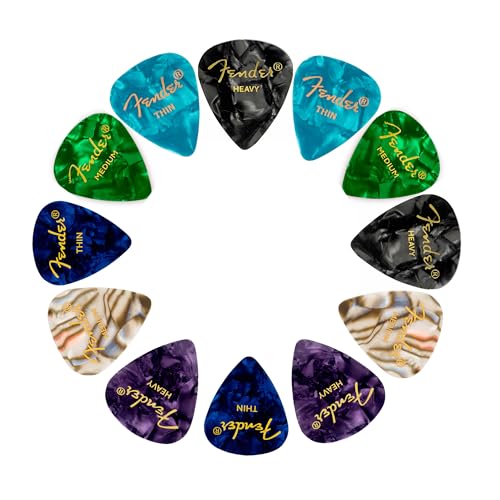
12. Fender Premium Picks Sampler – The 12-Pack That Solves the Pick Problem
- ✓Sampler includes Thin Medium and Heavy gauges
- ✓Iconic Fender 351 shape fits most players
- ✓Warm round celluloid tone with reduced pick noise
- ✓Great gift pack for finding preferred gauge
- ✓Compatible with guitar and bass
- ✕Celluloid wears faster than Delrin or nylon
- ✕Limited color variety in this pack
12 picks across Thin/Medium/Heavy gauges
Celluloid material
351 shape
Picks are the consumable every guitarist runs out of and never remembers to buy. The Fender Premium Picks Sampler solved a small but constant problem in my house: I never knew which gauge I wanted. This pack ships Thin, Medium, and Heavy gauges of Fender’s classic 351 shape, which covers about 90% of what players need.
This is the definition of a stocking stuffer gift. It is small, it costs under $15, and the musician will absolutely use every pick in the box. With 26,000+ reviews averaging 4.8 stars, it is one of the highest-rated pick packs ever sold.
For a beginner, the pack is a discovery tool — they can try three gauges without committing to a 50-pack. For a seasoned player, the pack restocks a depleted draw.
Why Celluloid Still Wins
Celluloid is the original guitar pick material and still preferred for its warm tone and grip. Modern picks made from Delrin, nylon, or ultem last longer, but they sound thinner to many players. If the musician in your life plays blues, jazz, classic rock, or country, celluloid is the right call.
Gauge Strategy and Playing Style
Thin picks (under .50 mm) work for light strumming and acoustic rhythm. Medium picks (.60 to .80 mm) are the most versatile. Heavy picks (.80 mm and up) work for lead lines, single-note runs, and aggressive strumming. The sampler lets players find their preferred gauge without buying five different packs.
Gift Pairing and Combos
Picks pair perfectly with strings, capos, or a guitar stand. I have wrapped a Sampler pack with a G7th capo and an Amazon Basics stand for under $50 as a “starter upgrade” bundle for new guitarists — a thoughtful, useful, affordable gift.
How to Choose the Right Gift for a Musician
Choosing a gift for a musician does not have to be stressful. The trick is matching the gift to three things: the musician’s instrument, their skill level, and the kind of setup they already own. Once you have those answers, the rest of the gift-picking is simple.
Match the Gift to the Musician Type
Guitarists and bassists almost always need more picks, strings, capos, cables, and stands than they already own. Drummers need sticks, practice pads, drum keys, and dampening gels. Producers and DJs need MIDI controllers, audio interfaces, studio headphones, and software. Vocalists and content creators need microphones, pop filters, and acoustic treatment. If you know which of these buckets your musician falls into, you can stop guessing.
Budget Tiers That Actually Make Sense
For a budget under $25, lean on consumables and accessories: picks, strings, drumsticks, practice pads, tuners, and earplugs. For $25 to $50, audio accessories and small electronics dominate: headphone stands, keychain tuners, and portable microphones. For $50 to $100, you enter real gear territory: MIDI controllers, audio interfaces, and studio headphones. Above $100, you can buy meaningful instrument upgrades, full microphones, or an entire starter home studio. Pick a tier and stay inside it.
Brands Musicians Recognize and Trust
Fender, Gibson, Shure, Audio-Technica, Sony, AKG, Yamaha, Roland, Boss, Focusrite, Akai, Native Instruments, Ableton, Korg, Donner, Pearl, Meinl, Rode, Tascam, and Teenage Engineering. A gift from any of these brands signals real musical knowledge. A gift with no brand recognition can feel risky, even if it is well made.
Health and Wellness Gifts That Go Overlooked
No competitor covers this in any depth, but our team’s research kept returning to the same insight: hearing protection, posture tools, and stress relief matter as much as new gear. Loop Experience 2 or Eargasm earplugs are a thoughtful gift for any gigging musician. Stretch straps, finger strengtheners, and ergonomic stool cushions are easy to find and universally appreciated.
Gift Cards as the Safe Escape Hatch
If you genuinely have no idea what to buy, a gift card to Sweetwater, Guitar Center, or Reverb is the right answer. Reddit musicians say the same thing in thread after thread — they would rather pick their own gear than receive the wrong one. Pair a gift card with a small physical gift (picks, strings, or an earplug set) and you have a thoughtful combo.
Gifts to Avoid (And Why)
Some gift categories look good in theory and disappoint in practice. Reddit threads on r/musicians are unanimous on what to skip.
Music-themed novelty items — mugs, t-shirts, socks, posters. Most musicians already own several and these gifts often end up in a drawer. They signal “I did not know what to buy” more than they signal thoughtfulness.
“Beginner” gear for advanced players — entry-level instruments, toy MIDI controllers, plastic drum sets. If your musician has been playing for years, anything that implies a beginner level can feel patronizing.
Brand mismatches on real gear — buying the wrong pickups, wrong cable type, or wrong string gauge. Musicians are picky about gear specs and brand preferences. If you are not sure, do not guess.
Anything that suggests you want them to perform for you — karaoke machines, harmonicas labeled “easy,” or beginner banjos as jokes. Comedy gifts at the expense of the recipient’s craft rarely land well.
Frequently Asked Questions
What are some good gift ideas for musicians?
Practical, brand-recognized gear wins every time. For guitarists and bassists, consider a clip-on tuner (the Fender FCT-2 is the safest pick), a folding guitar stand, or a multi-gauge picks sampler. For drummers, a Donner practice pad, premium sticks, or a drum multi-tool are reliable. For producers and DJs, the Focusrite Scarlett Solo audio interface, Akai MPK Mini MK3 MIDI controller, or Audio-Technica ATH-M20x headphones cover most home studio needs. For vocalists and content creators, the Blue Yeti USB microphone is a near-universal win. Add consumables (strings, picks, drumsticks) or hearing protection to round out the gift.
What do you buy a musician who already has everything?
Move off-stage with your gift. Quality-of-life items like a high-end coffee maker, a tea set, or a massage gun show you care about the person, not just the music identity. Experience gifts work too — concert tickets to an artist they admire, lessons with a teacher they respect, or a MasterClass subscription. For gear that they likely do not own, hearing protection like Loop Experience 2 earplugs or a guitar humidifier covers needs musicians often ignore. Gift cards to Sweetwater, Guitar Center, or Reverb are explicitly praised as safe, welcome gifts when the giver is unsure.
What does every musician need?
Every musician, regardless of instrument, relies on a few universal items: reliable headphones for monitoring and tracking, a working tuner of some kind (clip-on or pedal), proper hearing protection for live settings, and consumables for their primary instrument — strings, picks, drumsticks, rosin, or reeds. Beyond those, a way to record ideas (smartphone, audio interface, or portable recorder) and a comfortable place to practice round out the essentials. A backup SD card, a quality instrument cable, or a small flashlight for the gig bag are the small things musicians rarely replace on schedule.
Are music-themed gifts good for musicians?
Generally no — novelty mugs, t-shirts, and socks are the gift Reddit musicians consistently rank lowest. The exception is when the music-themed item has functional value: a metronome-shaped keychain, a pick-shaped bottle opener, a guitar wall mount that doubles as decor, or a vinyl record carrying case. These combine musical identity with daily use. Pure decoration is fine as a stocking stuffer, but pair it with a functional gift from this list to make sure your musician walks away with something they will actually use.
Final Verdict: Picking the Best Gift for Your Musician in 2026
If you want a single gift that every guitarist, bassist, or multi-instrumentalist will appreciate, the Fender FCT-2 clip-on tuner is my top recommendation. It is reliable, brand-trusted, and priced low enough for any gift budget. Pair it with a multi-gauge picks sampler and you have a thoughtful, useful, two-piece gift under $40.
For producers and home-studio musicians, the Focusrite Scarlett Solo 3rd Gen is the upgrade that unlocks serious recording. For creators who do livestreams, podcasts, or social video, the Blue Yeti USB microphone is the gift they will use every week. For drummers or anyone in a noise-restricted building, the Donner practice pad solves a daily problem. For a guitarist who already has a wall but no stand, the Amazon Basics folding guitar stand is the affordable upgrade they will not buy themselves.
Whatever you choose, lean on known brands, practical function, and thoughtful consumables. Pair any gear gift with consumables (strings, picks, drumsticks) or hearing protection (Loop Experience 2 or Eargasm) and you will walk away with a gift that respects the musician’s craft. Our team updates this list of the best gifts for musicians every quarter, so bookmark it for the next birthday, anniversary, or holiday.
For more recommendations on the gear musicians use daily, check out our 8 Best Headphones Musicians Complete Studio Guide and our 8 Best Guitar Stands Top Picks for Musicians.



Leave a Comment