
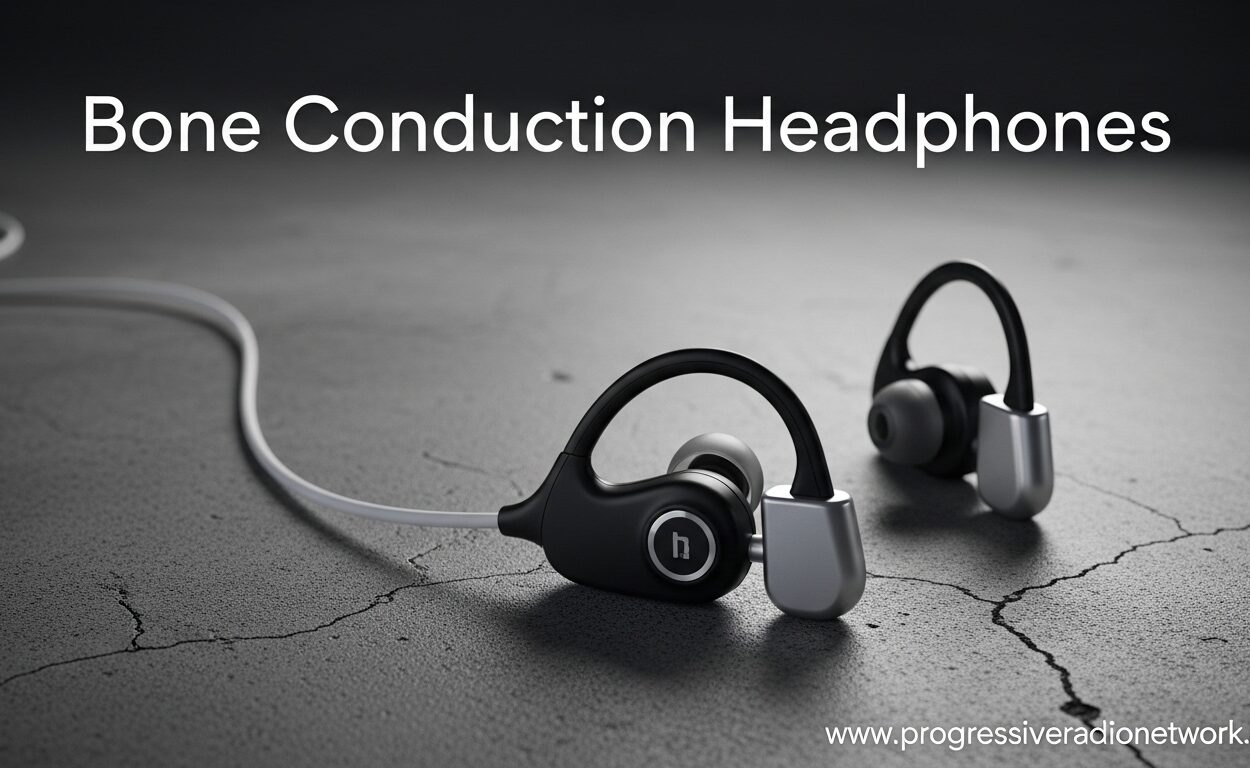
Bone conduction headphones transmit sound through vibrations along your cheekbones directly to your inner ear, completely bypassing your eardrums. This technology allows you to hear both your music and your surroundings simultaneously, creating a unique listening experience that traditional headphones cannot replicate.
When I first tried bone conduction headphones during a marathon training session three years ago, I was skeptical. How could vibrations through my skull possibly deliver clear audio? Yet there I was, hearing my running playlist perfectly while also hearing approaching cars, cyclists calling out, and fellow runners chatting. The same technology that composer Ludwig van Beethoven used to hear music after going deaf now sits in a lightweight device wrapped around my temples.
This technology also mirrors how marine mammals communicate underwater and how elephants detect distant sounds through their feet. Understanding how bone conduction headphones work reveals a fascinating intersection of anatomy, physics, and modern engineering.
How Do Bone Conduction Headphones Actually Work?
Bone conduction headphones operate on a simple yet brilliant principle: your skull bones can transmit sound vibrations directly to your cochlea, the spiral-shaped organ in your inner ear that converts vibrations into electrical signals for your brain. This bypasses the entire outer and middle ear system that traditional headphones rely upon.
The process involves five distinct steps that happen in milliseconds. First, a transducer within the headphone converts your device’s electrical audio signal into mechanical vibrations. Second, these vibrations travel through the transducer’s contact point with your cheekbone, typically positioned just in front of your ear on the temporal bone. Third, the vibrations propagate through your skull bones, following the path of least resistance toward your inner ear structures.
Fourth, the vibrations reach your cochlea and stimulate the fluid-filled chambers within, causing the basilar membrane to move hair cells that generate neural signals. Finally, your auditory nerve carries these signals to your brain, which interprets them as sound. All of this happens without a single sound wave traveling through the air in your ear canal.
Modern bone conduction headphones use two primary transducer technologies. Piezoelectric transducers use crystals that vibrate when electrical current passes through them, creating extremely efficient mechanical movement with minimal power consumption. Electromagnetic transducers function like tiny speakers where a voice coil moves a magnetic mass against your bone, producing stronger vibrations but requiring more energy and generating slightly more heat.
The placement of these transducers matters significantly. Manufacturers position them against the zygomatic arch or temporal bone because these facial bones provide excellent vibration transmission properties while remaining accessible without invasive contact. Your cheekbones offer a sweet spot of density and proximity to the cochlea.
Bone Conduction vs Traditional Headphones
To appreciate why bone conduction sounds different, you need to understand how traditional air conduction headphones work. Standard earbuds and over-ear headphones generate sound waves that travel through the air in your ear canal, hit your eardrum (tympanic membrane), move three tiny bones called ossicles in your middle ear, and finally reach your cochlea.
This air conduction pathway has evolved over millions of years to deliver rich, detailed sound with excellent frequency response across lows, mids, and highs. Your outer ear’s pinna even shapes sound waves to help your brain locate sounds in space. When you use traditional headphones, you harness this entire biological audio system that nature perfected.
Bone conduction takes a shortcut. By stimulating your cochlea directly through skull vibrations, it bypasses the resonant chambers of your ear canal and the mechanical amplification of your ossicles. This direct path sacrifices some frequency response, particularly in the low bass range where longer sound waves require more energy to transmit through bone.
The result is audio that feels slightly thinner and less bass-heavy than what you experience with in-ear monitors. However, this trade-off delivers something air conduction cannot: complete environmental awareness. Your ear canals remain open, allowing ambient sound to reach your eardrums naturally while the bone conduction audio overlays your awareness.
A Technology Beethoven Discovered Centuries Ago
The story of bone conduction begins with one of history’s greatest composers facing one of music’s cruelest ironies. By 1810, Ludwig van Beethoven had lost nearly all his hearing, yet continued composing some of his most profound works. Desperate to hear his own piano playing, he discovered that clamping a rod between his teeth and pressing the other end against his piano transmitted vibrations through his jawbone directly to his inner ear.
This primitive bone conduction device allowed the deaf composer to perceive enough pitch and timing to continue creating masterpieces. His 9th Symphony, including the famous Ode to Joy, was composed largely after he had gone completely deaf, likely with the assistance of bone conduction experiments similar to his rod technique.
Military applications emerged during World War II when bone conduction communication systems allowed tank crews and pilots to hear radio commands while maintaining awareness of their environment. The technology remained largely confined to military, medical, and industrial applications until the early 2000s, when miniaturization and improved transducer efficiency made consumer bone conduction headphones practical.
Today, companies like Shokz (formerly AfterShokz) have refined the technology through multiple generations, reducing weight, improving battery life, and enhancing sound quality while maintaining the core benefit of open-ear audio transmission. What began as Beethoven’s desperate improvisation has become a mainstream audio category with applications far beyond what the composer could have imagined.
How Whales and Elephants Use Bone Conduction
Bone conduction is not merely a human invention; it represents one of nature’s ancient communication strategies. Marine biologists have documented that whales and dolphins use bone conduction extensively for underwater hearing, where traditional air conduction fails completely because sound waves behave differently in water than in air.
Research published in 2015 demonstrated that toothed whales receive echolocation signals through their lower jaws, which contain fat-filled cavities that transmit vibrations to their middle and inner ears. This jawbone hearing pathway allows them to detect prey and navigate through dark ocean depths using sound.
Elephants take bone conduction even further. These massive mammals generate low-frequency rumbles through their vocal cords that travel through the ground as seismic waves. Other elephants detect these vibrations through their feet and legs, where the bones transmit signals to their inner ears. This allows elephant herds to communicate across distances exceeding two miles, coordinating movements and warning of danger without making audible sounds detectable by predators.
These natural precedents validate bone conduction as a robust, evolutionarily tested mechanism for sound perception. Your skull is already designed to transmit vibrations; bone conduction headphones simply harness this capability with precision engineering.
Why People Choose Bone Conduction Technology
The primary advantage of bone conduction headphones is situational awareness. When you wear them, nothing blocks your ear canals. You hear traffic approaching while cycling, runners calling out behind you on trails, and colleagues trying to get your attention at work. This open-ear design has made bone conduction headphones for cycling the preferred choice for safety-conscious riders.
Runners particularly benefit from this awareness. Many organized races now require bone conduction headphones because in-ear devices create liability issues by blocking instructions from race officials, emergency vehicle sirens, and warnings from other participants. England Athletics officially partnered with Shokz to promote bone conduction technology for runner safety.
Hygiene represents another significant advantage. Traditional earbuds insert into warm, moist ear canals where bacteria thrive. Bone conduction headphones never touch your ear canal, eliminating earwax buildup on drivers, reducing infection risk, and keeping your ears naturally ventilated. For people prone to ear infections or who find earbuds uncomfortable, this external placement solves multiple problems simultaneously.
Waterproof bone conduction models have revolutionized aquatic audio. Because they do not rely on ear seals that water would compromise, bone conduction headphones for swimming can deliver music during lap sessions where traditional waterproof earbuds fail. The vibrations transmit through your skull even when submerged.
Perhaps most importantly, bone conduction technology provides audio access for people with certain hearing impairments. Individuals with conductive hearing loss, where the outer or middle ear is damaged but the cochlea remains functional, can hear through bone conduction when traditional headphones fail. Bone conduction for hearing impaired users represents a significant accessibility application that manufacturers increasingly prioritize.
The Downsides You Should Know About
No technology is perfect, and bone conduction headphones make audible trade-offs for their unique benefits. The most immediately noticeable limitation is sound quality. When you bypass the resonant chambers of your outer ear, you lose acoustic properties that shape and enrich sound. The result is audio that users frequently describe as thinner, flatter, or less immersive than traditional headphones.
Bass response suffers particularly. Low-frequency sounds require moving more air mass, and vibrating your skull to recreate deep bass demands significant energy. At higher volumes attempting to compensate, you may experience a tickling or buzzing sensation where the transducers contact your cheekbones. This vibration intensity can become uncomfortable during extended listening sessions or when playing bass-heavy music.
Sound leakage presents another practical concern. Because bone conduction headphones are essentially small speakers pressed against your head, some audio escapes into the surrounding environment. At normal listening volumes in quiet offices, colleagues within three feet may hear faint traces of your music. Crank the volume to overcome wind noise during outdoor activities, and nearby people will definitely hear what you are playing.
Volume limitations also constrain the experience. Your skull can only handle so much vibration intensity before discomfort becomes unavoidable. In noisy environments like airplanes or busy gyms, bone conduction headphones may not achieve sufficient volume to overcome ambient noise, even at maximum settings. They excel in moderate noise environments but struggle where extreme isolation is required.
Who Should Use Bone Conduction Headphones?
The ideal bone conduction user prioritizes safety and awareness over audiophile sound quality. If you run on roads with vehicle traffic, best bone conduction headphones for running provide entertainment without compromising your ability to hear approaching hazards. The same applies to cyclists navigating shared paths, hikers on trails with mountain bikers, and anyone exercising in environments requiring environmental awareness.
Swimmers represent another perfect match. Waterproof bone conduction models with IP67 or IPX8 ratings survive complete submersion while delivering consistent audio that does not depend on ear seals. The underwater experience differs from air listening due to bone’s different acoustic properties in water, but music remains audible and motivating throughout your workout.
Office workers who need to remain available for interruptions benefit from bone conduction’s dual-input capability. You can concentrate on podcasts or focus music while hearing when someone calls your name or approaches your desk. This eliminates the social friction of removing earbuds every time a colleague needs your attention.
People with specific hearing conditions find bone conduction transformative. Those with conductive hearing loss, single-sided deafness, or certain types of tinnitus report that bone conduction provides audio access impossible with traditional headphones. Some users with tinnitus specifically use bone conduction devices to deliver masking sounds that help manage their symptoms without blocking environmental awareness.
Conversely, if you primarily listen in quiet environments, prioritize bass-heavy music genres, or require complete audio isolation, traditional headphones or quality earbuds remain the better choice. Bone conduction fills specific niches exceptionally well but does not replace conventional audio equipment for every scenario.
Frequently Asked Questions
What are the disadvantages of bone conduction headphones?
The main disadvantages include reduced sound quality compared to in-ear headphones, weak bass response, sound leakage that others nearby can hear, a tickling vibration sensation at higher volumes, and volume limitations that make them unsuitable for very noisy environments. They also require proper placement against your cheekbones to work effectively.
Can a deaf person hear with bone conduction?
It depends on the type of hearing loss. Bone conduction works for people with conductive hearing loss where the outer or middle ear is damaged but the cochlea and auditory nerve remain functional. It bypasses damaged eardrums and ossicles. However, it does not help those with sensorineural hearing loss affecting the cochlea or auditory nerve directly.
Can people hear what you’re listening to with Shokz?
At normal listening volumes in typical environments, people more than three feet away cannot hear your audio. However, at higher volumes or in quiet spaces, some sound leakage occurs. The leakage is generally less noticeable than from open-back traditional headphones but more than from sealed in-ear monitors. Social distancing in public spaces usually prevents others from hearing your content.
Do bone conduction earphones actually work?
Yes, bone conduction technology is scientifically proven and has been used for decades in military, medical, and hearing aid applications. The technology works by transmitting vibrations through your skull bones to stimulate your cochlea directly. Millions of users worldwide successfully use bone conduction headphones for running, cycling, swimming, and daily listening.
How do the bone conduction headphones work?
Bone conduction headphones use transducers to convert electrical audio signals into mechanical vibrations. These vibrations travel through your cheekbones and skull directly to your inner ear’s cochlea, stimulating the fluid and hair cells that generate neural signals your brain interprets as sound. This bypasses your eardrum and outer ear entirely.
What is the downside of bone conduction headphones?
The primary downsides are inferior sound quality compared to traditional headphones, particularly weak bass response, and the fact that others nearby may hear your audio at higher volumes. Some users also experience a tickling sensation from the vibrations at maximum volume. They are not ideal for very noisy environments where volume limitations prevent overcoming ambient noise.
Why do races only allow bone conduction headphones?
Running races increasingly restrict in-ear headphones for safety reasons. Bone conduction headphones allow runners to hear race official instructions, approaching vehicles, emergency sirens, and warnings from other participants. England Athletics officially recognizes bone conduction technology as safe for road running because the open-ear design preserves situational awareness that sealed earbuds eliminate.
Final Thoughts
Bone conduction headphones represent one of audio technology’s most elegant solutions to a fundamental problem: how to enjoy personal audio without disconnecting from your environment. By understanding how bone conduction headphones work, you can make informed decisions about whether this technology matches your specific needs.
The technology proves especially valuable for outdoor athletes, swimmers, office workers needing availability, and individuals with certain hearing conditions. While sound quality trade-offs exist, the safety benefits and situational awareness often outweigh audiophile concerns for active lifestyles.
As transducer technology continues improving and manufacturers refine vibration delivery systems, the gap between bone conduction and traditional audio quality keeps narrowing. What began as Beethoven’s desperate improvisation has evolved into a mature technology category serving millions of users who refuse to choose between their music and their safety. Whether you are training for a marathon, commuting through busy streets, or simply seeking an alternative to earbuds, bone conduction offers a compelling approach that leverages the natural audio capabilities of your own anatomy.





Leave a Comment