
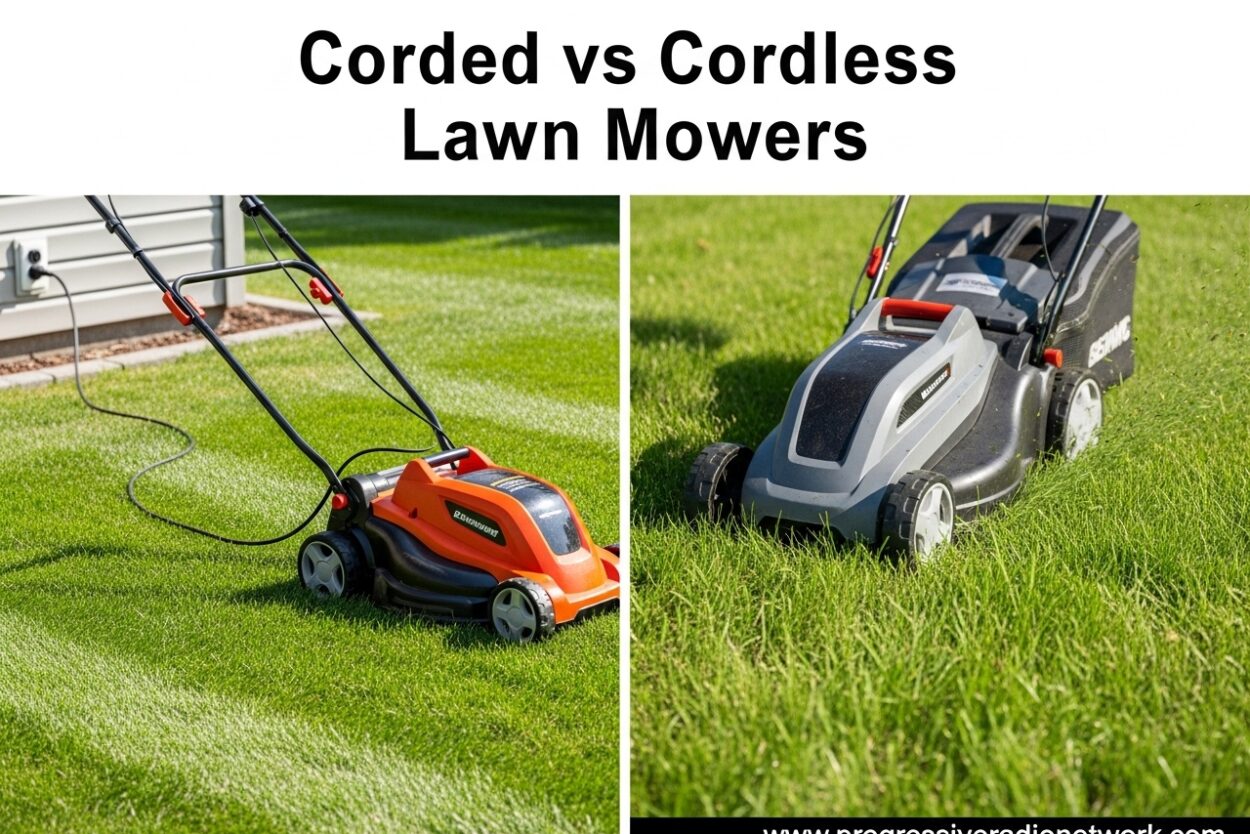
When it’s time to replace your old gas mower or upgrade from manual push power, you’re likely facing the corded vs cordless lawn mowers dilemma. Both electric options offer significant advantages over gas mowers – no fumes, less maintenance, quieter operation – but they work very differently. The choice you make will affect your mowing experience every single weekend for years to come.
I’ve spent years researching lawn equipment and talking with homeowners who’ve made the switch to electric. The right choice depends almost entirely on your lawn size, layout, and budget. Let me break down everything you need to know to make the right decision for your specific situation.
Before we dive in, if you’re looking for electric lawn mower deals, check out our guide to current promotions. Both corded and cordless models go on sale throughout the year.
Corded Vs Cordless Lawn Mowers: The Core Difference
A corded lawn mower is an electric mower that draws continuous power from a wall outlet through an extension cord. You’re tethered to your electrical supply, but you never run out of battery mid-mow. Corded mowers typically range from 12-15 amps and plug into standard household outlets.
A cordless lawn mower runs on rechargeable lithium-ion batteries, usually ranging from 40V to 80V systems. You get complete freedom to move anywhere in your yard without managing a cord, but you’re limited by battery runtime. Most cordless mowers provide 30-80 minutes of cutting time per charge, depending on grass conditions and battery capacity.
What is a Corded Lawn Mower?
Corded electric mowers have been around for decades and remain a reliable choice for many homeowners. They use standard household electricity (120V in the US) delivered through a heavy-duty extension cord. The motor converts this electrical energy directly into cutting power, providing consistent performance until you turn it off or unplug it.
These mowers typically feature 12-15 amp motors, which translates to roughly 1,440-1,800 watts of cutting power. That’s plenty for most residential lawns. They’re simpler machines than cordless models – no battery management systems, no charging circuits, just a motor and a switch.
The main limitation is obvious: you can only mow as far as your extension cord reaches. Most manufacturers recommend staying within 100 feet of your outlet, though some users push this limit with heavier gauge cords. You also need accessible outdoor outlets or a safe way to run power from inside.
What is a Cordless Lawn Mower?
Cordless mowers represent the newer wave of electric lawn equipment, powered by rechargeable battery packs similar to what powers your phone or laptop – but much larger and more powerful. Most modern cordless mowers use lithium-ion batteries in 40V, 56V, 60V, or 80V configurations.
The voltage isn’t the only factor that matters. Battery capacity (measured in amp-hours) determines runtime, while motor efficiency (brushless vs brushed) affects how much power you get from that energy. Higher-end cordless mowers often feature multiple batteries that can be swapped for extended runtime.
These mowers have exploded in popularity because they solve the cord management problem entirely. You can mow around trees, through gates, and across obstacles without thinking about your power source. The trade-off is that you need to plan your mowing around battery life and charging time.
Corded Lawn Mower Pros: The Advantages
Unlimited runtime tops the list of advantages. As long as you have power, you can keep mowing. This is huge for larger properties or when you’re behind schedule and need to knock out the entire yard in one session. No stopping to swap batteries or waiting for recharging.
Corded mowers cost significantly less upfront. You’re typically paying $150-300 less than an equivalent cordless model. That’s substantial money that could go toward other lawn care equipment or lawn care equipment like trimmers and blowers.
They’re lighter without the battery pack. A corded mower might weigh 10-15 pounds less than its cordless counterpart, making it easier to push, especially for those with physical limitations. Lighter weight also means less turf damage when turning.
Consistent power delivery is another plus. Corded mowers don’t experience power drop-off as they run. You get the same cutting performance in minute 60 as you did in minute one. No gradual slowing as the battery drains.
Zero battery replacement costs over the mower’s lifespan. Cordless batteries typically need replacement every 3-5 years at $100-200 each. Corded mowers avoid this ongoing expense entirely.
Corded Lawn Mower Cons: The Drawbacks
Cord management is the obvious frustration. You’re constantly aware of the cord’s position, planning your mowing pattern to avoid running over it. It’s like having a stubborn snake following you around the yard. This can be genuinely annoying in yards with lots of obstacles.
Limited range from your outlet restricts where you can mow. Most corded mowers are effectively limited to about 100 feet from the power source, even with heavy-duty extension cords. Larger properties simply aren’t practical candidates.
You need accessible outdoor electrical outlets. If your home lacks exterior GFCI outlets, you’ll need to install them or run cords through doors/windows (which creates safety concerns). This adds cost and complexity.
Cord safety hazards are real. It’s easy to accidentally cut the extension cord if you’re not careful. You also need to be mindful of the cord when children or pets are around. Rainy conditions create additional safety concerns.
Less suitable for yards with lots of obstacles. Trees, gardens, and landscaping features make cord management exponentially more difficult. Every obstacle becomes a potential cord-snagging point.
Cordless Lawn Mower Pros: The Freedom
Complete freedom of movement is the game-changer. Mow wherever you want without thinking about power cords. Navigate around trees, through narrow passages, across driveways – zero restrictions. This convenience factor is hard to overstate.
Perfect for yards with obstacles and landscaping. Trees, flower beds, walkways – none of these complicate your mowing pattern. You can push the mower anywhere without planning around a cord’s path.
Works great on sloped terrain. No cord to manage on hills means safer mowing on inclines. You’re not fighting gravity and a stubborn cord simultaneously.
Ideal for larger properties. With multiple batteries or quick charging, you can tackle substantial lawns that would be impossible with a corded model. Many cordless owners keep two batteries and swap them out.
No outlet dependency. Mow anywhere regardless of electrical access. This is huge for properties with limited outdoor outlets or where running extension cords would be impractical.
Portability for multiple properties. Easily transport the mower between homes without worrying about different outlet configurations. Throw it in the truck and go.
Cordless Lawn Mower Cons: The Limitations
Limited runtime per charge is the fundamental constraint. Most cordless mowers provide 30-60 minutes of actual cutting time in real-world conditions. That might not be enough for larger lawns, especially if grass is thick or wet.
Battery degradation over time is inevitable. Even with proper care, lithium-ion batteries lose capacity after 3-5 years of regular use. You’ll notice gradually decreasing runtime until replacement becomes necessary.
Higher upfront cost creates a steeper entry barrier. Quality cordless mowers typically run $400-800+ versus $200-400 for corded models. That’s a significant investment, especially if you’re transitioning from gas.
Battery replacement costs add up over time. Expect to spend $100-200 every 3-5 years for new batteries. Over a 10-year ownership period, that’s $300-600 in additional costs that corded owners never face.
Charging time creates planning requirements. Most batteries take 60-120 minutes to fully recharge. If your mower needs multiple batteries to finish the lawn, you’re looking at significant time investment.
Power can decrease as battery drains. While modern batteries maintain voltage well, you may notice reduced performance in the final minutes of a charge. This can be frustrating when tackling tough patches at the end of a mowing session.
Heavier weight affects maneuverability. Battery packs add 15-25 pounds depending on voltage and capacity. This matters for those who struggle with heavier equipment or have physical limitations.
Power and Performance: Which Actually Cuts Better?
Here’s what most people don’t realize: corded mowers often deliver more consistent cutting power than cordless models. A 15-amp corded mower produces roughly 1,800 watts continuously. A typical 40V cordless mower might produce 1,000-1,200 watts, with higher voltage systems approaching corded performance.
In real-world mowing, this means corded mowers often handle thick, tall, or wet grass better than their cordless counterparts. They don’t bog down as easily because they’re drawing consistent power from the grid. Many Reddit users report that corded mowers power through overgrown grass that would stall a cordless model.
However, modern high-voltage cordless mowers (80V systems) have narrowed this gap significantly. Premium cordless models with brushless motors can now match or exceed corded performance, though at a much higher price point. The technology gap continues to shrink.
The key consideration: most residential lawns don’t need maximum power. If you maintain a regular mowing schedule and don’t let grass get overgrown, either option will handle typical cutting duties just fine. Power differences become apparent only in challenging conditions.
Lawn Size: Which Mower Fits Your Yard?
Small lawns under 1/4 acre (approximately 10,000 square feet) are ideal for corded mowers. You can easily cover this area within the 100-foot cord range, and you’ll never run out of power mid-mow. The lower cost and lighter weight make corded the practical choice here.
Medium lawns between 1/4 and 1/2 acre can go either way. If your lawn layout is simple and close to outlets, corded might work. But if you have lots of obstacles or distant corners, cordless becomes more attractive despite the higher cost.
Large lawns over 1/2 acre increasingly favor cordless models. The cord management becomes impractical at this scale, and you’ll likely need multiple corded setups or very creative outlet positioning. Cordless with multiple batteries becomes the more convenient option.
Yard shape matters too. Long, narrow lawns are corded-friendly. Odd-shaped lawns with multiple levels, distant corners, or lots of landscaping favor cordless convenience. Consider your actual mowing pattern, not just total square footage.
Cost Comparison: Upfront and Long-Term
Let’s break down the real costs over a 10-year ownership period. Corded mowers typically cost $200-400 upfront. Add $50-100 for a quality extension cord. That’s your total investment – no additional costs unless something breaks.
Cordless mowers typically cost $400-800+ upfront for quality models. Factor in $100-200 every 3-5 years for battery replacements. Over 10 years, you might spend $300-600 on replacement batteries alone. Many cordless owners also purchase extra batteries ($100-200 each) for extended runtime.
The 10-year total often looks like this: Corded ($250-450 total) versus Cordless ($700-1,400+ total). The cordless option can cost 2-3 times more over its lifespan. However, cordless owners often argue the convenience premium is worth every penny.
Electricity costs are minimal for both types. Corded mowers use about 1.2-1.8 kWh per hour of operation. At average US electricity rates, that’s roughly $0.15-0.25 per hour of mowing. Cordless charging costs are similar, just measured in battery cycles rather than continuous draw.
Battery Lifespan and Replacement Costs
Lithium-ion batteries typically last 3-5 years with proper care, though some users report 5-7 years from premium batteries. The lifespan depends heavily on usage patterns, storage conditions, and how often you fully discharge the batteries.
Extreme temperatures are battery killers. Storing batteries in a garage that reaches 100°F in summer or freezing temperatures in winter will significantly reduce lifespan. The sweet spot is around 60-80°F – which often means bringing batteries indoors during extreme weather.
Replacement costs vary by voltage and brand. Budget $100-150 for 40V-56V batteries, $150-200+ for 60V-80V systems. Some manufacturers offer battery recycling programs or discounts when trading in old batteries.
Pro tip: don’t buy more battery than you need. If your lawn takes 45 minutes to mow, a 60-minute battery provides adequate buffer without paying for excess capacity you’ll rarely use. Matching battery capacity to your actual needs optimizes value.
Extension Cord Requirements and Safety
If you choose corded, invest in a quality extension cord. Use 14-gauge wire for cords up to 50 feet, 12-gauge for 50-100 feet. Never exceed 100 feet total cord length – voltage drop will reduce mower performance and could damage the motor.
Look for cords rated specifically for outdoor use with water-resistant connections. Yellow or orange cords are easier to see in grass. Consider a cord with built-in GFCI protection for additional safety, especially if your outdoor outlets lack this feature.
Mowing pattern matters with corded mowers. Start near the outlet and work away in straight lines, then return in the opposite direction. This minimizes cord crossings. Always keep the cord behind you and in your line of sight.
Safety first: never cut the extension cord. If you do accidentally cut it, replace it immediately – don’t attempt a repair that could fail and cause injury or damage. Keep children and pets away from the cord during operation.
When to Choose a Corded Lawn Mower
Choose corded if you have a small to medium-sized lawn (under 1/4 acre) with simple layout and accessible outdoor outlets. Budget-conscious buyers will appreciate the lower upfront cost and minimal long-term expenses. Those who prioritize simplicity and reliability over convenience often prefer corded.
Physical limitations make the lighter weight of corded mowers attractive for some users. If you struggle with heavy equipment, the 10-15 pound weight difference matters. Apartment or condo owners with small shared green spaces often find corded perfect for their limited needs.
Anyone who values “buy it once and forget it” simplicity will appreciate corded mowers. No battery management, no charging routines, no replacement costs. Plug it in and mow – same as it’s been done for decades.
When to Choose a Cordless Lawn Mower
Choose cordless if your lawn exceeds 1/4 acre or has complex landscaping with lots of obstacles. Convenience-focused users who want to grab the mower and go without cord management will love the cordless experience. Larger property owners who need to mow distant areas from any outlet should go cordless.
Those who already own other cordless outdoor power tools from the same brand can benefit from battery interoperability. One battery platform can power your mower, trimmer, blower, and chainsaw – reducing total investment.
If budget allows for the higher upfront cost and you prioritize freedom and convenience above all, cordless delivers the superior user experience. The frustration-free mowing pattern is genuinely transformative compared to managing a cord.
Maintenance Comparison: Both Win Over Gas
Both corded and cordless electric mowers are dramatically lower maintenance than gas mowers. No oil changes, no spark plugs, no fuel stabilization, no air filters, no winterizing procedures. Just keep the blade sharp and the deck clean.
Corded mowers are slightly simpler – no battery maintenance to worry about. Cordless owners should follow battery care guidelines: store at partial charge (around 50%), avoid extreme temperatures, and don’t leave batteries on the charger indefinitely.
Blade sharpening is the same for both types – typically once per season or more depending on use. Deck cleaning prevents grass buildup and maintains cutting efficiency. Both types benefit from an annual check of fasteners and wheels.
Compared to gas mowers, both electric options save approximately 2-3 hours of maintenance time per year and $100-200 in annual maintenance costs. This is a major reason many homeowners are making the switch.
Noise and Environmental Impact
Both corded and cordless mowers are significantly quieter than gas mowers – typically 60-75 decibels versus 85-95+ decibels for gas. This allows for early morning or late evening mowing without disturbing neighbors. Many users pair their electric mower with hearing protection for mowing or music headphones.
Environmentally, both electric options produce zero direct emissions. No exhaust fumes, no spilled gasoline, no oil disposal issues. The environmental difference between corded and cordless is minimal – the main distinction is battery manufacturing and eventual recycling for cordless models.
Electricity source matters for overall environmental impact. If your electricity comes from renewable sources, corded mowers are essentially carbon-free in operation. Cordless mowers have embedded carbon from battery manufacturing but still typically outperform gas mowers over their lifecycle.
FAQ
Is a corded or cordless lawn mower better?
Neither is universally better – the right choice depends on your lawn size and needs. Corded mowers are better for small lawns under 1/4 acre with simple layouts, offering lower cost and unlimited runtime. Cordless mowers are better for medium to large lawns with obstacles, providing freedom of movement and convenience. Both are superior to gas mowers in maintenance, noise, and ease of use.
What is a major disadvantage of battery operated lawn mowers?
The biggest disadvantage of battery operated lawn mowers is limited runtime. Most cordless mowers provide 30-60 minutes of cutting time per charge, which may not be sufficient for larger lawns. Additionally, batteries degrade over 3-5 years, requiring replacement at $100-200 each. This creates ongoing costs that corded mower owners never face, and means planning your mowing around charging time.
How long do cordless lawn mower batteries last?
Cordless lawn mower batteries typically last 3-5 years with proper care, though premium batteries can last 5-7 years. Lifespan depends on usage patterns, storage conditions (avoid extreme temperatures), and charging habits. Replacement costs range from $100-200 per battery depending on voltage and brand. Storing batteries at partial charge around room temperature when not in use maximizes lifespan.
Can you use extension cord with any corded mower?
Yes, but you must use the correct gauge and length. Use 14-gauge cord for up to 50 feet, 12-gauge for 50-100 feet. Never exceed 100 feet total length or voltage drop will damage the motor. Only use outdoor-rated cords with water-resistant connections. The cord must be rated for the mower’s amperage (typically 12-15 amps). Using undersized or overly long cords creates fire hazards and can void warranties.
Are corded mowers more powerful than cordless?
Generally yes, corded mowers deliver more consistent power. A 15-amp corded mower produces roughly 1,800 watts continuously, while typical 40V cordless mowers produce 1,000-1,200 watts. This means corded mowers often handle thick, wet, or tall grass better without bogging down. However, modern 80V cordless systems with brushless motors can match or exceed corded performance, though at a significantly higher price point. For typical lawn conditions, both provide adequate power.
Is a corded lawn mower worth it?
Corded lawn mowers are absolutely worth it for the right situation. If you have a small to medium lawn (under 1/4 acre) near outdoor outlets, corded mowers offer unbeatable value at $200-400 versus $400-800+ for cordless. You get unlimited runtime, lighter weight, zero battery replacement costs, and simpler maintenance. The only downside is cord management, which becomes negligible on smaller properties. Over 10 years, corded owners typically spend 50-70% less total than cordless owners.
What size lawn is too big for corded mower?
Lawns larger than 1/4 acre (approximately 10,000 square feet) become challenging for corded mowers. The practical limit is around 100 feet from your outlet due to extension cord length restrictions. Even with heavy-duty 12-gauge cords, voltage drop and cord management become problematic beyond this distance. For lawns over 1/4 acre, especially those with obstacles or complex layouts, cordless mowers become the more practical and convenient choice despite higher upfront costs.
Final Verdict
There’s no universal winner between corded and cordless lawn mowers – the best choice depends entirely on your specific situation. Small lawn, tight budget, simple layout? Corded delivers unbeatable value and simplicity. Larger property, lots of obstacles, convenience matters? Cordless provides the freedom and flexibility that make mowing less of a chore.
Both options represent a massive upgrade from gas mowers in terms of maintenance, noise, and ease of use. You really can’t go wrong either way – you’re just choosing which set of limitations bothers you less: cord management or battery management.
My recommendation: be honest about your lawn size and mowing habits. If you’ll truly only mow small areas near the house, save money and go corded. If you want the freedom to mow anywhere without thinking about power sources, invest in cordless. Either way, welcome to the future of lawn care – it’s quieter, cleaner, and easier than ever before.

Leave a Comment