

When you’re shopping for an air conditioner, furnace, or heat pump, you’ll see BTU ratings everywhere. What Is Btu? BTU stands for British Thermal Unit, and it’s the standard measurement for heat energy in heating and cooling equipment. Simply put, one BTU is the amount of heat required to raise the temperature of one pound of water by one degree Fahrenheit. This measurement tells you how much heating or cooling power an HVAC system can deliver per hour.
Understanding BTU helps you choose the right equipment size for your home. I’ve worked with homeowners for years who struggled with uncomfortable rooms and high energy bills, all because they didn’t understand BTU sizing. The wrong BTU rating means your system works harder, costs more to run, and fails to keep you comfortable. Let me break down exactly what BTU means and how to use it when selecting HVAC equipment.
What Is BTU? The Complete Definition
A British Thermal Unit measures thermal energy. It originated in the 1800s when engineers needed a standard way to quantify heat. The definition is precise: one BTU equals the amount of heat energy required to raise one pound of water by one degree Fahrenheit at sea level.
Here’s a simple way to visualize BTU. A single wooden kitchen match burning completely releases approximately one BTU of heat energy. That tiny flame? That’s one BTU. A typical home air conditioner might remove 12,000 to 24,000 BTU of heat per hour. Think of that as 12,000 to 24,000 matches worth of heat being pulled from your home every 60 minutes.
BTU differs from other energy units but serves the same purpose. One BTU equals about 1,055 joules in the metric system. The joule is the international standard for energy, but BTU remains the preferred unit in American HVAC and fuel industries. You’ll also see BTU used to measure the energy content of natural gas, propane, heating oil, and other fuels.
The Energy Information Administration uses BTU extensively because it provides a common language to compare different energy sources. A cubic foot of natural gas contains about 1,037 BTU. A gallon of propane contains about 91,500 BTU. This lets homeowners and contractors compare fuel costs directly, regardless of the energy source.
BTU in HVAC: How It Powers Your Home Comfort
BTU in HVAC works differently depending on whether you’re heating or cooling. For air conditioners and heat pumps in cooling mode, BTU measures heat removal. An 18,000 BTU air conditioner removes 18,000 BTU of heat from your home each hour. This is why air conditioners are often called “heat movers” rather than “cool makers” — they literally move heat from inside to outside.
Furnaces use BTU to measure heat output. A 60,000 BTU furnace produces 60,000 BTU of heat per hour when running at full capacity. This heat warms the air that circulates through your ductwork and into your living spaces. Higher BTU furnaces can heat larger homes or homes in colder climates.
Heat pumps use BTU for both heating and cooling. A 3-ton heat pump provides approximately 36,000 BTU of cooling in summer and heating in winter. The same BTU rating applies to both modes, though actual heating capacity drops in very cold temperatures. This dual function makes BTU particularly important for heat pump sizing.
BTUH (BTU per hour) is the more precise term you’ll see on equipment specs. All the BTU numbers I’ve mentioned are actually BTUH, but the industry often shortens this to just “BTU.” When you see “12,000 BTU” on an AC unit, it means 12,000 BTU per hour of cooling capacity. This hourly rate matters because HVAC equipment runs continuously when maintaining temperature.
BTU to Tons: Understanding the 12,000 BTU Conversion
One ton of cooling equals 12,000 BTU per hour. This seemingly arbitrary number comes from historical context. Before modern refrigeration, cooling was measured by how many tons of ice a system could melt in 24 hours. One ton of ice requires 288,000 BTU to melt completely. Divide that by 24 hours, and you get 12,000 BTU per hour.
So what does 12000 BTU mean? It means one ton of cooling capacity. A 2-ton air conditioner provides 24,000 BTU of cooling. A 3.5-ton system delivers 42,000 BTU. Most residential air conditioners range from 1.5 tons (18,000 BTU) to 5 tons (60,000 BTU). Larger homes or commercial spaces use multiple units or bigger systems.
Tonage and BTU are interchangeable in the HVAC industry. Contractors often say “tons” while equipment labels show “BTU.” This historical measurement stuck around because it’s convenient for quick sizing. A 2,000 square foot home might need a 4-ton system, which is easier to discuss than 48,000 BTU.
The ton to BTU conversion is exact, never approximate. Every ton is precisely 12,000 BTU. This standardization helps when comparing equipment from different manufacturers. Whether you’re looking at Carrier, Trane, Lennox, or Goodman, a 3-ton unit always means 36,000 BTU of capacity.
How Many BTU Per Square Foot? Complete Sizing Guide
BTU per square foot provides a quick starting point for sizing HVAC equipment. The general rule is 20 BTU per square foot for cooling. A 1,000 square foot room would need approximately 20,000 BTU of cooling capacity. However, this is just a rough estimate — actual requirements vary significantly based on several factors.
Climate zone dramatically affects BTU needs. Homes in hot southern climates need 25-30 BTU per square foot for cooling. Northern homes might only need 15-20 BTU per square foot. The same 1,500 square foot home in Phoenix needs more cooling capacity than the same home in Seattle, simply because of outdoor temperature differences.
Ceiling height matters too. The standard 20 BTU per square foot assumes 8-foot ceilings. If you have 10-foot ceilings, you need about 25% more BTU. Vaulted or cathedral ceilings require even more capacity because there’s more air volume to condition. Heat rises, so tall spaces collect warm air that needs more cooling power to manage.
Insulation quality significantly impacts BTU requirements. Well-insulated homes with double-pane windows, proper sealing, and adequate attic insulation need less capacity. Older homes with poor insulation might need 30-40% more BTU to overcome heat gain in summer and heat loss in winter. I’ve seen identical homes in the same neighborhood need different equipment sizes simply because one was recently weatherized.
Sun exposure affects cooling load. South- and west-facing windows bring in substantial heat gain. Large windows, especially without shade or low-e coatings, can increase BTU needs by 20-30%. Trees, awnings, and window treatments reduce this load. A shaded home needs less cooling capacity than the same home exposed to direct sunlight all day.
Here’s a quick BTU per square foot guide for cooling:
- Well-insulated home, moderate climate: 15-18 BTU/sq ft
- Average insulation, average climate: 18-22 BTU/sq ft
- Poor insulation, hot climate: 22-30 BTU/sq ft
- High ceilings (10+ feet): add 25% to base calculation
- Heavy sun exposure: add 10-20% to base calculation
What Happens When BTU Is Too High or Too Low
Is it better to have higher or lower BTU? Neither — both cause problems. An oversized system (too high BTU) short cycles. This means it runs for very short periods, cools the space quickly, then shuts off before removing humidity properly. The cycle repeats frequently, wearing out components faster and leaving your home feeling clammy despite reaching the set temperature.
Short cycling causes several issues. First, the system never reaches peak efficiency. Equipment uses the most energy during startup and shutdown. Frequent cycling means more energy wasted. Second, humidity removal suffers. Air conditioners remove moisture while running. Short runs don’t provide enough runtime to dehumidify effectively. Third, temperature swings become noticeable. The space cools rapidly, then warms up before the next cycle starts.
An undersized system (too low BTU) runs constantly but never reaches the desired temperature. The system works harder than designed, increasing wear and reducing lifespan. Energy bills spike because the equipment runs continuously without achieving comfort. During extreme weather, an undersized system simply cannot keep up, leaving you uncomfortable.
Constant running also affects humidity control. While an undersized system does remove some humidity, it may not reduce it enough for comfort. In humid climates, this leads to that muggy, sticky feeling even when the temperature is acceptable. The air feels heavy and uncomfortable, and you may notice musty odors or condensation on surfaces.
I’ve seen both scenarios cause homeowner frustration. One client installed a massive 5-ton system for a 1,200 square foot addition. It cooled the space in 5 minutes but cycled on and off every 10 minutes. Their humidity levels stayed above 60%, and the compressor failed after just 7 years. Another client chose a budget system with 30% less BTU than recommended. Their unit ran 24/7 during summer, never quite reaching 75 degrees, and electricity bills doubled.
BTU Conversion: Joules, kWh, and Watts Explained
BTU to joules conversion is straightforward. One BTU equals 1,055 joules. The joule is the standard international unit for energy, used by scientists worldwide. When you see energy content listed in joules, you can convert to BTU by dividing by 1,055. This conversion helps compare energy across different measurement systems.
BTU to kilowatt hours (kWh) matters for calculating energy costs. One kilowatt hour equals 3,412 BTU. To convert BTU to kWh, divide BTU by 3,412. For example, a natural gas furnace rated at 80,000 BTU per hour consumes about 23.4 kWh worth of energy each hour. This conversion lets you estimate operating costs when you know your electricity or gas rates.
Here’s a practical cost example. Electric resistance heating converts nearly 100% of electrical energy to heat. If electricity costs $0.15 per kWh, one million BTU of electric heat costs about $44 (1,000,000 ÷ 3,412 × $0.15). Natural gas at $1.50 per therm (100,000 BTU) costs about $15 for the same million BTU. This is why natural gas heating typically costs less than electric heating.
BTU to watts conversion helps with electric heating equipment. One watt equals 3.412 BTU per hour. A 1,500-watt space heater provides about 5,118 BTU of heat per hour. This explains why electric space heaters struggle to warm large rooms — their BTU output is limited by electrical circuit capacity. Most household circuits provide 1,500 watts maximum, capping electric space heaters around 5,000 BTU.
Understanding these conversions helps you compare energy costs and equipment efficiency. When shopping for heating equipment, look at both BTU output and energy input. The ratio tells you efficiency. A 100,000 BTU furnace using 100,000 BTU of fuel is 100% efficient. Most gas furnaces achieve 90-98% efficiency, meaning they convert that percentage of fuel energy to usable heat.
BTU in Cooking: Grills, Stoves, and Ovens
BTU in cooking measures heat output from gas burners. Gas grill BTU ratings indicate total heat output from all burners combined. A typical 4-burner gas grill might produce 40,000-60,000 BTU total. Higher BTU generally means more heating power and faster preheating, but efficiency and burner design also matter.
What does high BTU mean for cooking? High-BTU burners (12,000-15,000+ BTU) excel at searing steaks, boiling water quickly, and wok cooking where intense heat is needed. Low-BTU simmer burners (3,000-5,000 BTU) provide gentle, consistent heat for sauces, melting, and keeping food warm. The best grills offer a range of BTU outputs for different cooking techniques.
BTU per burner matters more than total BTU. A grill with four 10,000 BTU burners (40,000 total) offers more versatility than a grill with one 30,000 BTU burner and three tiny 3,000 BTU burners (39,000 total). You want flexibility to have multiple high-heat zones and low-heat zones simultaneously.
Gas stove burners typically range from 5,000 to 18,000 BTU. Professional ranges feature burners up to 25,000 BTU for restaurant-style searing. Induction cooking doesn’t use BTU ratings because it uses electromagnetic heating rather than gas combustion, but the power output can be compared indirectly through wattage.
Remember that BTU isn’t everything in cooking. Heat distribution, burner design, grill construction, and lid quality all affect cooking performance. A well-designed 40,000 BTU grill can outperform a poorly engineered 60,000 BTU model. Focus on BTU as one factor among many when choosing cooking equipment.
Frequently Asked Questions
What does 12000 BTU mean?
12,000 BTU equals one ton of cooling capacity. An air conditioner rated at 12,000 BTU can remove 12,000 BTU of heat from your home per hour. This is enough to cool approximately 500-600 square feet in average conditions. The ton measurement originated from the amount of ice needed to produce equivalent cooling before modern refrigeration.
Is it better to have higher or lower BTU?
Neither is better — you need the correct BTU for your space. Too high BTU causes short cycling, where the system runs briefly then shuts off before removing humidity properly. Too low BTU means the system runs constantly without reaching the desired temperature. Both scenarios waste energy, reduce comfort, and shorten equipment life. Proper sizing matters more than simply choosing higher or lower BTU.
What is a good BTU for a room?
For cooling, aim for 20 BTU per square foot as a starting point. A 200 square foot bedroom needs approximately 4,000 BTU. A 400 square foot living room needs about 8,000 BTU. Adjust this base calculation for your specific conditions: add 10-20% for heavy sun exposure, add 25% for high ceilings, and reduce by 10-20% for heavily shaded spaces. Heating requirements follow similar guidelines but may vary more based on climate zone and insulation quality.
What does 1 BTU stand for?
One BTU (British Thermal Unit) is the amount of heat energy required to raise the temperature of one pound of water by one degree Fahrenheit. This precise definition originated in the 19th century as engineers needed a standard measurement for heat. A simple way to visualize one BTU is the amount of heat released by burning a single wooden kitchen match completely. This small amount of energy forms the basis for measuring much larger heating and cooling capacities in HVAC equipment.
How do I calculate BTU for my room?
Start with your room’s square footage and multiply by 20 BTU for cooling needs. Then adjust based on specific factors: add 25% if ceilings exceed 8 feet, add 10-20% for south or west-facing windows, and add 10% for poor insulation. For heating in cold climates, use 30-40 BTU per square foot. The most accurate method is a Manual J load calculation performed by an HVAC professional, which considers all factors including climate, insulation, windows, and occupancy to determine exact BTU requirements.
What is BTUH vs BTU?
BTUH stands for BTU per hour and is the technically accurate term for HVAC equipment ratings. When you see 12,000 BTU on an air conditioner, it actually means 12,000 BTU per hour of cooling capacity. The industry commonly shortens BTUH to just BTU, but both terms refer to the same hourly rate. BTU without the H can theoretically measure total energy, but in HVAC context it always means BTU per hour.
Does higher BTU mean more electricity usage?
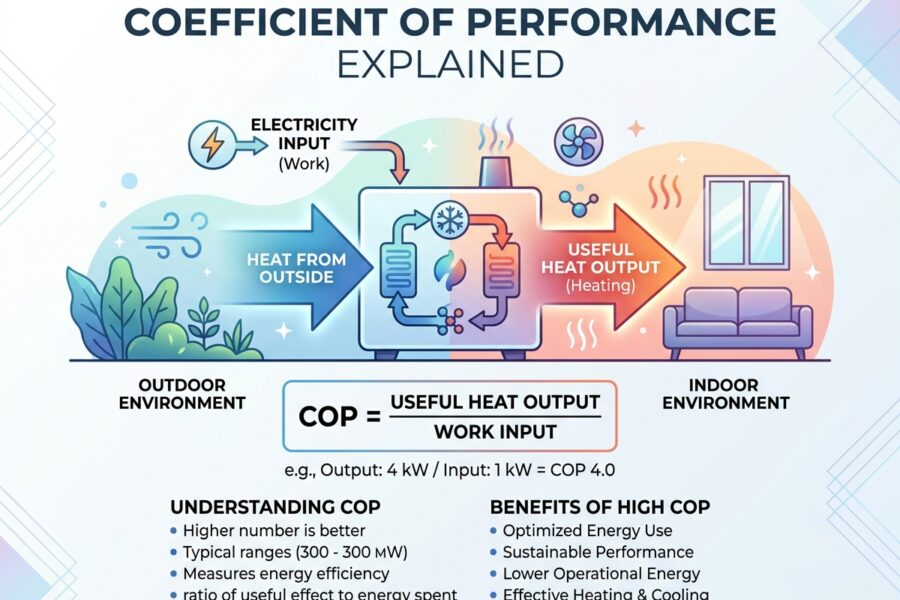
Not necessarily. Higher BTU indicates capacity, not consumption. An efficient 24,000 BTU air conditioner might use less electricity than an inefficient 18,000 BTU unit. Look at SEER2 ratings for air conditioners and AFUE for furnaces to understand efficiency. These ratings tell you how much cooling or heating you get per unit of energy consumed. Higher efficiency equipment delivers more BTU output per BTU or kilowatt of energy input, reducing operating costs despite higher capacity.
Conclusion
What Is Btu? It’s the fundamental measurement that determines whether your HVAC system keeps you comfortable or leaves you frustrated. British Thermal Unit ratings tell you exactly how much heating or cooling power equipment delivers. Understanding BTU helps you avoid the costly mistakes of oversizing or undersizing your system.
Remember the key points: one BTU raises one pound of water one degree Fahrenheit. One ton of cooling equals 12,000 BTU per hour. Aim for approximately 20 BTU per square foot for cooling, but adjust for your specific home conditions. Always consider ceiling height, insulation quality, sun exposure, and climate zone when calculating your needs.
For most homeowners, a professional Manual J load calculation provides the most accurate BTU requirements. This detailed analysis accounts for every factor affecting your home’s heating and cooling load. The small cost of professional sizing pays back through lower energy bills, better comfort, and longer equipment life.
Whether you’re replacing an old system, adding air conditioning to your home, or just trying to understand your energy usage, BTU knowledge gives you control. You’ll make better decisions, ask smarter questions of contractors, and ultimately enjoy a more comfortable home. The next time you see BTU ratings on equipment, you’ll know exactly what they mean and how to use that information.





Leave a Comment