
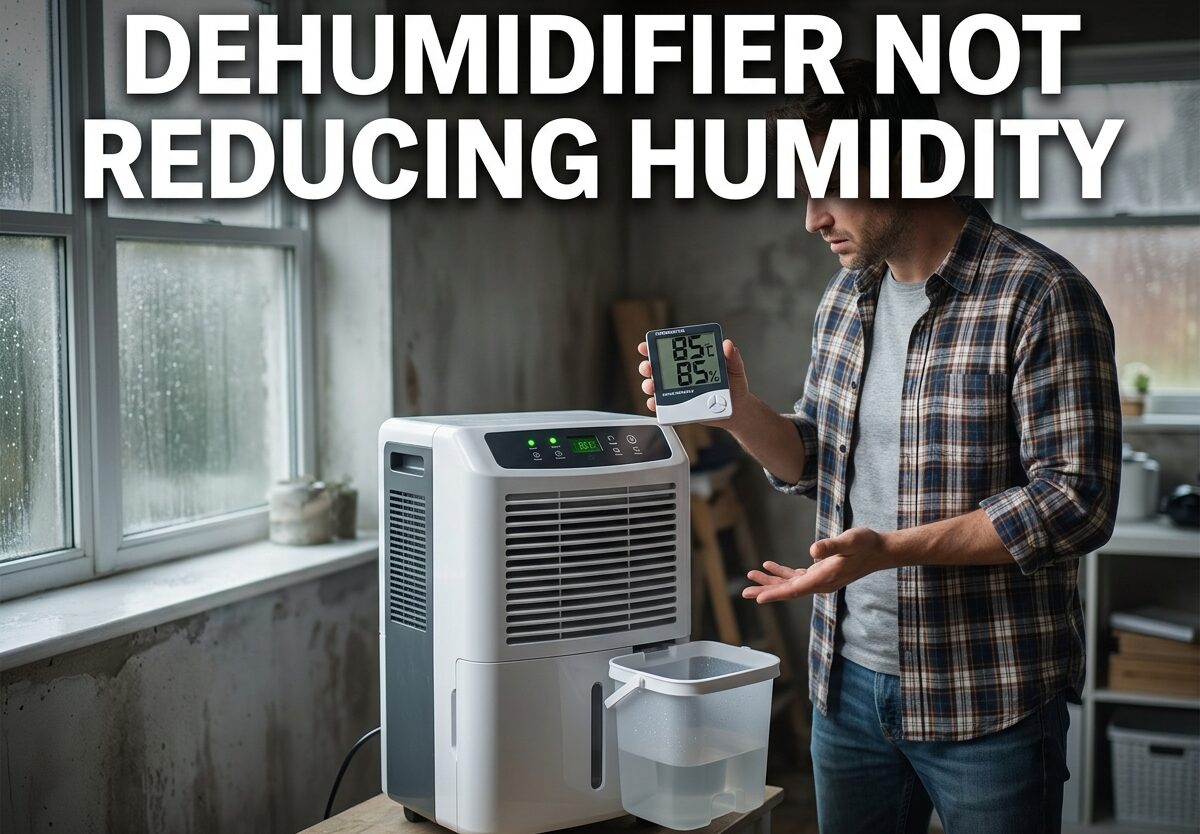
You’ve been running your dehumidifier for days, maybe even weeks. The bucket is filling with water, but your hygrometer still reads 60%, 65%, or even 70% humidity. It’s frustrating, especially when you’re dealing with musty smells, condensation on windows, or that sticky feeling in the air. You might be wondering if your unit is defective or if you’re doing something wrong.
After researching hundreds of user experiences and consulting HVAC experts, I’ve found that most dehumidifier not reducing humidity problems stem from a few common issues. The good news is that most of these problems have simple fixes you can try yourself before calling a technician or replacing your unit.
In this guide, I’ll walk you through why your dehumidifier isn’t lowering humidity, what realistic expectations you should have, and step-by-step troubleshooting to get your unit working properly again.
Why Is My Dehumidifier Not Reducing Humidity?
Dehumidifiers not reducing humidity is one of the most common complaints I see in homeowner forums and support communities. The issue typically falls into one of three categories: wrong sizing for your space, environmental factors beyond the unit’s control, or mechanical problems with the dehumidifier itself.
What surprises most people is that the rated capacity on your dehumidifier (like “12 liters per day”) is a laboratory measurement under ideal conditions. Real-world performance is often significantly lower. A 12L unit might only extract 1-2 liters per day in actual home conditions, especially in open-plan spaces or areas with constant moisture intrusion.
Understanding the difference between rated capacity and actual performance is key to solving your humidity problem. Let’s dive into the most common causes and their solutions.
The Rated vs Real Capacity Gap
Here’s what confuses almost everyone: your dehumidifier says it removes 12 liters (or 30 pints, or 50 pints) per day, but you’re only seeing the bucket fill every 2-3 days. Is your unit defective? Probably not.
Manufacturers test dehumidifiers in laboratory conditions: 80°F (27°C) with 60% relative humidity. These are ideal conditions that most homes rarely achieve consistently. In your actual home, temperatures fluctuate, doors open, and moisture sources constantly add humidity back into the air.
In real-world conditions, a 12L/day rated dehumidifier might only extract 2-4 liters per day in a typical bedroom or living space. In larger areas or open-plan homes, that number drops even further. This isn’t false advertising—it’s just the difference between laboratory testing and real-world usage.
Wrong Size for Your Space
One of the most common reasons a dehumidifier isn’t reducing humidity is simply that it’s too small for the space. Dehumidifiers are rated for specific square footage under specific conditions. If you put a 20-pint unit in a 1,500 square foot basement, it will run continuously but never catch up.
For moderately damp conditions, most manufacturers recommend approximately 10-14 pints per 500 square feet. For very damp or wet conditions, you need 30-50% more capacity. And if you have an open-plan layout where air can circulate freely between rooms, you need to calculate the total square footage of the entire open area, not just the room where the dehumidifier is located.
Open Plan vs Single Room Performance
This is a huge factor that most people overlook. Dehumidifiers are designed for enclosed spaces. If you place one in an open-plan living area, kitchen, and dining room combo, the unit has to treat all that air volume, not just the immediate area around it.
I’ve seen countless forum posts from users frustrated that their 12L unit won’t control humidity in their open-plan ground floor. The reality is that dehumidifiers work best in enclosed rooms with doors closed. For open spaces, you either need a much larger capacity unit or multiple smaller units placed strategically.
Quick Troubleshooting Checklist
Before we dive into detailed solutions, run through this quick checklist. These are the most common issues I see, and checking them first can save you hours of frustration:
- Check your humidity setting: Make sure you haven’t set the target humidity higher than your current level. If your room is at 60% and your dehumidifier is set to 65%, it won’t run.
- Verify proper sizing: Calculate your total square footage (including open-plan areas) and compare it to your unit’s rating.
- Check for airflow obstructions: Ensure 12-18 inches of clearance around all sides of the unit.
- Clean or replace the air filter: A clogged filter can reduce efficiency by 30% or more.
- Check room temperature: Most compressor dehumidifiers won’t work effectively below 41°F (5°C).
- Close windows and doors: Dehumidifiers work best in enclosed spaces.
- Run continuously for 24-48 hours: Some units need time to catch up, especially in very damp conditions.
Common Causes and How to Fix Them
Airflow Obstructions
Your dehumidifier needs to breathe. If air can’t circulate through the unit properly, it can’t extract moisture efficiently. I recommend keeping at least 12-18 inches of clearance around all sides of the unit, especially the back and sides where intake and exhaust vents are located.
Common obstructions I see include furniture pushed too close, curtains touching the unit, or items stored on top of the dehumidifier. Even something as simple as a dusty grill can reduce airflow by 20% or more. Clean the exterior vents regularly with a vacuum attachment or soft brush.
Temperature Operating Range
This is a critical factor many homeowners miss. Standard compressor dehumidifiers struggle when temperatures drop below 41°F (5°C). The evaporator coils can ice up, which actually reduces efficiency and can damage the compressor over time.
If you’re trying to dehumidify a basement, garage, or crawl space that gets cold, you need a unit specifically designed for lower temperatures. These models have special features like auto-defrost cycles and optimized compressors for cold environments. Desiccant dehumidifiers are another option for cold spaces as they don’t rely on cooling coils to extract moisture.
For best results, most standard dehumidifiers perform optimally between 65°F and 80°F (18°C-27°C). If your space is consistently outside this range, you may need a specialized unit.
Filter Maintenance Issues
A dirty air filter is one of the most common causes of reduced dehumidifier performance. The filter protects the internal components from dust and debris, but when it gets clogged, it restricts airflow and forces the unit to work harder.
I recommend checking your filter every 2-4 weeks during heavy use. Clean permanent filters with warm water and mild soap, let them dry completely, then reinstall. Replace disposable filters according to the manufacturer’s schedule—typically every 3-6 months depending on usage and environmental conditions.
A clean filter can improve efficiency by 20-30% and extend the life of your compressor. It’s a simple maintenance task that pays big dividends in performance and energy savings.
Humidity Settings Problems
Sometimes the problem isn’t with the unit at all—it’s with how it’s set. I’ve seen cases where users set their target humidity to 70% (thinking lower is better) when they actually wanted 30%. Always verify your target setting matches your intended humidity level.
For most homes, the ideal indoor humidity is between 30% and 50%. Below 30% can cause dry skin, respiratory irritation, and static electricity. Above 50% promotes mold, dust mites, and musty odors. I recommend starting with a target of 45% and adjusting based on comfort and conditions.
Some humidistats aren’t perfectly calibrated and can be off by 5-10 percentage points. If you suspect this issue, place a separate hygrometer near the dehumidifier to compare readings. This will help you determine if the unit’s sensor is accurate.
Compressor Failure Signs
If you’ve ruled out all the above issues and your dehumidifier still isn’t working, you may have a mechanical problem. The compressor is the heart of your dehumidifier, and when it fails, the unit can’t extract moisture effectively.
Signs of compressor problems include: the unit running but not collecting water, unusual clicking or buzzing sounds, the compressor not turning on at all, or the unit repeatedly tripping circuit breakers. In some cases, the fan will run but the compressor won’t engage—this usually indicates a bad start relay or capacitor.
Compressor repairs typically cost between $150-$300, depending on the issue. For units over 5 years old, replacement might be more cost-effective than repair. The average life expectancy of a dehumidifier is 5-10 years with proper maintenance.
Understanding Capacity and Room Size
Choosing the right size dehumidifier is critical for effective humidity control. Most manufacturers provide square footage guidelines, but these assume standard ceiling heights and moderate conditions. Here are some realistic capacity recommendations based on actual user experiences:
For small spaces up to 500 square feet (bedroom, bathroom, small office), a 20-30 pint unit typically suffices for moderately damp conditions. For 500-1,000 square feet (large bedroom, small basement, family room), look for 30-50 pint capacity. Spaces over 1,000 square feet or very wet conditions require 50+ pint units or multiple smaller units.
Remember that these recommendations assume enclosed spaces with doors closed. For open-plan areas, calculate the total square footage of the entire open area and size up accordingly. Wet conditions like recent water damage, active leaks, or very damp basements require 30-50% more capacity than the standard recommendations.
Ventilation vs Dehumidification Balance
There’s a common misconception that you should keep all windows and doors closed when running a dehumidifier. While this is generally true for maximum efficiency, some ventilation is actually necessary in certain situations.
The key is understanding when to ventilate and when to seal the space. For daily moisture from breathing, cooking, and showering, keep doors and windows closed while the dehumidifier runs. This allows the unit to cycle the air multiple times and extract moisture efficiently.
However, if you’re dealing with chemical fumes, strong odors, or extremely high initial humidity above 80%, some ventilation can help. The exception is during very humid weather—if it’s more humid outside than inside, definitely keep windows closed.
Most dehumidifiers are designed to cycle the air in a room 3-4 times per hour. This means all the air in your space passes through the unit every 15-20 minutes. In open-plan homes, this cycling rate drops significantly, which is why capacity sizing is so important for those layouts.
When to Call a Professional
Most dehumidifier problems can be diagnosed and fixed with the troubleshooting steps above. However, there are situations where professional help is warranted. If you notice refrigerant leaks (indicated by oil residue or hissing sounds), electrical issues like repeated breaker trips, or compressor problems that require specialized tools to repair, it’s time to call a technician.
Also consider that persistent humidity problems might indicate larger issues with your home. Moisture intrusion from foundation leaks, poor drainage, or inadequate ventilation can overwhelm even the best dehumidifier. If you’ve addressed all unit-related issues and still have problems, consult a home inspector or waterproofing professional.
Professional repairs typically cost $100-$300 for minor issues, while replacement units range from $150-$600 depending on capacity and features. Consider the age of your unit—repairs are usually worthwhile for dehumidifiers under 5 years old, while replacement often makes more sense for older units.
FAQs
Is 70% humidity too high for a bedroom?
Yes, 70% humidity is too high for a bedroom. Ideal indoor humidity should be between 30-50%. At 70%, you risk mold growth, dust mites, musty odors, and potential respiratory issues. Prolonged exposure to humidity above 60% creates an environment where mold and mildew thrive, which can trigger allergies and asthma. If your bedroom consistently stays above 60%, identify moisture sources and ensure your dehumidifier is properly sized and maintained.
What are the most common problems with dehumidifiers?
The most common dehumidifier problems include: 1) Unit too small for the space, 2) Dirty or clogged air filters reducing airflow, 3) Operating below the minimum temperature (41°F/5°C for most models), 4) Blocked airflow from furniture or curtains, 5) Humidity settings too high, 6) Compressor failure in older units, 7) Humidistat calibration issues. Most of these issues can be resolved with proper sizing, regular maintenance, and correct settings.
What is the average life expectancy of a dehumidifier?
The average dehumidifier lasts 5-10 years with proper maintenance. Units in harsh environments (very damp basements, dusty areas) tend to have shorter lifespans around 5-7 years. Dehumidifiers in moderate conditions with regular filter cleaning and proper airflow can last 8-10 years or longer. Compressor failure is the most common reason for replacement, usually occurring after 5+ years of use. Regular maintenance like filter cleaning and coil cleaning can extend the life of your unit.
Will a dehumidifier help dry out plaster?
Yes, a dehumidifier can help dry out plaster after installation or water damage. Fresh plaster typically needs 4-6 weeks to fully cure, and controlling humidity speeds this process. For best results, run the dehumidifier continuously in the room where fresh plaster is installed, keeping humidity around 40-45%. Ensure good ventilation but avoid direct drafts on the plaster. Note that very low humidity below 30% can cause plaster to dry too quickly and crack, so monitor levels carefully.
Should you use a dehumidifier if you have COPD?
Yes, dehumidifiers can benefit people with COPD. High humidity above 60% makes air feel heavier and can aggravate breathing difficulties. Maintaining indoor humidity between 35-45% can make breathing easier and reduce respiratory irritation. However, humidity below 30% can also irritate airways. If you have COPD, monitor humidity levels carefully and consult your healthcare provider about optimal environmental conditions for your specific situation. Clean your dehumidifier filter regularly to prevent circulating allergens.
Is there a reset button on a dehumidifier?
Some dehumidifiers have reset buttons, but not all models. If your unit has one, it’s typically located on the control panel or near the compressor compartment. Reset buttons are usually pressed after cleaning the filter, emptying the bucket, or if the unit malfunctions. If your dehumidifier doesn’t have a reset button but isn’t working, try unplugging it for 15-30 minutes, then plugging it back in. This can reset the electronics and clear minor glitches. Consult your owner’s manual for specific reset procedures for your model.
Why does my dehumidifier collect water but humidity stays high?
This common issue usually means your dehumidifier is working but can’t keep up with moisture load. Causes include: unit too small for the space, constant moisture intrusion (leaks, ground seepage), open-plan layout overwhelming capacity, or high humidity outdoors entering through ventilation. The dehumidifier is extracting moisture, but new moisture enters faster than it can remove it. Solutions include sizing up to a larger unit, adding a second unit, addressing moisture sources, or improving room enclosure to reduce fresh air intake.
How long should it take for a dehumidifier to lower humidity?
Under ideal conditions, a properly sized dehumidifier should lower humidity by 5-10% every 6-12 hours. Starting from very high humidity (75-80%), expect 24-48 hours to reach target levels below 50%. In severely damp basements or after water damage, initial reduction may take 3-5 days of continuous operation. If humidity hasn’t dropped after 48 hours of continuous running, verify the unit is properly sized, check for moisture sources, ensure proper airflow, and confirm the compressor is cycling on. For very damp spaces, some users see initial improvement within 4-8 hours.
Conclusion
Dealing with a dehumidifier not reducing humidity can be incredibly frustrating, but most problems have straightforward solutions. The key is understanding that rated capacity doesn’t equal real-world performance, proper sizing is critical, and environmental factors like temperature and airflow play major roles in performance.
Start with the troubleshooting checklist: verify your settings, check for airflow obstructions, clean the filter, and ensure proper sizing. Most issues resolve with these basic steps. For open-plan homes or very damp spaces, you may need a larger capacity unit or multiple units to achieve your target humidity levels.
If you’ve tried everything and your dehumidifier still isn’t reducing humidity, consider whether you might have an underlying moisture problem that the unit simply can’t overcome. Foundation leaks, poor drainage, or excessive ventilation can overwhelm even the best dehumidifier. In these cases, addressing the source of moisture is essential before your dehumidifier can work effectively.
With proper sizing, regular maintenance, and realistic expectations about performance, your dehumidifier can effectively control humidity and protect your home from mold, musty odors, and moisture-related damage. The 2026 models offer improved efficiency and better low-temperature performance, so if your unit is over 8 years old, replacement might be more cost-effective than repair.
Leave a Comment