
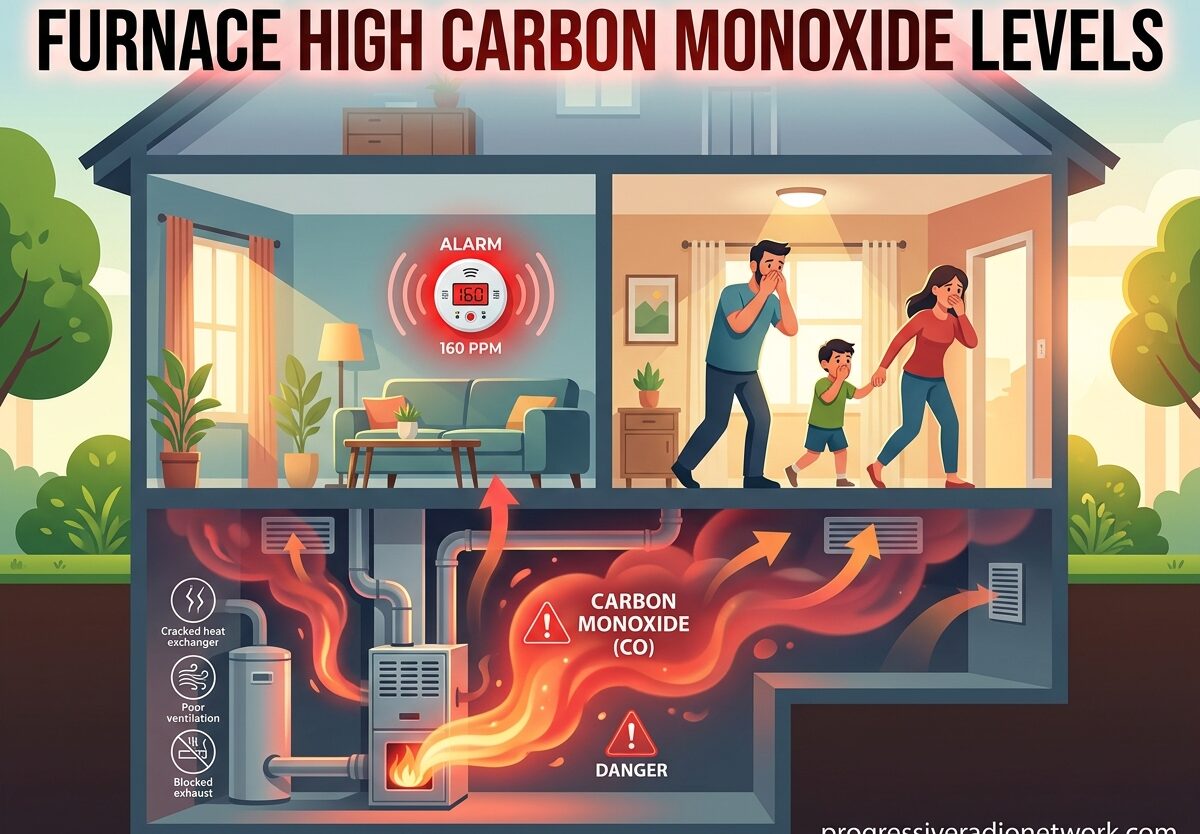
Carbon monoxide (CO) is an odorless, colorless gas that kills hundreds of Americans each year, and faulty furnaces are one of the leading causes of these preventable deaths. Understanding furnace high carbon monoxide levels isn’t just technical knowledge—it’s life-saving information that every homeowner with a gas, oil, or propane heating system needs to know. I’ve spent years researching HVAC safety and consulting with industry professionals, and I’ll tell you exactly what CO levels are dangerous, what warning signs to watch for, and what to do if your furnace has high carbon monoxide levels.
What is Carbon Monoxide and Why Do Furnaces Produce It?
Carbon monoxide forms whenever fuel burns without enough oxygen present for complete combustion. Your furnace is designed to burn fuel completely, producing harmless carbon dioxide and water vapor as byproducts. But when something goes wrong with the combustion process, carbon monoxide is produced instead.
Modern furnaces are engineered to vent all combustion gases safely outside your home through a flue pipe or chimney. The heat exchanger is the critical component that separates the combustion gases from the warm air blowing through your ductwork. When the heat exchanger is intact and the venting system is working properly, CO never enters your living space. But when any part of this system fails, carbon monoxide can leak into your home and put your family at risk.
The scary reality is that carbon monoxide is completely undetectable by human senses. You can’t see it, smell it, or taste it. The only way to know if your furnace is producing high carbon monoxide levels is through proper testing and CO detectors.
Furnace High Carbon Monoxide Levels: Safe vs Dangerous PPM Thresholds
Understanding CO levels requires knowing how they’re measured. Carbon monoxide is measured in parts per million (PPM). To put this in perspective, 1 PPM means one molecule of CO for every million molecules of air. Even small amounts can be dangerous over time, while larger concentrations can be deadly within minutes.
Here are the CO level thresholds every homeowner should know:
0-9 PPM: Normal, acceptable level. Well-maintained furnaces typically produce exhaust CO readings below 50 PPM, and ambient indoor air should remain under 9 PPM. This is considered safe for continuous exposure.
10-34 PPM: Marginal concern. At this level in living spaces, you might experience headaches with prolonged exposure. In furnace exhaust, readings in this range are still acceptable but warrant monitoring.
35-99 PPM: Moderate concern. The Occupational Safety and Health Administration (OSHA) sets 35 PPM as the maximum allowable 8-hour exposure for workers. In furnace exhaust, readings approaching 100 PPM indicate combustion issues that need attention. In living spaces, evacuate immediately.
100-400 PPM: Dangerous. At 100 PPM, headaches and dizziness can develop within 1-2 hours. At 200 PPM, symptoms escalate within 2-3 hours. Most HVAC professionals consider 100 PPM in furnace exhaust as the upper limit of acceptability. Readings above this require immediate repair.
400+ PPM: Life-threatening. At 400 PPM, headaches occur within 1-2 hours, and death is possible within 3 hours. At 800 PPM, death can occur within 2 hours, and at 1,600 PPM, death occurs within 1 hour. These levels indicate severe furnace problems and require immediate evacuation.
12,800+ PPM: Immediately fatal. Death occurs within 1-3 minutes of exposure.
It’s crucial to understand the difference between furnace exhaust CO and ambient CO in your home. Furnace exhaust can contain higher CO levels (up to 100 PPM is technically acceptable by some codes) as long as it’s properly vented outside. But the moment CO enters your living space, even 9 PPM warrants concern, and 35+ PPM requires evacuation.
Is 400ppm a High CO Level for Your Furnace?
Yes, 400ppm is an extremely high and dangerous CO level for a furnace. A reading of 400 PPM in your furnace’s exhaust indicates severe combustion problems that create unsafe conditions. Most HVAC professionals would immediately red-tag a furnace producing 400 PPM and recommend shutting it down until repairs are made.
At 400 PPM, if carbon monoxide is leaking into your home rather than being properly vented outside, you and your family could experience headaches, dizziness, and nausea within 1-2 hours of exposure. Prolonged exposure at this level can be fatal. Many local gas companies use 250-400 PPM as their threshold for red-tagging equipment, meaning they’ll disable the furnace and mark it as unsafe until repaired.
Any furnace producing 400 PPM CO needs immediate professional attention. Don’t wait—this is not a “watch and see” situation.
Furnace High Carbon Monoxide Levels
Understanding what causes high CO in furnaces helps you prevent dangerous situations before they develop. I’ve seen countless cases where homeowners could have avoided CO emergencies if they’d recognized the warning signs earlier. Here are the most common causes of furnace high carbon monoxide levels.
Cracked Heat Exchanger: This is the most dangerous cause of furnace CO problems. Your heat exchanger is a metal chamber that separates the combustion chamber from your home’s airflow. Over time, metal fatigue can cause cracks to develop. When this happens, carbon monoxide from the combustion process can mix with the warm air blowing through your ductwork and distribute throughout your home. A cracked heat exchanger is often irreparable and typically requires furnace replacement.
Blocked or Plugged Vent Pipes: Your furnace’s vent pipe carries exhaust gases outside. If it becomes blocked by debris, bird nests, or ice, CO has nowhere to go and can backdraft into your home. I’ve seen cases where squirrels built nests in vent pipes, creating dangerous CO buildup. In winter, ice accumulation at the vent termination is a common problem that many homeowners overlook until it’s too late.
Dirty or Clogged Burners: Your furnace burners need the right mixture of fuel and air to burn cleanly. When burners become dirty or clogged with dust and debris, combustion becomes incomplete and CO production increases. This is why annual furnace maintenance is so critical—technicians clean burners and adjust the fuel-to-air ratio for optimal combustion.
Insufficient Combustion Air: Furnaces need oxygen to burn fuel completely. Modern, energy-efficient homes are sealed tightly, which can starve your furnace of the air it needs for proper combustion. This is especially common in homes that have been upgraded with better insulation and windows without considering the furnace’s air requirements. Your furnace may need a dedicated combustion air intake to ensure safe operation.
Improper Installation or Sizing: Furnaces that are too large for your home can short-cycle, meaning they turn on and off frequently. This prevents them from reaching optimal operating temperature and can lead to incomplete combustion and higher CO production. Similarly, improperly installed venting with incorrect pitch or inadequate rise can prevent proper drafting and cause CO to spill back into your home.
Backdrafting from Negative Pressure: Exhaust fans, kitchen range hoods, and bathroom fans can create negative air pressure in your home, pulling furnace exhaust back down the flue and into your living space. This backdrafting effect is more common than many homeowners realize and can cause dangerous CO levels even when the furnace itself is operating correctly.
Winter-Specific Risk: Snow Blocking Vents: During heavy snowfall, your furnace’s exhaust vents can become completely buried. This is especially dangerous because it often happens while you’re sleeping, and you may not realize the vent is blocked until CO has already spread through your home. After every major snowfall, take a few minutes to visually check that your furnace vents are clear. This simple step could save your life.
Warning Signs Your Furnace Has High Carbon Monoxide Levels
Since you can’t see or smell carbon monoxide, you need to rely on visible and physical warning signs. I’ve interviewed dozens of CO poisoning survivors, and nearly all of them noticed at least one of these signs but didn’t recognize the danger until it was almost too late.
Visible Soot: If you see black soot accumulating around your furnace, on the furnace cabinet, or near the vent pipe, this is a clear warning sign of incomplete combustion. Soot means carbon is not burning completely, which correlates directly with higher CO production. Any visible soot warrants immediate professional inspection.
Yellow or Orange Burner Flames: When you look at your furnace’s burners through the inspection window, the flames should be blue with a small yellow tip. If the flames are predominantly yellow, orange, or lazy and flickering, this indicates incomplete combustion and likely high CO production. Call a technician immediately if you see abnormal flame colors.
Excess Moisture: If you notice condensation on windows near your furnace, moisture on walls, or a damp feeling in your utility room when the furnace runs, this can indicate venting problems. Improper venting causes water vapor to condense before it exits your home, which often correlates with CO issues as well.
Stale or Stuffy Air: If your home feels stuffy, stale, or has a heavy feeling when the furnace runs, this can indicate poor ventilation and potential CO buildup. Many survivors describe the air feeling “heavy” or “oppressive” before they experienced symptoms.
CO Detector Alerts: Obviously, any CO detector alarm is a warning sign to take seriously. But don’t ignore chirping or low-battery warnings—CO detectors can malfunction, and intermittent alarms sometimes indicate low-level CO exposure rather than detector issues. If your detector alerts, evacuate first and investigate later.
Physical Symptoms in Household Members: If anyone in your home experiences headaches, dizziness, nausea, or fatigue that improves when they leave the house, this is a classic CO poisoning pattern. Pets often show symptoms before humans because they’re smaller and closer to the floor where CO can accumulate. If your dog seems lethargic or cats vomit when the furnace runs, don’t ignore these signs.
Carbon Monoxide Poisoning Symptoms from Furnace Exposure
Recognizing CO poisoning symptoms can save lives, but the challenge is that symptoms often mimic common illnesses like the flu. I’ve spoken with ER physicians who treated patients for flu for days before realizing they had CO poisoning. Understanding how symptoms progress based on exposure level can help you identify the problem faster.
Low-Level Exposure (9-50 PPM over several hours): At these levels, symptoms can be subtle and easily dismissed. You might experience a mild headache, slight fatigue, or difficulty concentrating. Many people attribute these feelings to stress, lack of sleep, or a coming cold. The danger is that low-level exposure can continue for days or weeks, causing cumulative damage to your heart and brain without ever triggering acute symptoms.
Moderate Exposure (50-200 PPM): Headaches become more pronounced and persistent. You may experience throbbing temples, dizziness, nausea, and confusion. Vision problems can develop, including blurred or double vision. Chest pain is common in people with heart conditions. At this level, symptoms typically develop within 1-2 hours of exposure and worsen the longer you remain in the contaminated environment.
High-Level Exposure (200-800 PPM): This is where things become life-threatening rapidly. Severe throbbing headache, dizziness, confusion, and disorientation develop within 1-2 hours. Loss of consciousness can occur. At 400 PPM, headache and nausea occur within 1-2 hours, and death is possible within 3 hours. At 800 PPM, death can occur within 2 hours.
Critical Exposure (800-12,800 PPM): At these levels, death occurs rapidly—within 1-2 hours at 800 PPM, within 1 hour at 1,600 PPM, and within minutes at 12,800+ PPM. Loss of consciousness happens so quickly that escape becomes impossible. This is why CO detectors and preventive maintenance are absolutely critical—once you’re exposed to these levels, it’s often too late to save yourself.
The most dangerous aspect of CO poisoning is that it affects judgment and awareness. As your brain becomes deprived of oxygen, you may not realize something is wrong, or you may feel too confused to take action. This is why CO poisoning kills people in their sleep—they simply never wake up.
How to Tell If Your Furnace Is Giving Off Carbon Monoxide
The only way to know for certain if your furnace is producing carbon monoxide is through professional testing. Homeowners cannot rely on symptoms alone—by the time you feel symptoms, exposure has already reached dangerous levels. Here’s how professionals test for furnace CO.
Combustion Analyzer Testing: HVAC technicians use electronic combustion analyzers to measure CO levels directly from your furnace’s exhaust. This test involves drilling a small hole in the flue pipe and inserting a probe that samples the exhaust gases. The analyzer provides precise PPM readings and can identify problems before they become dangerous. I recommend this test annually as part of your furnace maintenance.
CO Detector Placement: Install CO detectors according to manufacturer guidelines—typically on each level of your home and outside sleeping areas. Detectors should be placed at knee height (CO mixes with air and doesn’t rise like smoke) and away from fuel-burning appliances to avoid nuisance alarms. Test detectors monthly and replace batteries annually or per manufacturer recommendations.
Visual Inspection: During routine maintenance, technicians visually inspect the heat exchanger for cracks using mirrors, cameras, or UV dye testing. They check venting for proper installation, blockages, and corrosion. They also inspect burners for dirt, debris, and proper flame characteristics.
When to Test Your Furnace: Schedule professional testing annually before heating season begins. Test immediately if you notice any warning signs, install a new furnace, or experience CO detector alerts. Also test if you’ve made energy efficiency upgrades to your home, as reduced air leakage can affect furnace combustion.
DIY Limitations: While consumer-grade CO detectors are essential for home safety, they have limitations. Most detectors won’t alert until CO reaches 70 PPM for 1-2 hours or 400 PPM for 4-15 minutes—long after exposure has begun. Professional combustion analyzers can detect CO at 1 PPM, identifying problems long before they become life-threatening.
What To Do If Your Furnace Has High CO Levels: Emergency Steps
If you suspect your furnace is producing dangerous carbon monoxide levels, immediate action is critical. I cannot stress this enough: minutes matter when dealing with CO exposure. Follow these steps in order without hesitation.
Step 1: Evacuate Immediately
If anyone is experiencing symptoms—headache, dizziness, nausea—get everyone out of the house now. Don’t open windows first, don’t call from inside, don’t try to investigate. Just get out. If anyone is unconscious, evacuate them if you can do so safely without becoming a victim yourself. Otherwise, leave them and call 911 from outside—emergency responders have equipment to safely enter contaminated environments.
Step 2: Call for Help
Once outside and safe, call 911 if anyone is experiencing symptoms or if CO detectors read above 100 PPM. Emergency responders can test the air, administer oxygen, and determine if hospital evaluation is needed. If no one has symptoms and CO levels are below 100 PPM, call your gas company’s emergency line or a licensed HVAC contractor.
Step 3: Turn Off the Furnace
If you can do so safely without re-entering the contaminated area, turn off your furnace at the thermostat. Then locate the gas shut-off valve (typically near the gas meter where the line enters your home) and turn the valve perpendicular to the pipe to stop gas flow. Do not turn the furnace back on until a professional has inspected and repaired it.
Step 4: Ventilate If Safe
If CO levels are low (below 35 PPM) and you’re not experiencing symptoms, you can open windows to ventilate the home while waiting for professional help. However, if CO levels are above 35 PPM or anyone has symptoms, do not re-enter the home for any reason. Let professionals handle ventilation.
Step 5: Don’t Reoccupy Until Cleared
Do not return to your home until emergency responders or HVAC professionals have tested the air and confirmed CO levels are safe. This may take several hours depending on ventilation and the source of the problem. If the furnace needs repair, do not operate it until a licensed technician has certified it as safe.
Step 6: Seek Medical Attention
Even if symptoms seem mild after leaving the contaminated environment, seek medical evaluation. CO can bind to hemoglobin 200+ times more strongly than oxygen, causing ongoing damage even after exposure ends. Emergency departments can test your carboxyhemoglobin levels and administer oxygen therapy if needed. Pregnant women, children, elderly individuals, and people with heart or lung conditions are at higher risk and should always be evaluated after CO exposure.
Furnace CO Levels: Understanding the Difference Between Exhaust and Ambient Air
One of the most confusing aspects of furnace CO safety is understanding the difference between exhaust CO levels and ambient CO levels in your home. This distinction matters because what’s acceptable in your furnace’s exhaust would be dangerous in your living space.
Exhaust CO refers to carbon monoxide levels measured directly from your furnace’s flue pipe before it exits your home. Industry standards generally consider exhaust CO up to 100 PPM as acceptable, provided the venting system is intact and functioning properly. Some local jurisdictions allow up to 400 PPM in exhaust, though most HVAC professionals recommend keeping exhaust below 100 PPM for optimal safety.
Ambient CO refers to carbon monoxide levels in the air you breathe inside your home. Ambient CO should always be below 9 PPM, and levels above 35 PPM require immediate evacuation. The difference is that exhaust CO is contained within the venting system and should never enter your living space, while ambient CO is what you and your family are actually breathing.
The danger occurs when exhaust CO escapes the venting system and becomes ambient CO. A cracked heat exchanger, blocked vent pipe, or backdrafting can cause exhaust CO to spill into your home’s air supply. This is why you need both types of testing—combustion analysis of the exhaust AND ambient CO monitoring with detectors in your living space.
Professional technicians test both exhaust and ambient CO during service visits. They’ll measure exhaust CO at the furnace to ensure combustion is clean, and they’ll measure ambient CO in your utility room and living areas to ensure no CO is leaking into your home. Both measurements are essential for complete safety assessment.
How Long Does Carbon Monoxide Poisoning Take to Affect You?
The timeline for CO poisoning depends on two factors: the concentration (PPM level) and the duration of exposure. Higher concentrations affect you more quickly, but even low levels can cause harm over time. This is why CO detectors are essential—they alert you to dangerous situations before symptoms develop.
At 50 PPM: Headaches may develop within 2-3 hours of exposure. At this level, you might attribute symptoms to other causes, not realizing CO is the culprit.
At 100 PPM: Headache develops within 1-2 hours. Dizziness and nausea may occur after 2-3 hours. If exposure continues, loss of consciousness can result.
At 200 PPM: Headache within 1-2 hours. Loss of consciousness and potential death within 2-3 hours of continued exposure.
At 400 PPM: Headache within 1-2 hours. Death possible within 3 hours. At this level, the margin between symptoms and fatality is dangerously small.
At 800 PPM: Dizziness, nausea, and convulsions within 45 minutes. Death within 2-3 hours.
At 1,600 PPM: Headache within 20 minutes. Death within 1 hour.
At 3,200 PPM: Headache within 5-10 minutes. Death within 30 minutes.
At 6,400 PPM: Headache and dizziness within 1-2 minutes. Death within 10-15 minutes.
At 12,800 PPM: Immediate physiological effects. Death within 1-3 minutes.
Individual factors affect how quickly you’re affected. Children, elderly individuals, pregnant women, and people with heart or lung conditions are more susceptible and may experience symptoms sooner at lower concentrations. Physical activity increases your breathing rate, which accelerates CO absorption during exposure. Alcohol consumption and certain medications can also increase susceptibility to CO poisoning.
The most dangerous scenario is sleeping during CO exposure. When you’re asleep, you won’t feel headache symptoms, and by the time you wake up (if you wake up), CO levels may already be fatal. This is why working CO detectors on every level of your home, especially outside sleeping areas, are absolutely non-negotiable.
Preventive Maintenance: Keeping Your Furnace CO-Safe
The single most effective way to prevent dangerous CO levels from your furnace is preventive maintenance. I’ve reviewed countless CO incident reports, and nearly every one could have been prevented with basic maintenance and awareness. Here’s your complete furnace CO safety checklist.
Annual Professional Inspections: Schedule a professional furnace inspection and tune-up annually before heating season begins. The technician should clean burners, inspect the heat exchanger for cracks, test combustion efficiency, measure exhaust CO levels, check venting for proper installation and blockages, and verify adequate combustion air. This service typically costs $100-$200 and is the best investment you can make in your family’s safety.
Regular Filter Changes: Replace your furnace filter every 1-3 months depending on filter type and household conditions. A dirty filter restricts airflow, which can cause your furnace to overheat and operate inefficiently, potentially increasing CO production. Mark your calendar or set phone reminders so you never forget this simple but critical maintenance task.
CO Detector Installation and Maintenance: Install UL-listed CO detectors on each level of your home and outside each sleeping area. Test detectors monthly by pressing the test button. Replace batteries at least annually or follow manufacturer recommendations. Replace the entire detector unit every 5-7 years as sensors become less reliable over time. Never remove detector batteries for other uses—that false alarm might be the only warning you get.
Vent Pipe Inspections: Visually inspect your furnace’s vent pipe monthly for any signs of damage, rust, or separation. Check that the vent is properly secured and hasn’t shifted. Look for signs of bird or rodent activity near the vent opening. After storms or heavy snowfall, verify that the vent termination is clear of debris and snow.
Watch for Warning Signs Between Services: Between professional inspections, pay attention to your furnace’s operation. Note any unusual sounds, smells, or performance changes. Check burner flame color through the inspection window—it should be blue, not yellow or orange. Watch for soot accumulation around the furnace or vent. Trust your instincts—if something seems off, call a professional.
Winter Snow Precautions: After every snowfall, visually check that your furnace exhaust vents are clear. If vents are close to the ground, consider installing a vent extension to raise the termination point above typical snow accumulation. Mark vent locations with stakes so you can find them easily after heavy snow. Never shovel snow against the furnace vent—maintain at least 2 feet of clearance in all directions.
Combustion Air Supply: Ensure your furnace has adequate combustion air. If your furnace is in a small enclosed space like a closet, it may need vents to allow air flow. Never seal your furnace room completely—your furnace needs oxygen to burn fuel safely. If you’ve upgraded your home’s insulation or windows, consult an HVAC professional about whether your furnace still has adequate combustion air.
Know Your Emergency Plan: Every household should have a CO emergency plan. Ensure all family members know what CO detectors sound like and what to do if they alarm. Designate an outside meeting place. Post emergency numbers (911, gas company emergency line, HVAC contractor) near your thermostat or phone. Practice your emergency plan annually so everyone knows what to do without hesitation.
Frequently Asked Questions
What would cause high carbon monoxide for a furnace?
The most common causes of high furnace carbon monoxide include cracked heat exchangers, blocked or plugged vent pipes, dirty or clogged burners, insufficient combustion air, improper installation or sizing, and backdrafting from negative air pressure. Winter-specific causes include snow blocking exhaust vents. These issues prevent complete fuel combustion and can cause CO to leak into your living space.
Is 400ppm a high CO level?
Yes, 400ppm is an extremely high and dangerous CO level for a furnace. A reading of 400 PPM in furnace exhaust indicates severe combustion problems requiring immediate professional attention. At this level, headaches and dizziness can occur within 1-2 hours if CO leaks into your home, and death is possible within 3 hours. Most HVAC professionals consider 100 PPM as the maximum acceptable threshold for furnace exhaust.
What are two warning signs of carbon monoxide poisoning?
Two common warning signs of carbon monoxide poisoning include persistent headaches that improve when you leave your home and feelings of dizziness or nausea that coincide with furnace operation. Additional warning signs include confusion, blurred vision, shortness of breath, and loss of consciousness in severe cases. Since CO symptoms often mimic flu, pay attention if symptoms affect multiple household members or improve away from home.
What is a high CO level for a furnace?
For furnace exhaust, any reading above 100 PPM is considered high and requires repair. Most HVAC professionals recommend keeping exhaust CO below 50 PPM for optimal safety. In living spaces, any CO above 9 PPM warrants concern, and levels above 35 PPM require immediate evacuation. Local gas companies typically red-tag equipment at 250-400 PPM, meaning the furnace must be disabled until repaired.
How to tell if your furnace is giving off carbon monoxide?
The only definitive way to detect furnace carbon monoxide is through professional combustion analyzer testing. However, warning signs include visible soot around the furnace, yellow or orange burner flames (should be blue), excess moisture near the furnace, stuffy air when the furnace runs, and CO detector alerts. Physical symptoms like headaches or dizziness that improve when leaving home also indicate potential CO exposure.
What are the symptoms of carbon monoxide poisoning from a furnace?
Furnace carbon monoxide poisoning symptoms include headache, dizziness, nausea, confusion, blurred vision, and fatigue. As exposure increases, symptoms progress to chest pain, shortness of breath, loss of consciousness, and eventually death. Symptoms often mimic the flu, but CO poisoning typically affects multiple household members simultaneously and improves when you leave the contaminated environment.
Can a furnace leak carbon monoxide when turned off?
A properly functioning furnace should not leak carbon monoxide when turned off. However, a cracked heat exchanger or damaged venting can allow CO to enter your home even when the furnace isn’t running, especially if other gas appliances are operating or if downdrafts occur. Additionally, when a furnace turns off, the sudden change in air pressure can sometimes cause momentary backdrafting that pushes CO into your home.
How often should I test my furnace for carbon monoxide?
Schedule professional CO testing annually during your pre-season furnace maintenance. Test immediately if you notice warning signs like soot, abnormal burner flames, or if CO detectors alert. You should also test after any home energy efficiency upgrades, as reduced air leakage can affect furnace combustion. Between professional services, rely on working CO detectors to alert you to any problems.
Conclusion
Understanding furnace high carbon monoxide levels is essential knowledge for every homeowner with a fuel-burning heating system. The difference between safe and dangerous CO levels can be measured in PPM, but the real difference is measured in lives saved or lost. Now that you know what CO levels are dangerous, what warning signs to watch for, and what to do in an emergency, you have the knowledge to protect your family.
Install CO detectors on every level of your home and outside sleeping areas. Schedule annual professional furnace inspections before heating season. Learn to recognize warning signs like soot, abnormal burner flames, and symptoms that improve when you leave home. Check vents after snowfall. Replace furnace filters regularly. And never ignore a CO detector alarm.
Carbon monoxide is called the silent killer because it gives no warning—but you don’t have to be silent about it. Share this information with your family, neighbors, and friends. The more people understand about furnace carbon monoxide safety, the more lives we can save together. Stay vigilant, stay informed, and stay safe.



Leave a Comment