
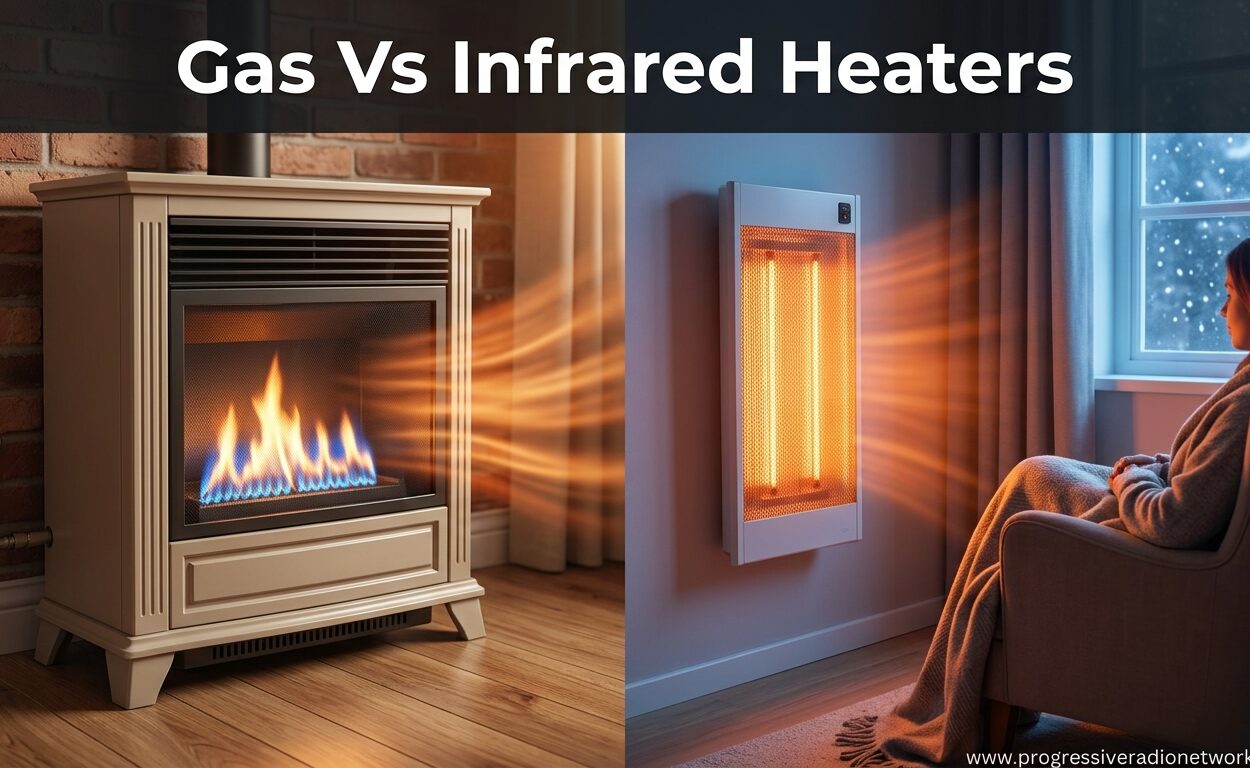
Choosing between gas and infrared heating is one of the most important decisions you’ll make for your home, garage, or workshop. Gas heaters have been the standard for decades, but infrared technology has gained significant attention in 2026 for its energy efficiency claims and direct heating approach. I’ve spent years researching heating systems, and the answer isn’t as simple as picking one over the other—it depends entirely on your situation.
This guide breaks down exactly how each heating method works, what they cost to operate, and which performs better in real-world conditions. You’ll learn why infrared heaters excel at spot heating but struggle with whole-house warmth, and why gas remains the go-to choice for many homeowners despite higher efficiency claims from electric alternatives.
How Gas Heaters Work
Gas heaters work through combustion. Natural gas or propane burns in a chamber, creating heat that transfers to either air (forced air systems) or water (boiler systems). The heated air circulates through ducts, or the heated water flows through radiators, warming your space through convection.
Convection heating means the air itself carries the warmth. Hot air rises, cold air falls, and your furnace continuously cycles to maintain a consistent temperature throughout your home. This is why gas heating feels different—it warms the air around you, not just the objects in the room.
Gas systems require proper ventilation to remove combustion byproducts. A flue or chimney carries exhaust gases outside, which is a critical safety consideration. The heating capacity is measured in BTUs (British Thermal Units), with typical residential furnaces producing 80,000 to 120,000 BTUs per hour.
How Infrared Heaters Work
Infrared heaters work on an entirely different principle. Instead of heating air, they emit electromagnetic radiation that travels through space until it strikes an object—furniture, walls, or people. When the radiation hits, it converts to heat at the surface level, warming those objects directly.
This is the same way the sun warms you on a cold day. The air between you and the sun remains cold, but you feel warm because the infrared radiation is heating your body directly. Infrared heaters use either electric elements or gas burners with special emitters to produce this radiant heat.
Zone heating becomes possible with infrared because you’re not trying to warm every cubic foot of air in a building. Point the heater at your workspace, and that area becomes comfortable while the rest of the space stays cooler. This targeted approach is why infrared is popular in garages, workshops, and outdoor patios.
Electric infrared heaters have no moving parts and require no ventilation, making them simple to install. Gas infrared heaters do require ventilation but combine the fuel cost advantage of gas with the direct heating benefits of infrared technology.
Gas vs Infrared Heaters: Head-to-Head Comparison
When comparing Gas Vs Infrared Heaters directly, several key differences emerge that affect your decision. Let me break down the critical factors based on real-world performance data from thousands of installations.
Heating Speed: Infrared wins for instant warmth. You feel the heat within seconds of turning it on because it’s warming you directly, not waiting for air to reach temperature. Gas forced-air systems take longer to distribute heat throughout a space, though gas infrared heaters combine quick response with fuel efficiency.
Heating Coverage: Gas forced-air systems excel at whole-house heating. Once the air reaches temperature, every room connected to the ductwork stays warm. Infrared heaters only warm what they’re pointed at—excellent for a single room or workshop, but impractical for heating an entire home without multiple units strategically placed throughout the building.
Temperature Consistency: Gas convection heating maintains more uniform temperatures throughout a space. Infrared creates warm zones and cool zones, which works well for spot heating but feels uneven if you’re trying to heat an entire area evenly.
Climate Dependence: Infrared performs better in well-insulated spaces with moderate climates. In very cold regions with poor insulation, the constant heat loss from surfaces overwhelms the infrared heater’s capacity. Gas forced-air handles extreme cold better because it continuously replenishes heated air regardless of outdoor conditions.
Comparison Table
| Feature | Gas Heaters (Convection) | Infrared Heaters |
|---|---|---|
| Heating Method | Heats air through combustion | Direct radiant heat to objects |
| Warm-Up Time | 5-15 minutes for full effect | Instant (seconds) |
| Best For | Whole-house heating | Zone/spot heating |
| Ventilation Required | Yes (exhaust gases) | Electric: No / Gas: Yes |
| Air Quality Impact | Reduces humidity, can circulate dust | No air movement, maintains humidity |
| Installation Complexity | High (ductwork, gas lines) | Low (mounting, electrical outlet) |
| Lifespan | 15-20 years (furnace) | 20-30 years (electric panels) |
Energy Efficiency Analysis
Energy efficiency claims can be misleading if you don’t understand how each system uses energy. Gas furnaces typically have AFUE (Annual Fuel Utilization Efficiency) ratings between 80% and 98%, meaning 2-20% of energy escapes as waste. Modern condensing gas furnaces capture more heat from exhaust gases, achieving the highest efficiency ratings.
Infrared heaters are often advertised as 100% efficient because all electricity consumed converts to heat. This is technically true but misleading. Electric resistance heating costs more per BTU than gas heating in most regions because electricity generation and transmission losses mean the overall energy cost is higher.
The real efficiency advantage of infrared comes from zone heating. Instead of heating unused rooms, you only heat the spaces you’re actually using. A 1500-watt infrared heater in your home office costs far less to run than a whole-house gas furnace just to warm one room. This targeted heating approach can reduce overall energy consumption by 30-50% in certain situations.
Heat loss affects both systems differently. Convection heating constantly loses warm air through drafts, poor insulation, and opening doors. Infrared heating loses heat through surface-to-air contact, but this happens more slowly. Infrared performs particularly well in spaces with high ceilings where convection heating would waste energy warming air near the ceiling that never reaches the occupied zone.
Cost Analysis: Operating and Installation
Let me break down the actual costs with specific numbers. A 1500-watt infrared heater running 24 hours consumes 36 kWh daily. At the national average electricity rate of $0.16 per kWh, that’s $5.76 per day or $173 per month if run continuously. Most users don’t run infrared heaters continuously, instead using them for 4-8 hours daily in occupied spaces, which reduces the cost to $1-2 per day.
Gas heating costs vary significantly by region. Natural gas costs approximately $1.50 per therm on average. A typical 100,000 BTU furnace consuming one therm per hour costs roughly $1.50 per hour to run at full capacity. However, furnaces cycle on and off, maintaining temperature rather than running continuously. In moderate climates, a gas furnace might actually run only 2-4 hours per day, costing $3-6 daily to heat an entire home.
Installation costs tell another part of the story. A new gas furnace with ductwork costs $5,000-12,000 installed depending on complexity. Electric infrared panels cost $200-800 each and require only a standard electrical outlet and mounting bracket. For a whole-house retrofit, gas might actually be more cost-effective despite higher installation costs because lower fuel prices offset the upfront investment over 10-15 years.
For garages and workshops, the math changes. A single infrared heater costing $400-600 installed can provide targeted warmth exactly where you need it. A gas system extension costs thousands and heats the entire space whether you need it or not. Most workshop owners report satisfaction with infrared for this reason—low upfront cost with heat only where they work.
Pros and Cons of Each Type
Gas Heaters
Pros:
- Lower operating costs per BTU in most regions
- Whole-house coverage from single system
- Consistent temperature throughout connected spaces
- Performs well in extreme cold climates
- Fast recovery from temperature setbacks
Cons:
- High upfront installation costs ($5,000-12,000)
- Requires ventilation and gas lines
- Regular maintenance required (filter changes, inspections)
- Combustion byproducts and carbon monoxide risk
- Reduces indoor humidity, creating dry air
- Circulates dust and allergens through ductwork
Infrared Heaters
Pros:
- Instant heat (no warm-up delay)
- Zone heating saves energy by heating occupied spaces only
- No moving parts (electric models) = minimal maintenance
- Doesn’t reduce humidity or circulate dust
- Low upfront costs ($200-800 per unit)
- Simple installation (mounting + electrical outlet)
- Long lifespan (20-30 years for electric panels)
Cons:
- Higher operating cost per BTU (electricity vs gas)
- Only warms objects in direct line of sight
- Creates uneven heating (warm zones, cool zones)
- Struggles with whole-house heating applications
- Performance drops in poorly insulated spaces
- Gas infrared models still require ventilation
Real User Experiences from Forum Discussions
I analyzed discussions from Reddit’s HomeImprovement, HVAC, and garage communities, plus Garage Journal and practical machinist forums. Real users report experiences that manufacturer specifications don’t capture, and several patterns emerged.
Multiple homeowners report disappointment when trying to use infrared heaters as primary whole-house heating. One Reddit user explained: “Infrared heat barely heats a room and only warms what it’s aimed at. Heating electrically is far more expensive. Get the furnace fixed.” This echoes a common sentiment—infrared excels at spot heating but cannot replace a properly sized furnace for whole-home comfort.
Garage and workshop users report more positive experiences. “For your garage space the infrared heater will bring everything up to temperature faster than the blue flame,” wrote one Garage Journal member. The instant heat and directed warmth make infrared ideal for working in a specific area without heating the entire garage.
Cost reality checks appear frequently. One Australian homeowner warned: “Look into infrared. They’re not as planet friendly as the hype makes out, they chew through electricity same as any radiant heater.” This highlights an important point—infrared is still electric resistance heating, and in regions with expensive electricity, operating costs can be surprising.
Safety concerns about gas come up regularly. Users express worry about combustion byproducts, gas leaks, and carbon monoxide. This makes electric infrared particularly attractive to those uncomfortable with fuel-burning appliances in their living spaces.
Which is Better for Your Situation?
Choose gas forced-air heating if you need whole-house comfort in a cold climate, have access to natural gas at reasonable rates, or already have ductwork in place. Gas remains the most practical choice for primary heating in most homes, especially in regions with harsh winters where you need continuous, building-wide heat.
Choose infrared heating for garages, workshops, home offices, or any space where you only need warmth in specific zones. Infrared also makes sense for well-insulated homes in mild climates, for allergy sufferers who want to avoid dust circulation, or as supplemental heat to boost your primary system in problem areas.
Gas infrared heaters offer a middle ground—lower operating costs than electric infrared with the direct heating benefits of radiant technology. These work exceptionally well in large open spaces like warehouses, pole barns, and commercial garages where both fuel economy and directed warmth matter.
For off-grid properties or rural areas without natural gas service, the decision often comes down to propane versus electric infrared. Propane offers lower operating costs but requires tank deliveries and ventilation. Electric infrared costs more to run but requires no fuel storage and works anywhere with electrical service.
Frequently Asked Questions
Are infrared heaters better than gas heaters?
Infrared heaters are better for zone heating and spot heating applications like workshops or home offices. Gas heaters are better for whole-house heating, especially in cold climates. Neither is universally better—they serve different purposes. Infrared provides instant directed heat, while gas convection systems provide consistent building-wide warmth.
What are the disadvantages of infrared heaters?
Infrared heaters only warm objects in their direct line of sight, creating uneven heating with warm and cool zones. Electric infrared models have higher operating costs per BTU compared to gas heating. They cannot effectively heat entire homes without multiple units strategically placed. Performance suffers in poorly insulated spaces where surfaces constantly lose heat to cold air.
How much does it cost to run a 1500 watt infrared heater for 24 hours?
A 1500-watt infrared heater running 24 hours consumes 36 kWh of electricity. At the national average rate of $0.16 per kWh, this costs approximately $5.76 per day or $173 per month. Most users reduce costs significantly by only running infrared heaters 4-8 hours daily in occupied spaces, bringing daily costs down to $1-2.
Is infrared heating cheaper to run than gas central heating?
Infrared heating is typically more expensive per BTU than gas heating because electricity costs more than natural gas in most regions. However, infrared can be cheaper overall when used for zone heating because you only heat occupied spaces rather than the entire home. The cost advantage depends on your local electricity versus gas rates and how you use the heater.
Which heating system is better for the environment: gas or infrared?
Electric infrared heaters powered by clean energy sources have a lower carbon footprint than gas heating. However, if your electricity comes from fossil fuel power plants, the overall emissions may be comparable to or higher than direct gas heating. Gas infrared heaters produce combustion emissions on-site, while electric infrared shifts emissions to the power plant. The environmental impact depends heavily on your local electricity generation mix.
Can infrared heating replace a gas central heating system?
Infrared heating cannot fully replace gas central heating in most whole-house applications. It works as supplemental heat or for zone heating specific rooms, but struggles to provide consistent comfort throughout an entire home. Some highly insulated homes in mild climates use multiple infrared panels successfully, but this requires careful planning and usually costs more to operate than gas in cold regions.
Are infrared heaters safe for home use?
Electric infrared heaters are generally very safe for home use. They have no combustion risk, produce no emissions, and many models include tip-over shut-off and overheat protection. The surfaces get hot and can burn on contact, but this is true of any portable heater. Gas infrared heaters require proper ventilation to prevent carbon monoxide buildup and carry the same safety considerations as any gas appliance.
What is the lifespan of infrared heaters compared to gas boilers?
Electric infrared heaters typically last 20-30 years with minimal maintenance because they have no moving parts. Gas boilers usually last 15-20 years with regular annual maintenance. The longer lifespan and lower maintenance requirements of electric infrared can partially offset their higher operating costs over the long term, especially when used as zone heaters rather than primary whole-house heating.
Conclusion
Gas Vs Infrared Heaters represents a choice between two fundamentally different approaches to heating. Gas convection heating warms air to create consistent, building-wide comfort at lower operating costs. Infrared heating delivers directed warmth to specific zones with instant response and simpler installation.
For most homeowners, gas remains the practical choice for primary heating. It handles extreme cold, covers entire homes efficiently, and costs less to operate in most regions. Infrared shines as supplemental heat for specific rooms, as primary heat for well-insulated spaces in mild climates, or as the perfect solution for garages and workshops where zone heating makes more sense than warming unused space.
The right choice depends on your climate, insulation, usage patterns, and local energy costs. Many homeowners actually use both—a gas furnace for whole-house comfort with infrared heaters for problem areas or work spaces. Understanding how each system works helps you make an informed decision rather than relying on marketing claims about efficiency.






Leave a Comment