
If you’ve ever wondered how those sleek wall-mounted units keep homes cool without bulky ductwork, you’re not alone. Ductless air conditioners, also called mini-splits, have become increasingly popular for room additions, older homes, and anyone seeking targeted cooling control. In this guide, I’ll explain exactly how ductless air conditioners work, what makes them different from central air systems, and whether they might be right for your home.
Understanding the technology behind ductless HVAC systems helps you make informed decisions about cooling your home. These systems operate on the same heat transfer principles as traditional air conditioning, but their design offers unique advantages in flexibility and efficiency. Let me break down everything you need to know.
What is a Ductless Air Conditioner
A ductless air conditioner, commonly called a mini-split system, is a type of HVAC equipment that provides cooling without requiring air ducts throughout your home. Unlike central air conditioners that push conditioned air through a network of ducts, ductless systems deliver cooled air directly into individual rooms.
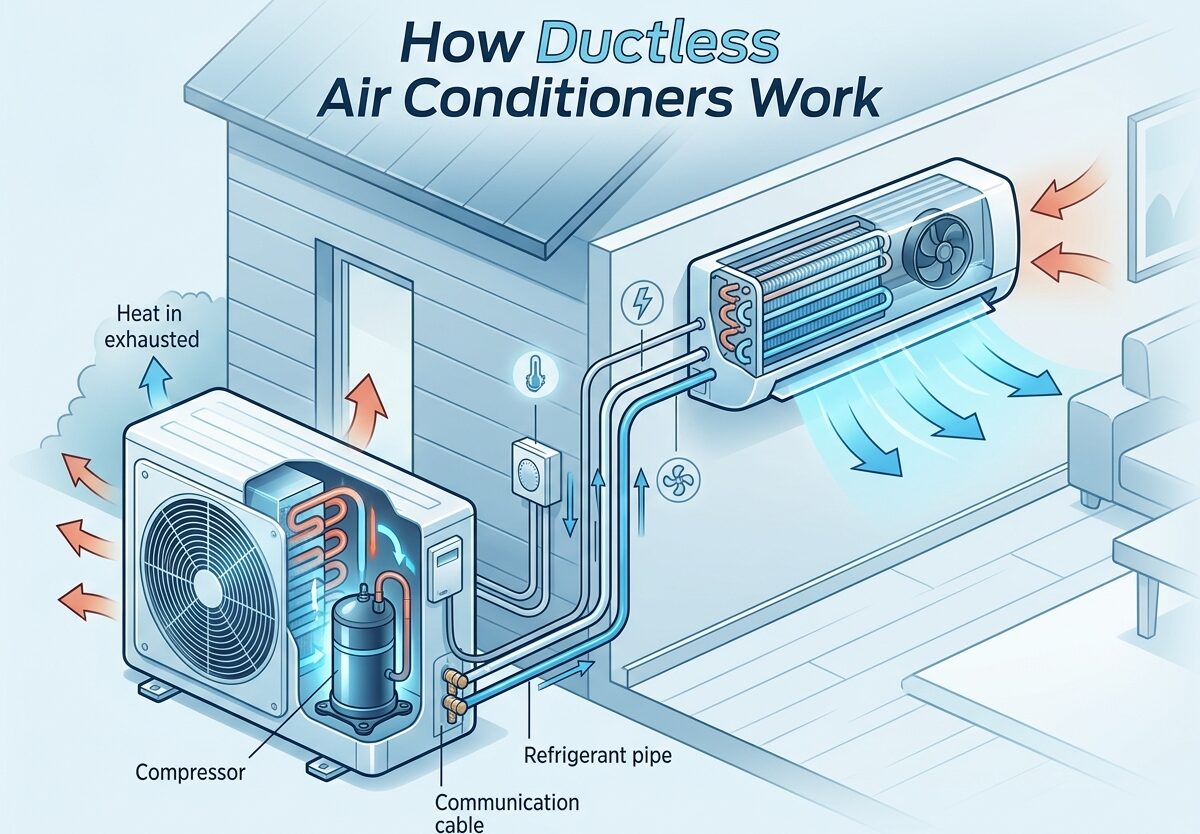
Each ductless system consists of at least one indoor unit mounted on a wall or ceiling, connected to an outdoor compressor unit. The indoor unit contains the evaporator coil and fan, while the outdoor unit houses the compressor and condenser coil. Refrigerant lines connect these components, allowing heat to be transferred from inside your home to the outdoors.
The term “mini-split” refers to the system being smaller than traditional central air (mini) and having the components split between indoor and outdoor locations. You’ll commonly hear these systems called ductless AC, ductless mini-splits, or simply mini-splits.
Core Components of a Ductless System
Understanding how ductless air conditioners work starts with knowing the key parts. Each component plays a specific role in the cooling process.
The Indoor Air Handler: This wall-mounted unit contains the evaporator coil, a fan, and an air filter. Warm air from your room is drawn across the cold evaporator coils, where heat is absorbed into the refrigerant. The cooled air is then blown back into your living space. Most indoor units are slim and unobtrusive, typically mounted high on a wall.
The Outdoor Condenser Unit: Housed in a metal cabinet outside your home, this unit contains the compressor and condenser coil. The compressor pressurizes the refrigerant, while the condenser coil releases the absorbed heat to the outdoor air. You’ll recognize this unit by its fan that helps dissipate heat.
Refrigerant Lines: Two copper pipes connect the indoor and outdoor units. One line carries cold refrigerant to the indoor unit, while the other returns warm refrigerant back outdoors. These lines are typically covered with insulation to prevent energy loss and protect them from the elements.
The Line Set: This is the term for the insulated refrigerant lineset that runs between indoor and outdoor units. A small hole (usually about 3 inches) is all that’s needed to pass these lines through your wall, making installation much less invasive than adding ductwork.
Control System: Each indoor unit has its own thermostat, usually in the form of a wireless remote control. Some systems offer smartphone control, allowing you to adjust temperatures from anywhere. Multi-zone systems can have multiple indoor units controlled independently or together.
How Ductless Air Conditioners Work – The Cooling Cycle
The cooling process in a ductless system follows the same thermodynamic principles as traditional air conditioning. Here’s the step-by-step cycle that keeps your home cool:
Step 1 – Warm Air Intake: The indoor unit’s fan pulls warm air from your room across the evaporator coil. This coil contains cold refrigerant that’s ready to absorb heat energy from the air passing over it.
Step 2 – Heat Absorption: As the warm air contacts the cold evaporator coils, heat transfers from the air into the refrigerant. The refrigerant evaporates from a liquid to a gas as it absorbs this heat energy. This phase change is what actually removes heat from your indoor air.
Step 3 – Cool Air Delivery: After passing over the evaporator coils, the air is now significantly cooler. The fan blows this conditioned air back into your room, lowering the temperature. Meanwhile, the now-gaseous refrigerant travels through the copper lines to the outdoor unit.
Step 4 – Compression: The outdoor compressor pressurizes the gaseous refrigerant, concentrating the heat energy it collected from inside your home. This compression also raises the refrigerant’s temperature substantially.
Step 5 – Heat Release: The hot, pressurized refrigerant flows through the condenser coils in the outdoor unit. The outdoor fan pulls air across these coils, transferring the heat from the refrigerant to the outside air. As the refrigerant releases its heat, it condenses back into a liquid.
Step 6 – Expansion and Return: The liquid refrigerant passes through an expansion valve, which reduces its pressure and temperature dramatically. Now cold and ready to absorb more heat, the refrigerant travels back to the indoor unit to repeat the cycle.
This continuous cycle runs as long as cooling is needed. The system’s thermostat monitors room temperature and cycles the compressor on and off to maintain your set temperature. Modern inverter-driven systems can vary compressor speed for more precise temperature control and improved efficiency.
Zoned Cooling Benefits
One of the biggest advantages of how ductless air conditioners work is zoned cooling. Each indoor unit operates independently, allowing you to set different temperatures in different rooms or areas of your home.
This zone control means you can cool only the spaces you’re actually using. If you spend most of your time in the living room during the day, you can keep that zone comfortable while letting unused bedrooms remain warmer. At night, you can prioritize cooling the bedrooms without wasting energy on empty living areas.
Zoned cooling also resolves the common household problem of some rooms being too hot while others are too cold. With individual temperature control for each zone, family members can adjust their own spaces to their preferred comfort levels. This flexibility is simply impossible with traditional single-zone central air systems.
Heat Pump Mode – How Heating Works
Most ductless systems are actually heat pumps, meaning they can both cool and heat your home. The heating mode works by simply reversing the cooling cycle through a component called a reversing valve.
When heating is needed, the system reverses the refrigerant flow. Now the outdoor unit acts as the evaporator, absorbing heat from the outdoor air (even when it’s cold outside) and transferring it indoors. The indoor unit becomes the condenser, releasing that heat into your living space.
This heat pump capability makes ductless systems a year-round solution. The same equipment that keeps you cool in summer can provide efficient heating in fall and spring, and in many climates, throughout winter as well. Heat pump mode is typically more energy-efficient than electric resistance heating because it moves heat rather than generating it.
Energy Efficiency and SEER Ratings
Ductless systems are highly efficient for several reasons. First, they eliminate the energy losses associated with ductwork, which can account for 20-30% of energy consumption in central air systems. Second, the zone control prevents cooling unused spaces. Third, modern inverter technology allows the compressor to run at variable speeds rather than full-blast on/off cycling.
The efficiency of ductless systems is measured by SEER (Seasonal Energy Efficiency Ratio) ratings. Higher SEER numbers indicate greater efficiency. Most quality ductless systems offer SEER ratings between 18 and 30, significantly higher than the minimum 14-15 SEER required for new central air systems. This efficiency advantage can translate to lower monthly energy bills, especially in homes where zone control is used effectively.
Installation Considerations
Installing a ductless system requires professional HVAC expertise. The process involves mounting the indoor unit, placing the outdoor unit on a concrete pad or bracket, running the refrigerant lineset through a small wall opening, connecting electrical wiring, and evacuating and charging the system with refrigerant.
The indoor unit should be positioned high on a wall where it can distribute air effectively without directing airflow directly onto seating areas or beds. The outdoor unit needs proper clearance for airflow and should be placed where noise won’t be bothersome. Refrigerant lines should follow the shortest practical path between units while protecting them from damage.
While some DIY-friendly mini-split kits are available, professional installation is strongly recommended to ensure proper refrigerant charging, leak-free connections, and optimal performance. Poor installation is the leading cause of ductless system problems and reduced efficiency.
Maintenance Tips
Keeping your ductless system running efficiently requires minimal but regular maintenance. The most important task is cleaning or replacing the air filter in the indoor unit every 1-3 months, depending on usage and air quality. Clogged filters reduce airflow and efficiency.
The outdoor unit should be kept clear of leaves, debris, and snow. Gently hose down the outdoor coil annually to remove dirt buildup. Schedule professional servicing every 1-2 years to check refrigerant levels, inspect electrical connections, and ensure all components are functioning properly.
Watch for warning signs like reduced cooling capacity, unusual noises, or ice formation on the refrigerant lines. These issues often indicate problems that need professional attention before they become more serious.
Cold Weather Performance
Ductless heat pumps can operate in cold weather, but their efficiency decreases as temperatures drop. Most standard models maintain rated heating capacity down to about 15-20°F. Below this temperature, heating output gradually diminishes.
For colder climates, cold-climate mini-splits are available with enhanced heating capability. These models can maintain full heating output down to -5°F or even lower, using features like hyper-heating compressors and improved defrost cycles. If you live in an area with harsh winters, specifically look for models designed for cold-weather performance.
The defrost cycle is an important cold-weather function. When frost builds up on the outdoor coil, the system temporarily switches to cooling mode to melt the ice. You might notice steam rising from the outdoor unit during defrost, which is normal operation.
Ductless vs Central Air Comparison
Ductless and central air systems both cool your home, but they work differently and suit different situations. Central air uses a single large air handler connected to ductwork that distributes conditioned air throughout your entire home. It’s ideal for new construction with existing ductwork or homes where ducts are already in place.
Ductless systems excel in homes without ductwork, room additions, sunrooms, garages, and situations where only certain areas need cooling. They’re more efficient due to no duct losses and offer zone control that central systems can’t match without expensive zoning equipment. However, ductless indoor units are visible in each room, which some homeowners find less aesthetically pleasing than discreet ceiling vents.
Installation cost is another consideration. While individual ductless units can seem expensive, a multi-zone system might cost less than adding ductwork to a home that lacks it. For whole-home cooling in houses with existing ducts, central air is often more economical. For targeted cooling or homes without ducts, ductless systems frequently make more financial sense.
Cost Considerations
The upfront cost of a ductless system typically ranges from $3,000 to $8,000 for a single-zone installation, depending on capacity, efficiency, and installation complexity. Multi-zone systems cost more, with each additional zone adding $1,500 to $3,500 on average. While this is higher than window units, it’s comparable to or less than central air installation when ductwork is needed.
Operating costs depend heavily on usage patterns and electricity rates. The zone control capability of ductless systems can significantly reduce energy consumption compared to cooling an entire home with central air. Many homeowners report energy savings of 20-30% after switching to ductless, especially when they take advantage of zone control to cool only occupied spaces.
Consider both upfront and long-term costs when deciding. Higher SEER-rated units cost more initially but save money over time through lower energy bills. In moderate climates where heating is also needed, the year-round capability of heat pump models can eliminate separate heating equipment costs.
FAQs
What are the disadvantages of ductless air conditioning?
The main disadvantages include higher upfront installation costs compared to central air in homes with existing ductwork, visible indoor units that some find less attractive, and the need for professional installation. Some models also have reduced heating efficiency in very cold temperatures below 15-20°F unless you purchase cold-climate specific models.
How do mini splits work in cold weather?
Mini split heat pumps extract heat from outdoor air even in cold temperatures, though efficiency decreases as it drops. Standard models work well down to 15-20°F, while cold-climate models can operate effectively down to -5°F or lower. The system includes a defrost cycle that temporarily melts frost buildup on the outdoor coil.
What is the life expectancy of a ductless mini split?
With proper maintenance, ductless mini split systems typically last 15-20 years. The indoor units often last longer than the outdoor compressor, which may need replacement after 12-15 years. Regular filter cleaning and annual professional servicing help maximize system longevity.
How much does a mini split cost for a 2000 sq ft house?
For a 2000 sq ft house, you’ll likely need a multi-zone system with 3-4 indoor units. Total installation cost typically ranges from $8,000 to $15,000 depending on the number of zones, system efficiency, and installation complexity. This compares favorably to central air installation when ductwork must be added.
Why is my electric bill so high with mini splits?
High electric bills with mini splits often result from leaving multiple zones running simultaneously, using emergency heat strips in cold weather, dirty filters reducing efficiency, or improper installation. Ensure you’re only cooling occupied zones, clean filters monthly, and have a professional check refrigerant levels if bills seem excessive.
What problems can occur with a ductless air conditioner?
Common problems include refrigerant leaks, frozen coils due to dirty filters or low refrigerant, condensate drain clogs causing water leaks, electrical issues with the outdoor unit, and sensor problems causing erratic operation. Most issues are preventable with regular maintenance and professional servicing.
Where is the reset button on a mini split air conditioner?
Most mini split units don’t have a physical reset button. To reset the system, turn off the indoor unit using the remote or wall switch, then turn off the breaker to the outdoor unit for 5-10 minutes. Restore power and the system should reset. If problems persist, check your owner’s manual or contact a professional.
Conclusion
Understanding how ductless air conditioners work helps you appreciate why these systems have become so popular. By eliminating duct losses, providing zone control, and offering both heating and cooling capabilities, ductless mini-splits deliver efficient, flexible comfort for a wide range of home situations.
Whether you’re cooling a room addition, updating an older home without ductwork, or simply want more control over your home’s climate, ductless technology offers a proven solution. The key is choosing the right system for your climate and having it professionally installed to ensure years of reliable, efficient operation.


Leave a Comment