
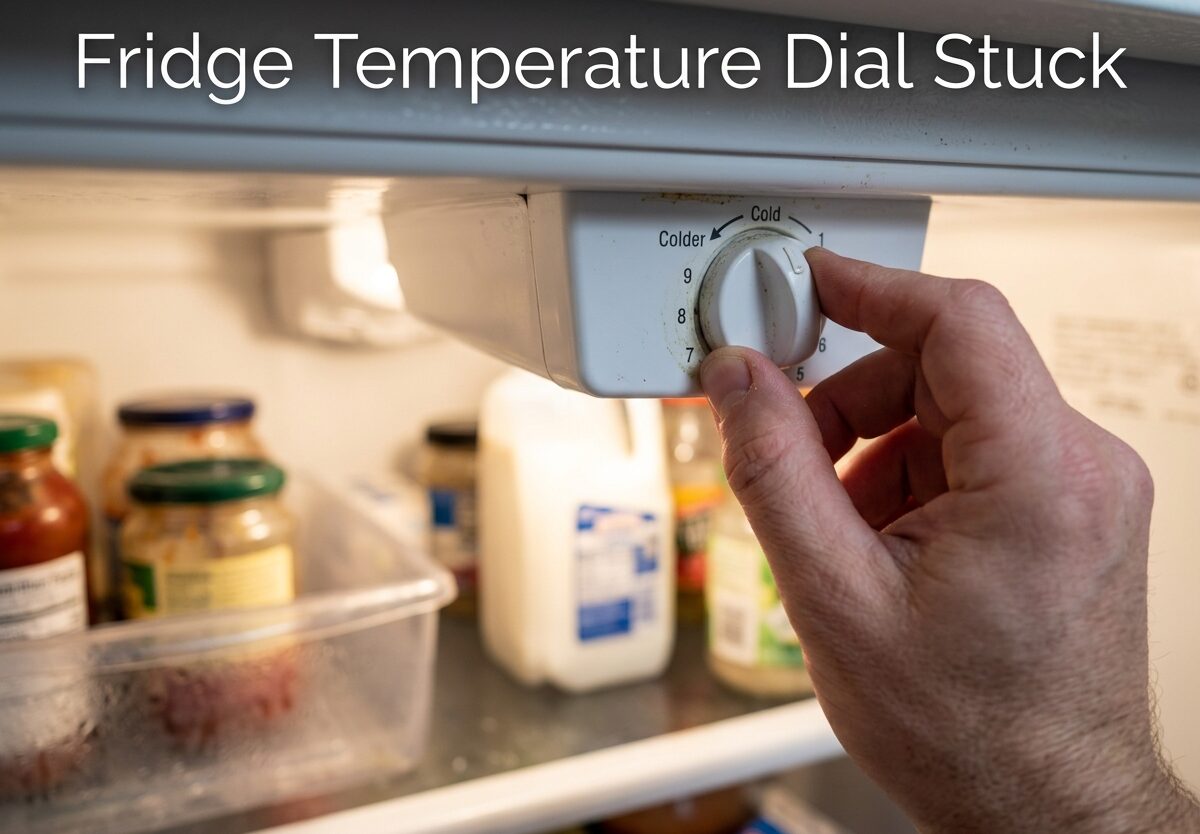
You reach into your fridge to adjust the temperature, but the dial won’t budge. It’s stuck tight, and no amount of effort seems to make it move. This frustrating problem leaves you unable to control your refrigerator’s cooling, potentially leading to food spoilage or wasted energy.
A fridge temperature dial dial stuck issue is more common than you might think. Over time, ice buildup, food debris, and simple wear can cause your temperature control to freeze in place. The good news? Most stuck dial problems can be fixed at home with basic tools and a bit of patience.
In this guide, I’ll walk you through everything you need to know about freeing a stuck refrigerator temperature dial. From quick fixes you can try right now to brand-specific solutions for major manufacturers, we’ll cover it all.
Quick Fixes to Try First
Before diving into more involved repairs, try these simple solutions. They often resolve minor sticking issues without requiring any tools.
Unplug and Wait Method: Sometimes a simple power reset can free up a stuck dial. Unplug your refrigerator for 5-10 minutes, then plug it back in. This can reset electronic components and release any frozen mechanisms.
Run a Defrost Cycle: Ice buildup behind the dial is a common culprit. If your fridge has an automatic defrost setting, run it. For manual defrost units, unplug the fridge and leave the doors open for 2-3 hours to melt any ice.
Clean Around the Dial: Use a damp cloth to wipe away any visible debris, spills, or sticky residue around the temperature control. Sometimes a simple cleaning is all it takes.
Test the Shaft: Carefully try to grip the dial shaft (the metal post behind the knob) with needle-nose pliers. If the shaft turns easily but the knob doesn’t, your problem is just the knob itself, not the thermostat.
What Causes a Fridge Temperature Dial to Stick?
Understanding why your dial is stuck helps prevent future problems. Here are the most common causes I’ve encountered:
Ice Buildup: Moisture from the fridge can freeze behind the temperature control, essentially welding it in place. This is especially common in older refrigerators or units with worn door seals.
Food Debris and Spills: Sticky spills, crumbs, and food residue can accumulate around the dial mechanism over time. Sugary substances harden and lock the control in place.
Worn Plastic Components: After 10+ years of use, plastic knobs can degrade and warp. The internal spline may strip, preventing proper grip on the thermostat shaft.
Corrosion: The metal thermostat shaft can corrode over time, especially in humid environments. This creates friction that makes turning difficult or impossible.
Wrong Cleaning Products: Using harsh cleaners or sticky products like Goo Gone near the controls can actually make things worse by attracting dirt and creating residue.
How to Fix a Stuck Fridge Temperature Dial Stuck
If the quick fixes didn’t work, follow these step-by-step instructions to free your stuck dial safely and effectively.
Step 1: Safety First – Unplug Your Refrigerator
Before doing any work on your refrigerator, always unplug it from the wall outlet. This prevents electrical shock and protects the fridge’s components from short circuits. If you can’t reach the outlet, turn off the refrigerator at the circuit breaker.
Safety reminder: Refrigerators have capacitors that can hold electrical charge even when unplugged. Avoid touching any electrical components beyond the temperature control area.
Step 2: Remove the Stuck Knob
Most refrigerator knobs simply pull straight off. Grip the knob firmly (not the dial indicator) and pull straight toward you with steady, even pressure. Rock it slightly if needed, but avoid twisting, which could damage the thermostat shaft.
For stubborn knobs that won’t pull off:
Wrap a thin cloth around the base of the knob to protect the surface. Use a flat-head screwdriver placed between the knob and the control panel to gently pry it off. Work your way around the knob, applying gentle pressure evenly.
If the knob is flush with the bezel and prevents proper grip, some users have successfully used a small amount of warm water around the edges to help loosen any adhesive or sticky residue.
Step 3: Clean the Mechanism
Once the knob is removed, inspect the thermostat shaft and the area behind it. You’ll likely find:
Use a clean, damp cloth to wipe away any visible debris. For stubborn grime, use a mild solution of warm water and dish soap. Avoid harsh chemicals that could damage plastic components or leave sticky residue.
If ice is present, use a hair dryer on low heat to melt it. Keep the dryer at least 6 inches away to avoid damaging plastic parts. Wipe away moisture as it melts.
Step 4: Lubricate Properly
A small amount of lubricant can help the mechanism move smoothly. However, choose wisely:
- DO use: Silicone-based lubricant, white lithium grease, or a tiny amount of petroleum jelly
- DON’T use: WD-40 (unless it’s the silicone version), cooking oil, or spray lubricants that attract dirt
Apply a tiny amount of lubricant to the thermostat shaft only. Avoid getting lubricant on electrical contacts. Rotate the shaft with pliers to distribute the lubricant evenly.
Step 5: Test and Replace the Knob
Before replacing the knob, test the thermostat shaft. It should turn smoothly with minimal resistance. If it still feels stuck or rough, there may be a deeper problem with the thermostat itself.
Once satisfied, push the knob back onto the shaft. Make sure it’s properly aligned with the temperature indicators. Test the dial by turning it through its full range. It should move freely without binding.
If the original knob is stripped or damaged, replacement knobs are available for most major brands. Check your refrigerator’s model number (usually found on a sticker inside the fridge door) to find the correct replacement.
Brand-Specific Solutions for Fridge Temperature Dial Stuck
Different manufacturers have unique designs and common issues. Here’s what I’ve learned from repairing various brands:
Whirlpool, KitchenAid, and Maytag
These brands share similar dial designs. A common issue is the knob becoming flush with the bezel over time, making it hard to grip. The solution: Some users have successfully pulled the shaft forward about 1mm with pliers to reduce friction and restore usability.
For Whirlpool models with electronic controls that appear stuck, try holding the “Filter Reset” and “Energy Saver” buttons simultaneously for 3 seconds to unlock the panel.
Samsung Refrigerators
Samsung models often feature digital control panels rather than analog dials. If your Samsung fridge temperature controls appear stuck:
Try unlocking the panel by holding the “Power Freeze” and “Power Cool” buttons simultaneously for 8-10 seconds. You should hear a chime indicating the panel is unlocked. For models with a dedicated “Child Lock” button, press and hold it for 3 seconds to disable the lock.
LG Refrigerators
LG models with digital displays may enter a demo mode that locks controls. To exit demo mode on most LG fridges: Press and hold the “Refrigerator” and “Ice Plus” buttons simultaneously for 5 seconds.
For LG models with analog dials that are stuck, the issue is often ice buildup in the damper control. This may require removing the interior panel to access and defrost the damper mechanism.
Frigidaire and Electrolux
These brands often have their temperature controls located at the top of the fresh food compartment. The dial mechanism can become sticky from spills. I’ve found that removing the control cover (usually held by clips) allows better access for cleaning.
Some Frigidaire models have a known issue with the thermostat shaft binding. If cleaning doesn’t help, the thermostat assembly may need replacement.
GE and Hotpoint
GE refrigerator knobs are notorious for becoming difficult to remove. The manufacturer actually makes a special knob removal tool for technicians. As an alternative, two spoons placed back-to-back under opposite edges of the knob can provide leverage for removal.
For GE models with digital controls that appear unresponsive, check if the “Control Lock” indicator is illuminated. Press and hold the “Lock” button for 3 seconds to unlock.
Digital Control Panel vs Analog Dial
Modern refrigerators increasingly use digital controls instead of analog dials. While they look different, both can become unresponsive. Here’s how to handle digital control issues:
Panel Lock: Most digital panels have a child lock feature. Look for a padlock icon or “Lock” button. Press and hold for 3-5 seconds to unlock.
Reset Procedure: Unplug the fridge for 5 minutes, then press and hold the “Power” and “Mode” buttons simultaneously while plugging it back in. This performs a hard reset on many models.
Error Codes: If the display shows a code like “FF” or “OF”, it may be in demo or showroom mode. Check your manual for the specific button combination to exit this mode.
Unresponsive Panel: If buttons don’t respond at all, check the ribbon cable connection behind the control panel. Loose connections are a common cause of unresponsive controls.
Stuck Dial or Failing Thermostat?
Sometimes what appears to be a stuck dial is actually a failing thermostat. Here’s how to tell the difference:
Dial is stuck: The knob won’t turn, but when you remove it and turn the shaft with pliers, it moves freely. Solution: Fix or replace the knob.
Thermostat is failing: The dial turns, but the temperature doesn’t change. Or the dial turns but feels loose and doesn’t click into place. Solution: The thermostat may need replacement.
Signs your thermostat is broken:
- The fridge runs constantly but never gets cold enough
- The compressor doesn’t turn on at all
- Temperature settings don’t affect actual temperature
- The dial spins freely without any resistance or clicks
Testing the thermostat requires a multimeter to check for continuity. If you’re not comfortable with electrical testing, this is a good time to call a professional.
When to Call a Professional
While most stuck dial issues are DIY-friendly, some situations require professional help:
Control Board Failure: If your digital panel shows error codes, displays random numbers, or some buttons work while others don’t, the control board may be failing. Control board replacement typically costs $150-300 including parts and labor.
Sealed System Issues: If the compressor won’t run or the fridge doesn’t cool at all regardless of settings, you may have a refrigerant leak or compressor problem. These repairs require EPA certification and specialized equipment.
Warranty Coverage: If your refrigerator is less than 5 years old, check your warranty. Attempting DIY repairs could void your coverage. Many manufacturers cover thermostat and control board issues during the warranty period.
When in Doubt: If you’ve tried the steps above and the problem persists, or if you’re uncomfortable performing any of these repairs, there’s no shame in calling a professional. Refrigerator repair technicians have the tools and experience to diagnose and fix issues quickly.
Preventing Future Dial Sticking
Once you’ve freed your stuck dial, a few simple habits can prevent the problem from returning:
- Clean spills around the temperature control immediately
- Avoid using spray cleaners near the dial mechanism
- Check door seals regularly and replace if worn to prevent excess moisture
- For manual defrost units, defrost annually to prevent ice buildup
- If the knob feels loose or cracked, replace it before it fails completely
FAQs
What are the signs of a dying refrigerator?
Common signs include: Food spoiling faster than usual, excessive condensation inside, the fridge running constantly, unusual noises (clicking, humming, or grinding), higher than normal energy bills, visible frost buildup in the freezer, and the compressor never turning off. If you notice multiple symptoms, it may be time to consider repair or replacement.
Will unplugging a fridge reset it?
Yes, unplugging your refrigerator for 5-10 minutes can reset many electronic issues, including unresponsive digital controls. This simple reset can clear minor glitches in the control board and may free up a stuck digital display. For stubborn issues, leave it unplugged for up to 30 minutes. Remember that a full reset may take several hours to return to proper operating temperature.
How to reset fridge temperature sensor?
For analog dials: Unplug for 10 minutes, then plug back in and turn the dial to its highest setting. For digital panels: Find your model’s reset button combination (often Power+Mode, or holding Lock for 5 seconds). Some models require accessing the control panel and pressing a small reset button with a paperclip. Consult your manual for model-specific instructions.
How do I know if my fridge thermostat is broken?
Signs of a broken thermostat include: The compressor runs but the fridge doesn’t cool properly, the compressor never turns on at all, temperature changes don’t affect cooling performance, the dial spins without any resistance, or the fridge is stuck at one temperature regardless of settings. Testing with a multimeter for continuity can confirm thermostat failure.
Is it worth replacing a fridge control board?
For refrigerators under 8 years old, control board replacement is usually worth it, costing $150-300 compared to $1000-2500 for a new fridge. Consider the fridge’s overall condition-if the compressor and seals are good, a board replacement can add years of life. For units over 10 years old, multiple failing parts may indicate it’s time to replace rather than repair.
Can I use WD-40 on my fridge temperature dial?
Standard WD-40 is not recommended for refrigerator dials because it can attract dirt and dust over time, potentially making the problem worse. Instead, use a silicone-based lubricant or white lithium grease designed for plastic and metal components. Apply only a tiny amount to the thermostat shaft, avoiding electrical contacts. Silicone spray versions of WD-40 are acceptable.
Why is my fridge temperature dial stuck?
The most common causes include ice buildup behind the dial mechanism, food debris or sticky spills around the control, worn or stripped plastic knobs (especially after 10+ years), corrosion on the thermostat shaft, or using harsh cleaning products that leave residue. In some cases, the thermostat itself may be failing rather than just being stuck.
How to fix refrigerator temperature control?
Start by unplugging the fridge for safety. Remove the knob by pulling straight off or gently prying with a flat-head screwdriver. Clean the area thoroughly with warm soapy water. For ice buildup, use a hair dryer on low heat. Apply a small amount of silicone lubricant to the shaft. Test that the shaft turns freely, then replace the knob. If the shaft won’t turn, the thermostat may need replacement.
Conclusion
A fridge temperature dial stuck is annoying, but rarely a reason to panic. In most cases, the issue can be resolved with basic tools and a bit of patience. Start with the simple fixes-unplugging, cleaning, and defrosting-before moving on to more involved repairs.
Remember to always unplug your refrigerator before attempting any repairs. If you’re unsure about any step or the problem persists after trying these solutions, don’t hesitate to call a professional. Your refrigerator is an essential appliance, and proper repair ensures it keeps running efficiently for years to come.
Have you successfully freed a stuck dial? Share your experience in the comments below to help others facing the same fridge temperature dial stuck problem.





Leave a Comment