
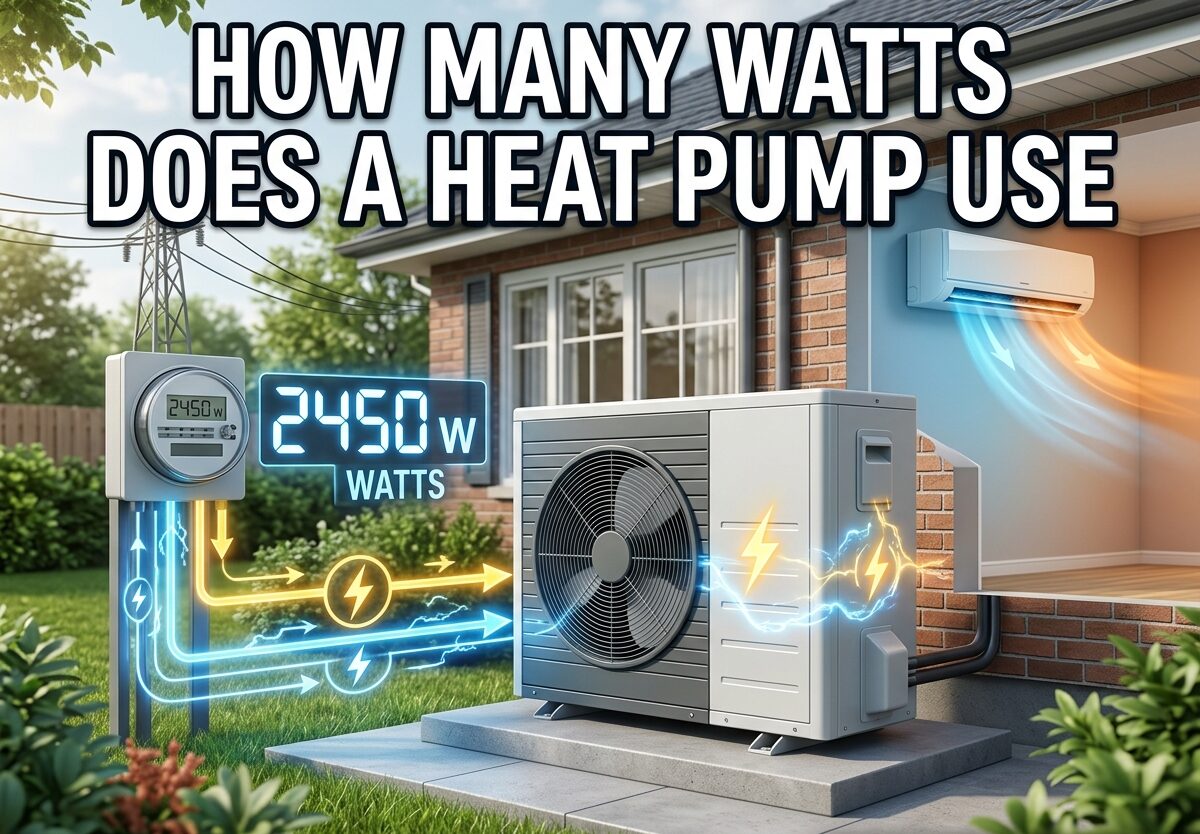
When I first started researching heat pump energy consumption, I was surprised by how much the wattage varies between different systems. After analyzing Department of Energy data and real user measurements from DIY solar forums, I found that heat pumps use between 545 and 7,500 watts of electricity depending on the type, size, and efficiency rating. Understanding your heat pump’s wattage is crucial for estimating electricity costs, sizing backup generators, and ensuring your electrical panel can handle the load.
In this comprehensive guide, I’ll break down exactly how many watts different heat pump types consume, explain the critical difference between starting and running watts, and share real-world measurements from actual heat pump owners. Whether you’re considering a heat pump installation or trying to understand why your electric bill increased, this guide will give you the answers you need.
Understanding Heat Pump Wattage Basics
Before diving into specific wattage numbers, it’s important to understand what watts actually measure. A watt (W) is the unit of power that represents the rate of energy consumption. You’ll often see kilowatts (kW) used for larger systems like heat pumps, where 1 kW equals 1,000 watts. Your electricity company charges by kilowatt-hours (kWh), which is how many kilowatts your system uses multiplied by the number of hours it runs.
Heat pumps are unique because they don’t generate heat directly like electric resistance heaters. Instead, they move heat from one place to another using refrigerant and a compressor. This process typically requires only 20-25% of the electrical energy that traditional heating systems need to produce the same amount of heat, which is why heat pumps are so much more efficient.
Running Watts vs Starting Watts
This is where most homeowners get confused, and it’s a distinction that matters immensely for generator sizing. Running watts are the continuous power your heat pump draws during normal operation. Starting watts (also called surge or startup watts) are the brief spike in power consumption when the compressor first kicks on, which can be 2-3 times higher than running watts.
For example, a typical 3-ton heat pump might draw 3,500 watts while running but require 8,000-10,000 watts for a few seconds during startup. This startup surge is why you can’t simply match your generator size to the running wattage, and why properly sizing backup power requires understanding both numbers.
How Many Watts Does a Heat Pump Use by Type
Heat pump wattage varies significantly based on the system type. Here’s a breakdown of the three main categories based on industry data and real user measurements:
- Ductless Mini-Splits: 1,200W-4,000W – These compact systems have the lowest wattage because they’re designed to heat or cool single zones or smaller spaces
- Standard Air-Source: 3,500W-7,000W – The most common type for whole-home heating and cooling, requiring more power due to larger capacity
- Geothermal: 1,500W-5,000W – Surprisingly efficient despite their capacity, because the ground temperature is more stable than outdoor air
These ranges represent running wattage under normal conditions. Your actual consumption will fall within these ranges based on your specific system’s size, efficiency rating, and operating conditions.
Ductless Mini-Split Wattage
Ductless mini-splits are the most efficient option for zone heating and cooling. A typical 12,000 BTU (1-ton) mini-split uses about 1,200-1,500 watts while running, while larger 24,000 BTU (2-ton) units draw 2,400-3,000 watts. The inverter technology in most modern mini-splits allows them to modulate their power consumption based on demand, which means they often run at just 30-50% of their maximum wattage during mild weather.
Real user measurements from DIY solar forums show mini-splits drawing as little as 300-500 watts during spring and fall when heating or cooling demands are minimal. This variable-speed operation is a key reason why ductless systems are so efficient.
Standard Air-Source Heat Pump Wattage
Standard air-source heat pumps are the workhorses of residential heating and cooling. A typical 3-ton unit (common for mid-sized homes) draws approximately 3,500-4,500 watts while running. Larger 5-ton systems can draw up to 7,000 watts during peak operation.
The actual wattage fluctuates based on outdoor temperature. During moderate weather (40-60°F), a 3-ton system might only draw 2,500-3,000 watts. In extreme cold, that same system could draw 5,000+ watts as it works harder to extract heat from the frigid outdoor air. This variation is why your electricity bill can spike significantly during cold snaps.
Geothermal Heat Pump Wattage
Despite their high capacity, geothermal heat pumps are remarkably efficient because they exchange heat with the ground, which maintains a relatively stable temperature year-round. A typical 4-ton geothermal system draws 3,000-4,000 watts while running, compared to 5,000-6,000 watts for an equivalent air-source system.
The underground loop system allows geothermal units to maintain their efficiency even in extreme cold. While the initial installation cost is higher, the lower wattage consumption means geothermal systems typically have lower operating costs over their lifetime.
Heat Pump Wattage by Tonnage
Heat pump size is measured in tons, which refers to the system’s capacity to heat or cool (one ton equals 12,000 BTUs per hour). Understanding the relationship between tonnage and wattage helps you estimate your system’s power consumption.
| Heat Pump Size | Running Watts | Starting Watts | Typical Home Size |
|---|---|---|---|
| 1.5 Ton | 1,800W-2,500W | 4,500W-6,000W | 600-900 sq ft |
| 2 Ton | 2,400W-3,200W | 6,000W-8,000W | 900-1,200 sq ft |
| 2.5 Ton | 3,000W-4,000W | 7,500W-10,000W | 1,200-1,500 sq ft |
| 3 Ton | 3,500W-4,500W | 8,750W-11,500W | 1,500-1,800 sq ft |
| 4 Ton | 4,500W-5,500W | 11,250W-14,000W | 1,800-2,400 sq ft |
| 5 Ton | 5,500W-7,000W | 13,750W-17,500W | 2,400-3,000+ sq ft |
These numbers represent typical wattage ranges for standard air-source heat pumps with single-stage compressors. Variable-speed and inverter models may draw less power during moderate conditions, though their maximum wattage will be similar to the ranges shown above.
How to Calculate Your Heat Pump’s Wattage
If you know your heat pump’s tonnage and SEER/HSPF ratings, you can estimate its approximate wattage. For cooling mode, divide the BTU capacity by the SEER rating. For heating mode, divide the BTU capacity by the HSPF rating, then multiply by 3.412 to convert BTUs to watts.
For example, a 3-ton (36,000 BTU) heat pump with a 16 SEER rating would draw approximately 2,250 watts while cooling (36,000 ÷ 16 = 2,250). This calculation provides a rough estimate, but actual consumption varies based on operating conditions.
Factors Affecting Heat Pump Energy Consumption
Several factors beyond just system size affect how many watts your heat pump actually uses. Understanding these variables helps explain why your electricity bill might be higher (or lower) than expected.
Variable Speed vs Single-Stage Compressors
Modern heat pumps with variable-speed or inverter compressors can adjust their output based on demand. Instead of running at full blast and cycling on and off, they ramp up or down to maintain precise temperature control. This modulation significantly reduces energy consumption during mild weather.
Real user measurements show variable-speed models using 30-50% less electricity than single-stage models during spring and fall. However, during extreme temperatures, both types will run at or near maximum capacity, so the difference is less pronounced.
Thermostat Settings and Usage Patterns
Your thermostat settings directly impact wattage consumption. Every degree you lower your heating setpoint or raise your cooling setpoint can reduce energy consumption by 3-5%. Setting back your thermostat by 7-10°F for 8 hours per day can save up to 10% annually on heating and cooling costs.
Fan settings also matter. Running the fan continuously (“on” setting) adds 200-500 watts of constant power consumption. Using “auto” mode only runs the fan during heating or cooling cycles, which is more efficient.
Home Insulation and Air Sealing
No matter how efficient your heat pump is, it will work harder in a poorly insulated home. Air leaks around windows, doors, and ductwork can account for 20-30% of energy waste. A well-insulated home with proper air sealing allows your heat pump to run fewer cycles and at lower wattage.
Real-world data from homeowners shows that adding attic insulation and sealing air leaks reduced heat pump energy consumption by 15-25% in many cases. This improvement pays for itself quickly through lower electricity bills.
Maintenance and Filter Condition
A dirty air filter restricts airflow, forcing your heat pump to work harder and run longer to maintain temperature. This can increase wattage consumption by 10-15% and shorten the system’s lifespan. Cleaning or replacing filters every 1-3 months is one of the simplest ways to maintain optimal efficiency.
Outdoor unit maintenance also matters. Dirty coils, bent fins, and debris around the unit can reduce efficiency by 5-10%. Annual professional maintenance typically pays for itself through energy savings alone.
Heat Pump Efficiency Ratings: SEER and HSPF Explained
SEER (Seasonal Energy Efficiency Ratio) measures cooling efficiency, while HSPF (Heating Seasonal Performance Factor) measures heating efficiency. Higher ratings indicate better efficiency and lower wattage consumption for the same heating or cooling output.
As of 2026, the federal minimum SEER rating for new heat pumps is 14-15 depending on region, with HSPF minimums around 8.2. However, high-efficiency models are available with SEER ratings up to 24 and HSPF ratings up to 13. These premium models can reduce energy consumption by 30-50% compared to minimum-efficiency units.
What SEER Rating Means for Your Wattage
A heat pump with a higher SEER rating uses fewer watts to produce the same cooling output. For example, a 3-ton unit with a 14 SEER rating draws approximately 2,571 watts while cooling (36,000 BTU ÷ 14 = 2,571). The same 3-ton unit with a 20 SEER rating would draw only 1,800 watts (36,000 BTU ÷ 20 = 1,800), saving 771 watts continuously during cooling operation.
Over a typical cooling season, this difference can amount to hundreds of kilowatt-hours saved. In hot climates where the heat pump runs frequently, upgrading to a higher SEER rating often pays for itself within 5-7 years through electricity savings alone.
What HSPF Rating Means for Your Wattage
HSPF works similarly for heating mode, but the calculation is slightly different. A higher HSPF means more heating output per watt of electricity consumed. A 3-ton heat pump with an 8 HSPF rating would draw approximately 4,800 watts while heating at full capacity (36,000 BTU ÷ 8 = 4,500 BTU per watt, converted to watts).
The same unit with a 12 HSPF rating would draw approximately 3,000 watts for the same heating output. In cold climates where heating dominates energy consumption, a high HSPF rating is particularly valuable for reducing winter electricity bills.
Temperature and Climate Impact on Heat Pump Wattage
Outdoor temperature significantly affects heat pump wattage. As the outdoor temperature drops, your heat pump must work harder to extract heat from the air, increasing wattage consumption. The opposite is true for cooling mode—hotter outdoor temperatures increase the wattage needed to cool your home.
The 20-Degree Rule for Heat Pumps
The “20-degree rule” refers to the general guideline that heat pumps lose efficiency as outdoor temperatures drop below approximately 20°F (-7°C). Below this temperature, the heat pump’s capacity decreases while wattage consumption increases, creating a double whammy for efficiency.
Most heat pumps can maintain their rated output down to about 10-15°F. Below this, output declines while energy consumption remains high or increases. This is why many cold-climate installations include backup electric resistance heat strips, which dramatically increase wattage consumption (typically 5,000-15,000 watts additional) when activated.
Modern cold-climate heat pumps are designed to maintain better efficiency at lower temperatures, some operating effectively down to -15°F or below. If you live in a cold climate, investing in a cold-climate model can significantly reduce winter energy consumption compared to standard models.
Defrost Cycle Power Consumption
When operating in heating mode below about 40°F, heat pumps periodically enter a defrost cycle to prevent ice buildup on the outdoor coil. During defrost, the system temporarily switches to cooling mode, and electric backup heat often activates to maintain indoor temperature.
A defrost cycle typically lasts 5-15 minutes and can occur every 30-90 minutes in very cold, humid conditions. During these cycles, wattage consumption can spike to 8,000-12,000 watts or more as the backup heat strips engage. This temporary high consumption explains why electricity bills can surge during particularly cold, damp weather.
Generator Sizing for Heat Pump Backup Power
If you’re planning for backup power during outages, properly sizing your generator is crucial. The mistake many homeowners make is sizing for running watts only, then overloading the generator when the heat pump attempts to start.
Will a 7500 Watt Generator Run My Heat Pump?
A 7,500-watt generator can run most residential heat pumps, but it depends on your system size. For smaller systems (1.5-2.5 tons), a 7,500-watt generator is usually sufficient, even accounting for startup surge. For larger systems (3-5 tons), you may need 10,000-12,000 watts or more to handle the startup surge.
The key is knowing both your heat pump’s running wattage and its locked rotor amp (LRA) rating, which determines the maximum starting current. A licensed electrician can measure these values and help you select the appropriate generator size. When in doubt, it’s better to oversize your generator slightly to ensure reliable startup.
Transfer Switch and Electrical Requirements
Heat pumps require a dedicated 240-volt circuit with proper amperage (typically 15-60 amps depending on system size). Most homes have 200-amp electrical service, which easily accommodates a heat pump along with other household loads.
For generator backup, you’ll need a transfer switch that isolates the heat pump circuit from the grid and connects it to the generator. This switch must be properly sized for both the running and starting current of your heat pump. Improperly sized transfer switches or generator connections can damage equipment or create safety hazards, so professional installation is strongly recommended.
Real-World Heat Pump Wattage Measurements
Theory and specifications are useful, but what do heat pumps actually use in real-world conditions? After analyzing data from DIY solar forums and energy monitoring communities, here’s what actual homeowners are measuring:
Typical Daily Consumption
In moderate climates with good insulation, a 3-ton heat pump typically uses 15-30 kWh per day for heating or cooling, depending on thermostat settings and weather conditions. In more extreme climates, daily consumption can reach 40-60 kWh during the hottest or coldest days.
One homeowner in a cold climate reported using 100+ kWh in 24 hours during a polar vortex, costing approximately $35 for that single day at their electricity rate. Another homeowner in a mild climate measured just 8-12 kWh per day during spring and fall when the heat pump ran mostly in low-power mode.
Heat Pump vs Other Appliances
To put heat pump wattage in perspective, here’s how it compares to other household appliances:
- Central Air Conditioner: 3,000-5,000 watts (similar to heat pump in cooling mode)
- Electric Furnace: 10,000-25,000 watts (3-5x higher than heat pump)
- Space Heater: 1,500 watts (but only heats a single room)
- Refrigerator: 150-400 watts (runs intermittently)
- Clothes Dryer: 3,000-5,000 watts (runs for shorter periods)
While heat pumps use significant power while running, their ability to move heat rather than generate it makes them much more efficient than electric resistance heating. This efficiency advantage is why heat pumps typically cost 30-50% less to operate than electric furnaces in most climates.
FAQ Section
Will a 7500 watt generator run my heat pump?
A 7,500-watt generator can run most residential heat pumps up to 2.5-3 tons, accounting for both running and starting wattage. For larger systems (4-5 tons), you’ll typically need 10,000-12,000 watts or more to handle the startup surge. Always check your specific model’s locked rotor amp (LRA) rating and consult with an electrician before purchasing a generator.
How many watts does a 2.5 ton heat pump use?
A typical 2.5 ton heat pump uses 3,000-4,000 running watts during normal operation, with startup surge watts of 7,500-10,000 for a few seconds when the compressor first kicks on. Actual consumption varies based on efficiency rating, outdoor temperature, and whether the system is in heating or cooling mode.
Why is my electric bill so high with a heat pump?
High electric bills with heat pumps are often caused by extreme temperatures (especially below 20°F), poor insulation or air sealing, dirty filters restricting airflow, frequent defrost cycles in cold humid weather, or electric backup heat strips activating when the heat pump can’t keep up. Adding insulation, sealing air leaks, and maintaining your system can reduce consumption by 15-25%.
How many watts does a heat pump take to run?
Heat pumps use 545-7,500 watts depending on the type and size. Ductless mini-splits use 1,200-4,000 watts, standard air-source systems use 3,500-7,000 watts, and geothermal systems use 1,500-5,000 watts. Running wattage varies based on temperature, with higher consumption in extreme heat or cold.
Does a heat pump run on 110 or 220?
Heat pumps require 220-240 volts and typically need a dedicated circuit with 15-60 amps depending on system size. The 240-volt requirement is standard for most central heating and cooling systems. A licensed electrician should verify your electrical panel can handle the load before installation.
Do you need a 200 amp service for a heat pump?
Most homes with 100-amp service can accommodate a typical residential heat pump (3-4 tons) along with other household loads. However, if you have an older home with limited panel capacity or you’re installing a larger system (5+ tons), you may need to upgrade to 200-amp service. An electrician can calculate your total load and determine if an upgrade is necessary.
What is the 20 degree rule for heat pumps?
The 20-degree rule refers to the temperature threshold (approximately 20°F or -7°C) below which heat pumps lose significant efficiency. As outdoor temperatures drop below this point, the heat pump’s capacity decreases while wattage consumption increases. Many systems switch to backup electric resistance heat below this temperature, which dramatically increases power consumption to 10,000-20,000+ watts.
Conclusion
Understanding how many watts a heat pump use is essential for managing energy costs and planning for backup power. As we’ve covered, heat pumps use between 545 and 7,500 watts depending on the type, size, and operating conditions. Ductless mini-splits are the most efficient option for zone heating, standard air-source systems are the most common for whole-home comfort, and geothermal systems offer the best long-term efficiency despite higher upfront costs.
The key takeaways are that heat pump wattage varies significantly based on system type and outdoor temperature, startup surge watts can be 2-3 times higher than running watts (crucial for generator sizing), and proper maintenance along with good home insulation can reduce energy consumption by 15-25%. If you’re considering a heat pump installation or trying to understand your current system’s energy use, I recommend consulting with a licensed HVAC technician who can calculate the specific wattage requirements for your home and climate.




Leave a Comment