
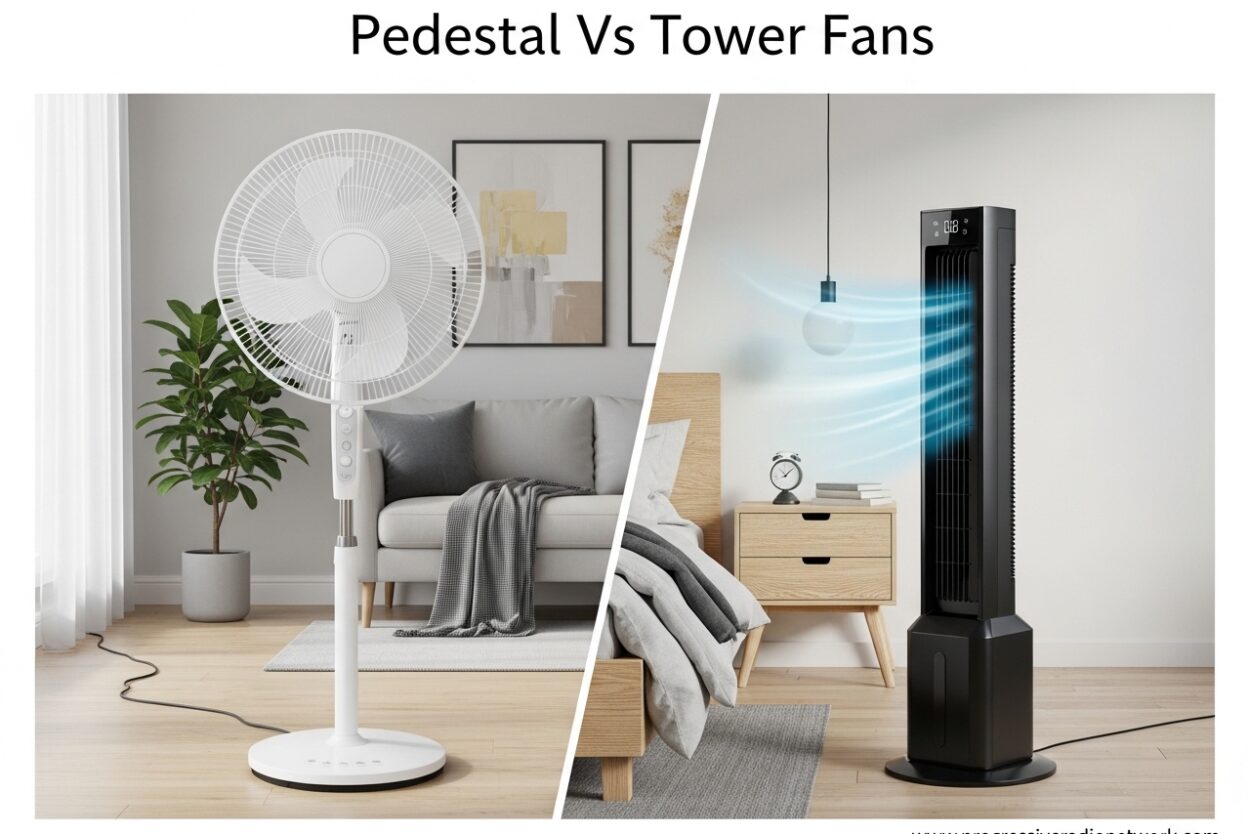
Choosing between pedestal vs tower fans can feel overwhelming when you’re trying to cool your space effectively. Both types offer distinct advantages depending on your room size, noise preferences, and cooling needs. This guide breaks down the key differences to help you make the right choice for your home or office.
What Are Pedestal Fans?
Pedestal fans are traditional cooling devices with a circular fan head mounted on an adjustable stand. The fan head features exposed rotating blades powered by a motor, typically ranging from 12 to 16 inches in diameter. You can adjust the height from around 30 to 55 inches, making them versatile for different seating positions and room layouts.
These fans use a standard oscillation mechanism to sweep air from side to side, covering a wide area. Most pedestal fans offer three speed settings and can tilt up or down to direct airflow where you need it most. The design has remained largely unchanged for decades, proving its effectiveness and reliability.
What Are Tower Fans?
Tower fans are tall, slim cooling devices that use internal vertical blades to circulate air. The fan head is enclosed in a cylindrical housing, typically 30 to 42 inches tall with a narrow footprint of about 12 inches square. Air is drawn from the base through the internal blades and expelled through a long vertical vent.
Modern tower fans often include advanced features like remote controls, digital displays, timer functions, and smart home integration. The vertical blade design creates a gentle, widespread breeze rather than a focused air blast. Their minimalist appearance makes them popular in contemporary homes and office environments.
Pedestal Vs Tower Fans: Airflow and Cooling Power
When it comes to raw cooling power, pedestal fans generally push more air than tower fans. A typical pedestal fan can move 2,500 to 3,500 CFM (cubic feet per minute) of air, while tower fans typically range from 1,500 to 2,500 CFM. The larger exposed blades and more powerful motors give pedestal fans the advantage in sheer airflow capacity.
Pedestal fans excel at creating a targeted air blast that you can feel directly. This makes them ideal for large rooms where you need powerful airflow to cool the space effectively. Living rooms, open-plan areas, and garages benefit from the stronger circulation pedestal fans provide.
Tower fans distribute air in a wider, gentler pattern that’s better for even circulation in small to medium rooms. The vertical blade design spreads air across a broader area without the intense focus of a pedestal fan. This makes tower fans suitable for bedrooms, home offices, and apartments where consistent, gentle airflow is preferred over raw power.
For rooms under 200 square feet, a tower fan provides adequate circulation without overwhelming the space. Pedestal fans become the better choice for rooms exceeding 300 square feet or areas with high ceilings where more powerful airflow is needed to reach all corners effectively.
Pedestal Vs Tower Fans: Noise Levels
Tower fans are generally quieter than pedestal fans on low to medium settings, operating around 40-50 decibels (similar to a quiet conversation). This makes them popular for bedroom use and home offices where background noise matters. Many models include dedicated sleep modes that further reduce noise output.
At higher speeds, tower fans can become noisier than pedestal fans due to their compact design. The enclosed housing can amplify motor noise, and the vertical blades may create more turbulence. Users often report that tower fans produce significant noise for relatively little air movement at maximum settings.
Pedestal fans typically run between 50-60 decibels on medium settings, comparable to normal conversation levels. While louder on average, the consistent white noise they produce can actually help mask other sounds and improve sleep quality for some people. The motor noise tends to be more constant rather than varying with oscillation.
For video calls and microphone-sensitive situations, tower fans usually perform better when kept on lower speeds. Pedestal fans create more distinct audio patterns that microphones can pick up, potentially interfering with calls and recordings.
Pedestal Vs Tower Fans: Space and Design
Tower fans win on space efficiency with their slim profile taking up minimal floor space. The narrow footprint allows placement in corners, against walls, or behind furniture without obstructing movement. This makes them ideal for small apartments, dorm rooms, and crowded offices where every square foot matters.
Modern tower fans feature sleek designs that blend well with contemporary decor. The cylindrical housing often comes in neutral colors like white, black, or silver, allowing them to integrate seamlessly into most room styles. The absence of exposed blades also creates a cleaner, safer appearance.
Pedestal fans require more floor space due to their wider base and oscillating head. The fan head needs clearance to rotate freely, and the base must be positioned away from walls for full oscillation range. This can be challenging in cramped rooms or areas with limited floor space.
The classic design of pedestal fans appeals to those who prefer traditional aesthetics or want a retro look. Some modern pedestal fans come in refined finishes and colors to match contemporary interiors. However, the exposed blades and mechanical appearance may not suit all decor styles.
Stability is another consideration. Pedestal fans are easier to knock over, especially if bumped into or placed on uneven surfaces. Tower fans typically have wider, heavier bases that make them more resistant to tipping, though some lightweight models can still be unstable.
Energy Consumption and Maintenance
Both fan types are relatively energy-efficient compared to air conditioning, but pedestal fans typically use slightly less power on average. A standard pedestal fan consumes 40-60 watts depending on speed, while tower fans often draw 50-70 watts. The difference is minimal over short periods but can add up for continuous operation.
Tower fans with advanced features like digital displays, remote receivers, and smart connectivity may use additional standby power even when turned off. Basic models without these features maintain efficiency comparable to pedestal fans. The energy difference between the two types is generally not significant enough to be a deciding factor for most users.
Maintenance requirements differ significantly between the two types. Pedestal fans are easier to clean because the blades are accessible. A quick wipe with a damp cloth or a vacuum with a brush attachment can remove dust buildup. The exposed design also makes it easy to spot when cleaning is needed.
Tower fans are notoriously difficult to clean internally. The enclosed housing and internal blades trap dust and debris, but accessing them for cleaning often requires disassembly. Many users report that tower fans accumulate significant dust over time that’s nearly impossible to remove without specialized tools or professional cleaning.
Durability favors pedestal fans for long-term use. The simpler mechanical construction means fewer parts can fail, and exposed components are easier to repair or replace. Tower fans with electronic features may experience more issues with displays, remotes, or internal electronics over time.
Pros and Cons: Pedestal Vs Tower Fans
Pedestal Fan Pros:
- More powerful airflow for large spaces
- Adjustable height for targeted cooling
- Easier to clean and maintain
- Generally more affordable
- Simpler design with fewer parts to fail
- Consistent white noise can aid sleep
Pedestal Fan Cons:
- Larger footprint takes up more floor space
- Exposed blades pose safety concerns
- More prone to tipping over
- Traditional appearance may not suit all decor
- Louder on average than tower fans
- Can obstruct movement with oscillating head
Tower Fan Pros:
- Slim profile saves floor space
- Modern, minimalist appearance
- Quieter operation on low speeds
- Often includes advanced features (remote, timer)
- Enclosed blades are safer
- Better for video calls and sensitive microphones
Tower Fan Cons:
- Less powerful airflow overall
- Harder to clean internally
- Can be noisy at higher speeds
- More expensive on average
- Electronic features may fail over time
- Less effective in larger rooms
Which Fan Type Is Best for Your Room?
Bedroom: Tower fans are typically the better choice for most bedrooms. The quieter operation on low settings and gentle airflow create comfortable sleeping conditions. Look for models with sleep modes and timers that automatically adjust or turn off during the night.
Living Room: Pedestal fans generally work better in living rooms where power matters more than quiet operation. The stronger airflow can cool larger spaces more effectively, and the noise is less of a concern during daytime activities. Consider a medium to large pedestal fan for optimal coverage.
Home Office: Tower fans are ideal for home offices, especially if you take video calls or participate in virtual meetings. The slim profile fits easily in corners or under desks, and the lower noise settings won’t interfere with calls. Avoid high speeds that can be picked up by microphones.
Small Apartment: Tower fans maximize limited space while providing adequate cooling for compact rooms. The narrow footprint allows placement in areas where a pedestal fan would be impractical. Choose a model with multiple speed settings to adjust for different room sizes and conditions.
Garage or Workshop: Pedestal fans are the clear winner for these spaces. The powerful airflow helps circulate air in large, open areas, and the durability of pedestal fans stands up to dustier environments. The simpler construction also means less sensitive electronics that could fail in harsher conditions.
Nursery: Tower fans are safer for nurseries due to enclosed blades and quieter operation. Look for models with tip-over protection and easy-to-clean surfaces. The gentle airflow is suitable for maintaining comfortable temperature without creating drafts.
When making your final decision between pedestal vs tower fans, consider your primary needs first. If power and coverage for large spaces are your priorities, a pedestal fan is likely the better choice. For quiet operation in smaller rooms with limited space, a tower fan will serve you better. Both types can provide effective cooling when matched to the right environment and use case.
FAQ
Does a tower fan cool better than a pedestal fan?
Tower fans provide gentle, widespread airflow that’s better for even circulation in small to medium rooms. Pedestal fans deliver more powerful, targeted airflow that’s superior for large spaces. Neither inherently cools better—it depends on your room size and whether you prefer gentle circulation or focused air blast.
What are the disadvantages of a tower fan?
Tower fans have limited airflow compared to pedestal fans, making them less effective in larger rooms. They can be noisier at higher speeds due to their compact design. Internal components are harder to clean, and dust accumulates over time. Tower fans also tend to be more expensive than pedestal fans with similar power output.
What type of fan pushes the most air?
Pedestal fans typically push the most air, with CFM ratings ranging from 2,500 to 3,500. The larger exposed blades and more powerful motors generate stronger airflow. Tower fans usually range from 1,500 to 2,500 CFM, making them better suited for small to medium rooms rather than large open spaces.
Which is better, a tower fan or a pedestal fan?
The better choice depends on your specific needs. Tower fans are better for small spaces, quiet operation, and modern aesthetics. Pedestal fans excel in large rooms, deliver more power, and cost less. Consider your room size, noise tolerance, budget, and whether space efficiency or raw cooling power matters more to you.
Are tower fans quieter than pedestal fans?
Tower fans are generally quieter on low to medium settings, operating around 40-50 decibels. This makes them better for bedrooms and offices. However, at higher speeds, tower fans can become noisier than pedestal fans due to their compact enclosed design. Pedestal fans produce consistent white noise around 50-60 decibels that some find helpful for sleep.
Conclusion
The pedestal vs tower fans decision ultimately comes down to matching the right tool to your space. Tower fans shine in bedrooms, home offices, and small apartments where quiet operation and space efficiency matter most. Pedestal fans dominate in living rooms, garages, and large open areas where power and coverage are the priorities. By considering your room size, noise tolerance, and primary use case, you can choose the fan that will keep you comfortable for years to come.




Leave a Comment