
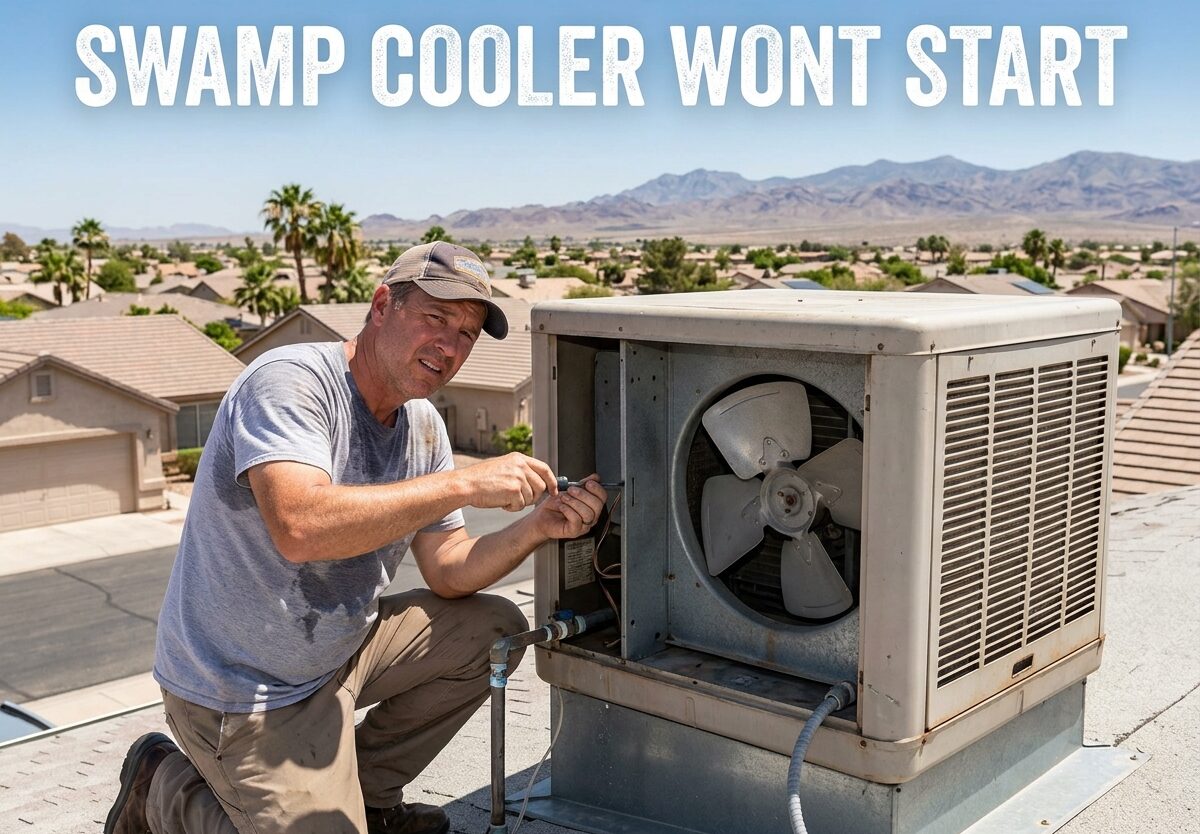
When your swamp cooler wont start on a hot day, it’s more than frustrating—it’s an emergency. The most common reasons a swamp cooler won’t turn on include power supply issues, a failed motor capacitor, thermostat problems, or a blown fuse. I’ll walk you through exactly how to diagnose and fix the problem so you can get your cooling running again.
Quick Diagnosis: Why Your Swamp Cooler Wont Start
The fastest way to identify the problem is by what you hear (or don’t hear) when you flip the switch. This symptom-based approach will point you to the right solution within minutes.
If your swamp cooler is completely dead with no sound at all, start with power supply checks. A dead unit usually means electricity isn’t reaching the motor at all. If you hear a humming or buzzing sound but the fan won’t spin, that’s different—it typically points to a bad start capacitor or a seized motor bearing. Intermittent problems where the unit sometimes starts and sometimes doesn’t often indicate thermostat issues or loose electrical connections.
Safety First: Before You Troubleshoot
Before touching any electrical components, turn off the power at the circuit breaker and disconnect the swamp cooler from its power source. Swamp coolers run on 120V or 240V electricity, which can cause serious injury or death if you’re working on a live circuit. If you’re not comfortable with electrical testing, there’s no shame in calling a professional.
Keep water away from electrical connections while troubleshooting. Even small amounts of moisture can cause short circuits. Make sure your work area is dry, and never stand in water while working on electrical components.
Power Supply Problems: Why Swamp Cooler Wont Turn On
Power supply issues are the most common reason a swamp cooler wont start. Let’s check these first since they’re the easiest to fix and the most likely culprits.
Check the Circuit Breaker
Start at your electrical panel. Look for the breaker labeled “swamp cooler,” “evaporative cooler,” or “attic fan.” If it’s tripped, it will be in the middle position or fully off. Flip it all the way off, wait 30 seconds, then flip it back on. If it trips again immediately, you have a short circuit that needs professional diagnosis.
Inspect the Fuse
Many swamp coolers have a fuse in the disconnect switch located near the unit. This fuse protects the motor from electrical surges. If the fuse wire inside is broken or the glass is darkened, the fuse has blown and needs replacement. Match the amperage rating exactly—using a higher-rated fuse creates a fire hazard.
Test the Disconnect Switch
The disconnect switch (usually a pull-out or toggle switch near the unit) can fail over time. Use a multimeter to test for voltage on both sides of the switch when it’s in the “on” position. No power on the output side means the switch needs replacement.
Verify the Thermostat is Calling for Cooling
If your thermostat isn’t set below the current room temperature, the swamp cooler won’t receive the signal to start. Set the thermostat at least 5 degrees below room temperature and try again. Some thermostats have a delay of 3-5 minutes before activating—wait before assuming something is wrong.
Motor Problems: When Swamp Cooler Hum But Wont Start
This is the scenario that frustrates most homeowners: you flip the switch, hear that telltale hum, but the fan refuses to spin. Let me break down what’s happening and how to fix it.
The Start Capacitor: Most Likely Culprit
A capacitor is a small cylindrical component that gives the motor the extra electrical kick it needs to start spinning. When a swamp cooler hums but won’t start, the capacitor has failed about 80% of the time. The motor is trying to start, but without that initial boost, it just sits there humming.
To test the capacitor, you’ll need a multimeter with capacitance testing capability. First, discharge the capacitor by touching the two terminals with an insulated screwdriver—this prevents shock. Then set your multimeter to capacitance mode and touch the probes to the capacitor terminals. A healthy capacitor will read within 10% of its rated microfarad (µF) value (printed on the side). If the reading is significantly lower or shows zero, replace it.
Replacement capacitors cost $15-40 and are easy to install—just note the wiring configuration before removing the old one. Match the voltage and microfarad ratings exactly. Using the wrong capacitor can destroy your motor.
Seized Motor Bearings
If the capacitor tests good but the motor still won’t start, the bearings may be seized. Try manually spinning the fan blade with the power off. If it’s stiff or won’t move at all, the bearings have locked up. This often happens after winter storage when lack of use causes corrosion.
Sometimes you can free up minor bearing seize by spraying penetrating oil into the bearing ports and manually working the fan back and forth. If the shaft is completely frozen, the motor will need professional rebuild or replacement.
Failed Motor Windings
The motor itself may have burned out. This often happens gradually—you might notice the motor running hotter than usual or making unusual noises before complete failure. Test for continuity across the motor terminals with your multimeter. No continuity means the windings are open and the motor needs replacement.
Expect to pay $200-500 for a new motor installed, depending on size and whether you DIY or hire a pro. Motors typically last 10-15 years with proper maintenance.
Thermostat and Control Issues
Sometimes the problem isn’t the cooler itself—it’s the controls telling it what to do. Let’s check the system that commands your swamp cooler to run.
Wall Switch Problems
The wall switch that controls your swamp cooler can fail internally. Test it with your multimeter by checking for continuity when the switch is in the “on” position. No continuity means the switch needs replacement. These are inexpensive (under $20) and easy to swap out yourself.
Thermostat Malfunction
Modern digital thermostats can display errors or lose programming. Try resetting the thermostat by removing it from the wall plate, waiting 60 seconds, and reattaching it. Replace the batteries if applicable. Some thermostats have a diagnostic mode—check your manual for error codes.
Older mechanical thermostats can fail internally. If you’re comfortable with wiring, you can test by bypassing the thermostat entirely (temporarily!) to see if the cooler starts. If it does, the thermostat is your problem.
Remote Control Issues
For units with remote controls, weak batteries or signal interference can prevent startup. Replace the remote batteries and ensure nothing is blocking the signal path between remote and receiver. Some units have a manual override on the receiver itself—try that to isolate whether the problem is the remote or the cooler.
Pump and Water Flow Problems
While most startup issues are electrical, some swamp coolers have safety interlocks that prevent operation if the water pump isn’t working properly. This protects the unit from running dry and overheating.
Water Pump Failure
Test the pump by disconnecting it from the controller and applying power directly (use caution with water and electricity). A working pump should immediately start humming and moving water. If it’s silent, check for power at the pump terminals—no power means a controller or wiring issue. Power present but no pump movement means a failed pump.
Replacement pumps cost $50-150 and are generally straightforward to install yourself. Make sure to match the flow rate (GPM) to your cooler size.
Clogged Water Lines
Mineral buildup from hard water can clog the water distribution tubes or pump intake. This causes low flow that may trigger safety switches. Disconnect the water line and flush it with clean water or vinegar to dissolve deposits. Inspect the spray bar for clogged holes—clean them out with a small wire or toothpick.
Float Valve Problems
The float valve controls water level in the reservoir. If it’s stuck closed, no water reaches the pump. If it’s stuck open, the reservoir may overflow, tripping safety switches. Move the float up and down manually—it should move freely. Replace if corroded or sticky.
Belt and Mechanical Issues
For belt-drive swamp coolers, mechanical problems can prevent startup even when electrical systems are functioning. The motor may attempt to start but be physically unable to turn the fan.
Belt Tension and Condition
A loose belt can slip so much that the fan won’t spin, even though the motor is running. Press down on the belt midway between pulleys—you should feel about 1/2 inch of deflection. More than that means the belt is too loose. Adjust tension by moving the motor mount.
Check the belt for cracks, fraying, or glazing (shiny spots). A worn belt should be replaced annually. Match the belt length and width exactly—incorrect sizing causes premature wear and poor performance.
Pulley Alignment
Misaligned pulleys cause belt drag and can prevent startup. Looking from the side, both pulleys should be in the same plane. If one cocked at an angle, adjust the motor mounting until they line up properly.
Preventive Maintenance: Avoid Swamp Cooler Wont Start Issues
Most swamp cooler failures are preventable with regular maintenance. I recommend this annual routine to keep your unit reliable:
Spring startup (before you need cooling):
- Clean cooling pads thoroughly or replace if worn
- Inspect and clean water distribution tubes
- Check belt condition and tension
- Test motor operation by spinning the fan manually—it should turn freely
- Test capacitor with multimeter if unit is over 5 years old
- Clean motor vents to prevent overheating
- Lubricate motor bearings if your model has oil ports
Monthly during cooling season:
- Check for unusual noises or vibrations
- Verify proper water level in reservoir
- Inspect pads for mineral buildup
- Clean any debris from around the unit
Fall winterization:
- Drain water completely from reservoir and lines
- Disconnect and store water pump indoors
- Clean pads and allow to dry completely
- Cover unit to prevent debris accumulation
- Turn off power at breaker
When to Call a Professional
Some problems are best handled by a qualified HVAC technician. Call a pro if you encounter any of these situations:
- The circuit breaker trips immediately when you try to start the cooler
- You smell burning electrical components
- The motor housing is extremely hot to the touch
- You’re uncomfortable working with electricity or testing components
- The unit is under warranty and you don’t want to void coverage
- Multiple components have failed simultaneously
FAQ
Professional diagnosis typically costs $75-150, but this fee may be applied to the repair cost if you proceed with their service. Consider the age of your unit when deciding between repair and replacement—swamp coolers over 15 years old may be better candidates for full replacement rather than sinking more money into repairs.
Why won’t my swamp cooler turn on?
The most common reasons a swamp cooler won’t turn on are a tripped circuit breaker, blown fuse, failed start capacitor, or bad thermostat. Start by checking the breaker and fuse. If those are fine, listen for a hum when you flip the switch—humming indicates the capacitor is likely the problem.
How do I tell if my swamp cooler motor is bad?
Signs of a bad swamp cooler motor include humming but no fan movement (80% of cases), burning smell, excessive heat, or complete silence with no hum at all. Test the capacitor first since it’s the most common cause. If the capacitor tests good but the motor still won’t start, test for continuity across the motor terminals—no continuity means the motor windings have failed.
Why is my cooler not turning on even with power?
If your cooler has power but won’t start, check the thermostat setting—it must be below room temperature. Test the wall switch for continuity with a multimeter. Listen for the hum indicating power is reaching the motor. No sound suggests a control or wiring issue; humming points to capacitor or motor problems.
What is the average lifespan of a swamp cooler?
A well-maintained swamp cooler typically lasts 15-20 years. The motor is the longest-lasting component at 15-plus years, while pumps usually last 5-10 years and capacitors fail after 5-7 years. Annual maintenance can extend lifespan significantly. Units over 15 years old may be better candidates for replacement than costly repairs.
Conclusion
When your swamp cooler wont start, work through these checks systematically: power supply first (breaker, fuse, disconnect), then the start capacitor if you hear humming, followed by thermostat and control issues, and finally mechanical problems like belts and bearings. Most startup issues are DIY-repairable with basic tools and a multimeter.
The key is listening to what your unit tells you—the hum gives away capacitor problems, while silence points to power issues. If you’re not comfortable with electrical testing or the problem seems beyond your skill level, there’s no shame in calling a professional. A working swamp cooler is essential in hot climates, and sometimes the fastest solution is the one that gets an expert to your door.



Leave a Comment