
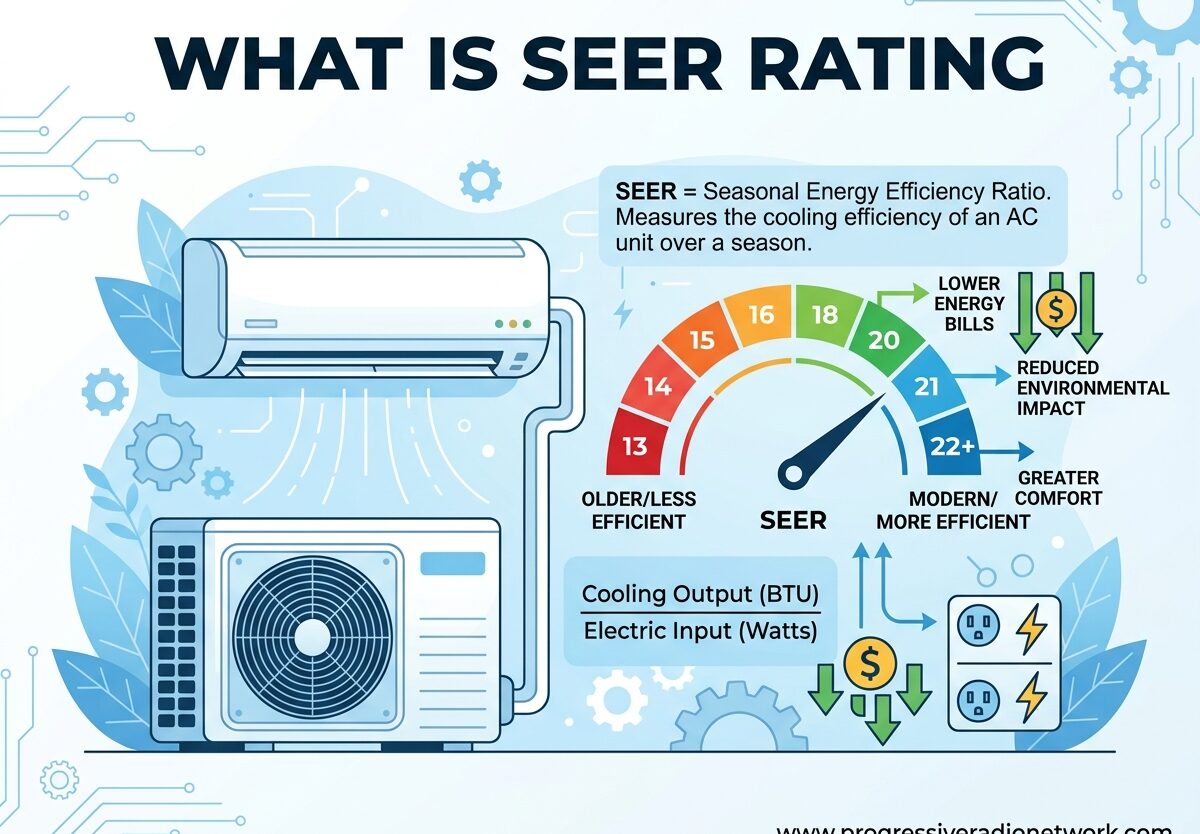
If you’re shopping for a new air conditioner or heat pump, you’ve probably seen SEER ratings everywhere. But what does that number actually mean? SEER rating stands for Seasonal Energy Efficiency Ratio, and it’s the standard measurement for cooling efficiency in HVAC systems. I’ve spent years researching HVAC efficiency standards, and I’ll break down everything you need to know about SEER ratings in plain English.
The SEER rating tells you how much cooling an air conditioner provides for each unit of electricity it consumes. Think of it like miles per gallon for your car, but for cooling. A higher SEER rating means better efficiency and lower energy bills. In 2026, all new HVAC systems use the updated SEER2 standard, which changed how these ratings are calculated.
This guide will explain what SEER rating means, how it’s calculated, the difference between SEER and SEER2, and help you decide which efficiency level makes sense for your home and budget.
What Is SEER Rating?
SEER stands for Seasonal Energy Efficiency Ratio. It measures the cooling efficiency of air conditioners and heat pumps by dividing the total cooling output (measured in BTUs) by the total electric energy input (measured in Watt-Hours) during a typical cooling season. The result is a number that typically ranges from 13 to 30+ for modern residential systems.
Here’s the simple formula: SEER equals total cooling output divided by total energy input over a season. The testing simulates a range of outdoor temperatures from 65 degrees Fahrenheit to 104 degrees Fahrenheit to represent real-world conditions. This seasonal approach differs from older efficiency ratings that only measured performance at a single temperature.
A BTU, or British Thermal Unit, is the amount of heat required to raise one pound of water by one degree Fahrenheit. When we talk about cooling, we’re removing BTUs from your home. Watt-Hours measure electricity consumption. So a SEER rating of 16 means your system provides 16 BTUs of cooling for every watt-hour of electricity consumed.
The higher the SEER rating, the more efficient the system. A 20 SEER air conditioner will cost less to operate than a 14 SEER model, but it will also typically cost more upfront. Understanding this tradeoff is key to making the right choice for your situation.
SEER vs SEER2: What Changed?
In January 2023, the Department of Energy implemented new testing procedures that changed how SEER ratings are calculated. The new standard is called SEER2, and it uses a more rigorous testing methodology called M1. This new test accounts for real-world installation factors like ductwork and external static pressure that weren’t included in the original SEER testing.
Under SEER2 testing, efficiency ratings are slightly lower than the old SEER ratings for the same equipment. This doesn’t mean the equipment became less efficient, it just means the testing became more accurate. A system that was rated 16 SEER under the old standard might be rated 14.5 SEER2 under the new system.
Here’s a simple SEER to SEER2 conversion guide for common ratings:
- 14 SEER converts to approximately 13.4 SEER2
- 16 SEER converts to approximately 14.5 SEER2
- 18 SEER converts to approximately 15.9 SEER2
- 20 SEER converts to approximately 17.2 SEER2
- 22 SEER converts to approximately 18.6 SEER2
The SEER2 transition also introduced new minimum efficiency standards. As of 2026, the minimum SEER2 rating varies by region and system type. In the northern United States, split-system air conditioners must be at least 13.4 SEER2 (15 SEER in the old rating). In the south, the minimum jumps to 14.5 SEER2 (16 SEER old rating).
Heat pumps have even higher minimum requirements because they provide both heating and cooling. The SEER2 change also affects how EER2 (Energy Efficiency Ratio) and HSPF2 (Heating Seasonal Performance Factor) are calculated for these dual-purpose systems.
How SEER Rating Is Calculated
The SEER calculation isn’t just a simple ratio of cooling to energy at one moment in time. Instead, it measures performance across a range of conditions that represent a typical cooling season. This seasonal approach gives a more accurate picture of real-world efficiency than steady-state ratings.
Here’s how the SEER calculation works: Manufacturers test the equipment at various outdoor temperatures ranging from 65 degrees to 104 degrees Fahrenheit. They measure both the cooling output in BTUs and the electricity consumption in Watt-Hours at each temperature point. Then they calculate a weighted average that accounts for how often each temperature occurs in a typical cooling season.
The formula looks complex, but the concept is simple: SEER equals total seasonal cooling output divided by total seasonal energy input. A system that maintains its efficiency better across different temperatures will have a higher SEER rating than one that performs well only in ideal conditions.
One important thing to understand is that SEER ratings are laboratory measurements. Your actual efficiency will vary based on factors like installation quality, ductwork condition, thermostat settings, and your local climate. A poorly installed 20 SEER system might perform worse than a properly installed 14 SEER system in the real world.
Forum discussions consistently show that thermostat settings have a bigger impact on energy bills than SEER rating. Setting your thermostat at 75 degrees instead of 68 degrees can save more energy than jumping from 14 SEER to 18 SEER. Your home’s insulation and duct sealing also matter more than most homeowners realize.
Understanding Compressor Types
The compressor is the heart of your air conditioning system, and its design has a major impact on SEER rating. There are three main types of compressors used in residential HVAC equipment, each offering different efficiency levels and performance characteristics.
Single-Stage Compressors operate like a light switch, either fully on or fully off. They run at 100% capacity whenever they’re running. This design is simple and reliable, but not very efficient. Single-stage systems typically achieve SEER ratings between 13 and 16. They’re the most affordable option and have fewer electronic components that could fail.
Two-Stage Compressors can operate at two different capacity levels, usually around 60% and 100%. This allows them to run on low capacity for milder days and ramp up to high capacity when needed. Two-stage systems typically achieve SEER ratings between 16 and 19. They provide better temperature control and humidity management than single-stage units.
Variable-Speed Compressors can adjust their output in small increments across a wide range, typically from 30% to 100% capacity. They can run almost continuously at very low capacity, which is much more efficient than constantly starting and stopping at full blast. Variable-speed systems achieve the highest SEER ratings, often 20 and above. They provide the best comfort and humidity control.
The efficiency advantage of variable-speed compressors comes from their ability to match output to demand perfectly. Instead of blasting cold air and then shutting off, they provide a steady stream of precisely conditioned air. This eliminates temperature swings and reduces energy consumption significantly.
However, higher efficiency comes with tradeoffs. Variable-speed systems have more complex electronics that can be expensive to repair. Some HVAC contractors report that circuit board replacements on high SEER systems can cost over $1,000, compared to a few hundred dollars for simpler single-stage equipment.
Benefits of Higher SEER Ratings
Higher SEER ratings offer several advantages beyond just lower energy bills. While the primary benefit is reduced electricity consumption, there are comfort and environmental benefits worth considering when deciding how much to invest in efficiency.
Lower Energy Bills are the most obvious benefit. Based on real user discussions on HVAC forums, upgrading from 14 SEER to 16 SEER typically saves around $15-20 per month in cooling costs during peak summer months. In hot climates with long cooling seasons, these savings add up. A homeowner in Phoenix might save $200-300 annually by choosing a higher SEER rating.
The payback period depends on your electricity rates and cooling season length. In moderate climates with short summers and cheap electricity, it might take 15-20 years to recoup the extra cost of a high SEER system. In hot southern states with expensive electricity, the payback can happen in 8-10 years. Forum users consistently report that thermostat choices and insulation make a bigger difference than SEER rating alone.
Improved Comfort comes from the advanced technology that enables higher SEER ratings. Variable-speed compressors, multi-stage cooling, and better humidity control work together to eliminate hot spots and maintain consistent temperatures throughout your home. You’ll notice fewer temperature swings and better humidity management, which makes your home feel more comfortable at higher thermostat settings.
Environmental Impact matters to many homeowners. Higher SEER systems consume less electricity, which means reduced demand on power plants and lower carbon emissions. Over a 15-year lifespan, a high SEER system can prevent tens of thousands of pounds of carbon dioxide emissions compared to a minimum efficiency model.
Potential Rebates and Tax Credits can offset the upfront cost of high SEER equipment. Many utility companies offer rebates for installing efficient HVAC systems, and federal tax credits are sometimes available for systems that meet specific efficiency thresholds. These incentives can significantly improve the return on investment for premium efficiency equipment.
Minimum SEER2 Requirements by Region
The Department of Energy established different minimum SEER2 requirements based on climate region. These standards took effect in 2023 and apply to newly manufactured equipment. The country is divided into three regions with different efficiency requirements.
Northern Region states have the lowest minimum requirements because cooling seasons are shorter and less extreme. Split-system air conditioners must be at least 13.4 SEER2, while packaged units must be 13.8 SEER2. Heat pumps in the north must meet a 14.3 SEER2 minimum.
Southeast Region states have higher minimum requirements due to longer, more humid cooling seasons. Split-system air conditioners must be at least 14.5 SEER2, and packaged units must meet 14.0 SEER2. Heat pumps must achieve 15.0 SEER2 in this region.
Southwest Region states face the most stringent requirements because of extreme heat and long cooling seasons. Split-system air conditioners must be at least 14.5 SEER2 with additional EER2 requirements, packaged units must be 14.0 SEER2, and heat pumps must meet 15.0 SEER2 minimums.
These regional differences recognize that cooling needs vary dramatically across the country. A system that barely meets northern requirements would struggle in Phoenix or Miami, while a high SEER system designed for the south might be overkill in Minnesota. The right SEER rating depends on your specific climate, home construction, and cooling habits.
Choosing the Right SEER Rating for Your Home
Deciding on the right SEER rating means balancing upfront cost against long-term savings. There’s no single answer that works for everyone, but understanding your specific situation can help you make the right choice.
Start by considering your climate. If you live in a hot southern state with long cooling seasons, investing in higher efficiency makes more sense than in a northern state where air conditioning runs only a few weeks per year. Homeowners in Florida, Texas, and Arizona often see reasonable payback periods on 18+ SEER equipment, while those in Minnesota or Wisconsin might never recoup the extra cost.
Your home’s construction matters too. Well-insulated homes with proper duct sealing and efficient windows gain less benefit from high SEER equipment. Before spending extra on efficiency, seal air leaks, add insulation, and ensure your ductwork is properly sealed and insulated. These improvements often provide better returns than equipment upgrades alone.
Consider how long you’ll stay in your home. If you plan to move within 5-7 years, a basic system meeting minimum requirements might make more sense. If this is your forever home, investing in efficiency can pay dividends over a 15-20 year lifespan. High SEER systems also add resale value in energy-conscious markets.
Your electricity rates factor into the equation. If you pay 12 cents per kilowatt-hour, energy savings matter less than if you pay 25 cents per kilowatt-hour. Check your electric bill to find your rate, then use online calculators to estimate savings for different SEER ratings in your area.
Don’t forget repair costs. High SEER systems with variable-speed compressors and sophisticated electronics can be expensive to repair. Forum discussions mention $1,500+ repair bills for inverter boards on premium systems, compared to $200-400 for simpler single-stage equipment. Set aside a repair budget or consider extended warranties for complex systems.
Is Higher SEER Always Worth It?
After reviewing thousands of real user experiences on HVAC forums, I’ve found that higher SEER isn’t always the best investment. Many homeowners report that the promised energy savings never materialized, while others are delighted with their high-efficiency systems. The difference often comes down to individual circumstances.
Honest contractors admit that installation quality matters more than equipment efficiency. A poorly installed 20 SEER system will perform worse than a properly installed 14 SEER system. Proper sizing, correct refrigerant charge, and excellent airflow are far more important than chasing the highest SEER rating. Don’t overspend on equipment if your installer doesn’t have a track record of excellence.
Consider your actual usage patterns. If you keep your thermostat at 75 degrees and use ceiling fans, you’ll see less benefit from high SEER equipment than someone who prefers 68 degrees. Your habits and comfort preferences should drive your decision, not marketing claims about maximum efficiency.
Sometimes the best choice is a middle-ground system with 16-18 SEER2 rating and two-stage compression. These systems offer improved comfort and moderate efficiency gains without the complexity and cost of top-tier models. Many long-time HVAC professionals recommend this sweet spot for most homeowners.
The bottom line is that SEER is just one factor among many. Choose a reputable brand, find an excellent installer, right-size the equipment for your home, and then decide if the extra cost of higher efficiency makes sense for your specific situation. There’s no one-size-fits-all answer when it comes to SEER rating.
Understanding SEER Rating: Key Takeaways
SEER rating measures cooling efficiency by dividing cooling output by energy consumption over a season. Higher numbers indicate better efficiency, with modern residential systems ranging from 13 to 30+ SEER. The SEER2 standard implemented in 2023 uses more rigorous testing and slightly lower numbers for the same equipment.
Compressor type significantly affects SEER rating. Single-stage compressors offer basic reliability at 13-16 SEER, two-stage compressors provide improved efficiency at 16-19 SEER, and variable-speed compressors deliver maximum efficiency of 20+ SEER with superior comfort. However, complex systems have more expensive potential repairs.
Real user experiences show that energy savings from upgrading SEER ratings typically range from $15-20 per month, with payback periods varying from 8-20 years depending on climate and electricity rates. Factors like insulation, duct sealing, and thermostat settings often have bigger impacts on energy bills than SEER rating alone.
When choosing a SEER rating, consider your climate, how long you’ll stay in your home, your electricity rates, and your tolerance for complex repairs. Many homeowners find that systems in the 16-18 SEER2 range offer the best balance of efficiency, comfort, and value. The right choice depends on your specific situation rather than chasing the highest number.
FAQs
What is considered a good SEER rating?
A good SEER rating depends on your climate and budget, but generally 14-16 SEER2 meets minimum requirements in most regions, 16-18 SEER2 offers improved comfort and efficiency for most homeowners, and 20+ SEER2 provides maximum efficiency for hot climates or long-term homeowners. The key is choosing a rating that makes sense for your specific situation rather than automatically selecting the highest option.
Is it worth going from 14 SEER to 16 SEER?
Upgrading from 14 SEER to 16 SEER typically saves $15-20 per month in energy costs during cooling season, which amounts to $150-200 annually in hot climates. The payback period ranges from 8-15 years depending on your electricity rates and cooling season length. If you plan to stay in your home long-term and live in a hot climate, the upgrade can be worth it, but the savings are modest compared to the upfront cost difference.
What SEER is a 20 year old AC?
A 20-year-old air conditioner typically has a SEER rating between 8 and 10, which is significantly less efficient than modern minimum standards of 13-14 SEER2. Efficiency standards have improved dramatically over the past two decades, so replacing an old 8-10 SEER unit with even a basic 14 SEER2 system can reduce cooling costs by 30-50%. The exact rating depends on the original equipment efficiency, which was often lower than today’s minimum requirements.
Is a 17 SEER mini split good?
Yes, a 17 SEER mini split is considered a good efficiency rating that offers excellent value. Mini split systems naturally achieve higher efficiency than traditional central air conditioning, and 17 SEER places it in the mid-range of available options. This efficiency level provides noticeable energy savings compared to older equipment while avoiding the premium cost of the highest-tier models. Most homeowners find that 16-18 SEER mini splits offer the best balance of efficiency and cost-effectiveness.
How much can I save with a higher SEER rating?
Energy savings from higher SEER ratings vary based on climate, electricity rates, and usage patterns. Based on real user reports, upgrading from 14 SEER to 16 SEER typically saves $15-20 monthly during peak cooling season, while jumping to 20+ SEER might save $30-50 monthly in hot climates. However, these savings must be weighed against the higher upfront cost, which can be $2,000-5,000 more for premium efficiency equipment. Your actual savings depend on your specific situation and may not match manufacturer claims.
Conclusion
Understanding SEER rating helps you make informed decisions when replacing your air conditioning system. SEER measures cooling efficiency, with higher numbers indicating better performance. The SEER2 standard implemented in 2023 uses more accurate testing methods, resulting in slightly lower ratings for the same equipment.
Choosing the right SEER rating means balancing upfront costs against long-term savings. Consider your climate, home construction, electricity rates, and how long you’ll stay in your home. For many homeowners, systems in the 16-18 SEER2 range offer the best combination of efficiency, comfort, and value without the complexity and repair costs of the highest-tier models.
Remember that installation quality matters more than equipment efficiency. A properly installed basic system will outperform a poorly installed premium system every time. Choose a reputable contractor who will size your system correctly and install it according to best practices. The SEER rating matters, but it’s just one piece of the puzzle.


Leave a Comment