
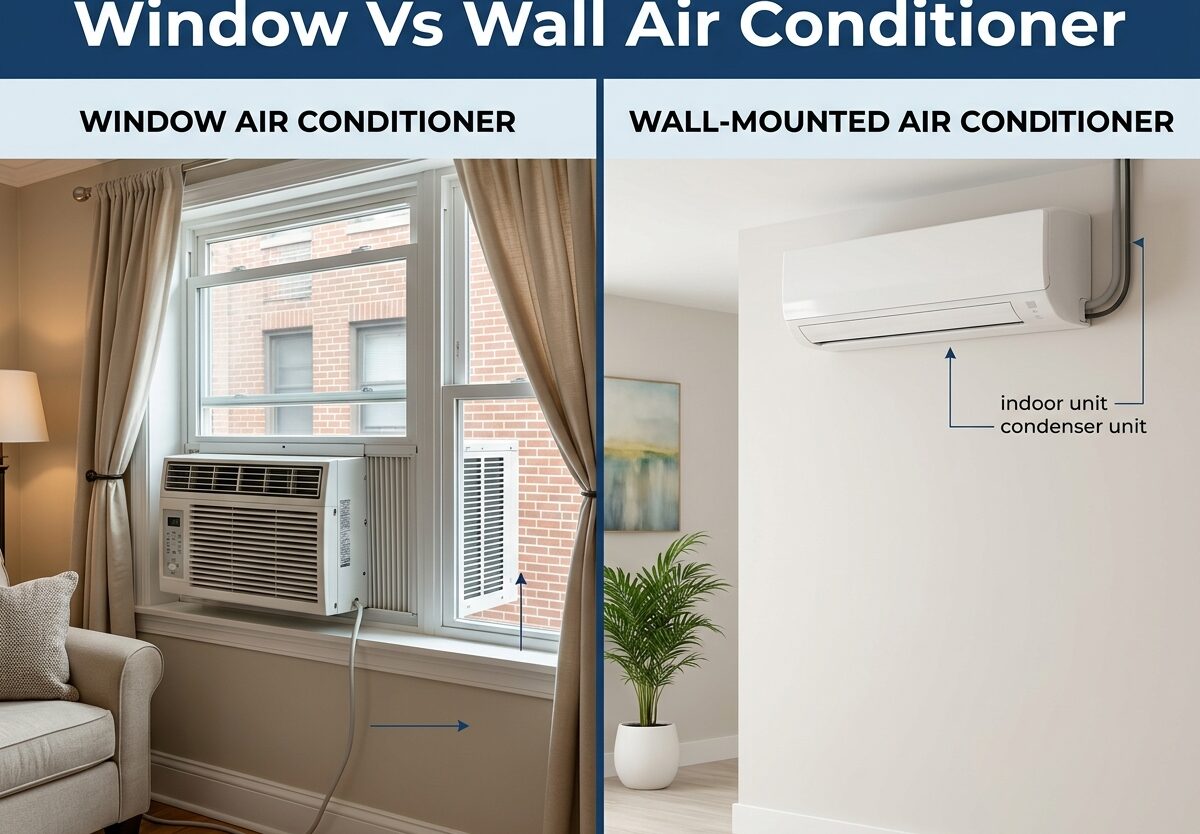
Choosing between a window vs wall air conditioner can feel confusing when you start comparing options. Both types cool rooms effectively, but they differ significantly in how they install, how efficiently they operate, and how much they cost over time. Our team spent weeks reviewing real user experiences and comparing technical specifications to help you make the right decision for your space.
In this guide, I’ll walk you through everything you need to know about window air conditioners and through-the-wall units. You’ll learn exactly how each type works, where they differ in performance, and which scenarios favor one over the other. By the end, you’ll have clear answers on which cooling solution fits your home, your budget, and your installation situation.
Let’s start by understanding what makes these two AC types fundamentally different from each other.
Understanding Window and Wall Air Conditioners
Before we dive into the comparison, you need to understand what actually sets these two types apart. Many people assume window and wall air conditioners are completely different machines, but the reality is more nuanced.
What Is a Window Air Conditioner?
A window air conditioner is a self-contained cooling unit that mounts directly into a window opening. All components live in one box: the compressor, evaporator, condenser, and fans all work together to pull hot air from your room and vent it outside through the rear of the unit.
The installation process involves placing the AC in your window frame, extending the side panels to seal the gaps, and plugging it into a standard electrical outlet. Most window units use 115V power, making them compatible with typical household circuits. The cooling capacity ranges from 5,000 to 25,000 BTU, covering rooms from small bedrooms to large living spaces.
Window AC units are designed for temporary or removable installation. You can take them out during winter, store them, and reinstall them the following summer. This makes them particularly popular among renters who cannot make permanent modifications to their living spaces.
What Is a Through-the-Wall Air Conditioner?
A through-the-wall air conditioner installs through a hole cut into an exterior wall. Unlike window units, wall AC units typically use a dedicated sleeve that gets permanently mounted during construction or renovation. The sleeve creates a stable housing that the AC unit slides into and out of for maintenance.
The venting for wall units exhausts heat horizontally through the wall to the exterior, rather than upward into a window opening. This design creates a more secure seal against weather and provides better insulation. Wall units generally require 230V power for larger models, though some smaller units operate on 115V.
Through-the-wall units often feature more robust construction than window models because they’re designed for permanent installation. Many come with advanced features like inverter compressors, digital controls, and improved filtration systems. The cooling capacity typically ranges from 8,000 to 14,000 BTU for most residential models.
Key Differences Between Window and Wall Air Conditioners
Now that you understand the basics of each type, let’s examine the specific differences that matter most when choosing between them. These differences go beyond just aesthetics and affect your wallet, your comfort, and your home’s energy efficiency.
Installation Methods
The most obvious difference lies in how each unit installs. A window AC literally sits in your window frame and requires no permanent modification to your home. You simply place it, secure it with the included brackets, and plug it in. The entire process takes 30 minutes to an hour for most people.
Through-the-wall installation requires cutting a hole in your exterior wall, which typically costs $200-$500 for professional installation. The wall sleeve must be properly flashed and sealed to prevent water intrusion. This means wall units represent a significant commitment that most renters cannot make without landlord approval.
One critical point from forum discussions: never attempt to install a window AC unit through a wall opening. The venting configurations and airflow paths are fundamentally different between the two types. Window units vent heat upward and backward, while wall units vent horizontally. Forcing a window unit into wall installation creates fire hazards and severe efficiency problems.
Sealing and Energy Efficiency
Wall air conditioners generally achieve better energy efficiency due to superior sealing. When properly installed with a quality sleeve, wall units create an airtight barrier between your home and the exterior. This means less cool air escapes and less hot air infiltrates during the cooling season.
Window units inherently struggle with sealing because they sit in an open window frame. Even with side panels extended, small gaps remain around the unit. Many users report feeling drafts around their window AC units during windy periods. This air leakage forces the AC to work harder and consume more electricity to maintain the same temperature.
From our analysis of user experiences, wall units consistently show lower monthly operating costs in scenarios where the units run for extended periods. The improved sealing pays for itself over time through reduced energy bills, particularly in climates with long, hot summers.
Aesthetics and Window View
Window air conditioners block a significant portion of your window when installed. This means reduced natural light entering your room and an obstructed view of the outdoors. For people who value their window views or need maximum daylight, this represents a meaningful drawback.
Through-the-wall units preserve your window’s functionality entirely. You can still open your window for fresh air, enjoy unobstructed views, and let natural light flood your space. This makes wall units more popular in applications where window aesthetics matter, such as living rooms with attractive outdoor views.
The visual impact extends beyond just the window itself. Window AC units protrude into your room and can look bulky or industrial. Wall units, when properly installed, sit more flush with the wall and often include decorative front panels that blend with interior design.
Portability and Flexibility
If you rent your home or anticipate moving, window units offer significant advantages. You can uninstall your window AC when you move and take it with you. The removal process takes under an hour, and once taken out, your window returns to normal operation.
Through-the-wall units are essentially permanent fixtures. While the AC itself can be removed from the sleeve for repair or replacement, the sleeve remains in your wall permanently. Removing the sleeve requires patching the wall, which involves exterior and interior work. This makes wall units practical only when you plan to stay in your current location for several years.
Technical Comparison: Cooling, Noise, and Efficiency
Beyond the practical differences in installation and aesthetics, you need to understand how these two types compare on the technical specifications that actually affect your comfort and operating costs.
Cooling Capacity and BTU Ranges
BTU (British Thermal Unit) ratings measure how much heat an AC unit can remove from a space per hour. Window air conditioners typically range from 5,000 to 25,000 BTU, covering spaces from small bedrooms (150-350 square feet) to large open areas (up to 1,500 square feet for the largest models).
Through-the-wall units generally fall in the 8,000 to 14,000 BTU range for most residential models. This covers typical room sizes of 350-700 square feet effectively. While you can find some higher-capacity wall units, the market for wall AC units is more limited than window options.
For most single-room cooling needs, both types provide adequate capacity. The key is matching BTU to your room size properly. An undersized unit struggles to cool your space, while an oversized unit short-cycles and fails to dehumidify properly. Use a BTU calculator to determine the right capacity for your specific room dimensions.
Noise Levels
Both AC types generate noise from the compressor and fans, but levels vary by model and design. On average, window air conditioners produce 50-60 decibels during operation. Through-the-wall units typically range from 52-65 decibels, with some models surprisingly louder due to their chassis design.
The placement also affects perceived noise. Window units sit closer to ear level when you’re in the room, which can make them feel louder. Wall units often sit lower on the wall, and the sound travels differently, sometimes feeling less intrusive even at similar decibel ratings.
If noise matters significantly for your space, look for models specifically marketed as “quiet” or “low noise.” Many manufacturers now offer enhanced compressor designs and vibration-dampening features in their premium models. Expect to pay more for whisper-quiet operation, typically $100-$200 above standard models.
Energy Efficiency Ratings
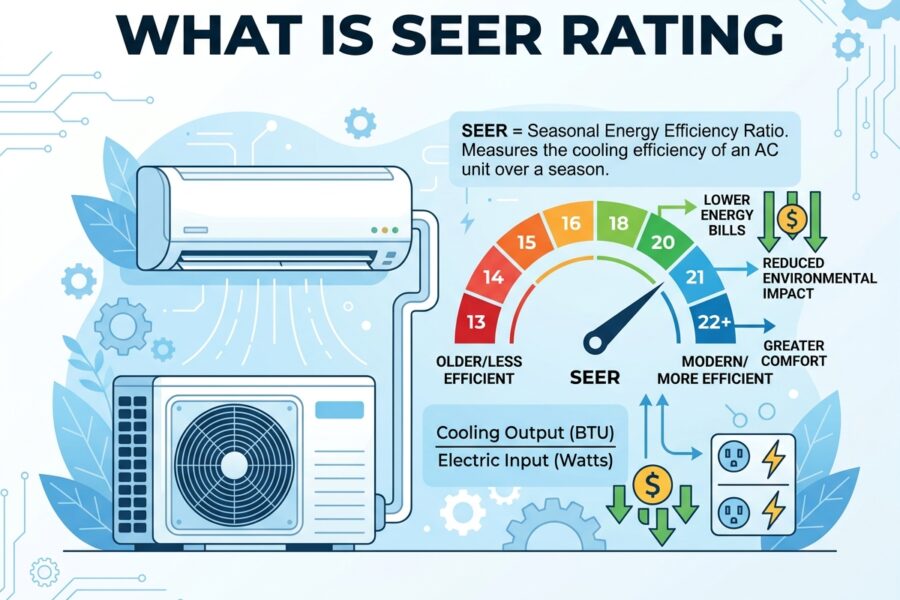
Energy Efficiency Ratio (EER) measures cooling output relative to power input. Higher EER ratings indicate better efficiency. Window units typically achieve EER ratings between 10 and 12, while through-the-wall units often reach 11 to 13 due to their more robust construction and better sealing.
The introduction of inverter compressor technology has significantly improved efficiency for both types. Inverter compressors adjust their speed based on cooling demand rather than cycling fully on and off. This prevents energy waste from constant restarting and provides more consistent temperature control. Many newer models from manufacturers like LG, Friedrich, and Frigidaire feature inverter technology.
For context, an EER increase of just 1 point can reduce your annual cooling costs by 5-10% depending on usage. Over a 10-year period, this difference can represent $200-$500 in electricity savings, potentially offsetting a higher initial purchase price for a more efficient model.
Cost Comparison: Initial Investment and Long-Term Value
Understanding the full cost of ownership helps you make a financially sound decision. The purchase price is only part of the equation when comparing window vs wall air conditioners.
Upfront Costs
Window air conditioners range from $150 for basic 5,000 BTU models to $900 for premium 12,000+ BTU units with advanced features. The average most people spend falls between $300 and $500 for a quality window unit that cools effectively and lasts several years.
Through-the-wall units cost more upfront, typically ranging from $300 to over $1,000 for the unit alone. You must also factor in installation costs if hiring a professional, which generally runs $200-$500 for the wall opening and sleeve installation. Total investment for a wall unit with professional installation can reach $500-$1,500.
The wall sleeve represents an additional consideration for through-the-wall units. If your home doesn’t already have a sleeve installed, you need to purchase one separately ($50-$150) or factor installation into your budget. Newer construction homes sometimes include sleeves during building, but this is not standard practice.
Operating Costs
Monthly operating costs depend heavily on your electricity rates, usage patterns, and the efficiency of your specific unit. Based on typical summer usage (8 hours daily at $0.12 per kWh), a standard window AC might cost $30-$50 per month to operate. More efficient models with inverter technology can reduce this to $20-$35 monthly.
Wall units often show lower operating costs due to better sealing and efficiency. Users report monthly costs ranging from $25-$45 for similar cooling capacity, representing savings of $5-$15 per month during cooling season. Over a 10-year period, this adds up to $600-$1,800 in electricity savings.
The “5000 rule” provides useful guidance for replacement decisions. If repair costs exceed $5,000 or your unit is over 10 years old, replacement typically makes more financial sense than repair. This becomes relevant when evaluating whether to fix an aging unit or invest in a new, more efficient model.
Lifespan and Durability
Window air conditioners typically last 3-7 years with proper maintenance. The exposure to elements from sitting in the window, combined with frequent removal and reinstallation, contributes to faster wear. Regular filter cleaning and end-of-season storage can extend window unit lifespan toward the longer end of this range.
Through-the-wall units generally last 8-12 years due to their protected installation and more robust construction. The permanent sleeve shields the unit from direct weather exposure, and the more stable mounting reduces vibration-related wear. Many homeowners report getting 10+ years from quality wall AC units.
Maintenance requirements are similar for both types. Regular filter cleaning (monthly during heavy use), annual inspection of the coils, and keeping the area around the unit clear of debris all help maximize lifespan. Wall units may require occasional inspection of the sleeve seal to ensure weatherproofing remains intact.
Which Air Conditioner Should You Choose?
The right choice between window and wall AC depends on your specific circumstances. Let me break down the decision framework based on different situations.
Choose Window AC If…
Renters should strongly consider window air conditioners. Since wall installation requires cutting into exterior walls, most lease agreements prohibit this modification without explicit landlord permission. Window units allow you to cool your space without violating lease terms or risking your security deposit.
Budget-conscious buyers benefit from the lower upfront costs of window units. You can find capable 8,000-10,000 BTU window units for $250-$400 that cool effectively without breaking your budget. When you need cooling on a limited budget, window units deliver the best value.
Anyone needing temporary cooling should choose window units. If you need AC for a specific situation (summer internship, temporary housing, events) window units allow easy setup and removal. The portability factor makes them ideal for anyone not planning to stay in one location long-term.
Seasonal users often prefer window units for their simplicity. If you only need cooling during the hottest months and prefer to store your AC during off-seasons, window units make this easy. Simply uninstall, clean, and store your unit until next summer.
Choose Wall AC If…
Homeowners planning to stay in their residence for 5+ years should consider wall units. The higher upfront investment pays off through lower operating costs, longer lifespan, and better aesthetics. When you plan to enjoy your home long-term, permanent cooling solutions often make more sense.
If aesthetics matter to you, wall units deliver superior visual integration. Preserving your window views, maintaining natural light, and achieving a cleaner interior look all favor through-the-wall installation. Many homeowners find the improved appearance worth the additional installation effort.
Improved sealing and energy efficiency make wall units attractive for those paying high electricity bills. The better thermal barrier between indoors and outdoors reduces your cooling costs month after month. Over years of operation, the efficiency advantage can offset the higher initial investment.
Those seeking better security should note that wall units don’t require open windows. Window AC units typically require the window to remain partially open for the unit to sit properly, which some consider a security risk. Wall units install completely through the wall with sealed exteriors.
Consider a Mini-Split Instead
Ductless mini-split systems represent an increasingly popular alternative to both window and through-the-wall AC units. Mini-splits offer the efficiency of central AC with the room-specific cooling of window units, all without requiring ductwork.
Mini-splits make sense when you’re considering major renovations or building new. The installation involves running refrigerant lines through walls rather than cutting large openings, and you can connect multiple indoor units to one outdoor condenser. This provides zoned cooling throughout your home with energy savings of 20-30% compared to window units.
However, mini-splits cost significantly more than either window or wall units, typically $2,000-$5,000 for professional installation of a single-zone system. For cooling just one or two rooms, this investment may not make sense. But for whole-home cooling or homeowners planning long-term residence, mini-splits deserve serious consideration.
Pros and Cons at a Glance
Here’s a quick reference summary of the key advantages and disadvantages of each type to help you weigh your options.
Window Air Conditioner
Pros:
- Lower upfront cost ($150-$900)
- Easy DIY installation (30-60 minutes)
- Portable and removable for moving
- No permanent home modification required
- Wide range of BTU capacities available
- Renter-friendly solution
Cons:
- Blocks window view and natural light
- Poor sealing leads to energy loss
- Higher monthly operating costs
- Shorter lifespan (3-7 years)
- Security concerns from open window
- Can be noisy at higher decibel levels
Through-the-Wall Air Conditioner
Pros:
- Superior sealing and energy efficiency
- Preserves window functionality completely
- More integrated, attractive appearance
- Longer lifespan (8-12 years)
- Lower monthly operating costs
- More permanent, secure installation
Cons:
- Higher upfront cost ($300-$1,500 total)
- Professional installation typically required
- Permanent modification to home
- Limited BTU range options
- Difficult to remove when moving
- Sleeve installation required separately
Frequently Asked Questions
Is a through the wall air conditioner better than a window unit?
It depends on your specific needs. Through-the-wall units offer better sealing, improved aesthetics, and lower operating costs, but they require higher upfront investment and permanent installation. Window units are more budget-friendly and portable, making them better for renters and temporary situations.
Can you use a window air conditioner through the wall?
No. Window AC units are designed specifically for window installation with their chassis and venting configured for upward and backward airflow into a window opening. Using a window unit in a wall application creates fire hazards due to improper heat venting and severe efficiency problems from incorrect airflow paths.
Can you use a through the wall air conditioner in a window?
Through-the-wall units are not designed for window installation. They require a proper wall sleeve and are configured for horizontal venting through a wall. Adapting them for windows is not recommended as the mounting mechanisms and venting configurations are incompatible with standard window frames.
How much does it cost to install a through the wall air conditioner?
Professional installation typically costs $200-$500 for creating the wall opening and mounting the sleeve. Combined with the AC unit itself ($300-$1,000+), total investment ranges from $500-$1,500 or more. DIY installation is possible for experienced homeowners but requires careful attention to flashing and weather sealing.
How long do window and wall air conditioners last?
Window AC units typically last 3-7 years with proper maintenance and seasonal storage. Through-the-wall units generally last 8-12 years due to their protected installation and more robust construction designed for permanent mounting.
What is the $5000 rule for AC?
The $5000 rule is a guideline suggesting that if repair costs exceed $5000 or if your AC unit is over 10 years old, replacement is often more cost-effective than repair. This helps homeowners decide between investing in repairs or putting that money toward a new, more efficient unit.
Are wall and window air conditioners ever the same?
Fundamentally, both use the same cooling technology with compressor, evaporator, and condenser components. The primary difference is the cabinet design and installation method, not the core cooling mechanism. Many manufacturers use similar internal components in their window and wall models.
Which AC type is better for allergies?
Both types have similar standard filtration capabilities. Wall units may have a slight edge due to better sealing, which reduces dust and allergen infiltration from outside. For enhanced air quality, look for units with washable filters and consider models with optional HEPA filter attachments.
Final Thoughts on Choosing Between Window and Wall Air Conditioners
The decision between window vs wall air conditioner ultimately comes down to your living situation, budget, and long-term plans. If you rent, need portability, or are working with a tight budget, window units deliver solid cooling without permanent commitment. If you own your home, plan to stay several years, and prioritize efficiency and aesthetics, through-the-wall units offer meaningful advantages.
Consider how much you’ll use the unit, what your electricity costs are, and whether the upfront investment in wall installation makes sense for your situation. For most people, the choice isn’t about which type is universally better, but which fits their specific circumstances better.
Take time to calculate your room size in square feet, determine your budget for both purchase and installation, and think honestly about how long you plan to stay in your current home. These practical factors will guide you toward the right decision for window vs wall air conditioner cooling comfort.



Leave a Comment