
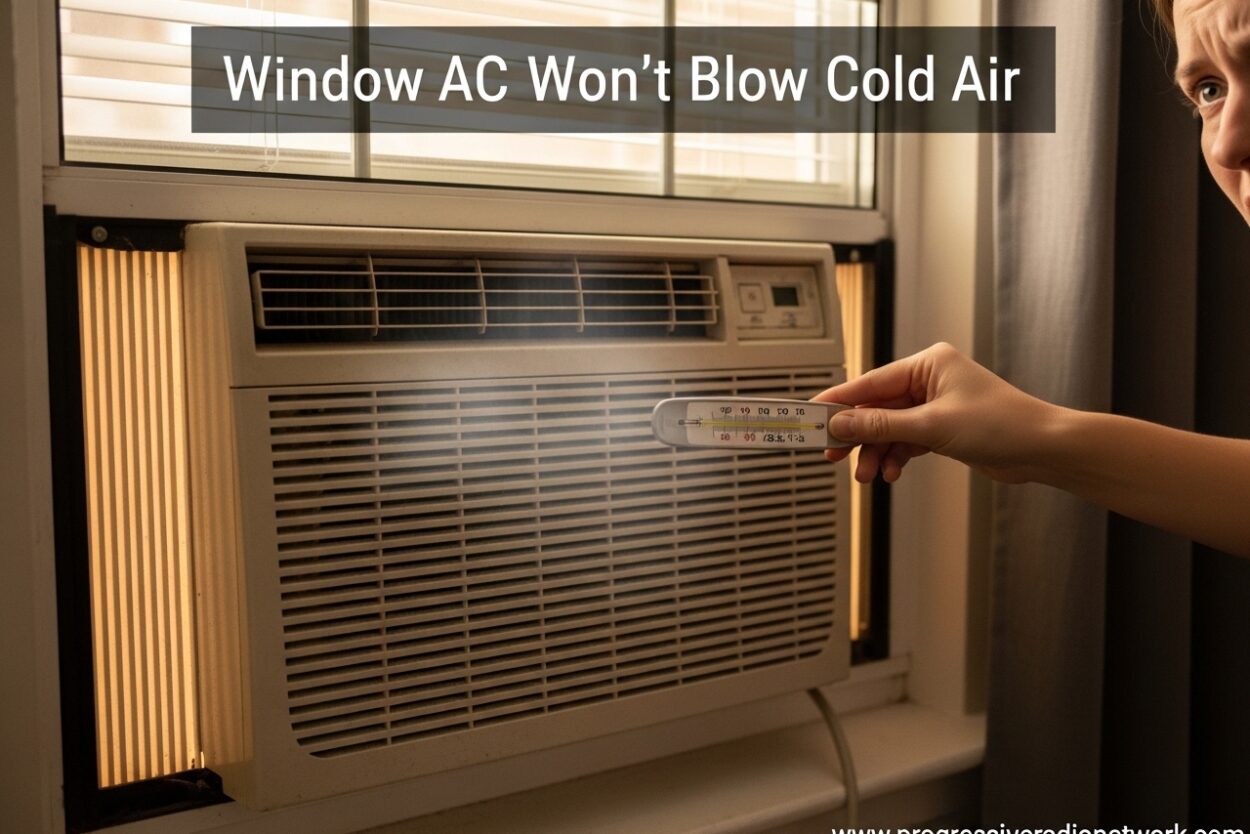
Nothing kills your comfort faster than a window AC that won’t blow cold air on a hot day. You’re sweating, the fan is running, but that refreshing blast of cool air never comes. This frustrating problem affects countless homeowners and renters every summer, but the good news is most causes are fixable without calling a professional.
I’ve spent years troubleshooting window air conditioners, and I can tell you that about 70% of cooling issues stem from three simple problems you can fix yourself. A dirty filter, blocked coils, or thermostat settings gone wrong are usually the culprits. Let me walk you through how to diagnose why your window AC won’t blow cold air and get it cooling again.
Quick Diagnosis Checklist
Before diving into detailed troubleshooting, run through this quick checklist. Most window AC problems fall into one of these categories, and identifying the issue early saves time and prevents unnecessary repairs.
- Check the air filter – Is it visibly dirty or clogged with dust? This is the number one cause of cooling problems.
- Verify thermostat settings – Is it set to cool mode with the temperature lower than the current room temperature?
- Listen to the compressor – Do you hear it humming when the AC is running? If not, it may not be engaging.
- Check for ice buildup – Is there frost on the coils or visible ice inside the unit?
- Examine outdoor coils – Are the outside coils blocked by debris, leaves, or dirt buildup?
If you identified any of these issues, jump to the corresponding section below for detailed solutions. If everything looks normal, continue reading for deeper troubleshooting steps.
Window AC Won’t Blow Cold Air: The Dirty Air Filter Problem
A dirty or clogged air filter is the single most common reason why window AC units stop blowing cold air. I’ve seen countless cases where a simple filter cleaning solved what owners thought was a major mechanical failure.
When your air filter gets clogged, it blocks airflow across the evaporator coils. These coils need warm air passing over them to absorb heat effectively. Without proper airflow, the coils get too cold and can even freeze over, which completely stops the cooling process.
Check your filter monthly during peak cooling season. If you hold it up to a light and can’t see through it, it’s time to clean or replace it. Most window AC units have washable foam filters that can be cleaned with mild soap and warm water. Let them dry completely before reinstalling to avoid moisture issues.
Replacing a disposable filter typically costs $10-30, while professional service calls to diagnose cooling problems run $75-150 just for showing up. That’s a $140+ saving for a 10-minute fix.
Thermostat and Temperature Control Issues
Sometimes your window AC is working fine, but the thermostat or temperature control settings are preventing it from cooling properly. This happens more often than you might expect, especially after power outages or when multiple people adjust the settings.
First, verify your AC is actually in cooling mode. Many units have fan-only, dry, and cooling modes. If it’s set to fan-only, the unit will run but won’t cool anything. The mode button or switch should clearly indicate the current setting.
Next, check that your set temperature is lower than the current room temperature. I’ve seen many cases where someone set the AC to 78°F while the room was already at 75°F, then wondered why it wasn’t cooling. Set it at least 3-5°F below your desired room temperature.
If your AC has a digital display and shows error codes, check your owner’s manual. Common error codes like E1, E2, or E3 often indicate sensor problems. The thermistor (temperature sensor) may have become dislodged during cleaning or installation, which causes inaccurate readings and prevents proper cooling.
Dirty or Clogged Coils: Evaporator and Condenser
Your window AC has two sets of coils that work together to cool your room: evaporator coils inside and condenser coils outside. When either set becomes dirty or clogged, your unit struggles to transfer heat and won’t blow cold air effectively.
The evaporator coils absorb heat from indoor air. Over time, they collect dust, pet dander, and other debris that acts as insulation. This insulation prevents heat transfer, so even with a perfectly clean filter, your AC won’t cool efficiently. Clean these coils annually using a soft brush and coil cleaning solution, being careful not to bend the delicate aluminum fins.
The condenser coils release collected heat outside. These are exposed to the elements and commonly get blocked by leaves, pollen, and outdoor debris. I’ve found units where the outdoor coils were completely covered in a blanket of cottonwood seeds. Clear away any visible debris with a soft brush, then rinse gently with a garden hose (disconnect power first).
Dirty coils can reduce cooling efficiency by 30% or more. Professional coil cleaning costs $100-200, but you can do it yourself in about an hour with basic cleaning supplies.
Frozen Evaporator Coils: Causes and Solutions
If you see ice or frost on your evaporator coils or inside the AC unit, your window AC won’t blow cold air until the ice melts. Frozen coils indicate an underlying problem that needs addressing to prevent recurrence.
The most common cause is restricted airflow from a dirty filter or blocked vents. When air can’t flow freely across the coils, they become too cold and moisture freezes on them. Start by turning off the AC and letting the ice melt completely before troubleshooting further.
Low refrigerant levels can also cause coil freezing. Without sufficient refrigerant, the pressure drops and coils become abnormally cold. This requires professional service to diagnose and repair, as refrigerant handling requires EPA certification.
Running your AC when outdoor temperatures are below 60°F can also cause freezing. Most window units aren’t designed for operation in cool weather. If you need cooling during transitional seasons, look for models specifically rated for low-ambient operation.
After the ice melts, address the root cause before running the AC again. Simply restarting a frozen unit will just lead to the same problem recurring.
Compressor Issues: Diagnosis and Repair Options
The compressor is the heart of your window AC – it’s what actually pumps refrigerant through the system. When the compressor fails, your fan may run but you’ll get no cold air at all.
First, determine if the compressor is actually running. Listen carefully when the AC kicks on. You should hear the compressor start humming within a minute or two. If you only hear the fan but no compressor hum, the compressor isn’t engaging.
A faulty start capacitor is a common and relatively inexpensive fix. The capacitor provides the electrical jolt needed to start the compressor. When it fails, the compressor may try to start but can’t get going. You might hear a clicking sound as it attempts to start repeatedly. Replacing a capacitor costs $15-50 in parts and is a straightforward repair for those comfortable with basic electrical work.
If the compressor itself has failed, you’re facing a significant repair decision. Compressor replacement typically costs $400-600 for parts and labor. On units more than 7-8 years old, this often exceeds half the cost of a new unit, making replacement the smarter choice.
Refrigerant Leaks: Signs and Professional Solutions
Your window AC relies on refrigerant to transfer heat. When refrigerant levels drop due to a leak, your unit can’t cool effectively regardless of how well everything else is functioning.
Signs of low refrigerant include weak cooling even on the coldest setting, ice buildup on coils, and a hissing sound when the AC runs. However, these symptoms can also indicate other problems, so professional diagnosis is recommended.
Never attempt to add refrigerant yourself. Window AC units use specific types and amounts of refrigerant determined by the manufacturer. Adding the wrong type or overfilling the system can cause compressor failure and potentially release harmful chemicals into the environment.
Professional refrigerant leak detection and repair typically costs $150-400 depending on the leak location and size. Small leaks can often be repaired and the system recharged for $200-300 total. If the leak is in the evaporator coils, repair costs can exceed the value of the unit, making replacement the practical choice.
Fan Motor and Capacitor Problems
The fan motor and capacitor work together to circulate air through your window AC. When either component fails, you’ll experience weak airflow or no airflow at all, which means no cold air reaching your room.
Listen to your AC when it runs. Do you hear the fan spinning? Is it making unusual grinding or squealing sounds? These noises indicate worn bearings or other motor problems. A failing fan motor may work intermittently or only at certain speeds.
The fan capacitor helps start and maintain fan operation. Like the compressor capacitor, fan capacitors can fail over time. Symptoms include slow-starting fans, fans that won’t reach full speed, or complete fan failure despite the motor receiving power.
Fan motor replacement typically costs $150-300 for parts and labor. Capacitors are much cheaper at $15-40 and can often be replaced yourself with basic tools. If you’re comfortable working with electricity and follow proper safety procedures, capacitor replacement is a good DIY project.
Electrical and Wiring Problems
Electrical issues can prevent your window AC from cooling properly or cause intermittent operation. These problems range from simple fixes to potentially dangerous situations that require professional attention.
Start by checking that your AC is receiving proper power. A dedicated 15 or 20-amp circuit is recommended for most window units. Sharing a circuit with other high-draw appliances can cause voltage drops that prevent the compressor from starting properly.
Inspect the power cord for any damage, fraying, or burn marks. Damaged cords are fire hazards and should be replaced immediately. The plug should fit snugly in the outlet – a loose connection can cause arcing and intermittent operation.
The thermostat wiring can also cause problems, especially in units with electronic controls. Loose connections or corroded terminals prevent signals from reaching components properly. If you’re comfortable with electronics and the AC is unplugged, you can check for loose wiring connections in the control panel.
Safety warning: Always disconnect power before working on electrical components. If you’re unsure about any electrical repair, call a professional. Incorrect repairs can create fire hazards or cause serious injury.
When to Call a Professional: Cost Considerations and Safety
Many window AC problems are DIY-friendly, but some situations call for professional help. Understanding when to call in an HVAC technician can save you money, time, and potential safety risks.
Call a professional if you suspect refrigerant problems. Only EPA-certified technicians can legally handle refrigerants, and improper handling can cause environmental damage and compressor failure. Professional leak detection and repair costs $150-400.
Compressor failure usually requires professional service unless you have HVAC experience and the right tools. Compressor replacement costs $400-600. If your unit is more than 8 years old, consider replacement instead – new units are more energy-efficient and often include better features.
Complex electrical problems beyond simple loose connections warrant professional service. If you’re dealing with circuit board issues, short circuits, or problems you can’t diagnose safely, an HVAC technician can identify and fix the issue correctly.
As a general rule, if repair costs exceed 50% of a new unit’s price and your AC is more than 7 years old, replacement is usually the better investment. New window AC units cost $200-600 for standard models and $500-1000+ for high-efficiency or smart models, with better energy savings and warranties.
Repair vs Replace: A Decision Guide
Deciding whether to repair or replace your window AC comes down to age, repair cost, and efficiency considerations. This simple framework can help you make the right choice.
Repair is usually the better choice when:
- Your AC is less than 5 years old
- The repair costs less than 50% of a new unit
- The problem is a simple fix (filter, capacitor, thermostat)
- Your current unit has high efficiency ratings
- The repair extends useful life by 3+ years
Replacement is usually the better choice when:
- Your AC is more than 8 years old
- Repair costs exceed 50% of a new unit
- The compressor has failed
- Multiple components need repair
- Your unit has low efficiency (high energy bills)
- You want newer features like smart controls or better efficiency
I recently helped a neighbor decide this exact issue. Her 10-year-old unit needed a $450 compressor repair. She bought a new $350 unit instead – the new model is 30% more efficient and came with a 5-year warranty, saving her money on both upfront cost and future energy bills.
Preventive Maintenance: Keep Your Window AC Cooling Properly
Regular maintenance prevents most cooling problems and extends your window AC’s lifespan. A little monthly attention saves significant money and frustration down the road.
Clean or replace your air filter monthly during cooling season. This single task prevents 70% of common cooling problems. Mark your calendar or set a phone reminder – it takes less than 5 minutes and costs nothing if you have a washable filter.
Clear debris from the outdoor coils weekly. A quick visual inspection and brush-off prevents buildup that blocks heat transfer. Pay special attention during spring when trees shed pollen and seeds.
Perform a deep clean annually before the cooling season starts. This includes cleaning both coil sets, checking all electrical connections, and inspecting the drainage system. Annual professional maintenance costs $75-150 but can prevent $300-1000 in repairs.
Check your drain pan and lines regularly. Clogged drains cause water backup that can damage the unit and your window frame. Clear any blockages with a stiff wire or compressed air.
Store your unit properly during winter if you remove it from the window. Cover it completely and store in a dry area to prevent moisture damage and corrosion.
Brand-Specific Troubleshooting Notes
Different window AC brands have unique quirks and common issues. Knowing these can speed up your diagnosis and point toward specific solutions.
LG window ACs sometimes experience thermistor calibration drift, causing inaccurate temperature readings. If your LG unit cycles on and off rapidly or won’t reach set temperature, the temperature sensor may need recalibration or replacement.
Midea units are known for efficient operation but can display error codes that indicate sensor problems. E1 typically means a room temperature sensor issue, while E2 points to evaporator coil sensor problems. Check that sensors haven’t become dislodged during cleaning.
Frigidaire models sometimes experience control board issues after power surges. If your Frigidaire unit won’t respond to any controls but has power, try unplugging for 5 minutes to reset the board. If problems persist, the control board may need replacement.
GE window ACs have robust reliability but can develop capacitor issues after 5+ years. If your GE unit’s fan or compressor struggles to start but eventually does, the start capacitor is likely failing and should be replaced before complete failure occurs.
Always consult your owner’s manual for brand-specific troubleshooting steps. Many manufacturers provide diagnostic guides and error code explanations online.
Understanding the 3-Minute Rule for Air Conditioners
The 3-minute rule is an important protective feature in modern air conditioners that prevents compressor damage. Understanding this rule can explain why your window AC seems to delay starting or cycles unexpectedly.
After the compressor turns off, most AC units require a 3-minute delay before it can restart safely. This delay allows pressure within the system to equalize. Attempting to restart the compressor immediately can cause significant damage to internal components.
This rule is often implemented electronically in modern units but applies to all compressors mechanically. If your AC seems to “wait” before starting after being off briefly, it’s likely functioning normally and protecting itself from damage.
Rapid cycling (turning on and off frequently) can indicate other problems like oversized units, thermostat placement issues, or refrigerant problems. If your AC cycles more than 3-4 times per hour on hot days, investigate further rather than assuming the 3-minute delay is the only issue.
The 3-minute rule is your friend – it prevents compressor failures that would cost $400-600 to repair. Never try to bypass this safety feature or force immediate restarts.
FAQ
Why is my window AC running but not cooling?
The most common reasons include a dirty air filter blocking airflow, blocked coils preventing heat transfer, thermostat set incorrectly, or low refrigerant levels. Start by checking and cleaning your air filter – this solves 70% of cooling problems. If the filter is clean, check that the AC is in cooling mode with a temperature setting lower than room temperature.
How do I reset a window air conditioner?
First, turn off the AC and unplug it from the power outlet. Wait 5 minutes to allow internal components to fully power down and any capacitors to discharge. While waiting, check for any visible issues like ice buildup or debris. After 5 minutes, plug the unit back in and restart. For persistent problems, press and hold the reset button if your model has one, or check your owner’s manual for model-specific reset procedures.
What is the 3 minute rule for air conditioners?
The 3-minute rule requires a 3-minute delay between compressor shutdown and restart. This delay allows pressure within the refrigerant system to equalize, preventing damage to the compressor when it restarts. Modern AC units implement this electronically, but it applies to all compressors. Never force an immediate restart after the compressor turns off – always wait the full 3 minutes.
Why is my window AC not blowing cold air in the winter?
Most window AC units are not designed to operate efficiently in temperatures below 60°F. Low outdoor temperatures can cause evaporator coils to freeze, sensors to malfunction, and components to work improperly. Some models have low-ambient operation settings, but most should not be used as primary heating. Consider using a dedicated space heater for winter heating instead of your AC.
How do I know if my window AC compressor is bad?
Signs of a failing compressor include the fan running but no compressor hum, the unit blowing warm air, unusual clicking sounds when trying to start, or the AC tripping circuit breakers. You can verify compressor operation by feeling the copper lines – the larger line should feel cool to the touch during operation. Professional diagnosis is recommended before replacing a compressor.
How much does it cost to fix a window AC that’s not cooling?
Simple fixes like cleaning or replacing an air filter cost $0-30. Capacitor replacement runs $15-50 for parts or $100-200 for professional service. Professional coil cleaning costs $100-200. Refrigerant leak detection and repair runs $150-400. Compressor replacement costs $400-600. As a rule, if repairs exceed 50% of a new unit’s cost on units over 7 years old, replacement is usually the better choice.
Conclusion
When your window AC won’t blow cold air, the solution is often simpler than you expect. Start with the basics – check that dirty filter, verify your thermostat settings, and clear any debris from the coils. These three simple fixes resolve the majority of cooling problems and cost almost nothing but a few minutes of your time.
For more complex issues like compressor problems or refrigerant leaks, knowing when to call a professional can save you money and frustration. Use the repair vs replace guide to make smart decisions about your unit’s future, especially if it’s more than 7-8 years old.
Preventive maintenance is your best defense against future cooling problems. Monthly filter cleaning and annual deep cleaning can extend your window AC’s lifespan by years and prevent expensive repairs. Mark your calendar and make maintenance a regular habit.
Now that you understand why your window AC won’t blow cold air and how to fix it, you can tackle cooling problems with confidence. Start with the quick diagnosis checklist, work through the troubleshooting steps, and get your AC back to keeping you cool and comfortable all season long.

Leave a Comment