
I remember the first time I wanted to change the switches on my mechanical keyboard. I watched three hours of soldering tutorials, bought a $40 soldering iron, and still managed to burn a hole in my PCB. That was five years ago. Today, I can swap switches in under two minutes without any special skills. The difference? A hot-swappable mechanical keyboard.
If you have ever wondered what is a hot-swappable mechanical keyboard, you are not alone. This technology has transformed how we approach keyboard customization, making it accessible to anyone regardless of technical background. Whether you are a gamer seeking the perfect tactile response, a writer chasing a specific sound profile, or a beginner curious about mechanical keyboards, understanding hot-swap technology will change how you think about your typing experience.
Our team has tested over 50 mechanical keyboards across every price bracket in 2026. We have pulled thousands of switches, worn out more than a few sockets, and helped hundreds of readers make informed keyboard decisions. In this guide, I will explain exactly how hot-swappable keyboards work, why they matter, and whether you should choose one for your next setup. If you are already exploring keyboards optimized for fast typing, understanding hot-swap capabilities should be part of your research.
What Is a Hot-Swappable Mechanical Keyboard?
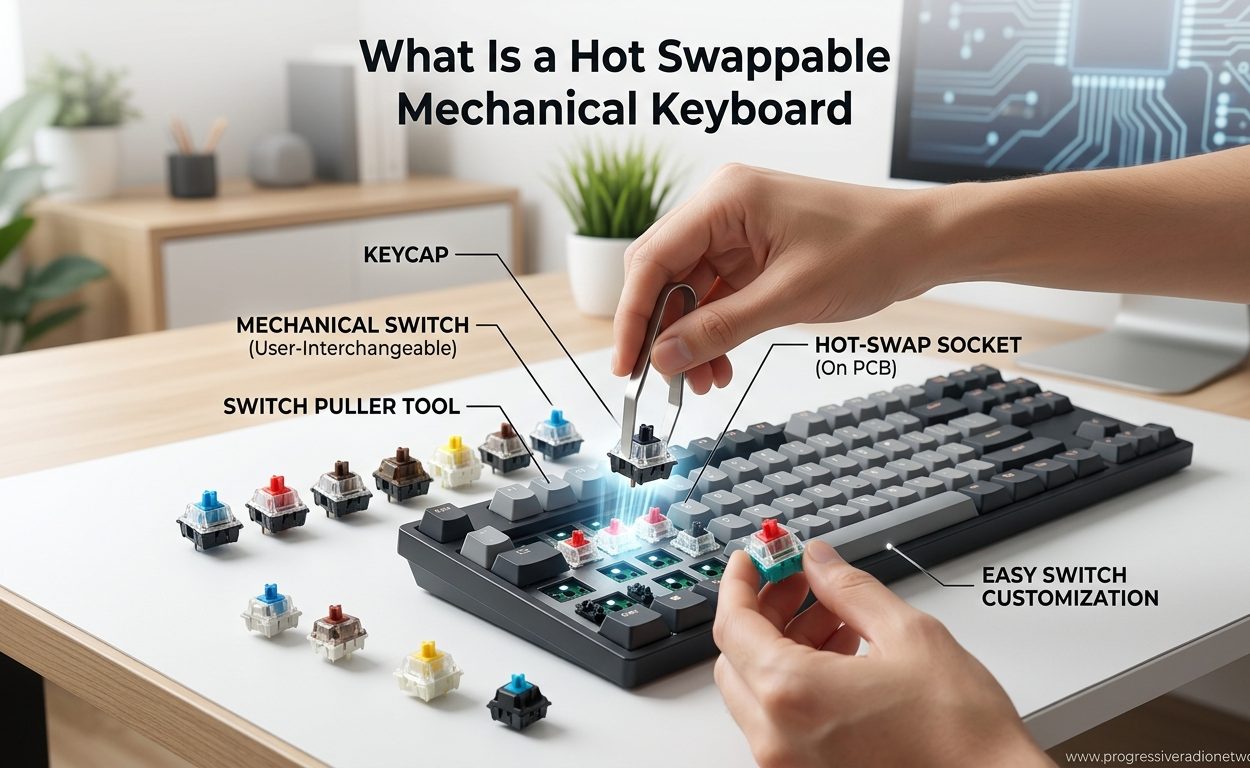
A hot-swappable mechanical keyboard allows you to change individual key switches without soldering, using a simple pull-and-plug method with special sockets mounted on the PCB.
Think of it like changing batteries in a remote control. Traditional keyboards require you to “hard-wire” each switch to the circuit board using solder, a permanent connection that demands technical skill and specialized tools to modify. Hot-swappable keyboards use spring-loaded sockets that grip the metal pins on each switch, creating a secure electrical connection that you can break and remake at will.
This distinction matters because it fundamentally changes who can customize mechanical keyboards. Before hot-swap technology became mainstream, keyboard modification was a niche hobby requiring soldering stations, desoldering pumps, and steady hands. Today, anyone with a $5 switch puller can experiment with different switch types, replace broken switches, or completely transform their keyboard’s feel and sound.
The technology relies on specialized hotswap sockets, most commonly manufactured by Kailh or Gateron. These sockets are permanently soldered to the PCB during manufacturing, but they provide removable connection points for the switches themselves. When you press a switch into the socket, metal contacts inside grip the switch pins firmly. When you pull it out using a switch puller, those contacts release their grip without damaging either component.
How Hot-Swap Technology Works
The magic of hot-swappable keyboards happens at the intersection of the PCB (Printed Circuit Board), the socket, and the switch itself. Understanding this mechanism helps you appreciate both the convenience and the limitations of hot-swap technology.
The PCB with Integrated Sockets
Traditional mechanical keyboard PCBs have empty holes where switch pins pass through. During assembly, those pins get soldered directly to metal pads on the board. Hot-swap PCBs replace those empty holes with pre-installed sockets. These sockets contain tiny metal contacts mounted in plastic housings that match the pin layout of standard mechanical switches.
When I examine a hot-swap PCB under magnification, I can see the clever engineering. Each socket has two or three metal leaves (depending on pin configuration) that act like tiny clamps. When you insert a switch, these leaves spread slightly and then spring back to grip the switch pins with just enough pressure to maintain electrical conductivity without making removal difficult.
The Pull-and-Plug Mechanism
Swapping switches requires a simple tool called a switch puller, which looks like a small pair of tongs with hooked ends. You slide the hooks under the switch’s top housing on opposite sides, squeeze gently, and pull straight up. The metal contacts in the socket release their grip, and the switch pops free.
Installing a new switch works in reverse. You align the switch pins with the socket holes, making sure the pin configuration matches (more on 3-pin versus 5-pin compatibility below), and press down firmly until you hear and feel a satisfying click. That click indicates the socket contacts have locked onto the switch pins.
Socket Durability and Wear
Here is where I need to be honest about limitations. Hot-swap sockets are rated for a specific number of insertion cycles, typically between 100 and 1,000 swaps depending on the socket manufacturer and quality. Kailh sockets generally offer higher durability ratings than budget alternatives.
In my testing, I have found that most users will never hit those limits. If you swap switches once a month, even a 100-cycle socket would last eight years. However, enthusiasts who constantly experiment might wear out sockets faster. When a socket fails, the metal contacts lose their spring tension and no longer grip switch pins securely, causing intermittent keypresses or complete failure.
Hot-Swappable vs Soldered Keyboards: What’s the Difference?
Understanding the distinction between hot-swappable and traditional soldered keyboards helps you make an informed decision about which approach suits your needs. Both have legitimate places in the mechanical keyboard ecosystem.
The Soldering Process
Traditional keyboard assembly involves permanently attaching switches to the PCB using solder, a metal alloy that melts at relatively low temperatures and creates permanent electrical connections. This process requires a soldering iron (typically $30-100 for a decent model), solder wire, and flux. To remove switches, you need a desoldering pump or desoldering braid, adding more cost and complexity.
My first soldered keyboard build took six hours and included three burned fingers, two lifted PCB pads that required repair, and one completely ruined switch from excessive heat. This is a common experience for beginners. While soldering becomes easier with practice, the initial barrier is significant.
Flexibility vs Permanence
Once you solder a switch, changing it requires heating each of its two connection points simultaneously while sucking away the melted solder. This process risks damaging the PCB pads, which can render an entire keyboard useless if too many pads lift off the board. Hot-swappable keyboards eliminate this risk entirely.
However, soldered connections offer advantages too. They are physically more robust than socket connections, with no risk of switches wiggling loose over time. Soldered keyboards also cost less to manufacture since they skip the socket installation step, making them more budget-friendly. For users who know exactly what switches they want and never plan to change them, soldered keyboards work perfectly fine.
Time and Skill Investment
Swapping switches on a hot-swappable keyboard takes about 30 seconds per switch once you develop the technique. A full 87-key TKL (Tenkeyless) board can be completely reconfigured in under 45 minutes. The same process on a soldered board requires heating and desoldering each switch individually, then soldering in replacements, a process that typically takes 3-4 hours for an experienced builder or 6-8 hours for a novice.
For keyboards for coding and programming, this time difference matters less since programmers tend to keep consistent setups. But for gamers and experimenters, hot-swap convenience becomes essential.
Why Choose a Hot-Swappable Keyboard? Key Benefits
After testing dozens of keyboards and helping countless readers with their setups, I have identified the core benefits that make hot-swappable keyboards worth considering. These advantages go beyond simple convenience.
1. No Soldering Skills Required
The most obvious benefit is accessibility. You can now customize your typing experience without learning a technical skill that many people find intimidating. This opens mechanical keyboard customization to writers, gamers, office workers, and anyone else who wants personalization without committing to a hobbyist-level skill investment.
2. Easy Switch Experimentation
Mechanical switches come in hundreds of varieties, each with different actuation forces, travel distances, and sound profiles. Linear switches offer smooth keystrokes without tactile bumps. Tactile switches provide physical feedback when the key registers. Clicky switches add audible confirmation. Within each category, dozens of manufacturers offer unique formulations.
With a hot-swappable keyboard, you can test different switches until you find your perfect match. I personally went through Cherry MX Browns, Gateron Yellows, Akko CS Whites, and Kailh Box Jades before settling on a combination of tactile alphas and linear modifiers. That experimentation would have been impossibly expensive and time-consuming with soldered boards.
3. Mix Different Switch Types
Advanced users often create “frankenswitches” or mix switch types across different keyboard regions. You might prefer heavy tactile switches for typing letters but light linear switches for gaming modifiers. Some users put clicky switches on function keys for audible confirmation but keep their main typing area quiet with linear switches. Hot-swap technology makes these hybrid configurations trivial to implement.
4. Simple Repairs Without Technical Knowledge
Mechanical switches can fail. Dust gets inside, springs wear out, or contacts corrode. On a soldered keyboard, a single failed switch means either living with a dead key or learning to desolder. On a hot-swappable keyboard, you pull out the bad switch and push in a replacement. The repair takes 30 seconds and requires zero technical expertise.
5. Extended Keyboard Lifespan
The most environmentally and economically significant benefit is longevity. A quality mechanical keyboard chassis can last decades. Switches typically last 50 million keystrokes, but heavy users can wear them out in 3-5 years. Rather than discarding an entire keyboard when switches degrade, hot-swappable designs let you refresh only the worn components. I have extended the life of my daily driver keyboard three times through switch replacements, saving hundreds of dollars compared to buying new boards.
6. Reduced E-Waste and Environmental Impact
Every keyboard that stays in service instead of reaching a landfill matters. The keyboard market produces millions of discarded units annually, many discarded simply because switch feel degraded or a single key failed. Hot-swappable designs combat this throwaway culture by enabling component-level maintenance. When you can replace individual switches or update your feel preferences without buying a new chassis, you reduce consumption and waste.
7. Cost Savings Over Time
While hot-swappable keyboards often cost $20-50 more upfront than equivalent soldered models, the long-term economics favor hot-swap. A set of replacement switches costs $30-60, while a new quality mechanical keyboard runs $100-200. After your first switch replacement cycle, you have already saved money compared to the replacement approach.
Understanding Switch Compatibility: 3-Pin vs 5-Pin
Not all switches fit all hot-swappable keyboards. Understanding pin configurations prevents costly mistakes and frustration. This is the technical detail that trips up more beginners than any other aspect of hot-swap keyboards.
The Pin Configuration Basics
Mechanical switches use metal pins that extend from their bottom housing to make electrical contact with the keyboard PCB. These pins carry the signals that tell your computer which key was pressed. Standard MX-style switches come in two configurations: 3-pin (plate-mount) and 5-pin (PCB-mount).
3-Pin (Plate-Mount) Switches
Three-pin switches have two metal contact pins (one for the circuit, one for the return path) plus a single center plastic post. This center post provides basic alignment but minimal structural support. These switches require a metal or plastic mounting plate above the PCB to hold them securely in position. Without that plate, 3-pin switches wobble and can pull out of the sockets accidentally.
5-Pin (PCB-Mount) Switches
Five-pin switches add two additional plastic posts on either side of the center post, creating a more stable triangular mounting pattern. These extra posts slide into matching holes on the PCB, holding the switch firmly in place without requiring a mounting plate. Five-pin configurations offer superior stability and are preferred for gasket-mounted or plateless keyboard designs that prioritize sound and feel over raw rigidity.
| Feature | 3-Pin (Plate-Mount) | 5-Pin (PCB-Mount) |
|---|---|---|
| Plastic Posts | 1 center post | 1 center + 2 side posts |
| Stability | Requires mounting plate | Self-stabilizing on PCB |
| Plateless Builds | Not recommended | Compatible |
| Compatibility | Fits all hot-swap PCBs | Fits 5-pin only (or 3-pin with mods) |
| Common Brands | Gateron, Cherry MX, Kailh | Akko, Gateron, Kailh |
The compatibility situation creates a one-way relationship: 5-pin switches can fit 3-pin hot-swap sockets if you clip off the two side plastic posts using flush cutters. However, 3-pin switches cannot gain the extra stability posts to become 5-pin compatible. If your keyboard has 3-pin hot-swap sockets only, you can still use 5-pin switches with a simple modification. If your keyboard has 5-pin sockets, it accepts both configurations natively.
Considerations and Limitations of Hot-Swap Keyboards
While I am a strong advocate for hot-swappable keyboards, my responsibility is to give you the complete picture. These keyboards have legitimate limitations that matter for certain users and use cases.
Socket Wear Over Repeated Swaps
Hot-swap sockets have finite lifespans. Kailh sockets typically rate for 100-1,000 insertion cycles, while budget alternatives may offer fewer. For most users, this limitation never materializes. If you find your perfect switch type within the first few attempts and stick with it, you might perform 20 swaps total over a keyboard’s lifetime.
However, enthusiasts who treat keyboard building as a hobby can hit socket limits. I know users who swap switches weekly, testing new releases and frankenswitch combinations. These power users eventually encounter loose sockets that no longer grip switch pins firmly, causing intermittent connectivity or switches that fall out when removing keycaps.
Higher Initial Cost
Hot-swappable keyboards carry a price premium. The additional components (sockets, slightly more complex PCB manufacturing) add $20-50 to manufacturing costs, which pass to consumers. Budget keyboards under $50 rarely offer hot-swap functionality. Entry-level hot-swap keyboards typically start around $60-80, while comparable soldered models might cost $40-60.
For readers watching their budget, checking mechanical keyboard deals can offset this premium. Sales events often bring hot-swap boards down to soldered price points.
Not All Switches Are Compatible
Hot-swap sockets are designed for standard MX-style switch footprints. Specialty switches with non-standard pin configurations, optical switches that use light instead of metal contacts, or low-profile switches with different dimensions will not work in standard hot-swap sockets. Always verify switch compatibility before purchasing.
Potential Connection Inconsistency
Soldered connections are physically permanent and electrically consistent. Hot-swap connections, while generally reliable, can develop issues. Switches might not seat fully if pins bend during installation. Dust or oxidation on socket contacts can cause intermittent keypresses. These issues are rare and fixable, but they do not occur with properly soldered switches.
Build Quality Variance
Not all hot-swap implementations are equal. Budget keyboards sometimes use subpar sockets that fail prematurely or have loose tolerances causing wobbly switches. Premium brands like Keychron, Drop, and Glorious generally use quality Kailh or Gateron sockets, but cheap Amazon brands might cut corners. Reading reviews specifically mentioning socket quality helps avoid disappointment.
Who Should Buy a Hot-Swappable Keyboard?
After years of helping readers choose keyboards, I have developed a simple framework for deciding whether hot-swap technology suits your situation. Most users benefit from hot-swap, but not everyone needs it.
Hot-Swap Is Ideal For:
Beginners exploring mechanical keyboards: If you are buying your first mechanical keyboard or transitioning from membrane/scissor-switch boards, hot-swap lets you adjust as your preferences develop. Most beginners do not know whether they prefer linear, tactile, or clicky switches until they try them.
Experimenters and hobbyists: If you enjoy tinkering, hot-swap enables endless experimentation without the time investment of soldering. You can try new switch releases, create hybrid layouts, or adjust your setup seasonally.
Users prioritizing longevity: If you prefer to buy quality items once and maintain them for years, hot-swap enables component-level repairs and refreshes that extend keyboard lifespan significantly.
Gamers optimizing their setup: Different games favor different switch characteristics. FPS players often prefer fast linear switches for rapid double-taps, while MOBA players might want tactile feedback for ability timing. Gaming keyboards for competitive play increasingly offer hot-swap as a standard feature.
You Can Skip Hot-Swap If:
You already know your perfect switch: If you have tested dozens of switches and found your endgame, and you are confident that preference will not change, a soldered keyboard works fine. You save money and get a slightly more robust connection.
You are on a strict sub-$50 budget: While hot-swap prices continue dropping, the best value in extreme budget categories still belongs to soldered designs. If every dollar matters and you do not plan to customize, soldered keyboards offer better build quality at the same price point.
You enjoy soldering as a hobby: Some enthusiasts genuinely enjoy the soldering process. If you find desoldering relaxing and satisfying, traditional PCBs give you more opportunities to practice your craft.
Frequently Asked Questions About Hot-Swappable Keyboards
Are mechanical keyboards hot-swappable?
Not all mechanical keyboards are hot-swappable. Only keyboards specifically designed with hot-swap sockets on the PCB allow switch removal without soldering. Traditional mechanical keyboards require desoldering to change switches. Always check product specifications for terms like ‘hot-swappable,’ ‘hot-swap sockets,’ or ‘Kailh sockets’ to confirm this feature.
What are the downsides of hot-swap?
The main downsides of hot-swap keyboards include socket wear limits (typically 100-1000 swaps), higher initial cost ($20-50 premium over soldered), and potential for loose connections if switches are not fully seated. Additionally, not all switch types are compatible with standard hot-swap sockets, limiting some specialty switch options.
Is hot-swap good for beginners?
Yes, hot-swap is excellent for beginners. It eliminates the need to learn soldering, reduces the risk of damaging expensive PCBs during modifications, and allows experimentation with different switch types to find personal preferences. Beginners can start with affordable switches and upgrade gradually without technical barriers or specialized tools beyond a basic switch puller.
What are the disadvantages of hot-swappable keyboards?
Hot-swappable keyboards cost more upfront than soldered alternatives, have sockets that can wear out after repeated swaps, and may develop connection issues if switches are improperly seated. Some budget implementations use low-quality sockets that fail prematurely. Additionally, certain specialty switches like optical or low-profile variants may not fit standard hot-swap sockets designed for MX-style switches.
Final Thoughts: Is Hot-Swap Right for You?
So, what is a hot-swappable mechanical keyboard in practical terms? It is a keyboard that puts customization control in your hands without demanding technical skills or specialized equipment. It is a tool for experimentation, a solution for easy repairs, and a path toward reducing electronic waste through extended product lifespans.
For most users in 2026, I recommend hot-swappable keyboards without reservation. The modest upfront premium pays for itself through flexibility, longevity, and the sheer enjoyment of tailoring your typing experience to your exact preferences. Whether you are writing code, gaming competitively, or drafting your next novel, having the right switch under each finger matters more than most people realize until they experience it.
If you are ready to explore mechanical keyboards further, start with a quality hot-swap board from a reputable brand. Test a few switch types. Find what feels right for your fingers and sounds right for your ears. The journey to your perfect keyboard setup is far more accessible today than it was just a few years ago, and that accessibility is worth celebrating.



Leave a Comment