
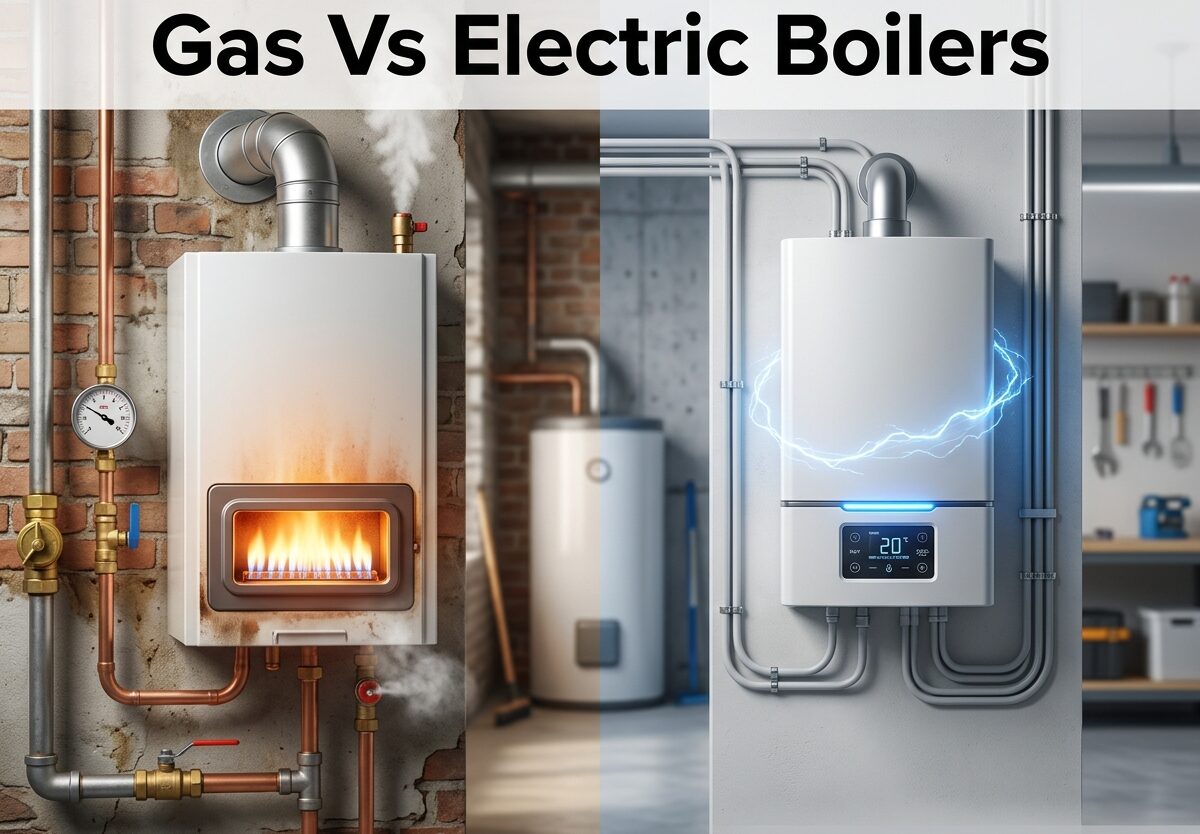
Choosing between gas and electric heating systems is one of the most significant decisions homeowners face when upgrading their central heating. This comprehensive guide breaks down the real-world differences between Gas Vs Electric Boilers, including installation costs, running expenses, efficiency ratings, and safety considerations that actually matter in 2026.
After analyzing industry data and real user experiences from heating forums, I’ll help you understand which boiler type makes the most sense for your property, your budget, and your lifestyle. The choice between gas and electric affects your monthly energy bills, environmental footprint, and even your home’s safety profile.
How Gas Boilers Work
Gas boilers burn natural gas or liquefied petroleum gas (LPG) to heat water directly through a combustion process. The burning gas heats a heat exchanger, which transfers thermal energy to water circulating through your central heating system and radiators. This combustion method has been the standard for UK home heating for decades.
The heated water then travels through pipes to radiators throughout your home, while a separate circuit supplies hot water to your taps and shower. Modern gas boilers are condensing models, meaning they capture heat from exhaust gases that would otherwise be wasted, improving efficiency significantly compared to older non-condensing units.
Combustion Process
Natural gas enters the boiler through a supply pipe and mixes with air in the combustion chamber. A spark or pilot light ignites the mixture, creating a controlled flame that heats the heat exchanger. The combustion produces carbon dioxide and water vapor as byproducts, which must be vented outside through a flue.
Heat Distribution
The heated water circulates through your central heating system using a pump, reaching radiators in each room. The system typically operates at higher temperatures (60-80°C) than electric boilers, providing faster heating response times. This makes gas boilers particularly effective for larger homes with multiple heat emitters.
Flue and Ventilation
Gas boilers require a flue system to vent combustion gases outside your home. This vertical or horizontal pipe must meet specific building regulations and safety standards. The flue also allows fresh air intake for combustion, which is why proper ventilation is essential for safe operation.
How Electric Boilers Work
Electric boilers function much like a large kettle, using electrical resistance elements to heat water directly without any combustion process. When electricity flows through the heating elements, they become hot and transfer that thermal energy to the water passing through the boiler. This simple design has fewer moving parts than gas boilers.
The heated water then circulates through your radiators and hot water system just like a gas boiler, providing central heating and hot water on demand. Because there’s no combustion, electric boilers don’t require a flue, gas supply, or ventilation, making them suitable for properties without access to the gas network.
Resistance Heating
Electrical current passes through resistant heating elements, typically made of metal alloys like nichrome. The resistance creates heat directly in the water, with nearly 100% of the electrical energy converted to thermal energy at the point of use. This direct heating method is why electric boilers achieve such high efficiency ratings.
Direct Water Heating
Water flows over the heating elements, absorbing heat rapidly before circulating to your radiators and taps. The heating process is controlled by thermostats and flow switches, ensuring the water reaches the desired temperature before distribution. This direct contact heating eliminates the heat losses associated with combustion-based systems.
No Combustion Required
Without burning fuel, electric boilers produce no carbon monoxide, carbon dioxide, or other combustion byproducts at the point of use. This eliminates the need for flues, ventilation, or carbon monoxide alarms specifically for the boiler. The absence of combustion also means no risk of gas leaks or explosions from the heating system itself.
Gas Vs Electric Boilers: Energy Efficiency Comparison
Understanding efficiency differences between Gas Vs Electric Boilers requires looking beyond simple percentage ratings. While electric boilers appear more efficient at first glance, the full picture includes energy generation and transmission losses that significantly impact real-world performance and cost-effectiveness.
Point-of-Use Efficiency
Electric boilers convert nearly 100% of the electricity they consume into heat at the point of use. Every unit of electrical energy entering the boiler becomes thermal energy in your water. Modern condensing gas boilers achieve 90-94% efficiency, meaning 6-10% of heat energy is lost through the flue and other system losses. This makes electric boilers appear superior when looking only at the appliance itself.
Systemic Efficiency Explained
However, electricity generation and transmission introduce substantial efficiency losses before power reaches your home. Power stations typically operate at 35-55% efficiency when burning fossil fuels to generate electricity. Transmission through the national grid loses another 5-8% of the generated power. When accounting for these upstream losses, the systemic efficiency of electric heating drops to approximately 35-50%, making gas boilers more efficient overall in many regions.
Real-World Efficiency
Forum users frequently report that despite the higher point-of-use efficiency of electric boilers, gas systems prove more cost-effective due to the systemic efficiency gap. One Reddit user noted that gas costs roughly one-fourth the price of electricity per kWh, meaning the 30% efficiency advantage of electric boilers doesn’t compensate for the fuel cost differential. This explains why gas boilers remain the dominant choice for most UK homes despite the apparent efficiency advantage of electric systems.
Installation Costs: Gas Vs Electric Boilers
The upfront investment differs significantly between Gas Vs Electric Boilers, with electric systems typically costing less to install but requiring specific electrical infrastructure. Installation costs vary based on your property’s existing infrastructure, location, and the complexity of the required work.
Initial Equipment Cost
Electric boiler units generally cost between £1,500 and £3,000 including VAT, while gas boilers range from £2,000 to £4,000 for the unit alone. The price difference reflects the simpler construction of electric boilers with fewer components. High-efficiency condensing gas boilers with advanced controls and modulating burners sit at the upper end of this range, offering better long-term efficiency for higher initial cost.
Labor and Installation Time
Electric boiler installation typically takes 1-2 days and costs £500-£1,000 for labor. The simpler system means fewer connections and no gas work required. Gas boiler installation usually requires 2-3 days with labor costs of £800-£1,500. The additional time reflects the complexity of gas connections, flue installation, and commissioning requirements that must be performed by Gas Safe registered engineers.
Gas Connection Requirements
Installing a gas boiler requires access to a natural gas supply. If your property already has gas, connection costs are minimal. However, bringing gas to a property without an existing connection can cost £2,000-£5,000 depending on distance from the mains and local authority requirements. This significant cost often makes electric boilers the default choice for off-grid properties.
Electrical Supply Considerations
Electric boilers require substantial electrical power, typically drawing 30-45 amps depending on capacity. Most UK homes have adequate single-phase power for standard electric boilers up to 12kW. However, larger units or installations in properties with limited electrical capacity may require a three-phase power supply upgrade, costing £3,000-£8,000 according to forum discussions. This hidden cost can dramatically affect the economics of electric boiler installation.
Running Costs: Gas Vs Electric Boilers
Running costs represent the most significant long-term difference between Gas Vs Electric Boilers, with electricity typically costing 3-4 times more per kWh than natural gas. This fundamental price difference means that despite electric boilers’ superior point-of-use efficiency, gas systems almost always prove cheaper to run in practice.
kWh Cost Comparison
As of 2026, natural gas costs approximately 7-10p per kWh, while electricity costs 27-34p per kWh depending on your tariff and region. This three-to-one price ratio means that even with perfect efficiency, electric heating costs significantly more. Forum users frequently report annual heating bills of £500-£800 with gas boilers versus £1,500-£2,400 for equivalent electric boiler usage, despite electric units being 100% efficient at the point of use.
Annual Heating Costs by Property Size
For a small one-bedroom flat, annual heating costs with an electric boiler typically run £400-£600, while a gas boiler would cost £150-£250 for equivalent heat output. A typical three-bedroom home sees electric boiler running costs of £1,200-£1,800 annually, compared to £450-£700 for gas heating. Large five-bedroom properties can face £2,500-£3,500 per year with electric boilers versus £900-£1,400 with gas systems, demonstrating how the cost differential increases with property size and heating demand.
Off-Peak Electricity Benefits
Some electric boiler owners reduce running costs by operating the system primarily during off-peak hours when electricity rates are lower. Economy 7 and similar tariffs offer significantly reduced rates overnight (typically 10-15p per kWh versus 30p+ during peak hours). However, this strategy requires excellent thermal insulation and heat storage capability to maintain comfort throughout the day, making it impractical for many properties. Even with off-peak optimization, electric boiler running costs typically remain 50-100% higher than gas systems.
Gas Vs Electric Boilers: Safety Comparison
Safety considerations differ substantially between Gas Vs Electric Boilers, with each system presenting distinct risks that homeowners must understand. Electric boilers eliminate combustion-related hazards but introduce electrical concerns, while gas systems require rigorous safety protocols to manage combustion byproducts.
Carbon Monoxide Risks
Gas boilers produce carbon monoxide as a combustion byproduct, creating a potentially fatal risk if the system malfunctions or ventilation fails. Building regulations require carbon monoxide alarms in any room containing a gas boiler, and annual servicing by Gas Safe registered engineers is essential to maintain safe operation. Poorly maintained gas boilers can develop cracks in heat exchangers or blocked flues, allowing CO to enter living spaces. Electric boilers produce zero carbon monoxide, eliminating this specific safety concern entirely.
Gas Leaks and Explosion Risk
Natural gas is highly flammable, and leaks create explosion hazards along with asphyxiation risks in confined spaces. Gas supply lines, connections, and the boiler itself must meet strict safety standards and undergo regular pressure testing. The distinctive odor added to gas (mercaptan) provides leak detection, but physical damage to gas pipes or degradation over time can create dangerous situations. Electric boilers eliminate gas leak and explosion risks entirely, as they require no combustible fuel supply.
Fire Safety Considerations
Both boiler types present some fire risk, though the nature differs. Gas boilers involve open flames or ignition sources, creating potential ignition points if flammable materials are stored nearby. Electric boilers eliminate combustion but generate significant heat in electrical components. Poor wiring or overloaded circuits can create electrical fire hazards, particularly in older properties with inadequate wiring. Proper installation by qualified professionals minimizes risks for both system types, but gas boilers require additional safety measures including CO alarms and gas leak detectors.
Lifespan and Durability
The longevity of your heating system affects long-term ownership costs, with differences in durability between Gas Vs Electric Boilers influenced by their distinct operating principles and maintenance requirements. Understanding these differences helps calculate total cost of ownership beyond initial purchase and installation.
Average Lifespan
Gas boilers typically last 10-15 years with proper maintenance, though some cast iron models can exceed 20 years with excellent care. The combustion process, high operating temperatures, and presence of multiple moving parts contribute to wear over time. Electric boilers generally last 15-20 years due to their simpler construction with fewer moving parts. Forum users frequently report cast iron gas boilers “running for years with very little service,” while noting electric systems are “simpler with fewer parts, so they don’t need repairs” as often.
Maintenance Requirements
Gas boilers require annual servicing by Gas Safe registered engineers to ensure safe and efficient operation. This service typically costs £80-£150 per year and includes combustion analysis, heat exchanger inspection, flue checking, and safety device testing. The annual service is essential for maintaining warranty coverage and ensuring safe operation. Electric boilers require less frequent maintenance, with most manufacturers recommending professional inspection every 2-3 years at a cost of £50-£100. The simpler design means fewer components to inspect and test.
Repair Frequency
Gas boilers experience more frequent repairs due to their complexity, with common issues including failed pumps, broken fans, faulty ignition systems, and heat exchanger problems. Repair costs typically range from £150-£400 depending on the component. Electric boilers have fewer failure points, with most issues related to heating elements or control boards. Repairs generally cost £100-£250 and occur less frequently. Forum discussions suggest that while electric boilers are theoretically more reliable, the difference in practice is less dramatic than expected, with well-maintained gas boilers providing reliable service for many years.
Pros and Cons of Gas Boilers
Gas boilers remain the most popular heating choice in the UK for good reason, offering a balance of cost-effectiveness, reliability, and performance that suits most households. Understanding the advantages and limitations helps determine whether a gas system meets your specific needs.
Advantages of Gas Boilers
Lower running costs are the primary advantage, with natural gas costing approximately one-third the price of electricity per kWh. This translates to annual heating bills that are typically 60-70% lower than equivalent electric systems. Gas boilers also provide faster heating response times, making them ideal for larger homes with multiple bathrooms and high hot water demand. The higher operating temperatures (60-80°C) mean radiators reach desired temperatures more quickly, improving comfort during cold periods.
Wider availability of models and installers makes gas boilers convenient to specify and repair. The established infrastructure means competitive pricing and faster service when problems arise. Gas boilers also handle higher hot water demand more effectively, making them suitable for families with simultaneous shower and bathing needs. The technology is mature and well-understood, with a wide range of options from budget to premium models.
Disadvantages of Gas Boilers
Carbon monoxide risk represents the most serious safety concern, requiring annual professional servicing and CO alarm installation. Gas boilers also produce carbon dioxide emissions during operation, contributing to your household’s carbon footprint. Installation is more complex and expensive, requiring Gas Safe registered engineers and potentially involving gas supply upgrades if not already present.
Planning permission may be required for flue installation in certain properties, particularly listed buildings or conservation areas. The combustion process requires ventilation, limiting installation options and potentially affecting aesthetics. Gas boilers are also noisier than electric models due to the combustion process and fan operation, which may be a consideration for open-plan living spaces or boiler cupboards adjacent to bedrooms.
Pros and Cons of Electric Boilers
Electric boilers offer compelling advantages for specific situations, particularly where gas supply is unavailable or environmental concerns prioritize lower emissions. However, the significantly higher running costs make them unsuitable for many households despite their technical advantages.
Advantages of Electric Boilers
Zero carbon emissions at the point of use make electric boilers attractive for environmentally conscious homeowners, particularly when paired with renewable electricity sources or solar panels. The absence of combustion eliminates carbon monoxide risks, gas leak concerns, and the need for annual safety certifications. Installation is simpler and faster, typically completing in 1-2 days with less disruption to your home.
Electric boilers operate silently, making them ideal for installations near living areas or bedrooms. Their compact size allows more flexible positioning, and they don’t require flues or ventilation, simplifying installation in apartments or properties with limited space. The simpler design with fewer moving parts means potentially lower maintenance requirements and fewer repair needs over the system’s lifetime. Electric boilers also work well with underfloor heating systems and are compatible with standard radiators.
Disadvantages of Electric Boilers
Running costs are 3-4 times higher than gas boilers, creating a substantial ongoing financial burden. Forum users report annual heating costs increasing from approximately £500 with gas to £1,500 or more with electric, making this the primary disadvantage for most households. Heat up times are significantly longer due to the liquid-to-liquid convection heating method, meaning the system takes longer to reach operating temperature and provide full heating output.
Power cuts affect both heating and hot water access, creating vulnerability during winter storms or grid failures. The high electrical draw (30-45 amps) limits simultaneous use of other high-power appliances, potentially requiring electrical system upgrades in older properties. Electric boilers also have lower maximum output compared to gas models, making them unsuitable for larger homes with high heating demand unless supplemented with additional heat sources.
Which Boiler Type is Best for Your Property?
The optimal choice between Gas Vs Electric Boilers depends on your specific circumstances, including property size, existing infrastructure, budget, and environmental priorities. This section provides tailored recommendations for different situations to help you make the right decision.
Small Homes and Flats (1-2 Bedrooms)
Electric boilers often make sense for smaller properties where heating demand is lower and the higher running costs have less financial impact. Flats and apartments frequently lack gas supply, making electric the practical choice. The lower installation cost and simpler requirements also suit smaller budgets. However, if gas is available and you plan to stay in the property long-term, the running cost savings of gas typically outweigh the higher initial investment within 3-5 years.
Medium Homes (3 Bedrooms)
Gas boilers are almost always the better choice for typical three-bedroom family homes. The moderate heating demand makes the running cost differential significant enough to justify gas infrastructure. Multiple bathrooms and family hot water needs favor the higher output and faster recovery times of gas systems. Unless environmental considerations override cost concerns, gas provides the best balance of performance, comfort, and economy for this property size.
Large Homes (4+ Bedrooms)
Gas boilers are the clear winner for larger properties with multiple bathrooms and high heating demand. The running cost savings of £1,000-£2,000 annually compared to electric quickly justify any installation premium. Higher output gas models (30-40kW+) can meet substantial demand while electric boilers would require multiple units or supplementary heating. If environmental concerns are a priority, consider heat pumps as an alternative to electric boilers for larger homes, as they offer better efficiency and lower running costs than direct electric resistance heating.
Properties Without Gas Supply
When gas isn’t available, the decision becomes more complex. Electric boilers provide a straightforward solution but with high running costs. Alternatives include LPG boilers (which burn liquefied petroleum gas and offer similar performance to natural gas but with higher fuel costs), oil boilers (common in rural areas but with environmental and maintenance considerations), or heat pumps (which offer excellent efficiency but with higher installation costs). If choosing electric, consider pairing with solar panels to offset running costs and investigate off-peak tariffs to minimize the impact of higher daytime electricity rates.
Frequently Asked Questions
Is it cheaper to run an electric boiler or a gas boiler?
Gas boilers are significantly cheaper to run, costing approximately one-third the price of electric boilers per kWh of heat produced. As of 2026, gas costs 7-10p per kWh while electricity costs 27-34p per kWh. Annual heating costs for a typical three-bedroom home run £450-£700 with gas versus £1,200-£1,800 with electric, despite electric boilers being 100% efficient at the point of use. The fuel cost differential outweighs the efficiency advantage of electric heating.
What are the disadvantages of electric boilers?
The main disadvantage is running cost, which is 3-4 times higher than gas boilers. Other drawbacks include longer heat up times, vulnerability to power cuts affecting heating and hot water, high electrical draw (30-45 amps) limiting simultaneous appliance use, and lower maximum output making them unsuitable for larger homes. Three-phase power supply upgrades may be needed in some properties, costing £3,000-£8,000. Forum users also report that heat pump alternatives often provide better efficiency for eco-conscious homeowners.
What boilers do plumbers recommend?
Most heating engineers recommend gas boilers for properties with access to natural gas due to lower running costs, better performance for larger homes, and faster heating response times. Gas systems handle multiple bathrooms and high hot water demand more effectively. For off-grid properties, recommendations vary between LPG boilers, oil boilers, and increasingly heat pumps. Electric boilers are typically recommended only for small flats, properties without gas supply where alternatives aren’t practical, or for eco-conscious homeowners paired with renewable electricity sources.
What’s the cheapest way to heat a house?
Gas boilers currently provide the cheapest heating for most UK homes, with annual costs typically 60-70% lower than electric resistance heating. However, heat pumps are becoming increasingly competitive, offering 300-400% efficiency and potentially lower running costs than gas boilers when properly installed and paired with appropriate insulation. The cheapest option depends on your property’s insulation, local energy prices, and available incentives. For off-grid homes, biomass boilers or heat pumps often prove cheaper than electric boilers or oil heating systems.
How long do electric boilers last compared to gas boilers?
Electric boilers typically last 15-20 years, while gas boilers generally last 10-15 years with proper maintenance. The simpler design with fewer moving parts contributes to the electric boiler’s longevity. However, some cast iron gas boilers can exceed 20 years with excellent care and regular servicing. Maintenance requirements differ significantly: gas boilers need annual professional servicing (£80-£150) while electric boilers typically need inspection every 2-3 years (£50-£100). Over their lifetime, repair frequency is similar, though gas boilers may require more repairs due to greater component complexity.
Are electric boilers safer than gas boilers?
Electric boilers eliminate combustion-related safety risks, including carbon monoxide production, gas leaks, and explosion hazards. They produce no emissions at the point of use and don’t require flues or ventilation specifically for combustion gases. However, both systems have safety considerations: gas boilers require CO alarms and annual servicing, while electric boilers create electrical fire risks if improperly installed or in properties with inadequate wiring. When installed by qualified professionals, both types are safe, but electric boilers have fewer serious failure modes and don’t require carbon monoxide detection.
Can I replace a gas boiler with an electric boiler?
Yes, gas boilers can be replaced with electric boilers, but the decision requires careful consideration. The installation is straightforward and typically takes 1-2 days, but annual running costs will increase 3-4 fold. Your existing radiators and pipework will generally work with the new electric boiler. However, you may need an electrical supply upgrade if your property lacks sufficient capacity (30-45 amps). Three-phase power upgrades can cost £3,000-£8,000 if required. Before switching, calculate the long-term cost implications and consider alternatives like heat pumps, which may offer better efficiency for the investment.
Do electric boilers work with radiators?
Yes, electric boilers work perfectly with standard radiators and existing central heating pipework. The boiler heats water which circulates through your radiator system just like a gas boiler. However, electric boilers typically operate at lower temperatures (50-70°C) compared to gas systems (60-80°C), meaning radiators may feel slightly cooler to the touch but still provide effective heating. For best results, consider upgrading to larger radiators or adding additional units if converting from gas, as this compensates for the lower operating temperature and maintains comfort levels.
Conclusion
Choosing between Gas Vs Electric Boilers ultimately depends on your specific circumstances, priorities, and long-term plans for your property. Gas boilers offer superior running cost-effectiveness and performance for most homes connected to natural gas, making them the practical choice for the majority of UK households. Electric boilers provide an excellent solution for smaller properties, flats without gas supply, or environmentally conscious homeowners willing to accept higher running costs for zero emissions at the point of use.
Before making your final decision, obtain quotes from qualified installers for both options, calculate long-term ownership costs including installation and expected annual running expenses, and consider whether heat pump technology might offer a better balance of efficiency and running costs for your situation. The right choice today depends on your property, your budget, and your priorities for comfort, cost, and environmental impact in 2026.

Leave a Comment