
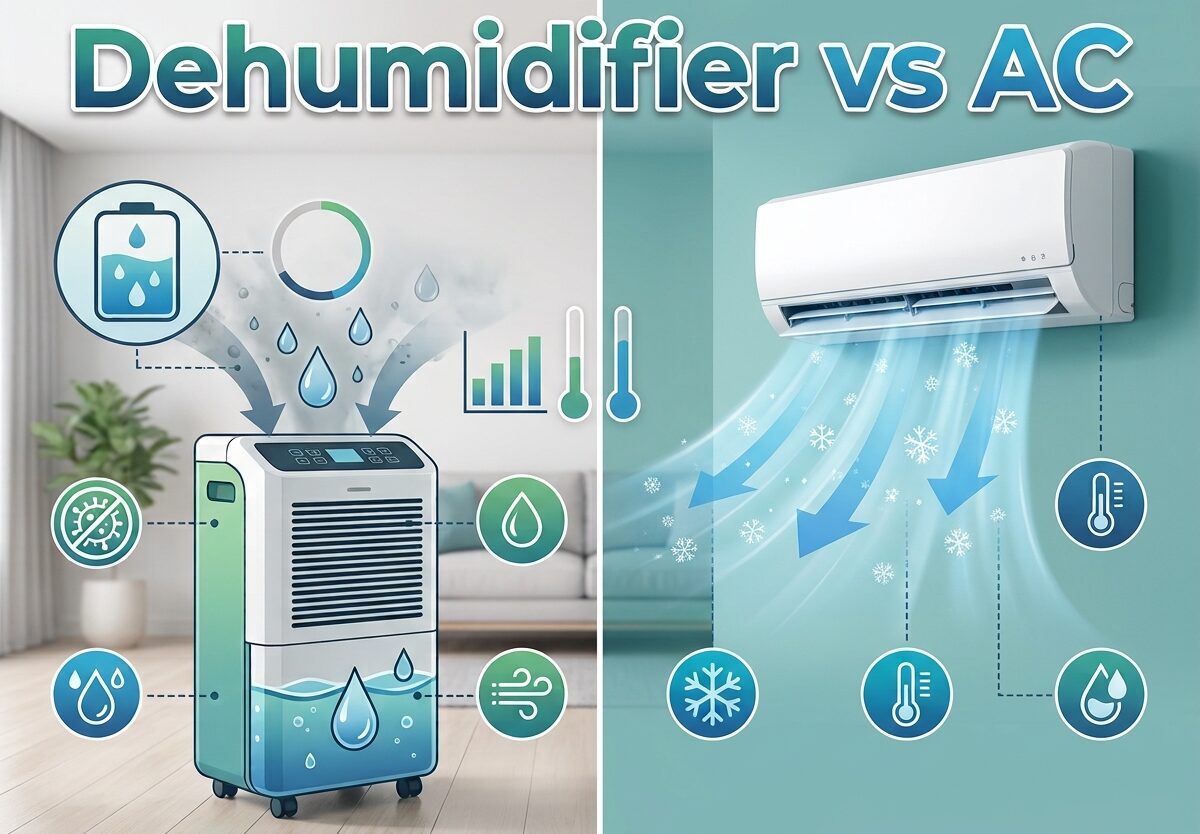
When summer arrives with its sticky humidity and sweltering heat, many homeowners face the same decision: invest in a dehumidifier or upgrade their air conditioning. I’ve spent years researching home climate solutions, and the Dehumidifier vs AC debate comes up constantly because people don’t understand the fundamental difference between these two appliances. While both can improve your comfort, they work in completely different ways and serve different purposes in your home.
The key difference comes down to this: air conditioners primarily cool your space by removing heat, while dehumidifiers primarily remove moisture from the air without significantly lowering temperature. Understanding this distinction is crucial because choosing the wrong solution can leave you with high energy bills and continued discomfort. In this comprehensive guide, I’ll break down exactly how each appliance works, when you should use one over the other, and why running both together might be the ultimate solution for your home.
Dehumidifier vs AC: Key Differences at a Glance
Before diving into the technical details, here’s what you need to know about the fundamental differences between these appliances:
Primary Function: Air conditioners cool air by removing heat; dehumidifiers remove moisture without significantly cooling air.
Energy Consumption: Dehumidifiers typically use 300-700 watts; AC units range from 500-3500+ watts depending on size and type.
Best For: Dehumidifiers excel in damp basements and spring/fall seasons; AC units are essential during hot summer months.
Heat Output: Dehumidifiers actually add warmth to a room (explained below); AC units remove heat from your space.
Moisture Removal: Dehumidifiers remove 30-70 pints of water daily; AC units remove moisture as a secondary effect of cooling.
How Dehumidifiers Work
A dehumidifier is essentially an air conditioner with both coils in the same room. Here’s what that means in practical terms: the unit pulls warm, humid air across cold refrigerant coils, causing moisture to condense and collect in a reservoir or drain hose. The dry air is then reheated by the hot side coils before being released back into your room.
This process explains why dehumidifiers actually add heat to your space. I’ve seen countless Reddit threads from confused homeowners wondering why their dehumidifier made the room warmer—it’s not a malfunction, it’s how the appliance works. All that electrical energy has to go somewhere, and it’s released as heat along with the dry air.
Most portable dehumidifiers use a refrigerant-based system similar to AC, but with a crucial difference: instead of sending hot air outside through exhaust hoses like a portable AC, dehumidifiers release that heat right back into your living space. This makes them ideal for cooler, damp environments where you want to reduce humidity without making the room uncomfortably cold.
Modern dehumidifiers can extract 30-70 pints of water per day depending on their capacity, making them highly effective at controlling moisture levels in basements, crawl spaces, and other damp areas. The best models maintain optimal humidity between 30-50%, which is the range recommended by the EPA for preventing mold growth and maintaining comfort.
How Air Conditioners Work
Air conditioners work on the same refrigeration principle as dehumidifiers but with a different goal: removing heat from your living space. Warm air from your room passes over cold evaporator coils, where both heat and moisture are absorbed. The refrigerant carries this heat energy to condenser coils located outside (in central and window units) or through exhaust hoses (in portable units), where it’s released outdoors.
The cooling capacity of an AC is measured in BTUs (British Thermal Units), with typical residential units ranging from 5,000 to 24,000+ BTUs. A general rule is that you need about 20 BTUs per square foot of living space, though this varies based on ceiling height, insulation, sun exposure, and climate zone.
While air conditioners do remove moisture as a byproduct of cooling, this dehumidification is secondary to their primary function. The AC only removes humidity while it’s actively cooling your space. Once your home reaches the set temperature, the compressor cycles off and humidity removal stops. This is why you might still feel sticky even with the AC running—the unit focuses on temperature, not moisture levels.
Central air conditioning systems can remove 5-15 gallons of water per day in humid climates, but this varies widely based on outdoor conditions and how often the compressor runs. Window units and portable ACs have less dehumidification capacity because they process less air volume than central systems.
Energy Efficiency Comparison
When it comes to energy consumption, dehumidifiers generally cost less to operate than air conditioners. A typical portable dehumidifier uses 300-700 watts of electricity, costing roughly $0.04-0.10 per hour to run. By comparison, a window AC unit draws 500-1500 watts ($0.07-0.21/hour), while central air conditioning can consume 3000-5000 watts ($0.41-0.68/hour) during operation.
However, the real efficiency question isn’t about watts—it’s about effectiveness for your specific problem. Running a dehumidifier in a hot, humid space might actually increase your cooling costs because it adds heat to the room. This forces your AC to work harder, potentially raising your overall energy consumption.
I’ve seen homeowners save money by using their dehumidifier strategically. By reducing indoor humidity to comfortable levels, you can often set your AC thermostat 2-4 degrees higher without sacrificing comfort. The Department of Energy estimates you can save 3-5% on cooling costs for every degree you raise your thermostat. This means running both appliances together can sometimes be more efficient than running the AC alone at a lower temperature.
The most energy-efficient approach depends on your climate and home conditions. In hot, humid regions, a properly sized AC with a good dehumidification feature is often the most efficient single solution. In damp but mild climates, a dehumidifier alone might handle your comfort needs with minimal energy use.
Humidity Control Effectiveness
When it comes to pure moisture removal, dehumidifiers are the clear winner. They’re specifically designed to extract water from the air continuously, regardless of temperature. Most models maintain precise humidity control through built-in humidistats, allowing you to set your target moisture level and forget about it.
Dehumidifiers excel at reducing relative humidity below 50%, which is critical for preventing mold growth, dust mite populations, and musty odors. They’re particularly effective in basements, crawl spaces, and other below-grade areas where humidity accumulates regardless of outdoor conditions. Many models can continue operating effectively at temperatures as low as 41°F, making them useful year-round in many climates.
Air conditioners remove moisture only as a side effect of cooling, and their effectiveness varies dramatically based on operating conditions. In moderate weather, your AC might run for short cycles that cool the air without removing much humidity. This is especially problematic during spring and fall when you need moisture control but not much cooling.
Some modern AC systems include enhanced dehumidification modes that run the compressor at lower speeds for longer periods, improving moisture removal. Variable-speed air handlers and two-stage compressors also help by allowing the system to run longer at reduced capacity, which removes more humidity than short, high-power bursts. However, even the best AC units can’t match the precise humidity control of a dedicated dehumidifier.
When to Choose a Dehumidifier
Dehumidifiers are the right choice when moisture is your primary problem rather than heat. Here are the scenarios where a dehumidifier makes the most sense:
Basements and Crawl Spaces: These underground areas stay naturally cool but damp year-round. A dehumidifier prevents mold growth and musty odors without making the space uncomfortably cold. I recommend a unit with a continuous drain option for basements, as they can extract gallons of water daily during humid months.
Spring and Fall: During shoulder seasons, you might not need cooling but still struggle with sticky humidity. A dehumidifier handles this efficiently without the energy cost of running your AC. This is especially valuable in regions with humid shoulder seasons where the temperature is comfortable but the air feels heavy.
Mild Climates: If you live in an area where temperatures rarely exceed 75°F but humidity stays high, a dehumidifier alone might provide all the comfort you need. This is common in coastal regions and areas with marine climates.
Health Concerns: For people with respiratory conditions like COPD, allergies, or asthma, maintaining consistent humidity below 50% is crucial. Dehumidifiers provide this control regardless of temperature, which is why the COPD Foundation recommends them for symptom management. If you have COPD or other respiratory issues, a dehumidifier can significantly improve your breathing comfort even when cooling isn’t necessary.
When to Choose an Air Conditioner
Air conditioners are essential when heat is your primary problem. Here’s when AC is the right solution:
Hot Summers: If temperatures regularly exceed 80°F, a dehumidifier alone won’t keep you comfortable. AC is non-negotiable for heat relief and preventing heat-related illnesses. The combination of heat and humidity is particularly dangerous, and AC addresses both problems simultaneously.
Bedroom Cooling: Most people sleep significantly better in cooler temperatures. If your bedroom stays above 70°F at night, AC will dramatically improve your sleep quality. The National Sleep Foundation recommends temperatures between 60-67°F for optimal rest.
Heat-Sensitive Individuals: Elderly residents, young children, and people with certain medical conditions are more vulnerable to high temperatures. If anyone in your household falls into these categories, AC is more than a luxury—it’s a health necessity.
Home Protection: Excessive heat can damage electronics, warp furniture, and cause other problems in your home. If indoor temperatures regularly exceed 80°F, AC helps protect your belongings and structural elements.
Combining Both Appliances for Optimal Comfort
Here’s something most articles won’t tell you: running both a dehumidifier and air conditioner together can provide better comfort than either appliance alone. This combination addresses both temperature and humidity simultaneously, creating an indoor environment that feels cooler at higher temperatures.
The science behind this is simple: humid air feels warmer than dry air at the same temperature. By reducing humidity with a dehumidifier, you can often set your AC thermostat 2-4 degrees higher while maintaining the same comfort level. This reduces the load on your AC and can lower your overall energy consumption despite running two appliances.
I recommend placing the dehumidifier centrally in your living space and setting it to maintain 45-50% humidity. Then set your AC thermostat a few degrees higher than you normally would. You’ll feel just as comfortable but use less energy overall. This strategy works especially well in hot, humid climates where AC alone struggles to control moisture during moderate weather.
Many modern AC systems include a “dry” or “dehumidify” mode, but these are rarely as effective as a dedicated dehumidifier. The AC’s dehumidification mode only works while the compressor is running, and it stops when the target temperature is reached. A standalone dehumidifier continues controlling moisture regardless of temperature, providing consistent humidity management.
Cost Analysis: Purchase and Operation
The purchase price varies widely between these appliances. Portable dehumidifiers typically cost $150-350 for units that cover 1,500-3,000 square feet. Window AC units range from $200-600, while central air conditioning systems cost $3,000-7,000 installed. For most homes, the dehumidifier represents a much smaller initial investment.
Operating costs tell a different story. A dehumidifier running 24/7 might cost $30-60 per month in electricity, while central AC can cost $150-400 monthly depending on usage rates and climate. However, the real question isn’t which costs more—it’s which solves your actual problem most effectively.
Many homeowners make the mistake of buying an AC when they really need a dehumidifier, or vice versa. I’ve seen people spend thousands on central air only to complain that their home still feels sticky. Conversely, others run dehumidifiers endlessly in hot homes, fighting a losing battle against heat while adding to their electrical load.
The most cost-effective solution is to match the appliance to your specific climate and comfort needs. In hot regions, AC is essential and worth every penny. In damp but mild climates, a quality dehumidifier might solve your problems for a fraction of the cost. And in many areas, using both strategically provides the best value by optimizing both comfort and efficiency.
Health Benefits and Indoor Air Quality
Both appliances improve your indoor environment, but in different ways. Dehumidifiers create an environment that discourages mold, dust mites, and other allergens by maintaining humidity below 50%. This is particularly important for people with allergies, asthma, or other respiratory conditions. The EPA recommends controlling humidity as the first line of defense against biological contaminants in your home.
For those with COPD, maintaining proper humidity is especially important. The COPD Foundation specifically recommends using dehumidifiers because humid air makes breathing more difficult and can exacerbate symptoms. However, they also note that air conditioning is valuable during hot weather because heat stress can trigger COPD flare-ups. The ideal solution for COPD patients is often both appliances working together to maintain optimal temperature and humidity year-round.
Air conditioners provide health benefits primarily through heat relief and air filtration. By recirculating air through filters, AC systems remove dust, pollen, and other particles. More importantly, AC prevents heat-related illnesses and can literally be lifesaving during extreme heat events. The Centers for Disease Control considers air conditioning the most important protection against heat-related illness.
Frequently Asked Questions
Does a dehumidifier work better than an AC?
Dehumidifiers work better than AC for moisture removal, while AC works better for cooling. If your problem is dampness rather than heat, a dehumidifier is more effective. For hot conditions, AC is superior. Many homes benefit from both appliances working together.
Should you use a dehumidifier if you have COPD?
Yes, the COPD Foundation recommends dehumidifiers for people with COPD because maintaining humidity below 50% makes breathing easier. Humid air feels heavier and can worsen respiratory symptoms. Dehumidifiers are particularly helpful in basements and during humid months.
What is the $5000 rule for AC?
The $5000 rule is a guideline suggesting that if your AC repair costs would exceed $5000, it’s more cost-effective to replace the system entirely. This rule accounts for the limited remaining lifespan of older units and the improved efficiency of modern replacements. Always get multiple quotes before deciding.
How do Amish cool their homes without air conditioning?
The Amish use various passive cooling techniques including strategic window placement for cross-ventilation, thick insulation, light-colored roofs that reflect heat, and shading with trees and awnings. They also minimize heat-generating activities during the hottest parts of the day and use basements as naturally cool living spaces.
Conclusion
The Dehumidifier vs AC decision ultimately comes down to your specific climate, home conditions, and comfort needs. Dehumidifiers excel at moisture control without cooling, making them ideal for damp basements, spring/fall humidity, and mild climates. Air conditioners provide essential heat relief during hot summers but have limited dehumidification capabilities. For many homeowners, the best solution is both appliances working together to optimize both temperature and humidity while minimizing energy costs.



Leave a Comment