
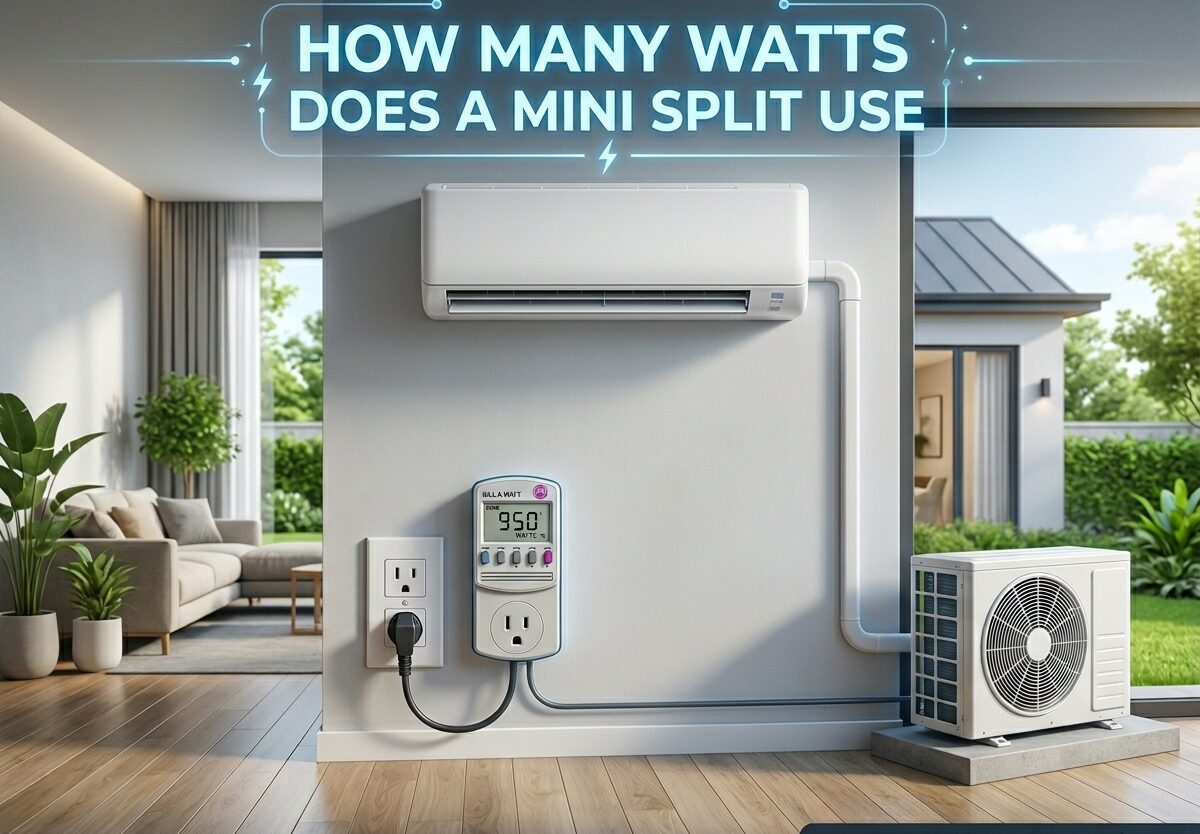
If you’re wondering how many watts does a mini split use, you’re not alone. Understanding the power consumption of your ductless system helps you calculate electricity costs, size generators for backup power, and make informed decisions about installation. Mini splits are among the most efficient HVAC options available, but their actual wattage varies significantly based on several factors we’ll cover in detail.
A typical mini split uses between 500 and 1,500 watts per hour during normal operation. The most common 12,000 BTU residential unit consumes approximately 800-900 watts when cooling and slightly more when heating. This makes mini splits significantly more efficient than traditional central air conditioning systems, which often require 3,500 watts or more for equivalent cooling capacity.
How Many Watts Does a Mini Split Use by BTU Size
The wattage of a mini split directly correlates with its BTU (British Thermal Unit) rating, which measures cooling and heating capacity. Higher BTU units require more power, but the relationship isn’t linear due to varying efficiency ratings across different models and brands.
Typical wattage ranges by BTU capacity:
- 9,000 BTU mini splits use 500-750 watts while running
- 12,000 BTU mini splits use 800-1,200 watts while running
- 18,000 BTU mini splits use 1,200-1,800 watts while running
- 24,000 BTU mini splits use 1,800-2,500 watts while running
It’s important to understand the difference between starting wattage and running wattage. When a mini split first powers on, the compressor requires a surge of power typically 2-3 times higher than the running wattage. This starting wattage lasts only 1-3 seconds but matters significantly when sizing generators or evaluating electrical capacity. For example, a 12,000 BTU unit might need 2,000-2,400 watts briefly at startup before settling into its normal 800-900 watt running range.
Heating mode typically consumes 10-20% more power than cooling mode for the same unit. This is because heat pumps must work harder to extract heat from cold outdoor air and transfer it indoors. In extremely cold temperatures below 20°F, many mini splits activate auxiliary electric resistance heating, which can increase power consumption to the maximum rated wattage or higher.
Factors That Affect How Many Watts a Mini Split Uses
Several variables influence the actual power consumption of your mini split beyond its rated BTU capacity. Understanding these factors helps explain why your electricity consumption might differ from expected values.
SEER and HSPF ratings: The Seasonal Energy Efficiency Ratio (SEER) measures cooling efficiency, while the Heating Seasonal Performance Factor (HSPF) measures heating efficiency. Higher ratings indicate better efficiency. A 12,000 BTU unit with 20 SEER might use 700 watts, while a similar capacity unit with 14 SEER could require 1,000 watts for the same cooling output. Modern high-efficiency mini splits often achieve SEER ratings above 25, significantly reducing how many watts they use.
Inverter technology: Nearly all modern mini splits use inverter-driven compressors that can vary their speed based on cooling or heating demand. Unlike traditional single-speed compressors that operate at full capacity or not at all, inverter models can run at as low as 10-30% of maximum power when maintaining temperature. This means your mini split might draw only 110-200 watts during mild weather rather than consistently running at its rated maximum wattage.
Outdoor temperature: Extreme temperatures significantly impact power consumption. On mild days (60-75°F), a mini split runs very efficiently at low power. During heat waves (95°F+), the system works harder and approaches its maximum rated wattage. In heating mode, power consumption increases dramatically as outdoor temperatures drop below freezing, especially if backup heat elements activate.
Thermostat settings: Each degree you lower your cooling setpoint increases power consumption by approximately 3-5%. Setting your thermostat to 68°F instead of 72°F can increase wattage by 15-20% or more. The same principle applies in heating mode—higher setpoints require significantly more power.
Home insulation and air sealing: Well-insulated homes with minimal air leakage reduce the workload on your mini split. Poor insulation forces the system to run longer at higher power levels to maintain temperature. Upgrading insulation and sealing air leaks can reduce how many watts your mini split uses by 20-30% in extreme climates.
Unit maintenance: Dirty air filters restrict airflow and reduce efficiency, forcing the system to work harder and consume more power. Clean indoor and outdoor coils ensure optimal heat transfer. Regular maintenance can keep your mini split operating at peak efficiency and minimum power consumption.
Calculating Mini Split Electricity Usage in kWh
Understanding how many watts a mini split use helps calculate electricity costs. The formula is straightforward: multiply wattage by hours of use, then divide by 1,000 to convert to kilowatt-hours (kWh), which is how utilities bill electricity.
Example calculation for a 12,000 BTU mini split:
Running at 900 watts for 8 hours daily during summer: 900 watts × 8 hours = 7,200 watt-hours = 7.2 kWh per day. At the national average electricity rate of approximately $0.15 per kWh, this equals $1.08 daily or $32.40 monthly for cooling alone.
Real-world measurements from users with electricity monitors show significant variation. One homeowner with a high-efficiency 9,000 BTU Fujitsu unit reported averaging only 3.7 amps at 240V (approximately 888 watts) during peak cooling and consuming about 6 kWh total per day. Another user with a 3-ton Mitsubishi system measured 2,700 watts at maximum cooling capacity but noted it rarely ran at full power.
Annual costs vary dramatically by climate. Homeowners in mild climates might spend $150-300 annually on mini split electricity, while those in extreme climates could spend $500-800 or more depending on usage patterns and local electricity rates. The advantage of mini splits is their zone capability—you only power the rooms you’re using, rather than conditioning the entire house.
110V vs 220V: Does Voltage Affect Wattage?
A common question is whether 110V or 220V mini splits are more efficient. The answer: voltage doesn’t affect efficiency or how many watts the system uses. Wattage equals volts multiplied by amps (W = V × A). A 1,200-watt mini split at 110V draws approximately 10.9 amps, while the same 1,200-watt unit at 220V draws only 5.5 amps. The power consumption remains identical.
The difference lies in amperage and wiring requirements. Higher voltage systems can deliver the same power with lower current, allowing for smaller gauge wire and reducing resistive losses in long cable runs. However, for typical residential installations with short wire runs, this difference is negligible in terms of actual efficiency or electricity costs.
Most mini splits above 12,000 BTU require 220V/240V power due to their higher wattage requirements. Smaller 9,000 BTU units sometimes offer 110V models, which can be convenient for installations without existing 220V circuits. When choosing between voltage options, consider your existing electrical infrastructure rather than expecting efficiency differences.
Breaker sizing should account for both running and starting wattage. A 12,000 BTU unit drawing 900 watts running might require a 15-20 amp breaker to handle startup surges. Always consult the manufacturer’s specifications and local electrical codes when installing or modifying electrical circuits for mini split systems.
Standby Power: How Many Watts When Turned Off?
An often-overlooked consideration is standby power consumption—the electricity your mini split uses even when turned off. Users with whole-house electricity monitors have reported that some 18,000 BTU units draw approximately 200 watts continuously when powered off but still connected to electricity.
This phantom load powers the control board, maintains communication between indoor and outdoor units, and keeps the system ready for quick startup. Over a month, 200 watts of standby power equals 144 kWh—approximately $21.60 at average electricity rates. This can add significantly to electricity bills, especially in seasons when the mini split isn’t actively heating or cooling.
To eliminate standby power consumption, you can install a hard switch or shutoff that completely disconnects the unit from power when not in use. However, this means the system won’t be ready for immediate operation and may require time to stabilize when reactivated. Some users employ smart plugs or timers to automatically disconnect power during extended periods of non-use.
10 Ways to Reduce How Many Watts Your Mini Split Uses
Maximizing efficiency reduces both electricity costs and environmental impact. These proven strategies help minimize how many watts your mini split consumes:
- Use programmable or smart thermostats to automatically reduce heating/cooling when you’re asleep or away from home. Even 8 hours of daily setback can reduce consumption by 15-20%.
- Clean or replace air filters monthly during peak usage seasons. Clogged filters restrict airflow and can increase power consumption by 10-15% while reducing comfort.
- Keep outdoor units clear of debris such as leaves, grass clippings, and snow. Maintain at least 2 feet of clearance around all sides for optimal airflow.
- Seal air leaks around windows and doors with weatherstripping and caulk. Preventing conditioned air from escaping reduces runtime and power consumption.
- Use curtains and blinds strategically—close them during summer days to block solar heat gain and open them during winter days to capture free solar heating.
- Maintain moderate thermostat settings—aim for 68-72°F in winter and 74-78°F in summer. Each degree closer to outdoor temperature reduces power consumption significantly.
- Run fans to circulate air and distribute conditioned air more evenly. This allows you to set thermostats 2-4 degrees more extreme while maintaining comfort.
- Schedule professional maintenance annually to check refrigerant levels, clean coils, and verify proper operation. Well-maintained systems operate at peak efficiency.
- Use zoning strategically by conditioning only occupied rooms. Multi-zone systems allow you to power down unused areas entirely.
- Consider SEER ratings when upgrading—investing in a higher-efficiency unit pays dividends over its 15-20 year lifespan through reduced electricity costs.
Generator Sizing for Mini Splits
If you’re planning backup power for your mini split, proper generator sizing requires accounting for both starting and running wattage. Starting wattage is the critical factor—generators must handle the 2-3 second startup surge without overloading.
Generator size recommendations by BTU:
- 9,000 BTU: 2,000-2,500 watt generator
- 12,000 BTU: 2,500-3,000 watt generator
- 18,000 BTU: 3,500-4,000 watt generator
- 24,000 BTU: 4,500-5,500 watt generator
Always maintain a 20% safety margin above the calculated starting wattage to account for fluctuations and prevent generator overload. Inverter generators are recommended for mini splits due to their clean, stable power output that protects sensitive electronics in the system’s control boards.
Remember to include other essential loads when calculating generator size. If you plan to power lights, refrigerators, or other appliances simultaneously, add their wattage to the mini split’s starting requirement before selecting a generator.
FAQs
How much electricity does a 18,000 BTU mini split use?
An 18,000 BTU mini split typically uses 1,200-1,800 watts while running, with starting wattage of 2,400-3,600 watts. In cooling mode, expect approximately 1,200-1,500 watts during normal operation. Heating mode may require 1,400-1,800 watts due to the increased work needed to extract heat from cold air. At average electricity rates, running an 18K BTU unit 8 hours daily costs approximately $1.35-1.80 per day or $40-55 per month during peak season.
Is it cheaper to run a 110 or 220 mini split?
Neither voltage is cheaper to run—both consume the same number of watts for equivalent cooling or heating output. Wattage equals volts multiplied by amps, so a 1,200-watt mini split at 110V draws about 10.9 amps while the same 1,200-watt unit at 220V draws only 5.5 amps. Your electricity bill depends on wattage (power consumption), not voltage or amperage. Choose voltage based on your existing electrical infrastructure rather than expected cost differences.
How many watts does it take to run a 12000 BTU mini split?
A 12,000 BTU mini split requires 800-1,200 watts while running, with starting wattage of 1,600-2,400 watts for the first 1-3 seconds of operation. High-efficiency models with 20+ SEER ratings may run as low as 700-800 watts during normal conditions, while lower-efficiency units might consume 1,000-1,200 watts. The actual wattage varies based on outdoor temperature, thermostat settings, and how hard the unit is working to maintain your desired temperature.
Can a mini split run off a 20 amp breaker?
Yes, most 9,000 to 12,000 BTU mini splits can run off a 20 amp breaker. A 12,000 BTU unit drawing 900 watts running at 220V pulls approximately 4.1 amps continuously, well within a 20 amp circuit’s capacity. However, starting wattage of 1,600-2,400 watts temporarily draws 7-11 amps during startup. Always verify the manufacturer’s specifications and consult local electrical codes, as breaker requirements vary by model and installation. Larger 18,000+ BTU units typically require 30 amp breakers or higher.
How many watts does a typical mini split use?
A typical residential mini split uses between 500 and 1,500 watts per hour while running, depending on its BTU capacity. The most common 12,000 BTU size consumes approximately 800-900 watts in cooling mode and slightly more in heating mode. Smaller 9,000 BTU units use 500-750 watts, while larger 24,000 BTU systems can draw 1,800-2,500 watts at maximum capacity. Modern inverter models can run at as low as 110-200 watts when maintaining temperature in mild conditions, making them highly efficient for partial-load operation.
Why is my electric bill so high with mini splits?
High electric bills with mini splits typically result from several factors: extreme outdoor temperatures forcing maximum output, thermostat setpoints too far from outdoor temperatures, poor insulation and air leaks, dirty air filters restricting airflow, heating mode consuming 10-20% more power than cooling, leaving units running 24/7 instead of using setbacks, or phantom standby power draw of 100-200 watts even when turned off. Additionally, multi-zone systems running all zones simultaneously multiply consumption. Check for proper sizing—oversized units short-cycle and run less efficiently than properly sized equipment running longer at lower power levels.
Conclusion
Understanding how many watts does a mini split use empowers you to make informed decisions about installation, operation, and backup power planning. Typical residential mini splits consume 500-1,500 watts while running, with high-efficiency inverter models capable of operating at as low as 110-200 watts during mild conditions. By considering factors like BTU capacity, SEER ratings, inverter technology, and operating conditions, you can accurately estimate your electricity costs and optimize efficiency.
Remember that actual consumption varies significantly based on climate, thermostat settings, home insulation, and maintenance habits. Implementing the efficiency strategies outlined above can reduce how many watts your mini split uses by 20-30% while maintaining comfort. Whether you’re sizing a generator for emergency backup or simply trying to lower your monthly electricity bill, knowing your system’s real-world power consumption is the first step toward smarter energy management.

Leave a Comment