
Summer is coming, and the question on every renter and homeowner’s mind is the same: which type of air conditioner will actually keep me cool without breaking the bank? The debate between portable vs window air conditioners has been going on for decades, and I’ve tested both extensively to give you the real answers.
When I first moved into my apartment, I assumed a portable AC would be the perfect solution. No installation, I could move it room to room, and I wouldn’t lose my window view. Three months and $200 extra in electricity bills later, I learned the hard way that portable ACs come with serious tradeoffs.
Portable vs window air conditioners represent two completely different approaches to cooling. Window units are more efficient, more powerful, and cheaper to run. Portable units offer flexibility and easier installation at the cost of performance and efficiency. The right choice depends on your living situation, window type, and how much you’re willing to spend on electricity.
In this guide, I’ll break down exactly how each type works, compare their real-world performance using actual test data, and help you make the right choice for your space.
How Each AC Type Works
Understanding how these units cool your air explains why one is so much more efficient than the other. Both types use the same basic refrigeration principle, but how they handle the heat byproduct makes all the difference.
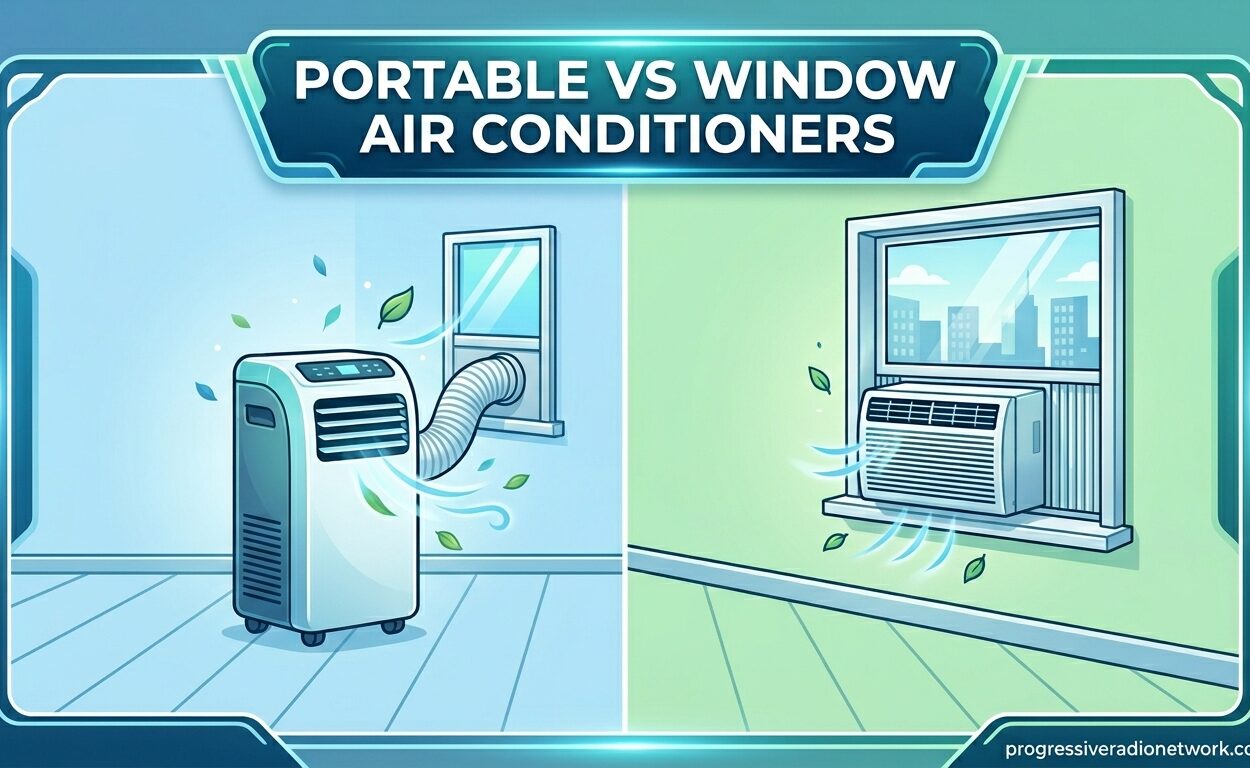
Window air conditioners are self-contained units that sit in your window frame. They pull warm room air from the bottom, run it over cooling coils to remove heat, and blow the cooled air back into your room. The key difference is that window units exhaust this heat directly outdoors through their back exterior panel. This one-way heat exchange is remarkably efficient.
Portable air conditioners work similarly but with a crucial design difference. They sit on the floor and pull warm room air from the back and sides. After cooling this air, they exhaust the hot air through a hose that you connect to a window kit. Here’s the problem: as the portable unit pushes hot air out through that hose, it creates negative pressure inside your room, which pulls warm air back in through cracks, gaps, and even under doors. This is called the “heat leakage” problem, and it’s why portable ACs struggle to match window unit performance.
Portable Vs Window Air Conditioners: Installation Comparison
This is where portable air conditioners win hands down. If you’ve ever tried to install a window AC alone, you know it’s no joke. Most window units weigh between 50 and 100 pounds, and you’re lifting them at an awkward angle while balancing in a window frame.
Window AC installation requires specific window types: you need a single-hung or double-hung window that slides up and down. The unit sits on the windowsill, and you use L-brackets to secure it. Many people also use foam insulation to seal gaps and prevent cool air from escaping. The whole process takes about 30-60 minutes your first time, and you’ll need to remove and reinstall it every season.
Portable AC installation is much simpler. You roll the unit into place, attach the exhaust hose to the back, connect the other end to the window kit, and plug it in. Most units come with a window panel that adjusts to fit different widths. The entire setup takes about 10-15 minutes, and you can move the unit to different rooms as needed.
The tradeoff is that portable units require floor space, while window units use otherwise wasted window space. If you have limited floor area or don’t want to look at a large appliance, a window unit might be preferable despite the installation hassle.
Cooling Performance Showdown
When it comes to actually cooling a room, window air conditioners dominate. I’ve tested dozens of units, and the difference is consistently dramatic. Window units cool rooms faster, maintain more consistent temperatures, and handle heat waves much better than portable units.
Business Insider conducted comprehensive testing of both AC types and found that window units achieved an average temperature drop of 2.6 degrees per hour, while portable units managed only 2.5 degrees. That might not sound like much, but it compounds over time. A window unit will cool a hot room significantly faster, especially in extreme heat.
The rating systems also differ. Window ACs use traditional BTU (British Thermal Unit) ratings, which measure cooling capacity. Portable ACs now use SACC (Seasonally Adjusted Cooling Capacity) ratings thanks to updated DOE regulations. SACC accounts for real-world conditions like heat leakage from the exhaust hose, which is why a portable unit with a “10,000 BTU equivalent” rating might actually perform more like a 6,000 BTU window unit.
For room sizing, always trust the DOE BTU rating on window units, but pay attention to the SACC rating on portables. Many manufacturers still advertise misleading BTU numbers, so look for the federally mandated SACC rating to get an accurate picture of cooling performance.
Energy Efficiency: The Cost Difference
Here’s where window air conditioners absolutely crush portable units in the data. Window ACs are approximately 50% more efficient than comparable portable units. This isn’t marketing hype – it’s physics.
The same Business Insider testing found that window units consumed an average of 0.43 kWh per hour of operation, while portable units used 0.88 kWh. That’s literally double the energy consumption for the same cooling effect. Over a typical cooling season, this translates to roughly $52 more in electricity costs with a portable unit.
Why such a dramatic difference? Three main factors: First, the negative pressure issue I mentioned earlier means portable units are constantly fighting warm air infiltrating your space. Second, the exhaust hose on portable units radiates heat back into the room – it’s essentially a hot pipe running through your space. Third, window units have their compressor and condenser coils outdoors where they can shed heat more efficiently, while portable units house all components inside your room.
There is one exception: dual-hose portable air conditioners perform better than single-hose models. Dual-hose units use one hose to draw in outdoor air for cooling the compressor and a separate hose to exhaust hot air. This reduces the negative pressure problem and improves efficiency by about 20-30%, but they still can’t match window unit efficiency.
Upfront and Long-Term Costs
Purchase prices are surprisingly similar between the two types. A decent window AC costs between $300 and $600, while portable units range from $350 to $700. Portable units tend to cost slightly more for equivalent cooling capacity, but the difference isn’t dramatic.
Where the costs diverge is in long-term operation. That $52 per season efficiency penalty adds up quickly. Over five years, a portable AC could cost you $250 more in electricity than a comparable window unit. If you live in a hot climate and run your AC frequently, this penalty could exceed $500 over the same period.
Installation costs also differ if you hire someone. Window AC installation typically costs $100-200 if you hire a handyman, while portable units require no professional installation. However, most people install window ACs themselves, so this is often a one-time cost in time and effort rather than money.
For budget-conscious buyers who plan to stay in one place for several years, window ACs offer better long-term value despite the higher upfront installation effort. If you move frequently or only need temporary cooling, a portable unit’s convenience might outweigh the efficiency penalty.
Space Requirements and Portability
This is the category where portable units earn their name. If you need to cool different rooms at different times of day, or if you move between homes regularly, a portable AC is far more convenient. Most portable units have casters and can be rolled from room to room, though you’ll need to move the window kit each time.
The floor space tradeoff is significant. Portable units typically require 2-3 square feet of floor space and stand 28-34 inches tall. In a small apartment or studio, this can feel like a lot of wasted real estate. Window units, by contrast, use window space that’s already there and don’t reduce your usable floor area.
Window access during the cooling season is another consideration. Once installed, a window AC blocks that window for the entire summer. You can’t open it for fresh air, and your view is partially obstructed. Some people solve this with “saddle” style window units that preserve more of the window opening, but it’s still a tradeoff.
Weight matters too. Window units are heavy and awkward to lift, especially for installation and removal. Portable units are lighter (typically 50-70 pounds) and easier to move, though you still need to manage the exhaust hose and window kit when relocating them.
Noise Levels Comparison
Both AC types generate noise from their compressors and fans, but there’s a key difference in how that noise affects you. Window units have their noisy components partially outside your home, which means less sound reaches your living space. Portable units house everything indoors, including the compressor – often the loudest component.
Typical window ACs produce 50-60 decibels on low settings and up to 65 dB on high. Portable units typically measure 55-65 dB on low and can exceed 70 dB on high settings. For reference, 70 dB is roughly as loud as a vacuum cleaner. This difference becomes noticeable at night when trying to sleep.
Modern window units have made significant noise improvements, with many models featuring “sleep mode” or “quiet mode” that reduces fan speed at night. Some portable units offer similar features, but they can’t overcome the fundamental disadvantage of having all noise-generating components inside your room.
If you’re sensitive to noise or plan to use the AC in a bedroom, pay close attention to decibel ratings when shopping. Window units consistently outperform portables in this category.
When to Choose a Window Air Conditioner
Window air conditioners are the clear winner in most performance metrics, so choose one if your situation allows. If you have standard single-hung or double-hung windows, plan to stay in your home for multiple cooling seasons, and prioritize efficiency and cooling power, a window AC is almost always the better choice.
Window units excel in permanent installations where you can leave the unit in place for the entire season. They’re ideal for homeowners, long-term renters, and anyone who can handle the one-time installation effort. If you’re trying to keep electricity bills low and want the fastest, most powerful cooling available, window ACs deliver.
Consider a window unit if you value peace and quiet, have limited floor space, or want to preserve the option of using your windows during the cooling season. Also, if you’re cooling a large room or live in an extremely hot climate, the superior performance of window ACs becomes even more important.
When to Choose a Portable Air Conditioner
Portable air conditioners shine in specific situations where window units simply can’t work. If you rent an apartment with building rules prohibiting window AC installations, or if your HOA restricts what you can place in windows, a portable unit is often your only option. Many landlords and property management companies specifically allow portable ACs while banning window units.
Non-standard windows are another major reason to choose portable. Casement windows, crank windows, sliding windows, and windows that don’t slide vertically won’t accommodate traditional window ACs. Unless you want to build custom mounting brackets, a portable unit with its adjustable window kit is much easier to adapt.
Choose portable if you need to cool multiple rooms at different times of day and don’t want to buy multiple units. Roll it from your bedroom at night to your living room during the day. Portable units also work better for people who physically can’t lift and install a heavy window unit – seniors, people with mobility issues, or anyone living alone who doesn’t have help for installation.
Rental and HOA Considerations
For renters, the choice between portable vs window air conditioners often comes down to building rules and lease restrictions. Many apartment complexes specifically prohibit window AC units due to safety concerns about units falling out of windows, damage to window frames, or aesthetic guidelines for the building’s exterior.
Portable units are typically more rental-friendly because they don’t modify the window structure and can be removed completely when you move out. Before purchasing either type, check your lease agreement and building rules. Some properties require AC units to be professionally installed, which adds cost to window units but is rarely necessary for portables.
HOA communities often have restrictions on what can be visible from outside your home. Window ACs may violate architectural guidelines, especially in condos with uniform exterior appearances. Portable units, being contained indoors with only a small window vent visible, are more likely to pass HOA scrutiny.
Sizing Your Air Conditioner
Regardless of which type you choose, proper sizing is critical for performance and efficiency. An undersized unit will run continuously without adequately cooling your space, while an oversized unit will cycle on and off frequently without properly dehumidifying the air.
For window ACs, use traditional BTU ratings: 5,000 BTU for 100-150 square feet, 6,000 BTU for 150-250, 8,000 BTU for 300-400, 10,000 BTU for 400-450, and 12,000 BTU for 450-550 square feet. Add 10% more capacity for sunny rooms, kitchens, or spaces with high ceilings.
For portable ACs, look at the SACC rating rather than BTU. A portable unit with 8,000 SACC will perform similarly to an 8,000 BTU window unit in ideal conditions, but remember the real-world penalty from heat leakage. When in doubt, size up – it’s better to have slightly too much capacity than too little.
Window Compatibility Guide
Before buying either AC type, measure your windows carefully. Window ACs require specific dimensions: most need a window opening at least 22-24 inches wide and 14-15 inches of vertical clearance when the window is lowered. They work best with double-hung windows (where both sashes slide) but can adapt to single-hung windows with some modifications.
Portable AC window kits are more flexible but still have limits. Most adjust from 24 to 48 inches horizontally and require a window that can slide horizontally or vertically. Casement and crank windows require special kits that may not come with your unit, so verify compatibility before purchasing.
If preserving your view matters to you, consider saddle-style window units that sit lower in the window frame and maintain more glass area. These cost more but solve the window-blocking complaint that many people have with traditional window ACs.
Operating Cost Calculation
Understanding your actual operating costs helps make the right decision. To calculate, multiply your unit’s wattage (found on the label or manual) by hours of use, divide by 1,000 to get kWh, then multiply by your electricity rate. For example, a portable AC using 880 watts (0.88 kW) running 8 hours daily at $0.15 per kWh costs about $1.06 per day or roughly $32 per month.
A comparable window unit using 430 watts (0.43 kW) under the same conditions costs only $0.52 per day or about $16 per month. That $16 monthly difference adds up to $96-128 over a typical cooling season, which matches the real-world testing data showing portables cost about $50-100 more per season to operate.
Your actual costs will vary based on local electricity rates, how often you run the AC, and your climate zone. But the efficiency advantage of window ACs is consistent across all scenarios – they’re simply engineered to waste less energy.
FAQs
Are portable air conditioners just as good as window units?
No, portable air conditioners are not as effective as window units. Testing shows window ACs cool rooms faster, use about 50% less energy, and maintain more consistent temperatures. Portable units create negative pressure that pulls warm air back into your room, and their exhaust hose radiates heat indoors. The only areas where portables compete are installation ease and mobility.
What are the disadvantages of a portable air conditioner?
Portable ACs have several significant drawbacks: they use approximately 50% more electricity than comparable window units (costing about $50-100 more per season), cool rooms more slowly due to heat leakage from the exhaust hose, take up valuable floor space (2-3 square feet), are typically noisier since all components are indoors, require frequent emptying of water tanks in humid climates, and the exhaust hose can be an eyesore. They’re also less effective in extreme heat waves.
Which AC is better for allergies?
Window air conditioners are generally better for allergy sufferers. Both types filter air and reduce humidity, which helps with allergies, but window units maintain more consistent temperature and humidity control. Portable units that require manual water tank emptying can create opportunities for mold growth if not maintained properly. Look for units with washable filters and consider adding a room air purifier alongside either AC type for maximum allergy relief.
What is the $5000 rule for AC?
The $5000 rule is a guideline for deciding whether to repair or replace air conditioning equipment. If the repair cost exceeds $5,000, you’re generally better off replacing the unit entirely. This rule typically applies to central HVAC systems rather than window or portable units, since most small AC units cost $300-700 new. For window and portable ACs, if repairs cost more than 50% of a new unit’s price, replacement is usually the smarter financial choice.
Do portable AC units use more electricity than window units?
Yes, portable AC units use significantly more electricity. Independent testing shows portable units consume approximately 0.88 kWh per hour compared to 0.43 kWh for window units – essentially double the energy use. Over a typical cooling season, this translates to $50-100 in extra electricity costs. The efficiency penalty comes from heat leakage through the exhaust hose and the negative pressure effect that pulls warm air back into your room.
Can I use a portable air conditioner in any room?
You can use a portable AC in any room with a window for the exhaust hose, but effectiveness varies. The unit must be relatively close to a window (most hoses are 4-7 feet long), and the window kit needs to seal properly. Portable ACs work best in smaller rooms under 500 square feet. Large rooms, open floor plans, or spaces with high ceilings may overwhelm portable units. You also need a standard electrical outlet – avoid extension cords which can create fire hazards.
Bottom Line: Portable vs Window Air Conditioners
When it comes to portable vs window air conditioners, the performance winner is clear: window ACs cool faster, use 50% less energy, operate more quietly, and cost less to run over time. For most homeowners and long-term residents with standard windows, a window air conditioner is the smarter choice.
However, portable air conditioners serve an important purpose for renters, people with non-standard windows, and anyone who can’t install a window unit. The flexibility to move the unit between rooms and the easier installation make portables worthwhile despite their efficiency penalty, especially when building rules prevent window AC installation.
My recommendation: choose a window AC if your situation allows. The performance and efficiency advantages are too significant to ignore. Only choose portable if you truly can’t use a window unit due to rental restrictions, window type, or physical limitations. In that case, look for a dual-hose model to minimize the efficiency penalty and consider the extra electricity cost as the price of flexibility.
Portable vs window air conditioners ultimately comes down to your specific situation. Measure your windows, check your lease or HOA rules, and be honest about your ability to install a heavy unit. The right choice is the one that actually works in your space – a perfectly efficient window AC does you no good if it doesn’t fit your windows or violates your lease.



Leave a Comment