
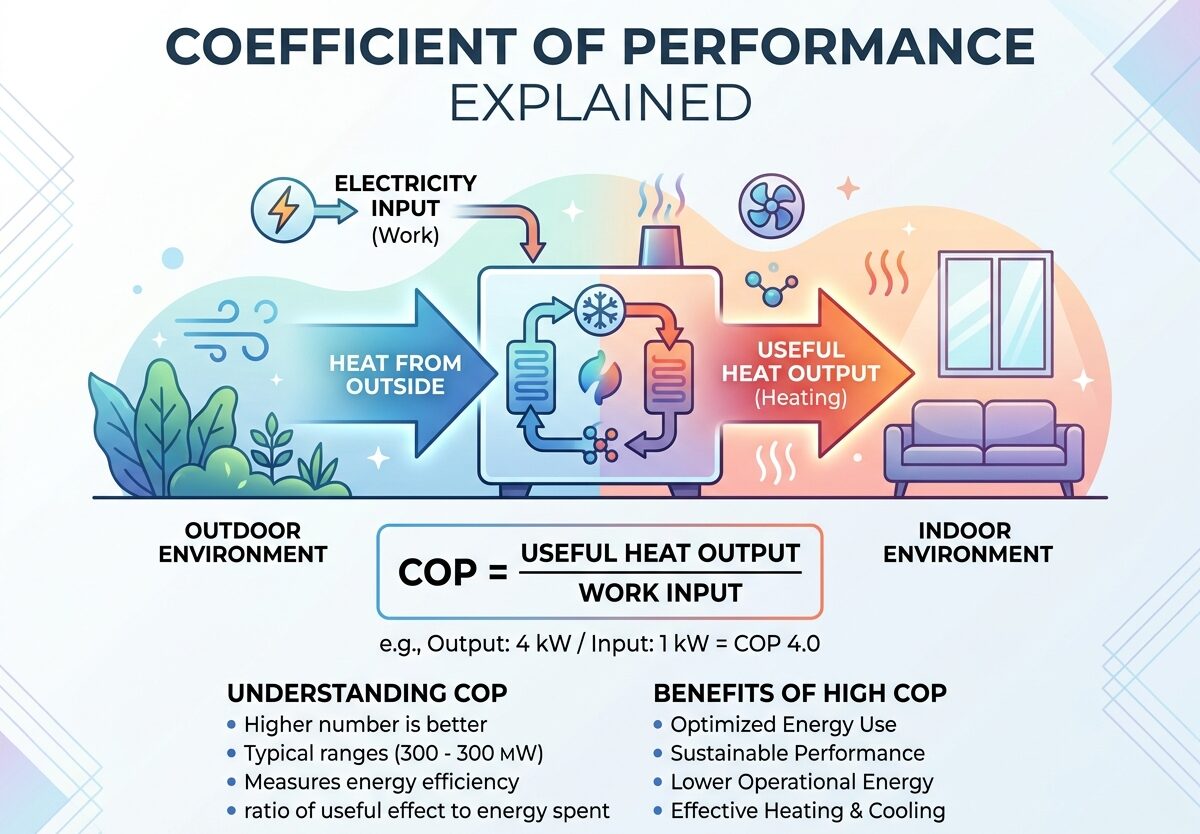
The Coefficient of Performance (COP) is a ratio that measures how efficiently heating and cooling systems use energy. Unlike traditional efficiency metrics that cap at 100%, COP can exceed 1 because heat pumps move existing heat rather than generating it. Understanding COP helps you compare HVAC systems and predict operating costs accurately.
When I first researched heat pumps for my home, the COP numbers on spec sheets seemed confusing. How could a system be 300% or 400% efficient when nothing can exceed 100% efficiency? The answer lies in what COP actually measures—and once you understand it, you’ll make smarter decisions about your HVAC investment.
What is Coefficient of Performance?
The Coefficient of Performance, or COP, measures the ratio of useful heating or cooling provided to the work (energy) required. For heat pumps, air conditioners, and refrigeration systems, COP tells you how many units of heating or cooling you get for each unit of electricity consumed.
COP is a dimensionless number, meaning it has no units—it’s simply a ratio. The formula is straightforward:
COP = Useful Heating or Cooling Output (kW) / Work Input (kW)
A COP of 3 means your heat pump delivers 3 kilowatts of heating for every 1 kilowatt of electricity it consumes. This doesn’t violate thermodynamics because heat pumps move heat from one place to another rather than creating it from scratch. They concentrate and relocate thermal energy that already exists in the air or ground.
COP applies to any system that moves heat: heat pumps in heating or cooling mode, air conditioners, refrigerators, and chillers. The higher the COP, the more efficient the system and the lower your operating costs.
Why is COP Greater Than 1?
COP can exceed 1 because it measures performance differently than traditional efficiency. Electric resistance heaters create heat by passing current through coils, converting electricity to heat at a 1:1 ratio (COP = 1). Heat pumps don’t create heat—they move it.
Think of it this way: moving a stack of books across a room takes less energy than creating new books from raw materials. Heat pumps work like book movers, extracting heat from outdoor air (even in cold weather) or the ground and concentrating it for your home. Spending 1 unit of electricity to move 3 or 4 units of heat is entirely possible.
This is why COP values of 3-5 are common for ground-source heat pumps, while air-source models typically achieve 2-4. The system isn’t creating energy—it’s leveraging existing thermal energy with relatively small electrical input.
How to Calculate COP
Calculating COP requires knowing your system’s heating or cooling output and its electrical input. Here’s a practical example:
Step 1: Find your heat pump’s rated heating capacity in kilowatts (kW). This is typically listed on the spec sheet—for example, 8 kW.
Step 2: Find the power input in kilowatts. For our example, let’s say it’s 2.5 kW.
Step 3: Divide output by input: 8 kW / 2.5 kW = 3.2 COP.
This means for every kilowatt-hour of electricity you pay for, you get 3.2 kilowatt-hours of heating. Compared to electric resistance heat (COP = 1), you’re getting more than three times the heating value for the same electricity cost.
Real-world COP varies from rated values because test conditions differ from actual operating conditions. Manufacturer ratings assume specific outdoor temperatures (usually 47°F for air-source heat pumps), while your system operates across a wide temperature range throughout the year.
Heating COP vs Cooling COP
The same heat pump has different COP values for heating and cooling. This is because the temperature difference between the heat source and destination changes, affecting how hard the system must work.
In heating mode, your heat pump extracts heat from cold outdoor air and delivers it to your warm home. In cooling mode, it extracts heat from your cool home and rejects it to hot outdoor air. The temperature lift differs between modes, so the COP differs as well.
Most manufacturers publish separate heating and cooling COP values. Heating COP is typically lower than cooling COP for air-source heat pumps because the temperature difference is greater when extracting heat from cold air. Ground-source systems have more consistent COP in both modes because ground temperatures stay relatively stable year-round.
Typical COP Values for Different Systems
Understanding what COP values are typical helps you evaluate whether a specific system is efficient. Here are realistic COP ranges for common equipment:
Air-source heat pumps: COP 2.0-3.5 at 47°F outdoor temperature. Below freezing, COP drops significantly—sometimes below 2.0 at 17°F. High-end cold-climate models maintain COP above 2.0 even at 5°F.
Ground-source (geothermal) heat pumps: COP 3.5-4.5 regardless of outdoor temperature. The stable ground temperature allows consistent performance year-round, making geothermal the most efficient option despite higher installation costs.
Air conditioners: COP 2.5-4.0 when expressed as cooling efficiency. Most people use SEER for air conditioners, but the COP equivalent is typically in this range.
High-efficiency furnaces: While furnaces don’t have COP (they create heat, don’t move it), their AFUE rating of 90-98% is equivalent to COP 0.9-0.98 if converted. This shows why heat pumps with COP above 3 are dramatically more efficient than even the best furnaces.
Is a COP of 3.5 good? Yes, it’s excellent for an air-source heat pump under normal conditions. A COP of 3.5 means you’re getting 350% more heating value than electric resistance heat for the same electricity cost.
Factors That Affect COP in Real-World Conditions
Rated COP values come from laboratory tests under ideal conditions. Your actual COP varies based on several factors:
Outdoor temperature: As outdoor temperature drops, your heat pump’s COP decreases because there’s less heat to extract and the temperature difference increases. At 17°F, many air-source heat pumps operate at COP 2.0 or below. This is why supplemental heat is often used in very cold climates.
System sizing: An oversized heat pump short-cycles, running in frequent bursts rather than longer, efficient cycles. This reduces real-world COP. Proper sizing ensures your system runs efficiently across various conditions.
Maintenance: Dirty coils, low refrigerant, and clogged filters all reduce COP. I’ve seen well-maintained 10-year-old heat pumps still achieving 80% of their rated COP, while neglected units dropped below 60%.
Ductwork: Leaky or poorly insulated ducts in attics or crawlspaces lose heating or cooling before it reaches your living space. This doesn’t change the heat pump’s COP, but it reduces the effective COP of your entire system.
COP vs Other Efficiency Ratings (SEER, EER, HSPF)
COP isn’t the only efficiency rating you’ll encounter. Different metrics measure different aspects of performance:
SEER (Seasonal Energy Efficiency Ratio): Measures cooling efficiency over an entire cooling season, accounting for varying outdoor temperatures. SEER is always higher than the equivalent COP because it uses different units. Roughly, SEER = COP × 3.412.
EER (Energy Efficiency Ratio): Similar to SEER but measured at a single outdoor temperature (95°F). EER is like a snapshot of cooling COP under peak conditions.
HSPF (Heating Seasonal Performance Factor): Measures heating efficiency over an entire heating season, including backup heat usage. HSPF to COP conversion varies by climate, but roughly COP = HSPF / 3.412.
SCOP (Seasonal Coefficient of Performance): The seasonal version of COP, accounting for varying temperatures throughout the heating or cooling season. SCOP provides a more realistic picture of year-round performance than single-point COP.
Why so many ratings? Each serves a different purpose. COP is best for theoretical calculations and comparing systems under identical conditions. SEER and HSPF better predict real-world energy consumption because they account for seasonal temperature variation.
How to Improve Your HVAC System’s COP
Whether you’re upgrading an existing system or maximizing a new one, these steps help achieve the best possible COP:
Proper sizing: Avoid the bigger-is-better trap. An oversized system costs more upfront and operates less efficiently. Manual J load calculations determine the right size for your home’s climate, insulation, and square footage.
Variable-speed technology: Modern heat pumps with variable-speed compressors adjust output to match demand. They run at lower speeds most of the time, maintaining higher COP than single-stage units that cycle on and off.
Regular maintenance: Annual professional servicing, including coil cleaning, refrigerant level checks, and airflow measurement, preserves your rated COP. Replace filters every 1-3 months to maintain airflow.
Optimized thermostat settings: Lowering your heating setpoint and raising your cooling setpoint reduces the temperature difference your system must overcome, improving effective COP. Smart setbacks save energy without sacrificing comfort.
Duct improvements: Sealing and insulating ductwork in unconditioned spaces can improve effective COP by 20% or more in homes with leaky ducts. A professional duct test identifies problems you can’t see.
FAQ
Is a COP of 3.5 good?
Yes, a COP of 3.5 is excellent for an air-source heat pump. It means you get 3.5 kilowatts of heating for every kilowatt of electricity consumed, which is 250% more efficient than electric resistance heat. Ground-source heat pumps typically achieve COP 3.5-4.5, making 3.5 a solid mid-range geothermal performance level.
Why is COP greater than 1?
COP exceeds 1 because heat pumps move existing heat rather than creating it. Electric resistance heaters convert electricity to heat at a 1:1 ratio (COP = 1), but heat pumps extract free heat from outdoor air or ground and concentrate it. Moving heat takes less energy than creating heat, allowing COP values of 2-5 for efficient systems.
What is the $5000 rule for HVAC?
The $5000 HVAC rule compares annual heating costs between a high-efficiency heat pump (COP 3-4) and standard electric resistance heat (COP 1). If heating costs exceed $5000 per year with electric heat, upgrading to a heat pump typically pays back the installation cost within 5-7 years through energy savings. The exact payback period varies by climate and electricity rates.
What is considered a good COP for a heat pump?
A good COP depends on the system type. For air-source heat pumps, COP 2.5-3.5 is good under standard test conditions (47F outdoor temperature). Ground-source heat pumps should achieve COP 3.5-4.5. Below-freezing temperatures reduce air-source COP to 1.5-2.5 for standard models, while cold-climate models maintain COP above 2.0 even at 5F.
Conclusion
The Coefficient of Performance provides a straightforward way to compare heating and cooling system efficiency. By understanding that COP measures how much heat your system moves per unit of electricity—not how much heat it creates—you can make informed decisions about HVAC upgrades and predict operating costs accurately.
Whether you’re evaluating a new heat pump installation or optimizing an existing system, focus on real-world COP rather than laboratory ratings. Proper sizing, regular maintenance, and climate-appropriate equipment selection ensure your system performs close to its potential. The most efficient system is one that’s correctly matched to your home, climate, and usage patterns.




Leave a Comment